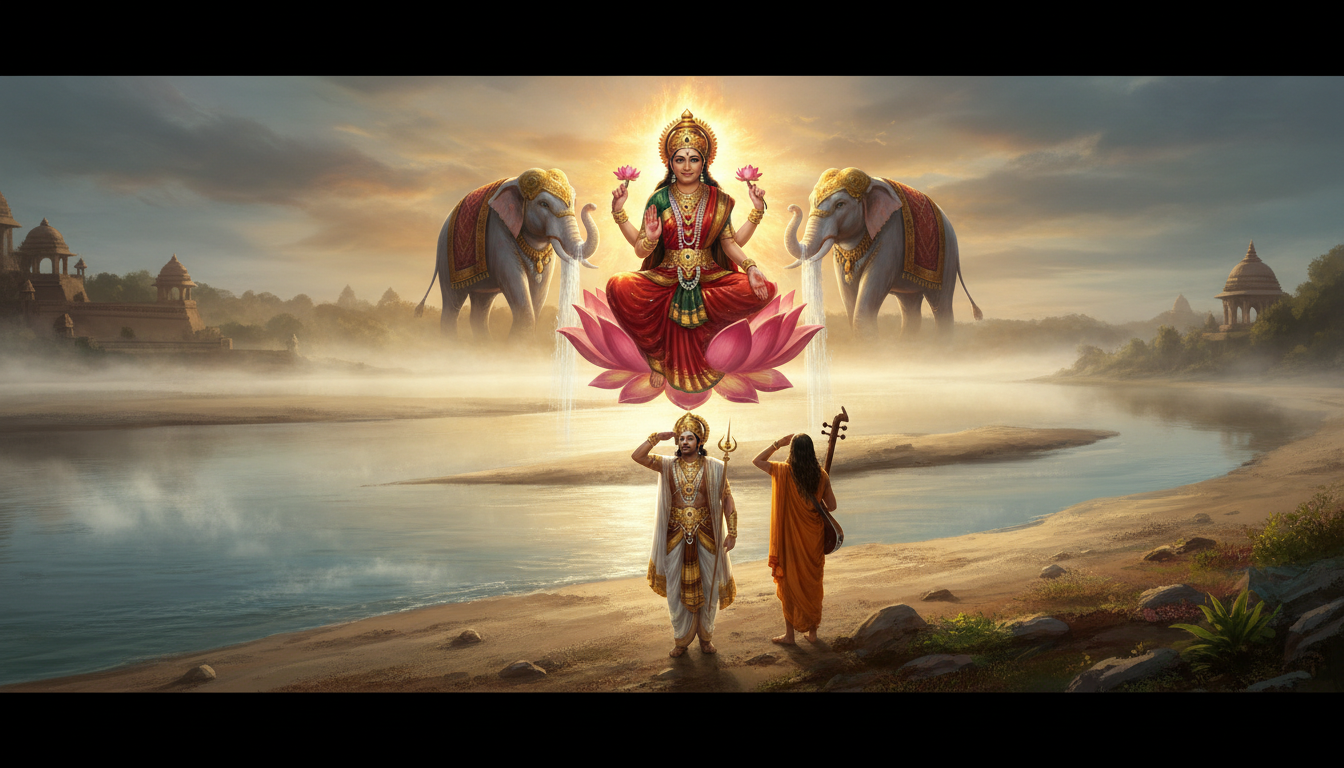
Fortune Changes Sides
Why Sri deserted the asuras, told on a bank of the Ganga
How a Fall Announces Itself
"Grandsire," said Yudhishthira, "tell me the signs. When a man is going to rise, and when a man is going to fall, what shows it beforehand?"
Bhishma lay on the arrows with his eyes half closed, and the answer came slowly. "The mind itself, blessed be you, shows the premonitory symptoms of a man's coming prosperity and his coming ruin. It is never the treasury that tells you first, and it is never the army. It is the mind, and after the mind the small habits of a house.
"On this there is an old story, the conversation between Sree and Sakra. Listen to it, Yudhishthira, and afterwards look at your own household with it in your hand. It happened at dawn, on a bank of the Ganga, and it began with two men sitting quietly after their bath, talking about old times."
Two Bathers at Dawn
There was (said Bhishma) the great ascetic Narada, whose effulgence was as immeasurable as Brahma itself, whose sins were all destroyed, who by the prosperity of his penances could look upon this world and the other world at the same moment, and who was the equal of the celestial Rishis in the region of the Creator. He roved through the triple world as he pleased.
Rising one day at dawn, he wished to perform his ablutions, and for that purpose he went to the river Ganga where she issues from the pass known by the name of Dhruva, and plunged into the stream. At that same hour the thousand-eyed Indra, wielder of the thunderbolt, the slayer of Samvara and of Paka, came down to the very bank where Narada was.
The Rishi and the god, both of them souls under perfect command, finished their bathing and completed their silent recitations and sat down together on the sand. They spent the hour as men who like each other spend it, reciting and listening to the excellent narratives told by the great celestial Rishis, stories of good and high deeds done long before either of them was there to see. Neither was in a hurry. The light came up the water.
While they sat there they saw the Sun rise, casting his thousand rays straight before him, and seeing the full orb both of them stood up and hymned his praises.
A Second Sun in the Wrong Quarter
Then, in the sky, in the quarter directly opposite to the rising star of day, they saw another luminous thing, resplendent as blazing fire, that looked like a second sun.
It was coming towards them. It rode upon Vishnu's own vehicle, which is adorned with Garuda and with Surya, and it blazed with unrivalled splendour and seemed to light the three worlds at once. And when it was near enough for the eye to hold, they saw that the object was Sree herself, attended by many Apsaras of splendid beauty. She looked like a great solar disc, with the effulgence of fire; her ornaments were like so many stars set upon her; the wreath she wore resembled a garland of pearls. Indra recognised the goddess called Padma, whose habitation is in the middle of lotuses.
She stepped down from that foremost of cars and began to walk towards the lord of the three worlds and the celestial Rishi. Maghavat, with Narada following him, went forward to meet her, and joining his hands he offered himself up to her and worshipped her with a reverence and a sincerity that have never been surpassed, for he knew, as he knew all things, exactly what it meant that she should be walking towards him on a river bank at sunrise.
When the adorations were over, the lord of the celestials said, "Lady of sweet smiles, who are you, and on what business have you come here? Lady of fair brows, where do you come from, and where will you go, auspicious one?"
The Names She Goes By
"In the three worlds that are full of the seeds of auspiciousness," she said, "every creature, mobile and immobile, strives with its whole heart to win an association with me. I am that Padma, that Sree decked with lotuses, who sprang from the lotus that blooms at the touch of the rays of Surya, for the prosperity of all creatures.
"I am called Lakshmi, and Bhuti, and Sree, slayer of Vala. I am Faith. I am Intelligence. I am Affluence, I am Victory, and I am Immutability. I am Patience, I am Success, I am Prosperity. I am Swaha and I am Swadha. I am Reverence, I am Fate, and I am Memory.
"I dwell at the van and on the standards of victorious and virtuous sovereigns, and in their homes and their cities and their dominions. I reside always with those foremost of men who pant after victory and never retreat from battle. I reside for ever with those who are firmly attached to virtue, who are of great intelligence, who are devoted to Brahma, truthful in speech, possessed of humility, and liberal.
"Formerly I dwelt with the Asuras, because it is my disposition to be bound by truth and merit, and truth and merit were there. Seeing, however, that the Asuras have assumed adverse natures, I have left them, and I wish to reside in you."
Indra did not say yes at once. "Lady of fair face," he said, "what behaviour of theirs was it that made you dwell with the Asuras at all? And what did you see there, for which you have come here, having deserted the Daityas and the Danavas?"
It is the only question worth asking of prosperity, and she answered it at length.
What the Danavas Once Were
"I attach myself steadfastly," said Sree, "to those who are devoted to the duties of their own order, who never fall away from patience, who take pleasure in walking the road that leads to heaven. I reside with those distinguished for liberality, for study of the scriptures, for sacrifices and the other scriptural rites, and for the worship of the Pitris, the deities, preceptors, seniors, and guests.
"Now hear what the Danavas were. They kept their houses clean. They kept their households in order. They poured libations on the sacrificial fire. They waited dutifully upon their preceptors. They restrained their passions. They were obedient to the Brahmanas and truthful in their speech. They were full of faith, and they kept their wrath under control, and they practised charity, and they envied nobody. They maintained their friends, their advisers, and their spouses, and there was no jealousy in them. They never attacked one another in anger. They were contented, and never felt any pain at the sight of another person's affluence.
"They were charitable and economical at once, of respectable conduct, endowed with compassion, inclined excessively to grace, simple in their conduct, steadfast in faith, with their passions under complete control. They kept their servants and their counsellors contented. They were grateful, and their speech was sweet. They served every one as each deserved according to his position and his honour. They had shame in them. They were rigid in their vows.
"They performed their ablutions on every sacred day. They smeared themselves properly with perfumes and with auspicious unguents and adorned their persons duly. They were observant of fasts and penances, trustful, and utterers of the Vedic hymns. The Sun never rose upon them while they lay asleep, and they never outslept the moon. They abstained from curds and from pounded barley. Every morning they used to look at clarified butter and the other auspicious articles, and with their senses withdrawn they recited the Vedas and worshipped Brahmanas with gifts. Their discourse was always virtuous, and they never accepted gifts themselves. They went to sleep at midnight and never slept during the day."
The Kindness That Kept Her
"They took pleasure," she went on, "in showing compassion to the distressed, the helpless, the aged, the weak, the sick, and to women, and they enjoyed nothing they possessed without sharing it with these. They used to reassure and comfort the agitated, the cheerless, the anxious, the terrified, the diseased, the weak and emaciated, the robbed, and the afflicted. They followed the dictates of virtue and never injured one another. They were ready and well disposed for every kind of action that deserved to be accomplished. They served and waited with reverence upon seniors and aged individuals. They worshipped the Pitris, the deities, and their guests duly, and every day they ate what was left after these had been gratified.
"They were firmly devoted to truth and to penances. Not one among them ever ate alone any food that was good. Not one of them had congress with another man's wife. As regards compassion, they behaved towards all creatures as they behaved towards their own selves.
"They were distinguished for gifts, for cleverness, for simplicity, for hopeful exertion, for humility, for friendliness, and for forgiveness. Truth, charity, penance, purity, compassion, soft speech, and the absence of animosity towards a friend were always in them. Slumber, procrastination, fretfulness, envy, want of foresight, discontent, melancholy, and cupidity never assailed them at all.
"Because the Danavas were distinguished by these good qualities, I dwelt with them from the beginning of the creation, and I dwelt with them for many yugas together. I did not come to them because they were strong. I came because of the list I have just given you, and there is no other reason why I come anywhere."
Times Were Altered
"Then times were altered," said Sree, "and that alteration brought about an alteration in their character. I saw virtue and morality desert them, and they began to own the sway of lust and of wrath.
"Men inferior in attainments began to cherish animosities against seniors in age who were better qualified than themselves, and when those seniors, who had virtue and merit, spoke upon proper topics in the middle of an assembly, the younger ones ridiculed them and laughed. When reverend seniors came in, the young men sat at their ease and would not rise and salute them. In the presence of sires, sons began to exercise power in matters that concerned the sires alone. Men who were in receipt of no wages accepted service and proclaimed the fact without shame. Those among them who amassed great wealth by doing unrighteous and censurable deeds came to be held in esteem for it.
"During the night they began to indulge in loud screams and shrieks. Their homa fires ceased to send their flames up bright and straight. Sons lorded it over their sires and wives dominated over their husbands. Mothers, fathers, aged seniors, preceptors, guests, and guides ceased to command respect for what they were. People stopped bringing up their own offspring with affection and began to desert them.
"Without giving away the portion defined for alms, and without reserving the fixed portion to be offered to the gods, every one ate what he had. Without offering anything to the deities in sacrifices, without sharing with the Pitris, the gods, the guests, and the reverend seniors, they appropriated everything to their own use, shamelessly. Their cooks no longer professed any consideration for purity of mind or deed or word. They ate what had been left uncovered. Their corn lay scattered in the yards, exposed to devastation by crows and rats; their milk stood exposed; they touched the clarified butter with hands they had not washed after eating. Their spades and their domestic knives, their baskets, their dishes and cups of white brass, lay about the houses, and their housewives abstained from looking after any of it. They stopped repairing their houses and their walls. They tethered their animals and then did not give them food or drink."
The Small Corruptions, Counted Out
"They slept after the sun had risen," she said, "and made night of their mornings. Disputes and quarrels waxed in every house of theirs, day and night. Those who were not respectable among them showed no respect to those who deserved it, even while such persons were seated in front of them. Fallen away from their own defined duties, they ceased to reverence those who had gone to the woods to lead a life of peace and contemplation.
"Brahmanas learned in the Vedas ceased to command any respect among them, and those who were ignorant of the Richs were neither condemned nor corrected, so that the man who deserved respect and the man who deserved none were treated upon a footing of equality. Their servant girls became wicked in behaviour and began to wear necklaces of gold and fine robes, and would stay in the house or walk out of it before their masters' eyes as they pleased. They began to take great pleasure in sports and diversions in which their women were dressed as men and their men as women.
"Those of their ancestors who had been affluent had made gifts of wealth to deserving persons. The descendants of those donors, even when they were themselves in prosperous condition, began to take those gifts back, out of unbelief. When difficulties threatened some undertaking, and friend sought counsel of friend, the purpose was frustrated by the friend himself, if he had even the slightest interest of his own to serve by frustrating it.
"Among even their better classes there have appeared traders and dealers in goods, intent upon taking the wealth of others. Some among them have begun to study without making any rules for their hours or their food, and others study by rules that are useless. Disciples have stopped rendering obedience and service to preceptors, and preceptors have come to treat their disciples as friendly companions. Every morning it is now the preceptors who wait upon the disciples and enquire what needs doing. Fathers and mothers are worn out with work and have given up their festivals. Parents in old age, divested of all power over their sons, are made to beg their food from those sons. Daughters-in-law, in the presence of their husbands' mothers and fathers, rebuke and chastise the servants and the maids, and summon their husbands and lecture them.
"Even the friends of a man who has been ruined by fire or by robbers or by the king look at him and laugh in mockery. They have become ungrateful, unbelieving, sinful. They eat forbidden food. They have transgressed every bound and restraint, and the splendour that used to distinguish them is gone out of them.
"For these reasons, chief of the gods, and for others like them, I shall not dwell among them any longer."
Receive Me With Respect
"I have come to you of my own accord," she said. "Receive me with respect, lord of Sachi. Honoured by you, chief of the celestials, I shall receive honour from all the other deities.
"And where I reside, seven other goddesses, with Jaya for their eighth, who love me and are inseparably associated with me and depend upon me, desire to live also. They are Hope, Faith, Intelligence, Contentment, Victory, Advancement, and Forgiveness. She who forms the eighth, Jaya, occupies the foremost place among them, chastiser of Paka. All of them, and myself, have deserted the Asuras and come into your domains. We shall live henceforward among the deities, who are devoted to righteousness and to faith."
When the goddess had said this, the celestial Rishi Narada and Vasava, the slayer of Vritra, offered her a joyful welcome to gladden her. The god of wind, that friend of Agni, began to blow gently through heaven, carrying delicious odours, refreshing every creature he touched and contributing to the felicity of every one of the senses.
All the deities, hearing the news, assembled in a pure and desirable spot and waited there in expectation of seeing Maghavat seated with Lakshmi beside him. Then the thousand-eyed chief of the gods, with Sree and his friend the great Rishi, riding upon a splendid car drawn by green horses, came into that assembly and was honoured by all. Narada, observing a sign that the wielder of the thunderbolt made, and which Sree herself approved, welcomed the coming of the goddess and proclaimed it exceedingly auspicious.
The firmament of heaven became clear and bright and began to shower nectar upon the region of the self-born Grandsire. The celestial kettledrums, though nobody struck them, began to beat. Every point of the horizon cleared and seemed ablaze with splendour. Indra poured rain upon crops that came up each at its proper season, and nobody deviated from the path of righteousness. The earth was adorned with mines full of jewels and gems. Vedic recitation and other melodious sounds swelled up on the occasion of that triumph of the celestials. Not a flower, let alone a fruit, dropped untimely from any tree even when the wind shook it hard. Every cow yielded sweet milk when men milked her, and cruel and harsh words ceased to be uttered by anybody at all.
Look at Your Own House
Bhishma let the arrows take his weight for a while before he finished.
"Those, chief of the Kurus, are the foremost indications of prosperity and adversity. Mark what is in that list and what is not. She did not leave the Asuras when they lost a battle. She did not leave them when their treasury emptied or their walls fell, for none of that had happened yet, and she was already gone before any of it did. She left when a young man stayed sitting as an old man came in. She left when a son took his father's decision out of his hands. She left over unwashed hands touching the butter, and grain lying out for the crows, and a tethered beast standing all day without water.
"That is why I say it is the mind that gives the sign, and after the mind the small habits of a house. A kingdom is only a great many houses. When you wish to know whether your rule will stand, do not count your elephants. Go and see whether the old are still spoken to properly in your own courtyard, whether the man who took wages is doing the work he took them for, and whether the gifts your fathers gave away are staying given.
"Fortune is bound by truth and merit. She is not bound by anything else, not by strength, not by prayer, not by the length of a lineage. She stayed with the Danavas for whole yugas while they deserved her, and she walked out of a world that was still, on the face of it, winning.
"Urged on by you, I have told you all of it. It becomes you to bear yourself according to what is in it, after you have thought it over carefully."
Yudhishthira said that he would, and went back that evening and looked at his own household as a man looks at a house he has just been told is on fire somewhere he cannot see.
Dharma Lesson
Prosperity is not seized by strength and it is not kept by strength. Sri stayed with the asuras for whole yugas while they honoured elders, fed the sick and the aged before themselves, and left given gifts given, and she walked out over unwashed hands touching the butter and a tethered beast standing all day without water, long before any battle was lost. Look for the signs in the courtyard, not in the treasury.