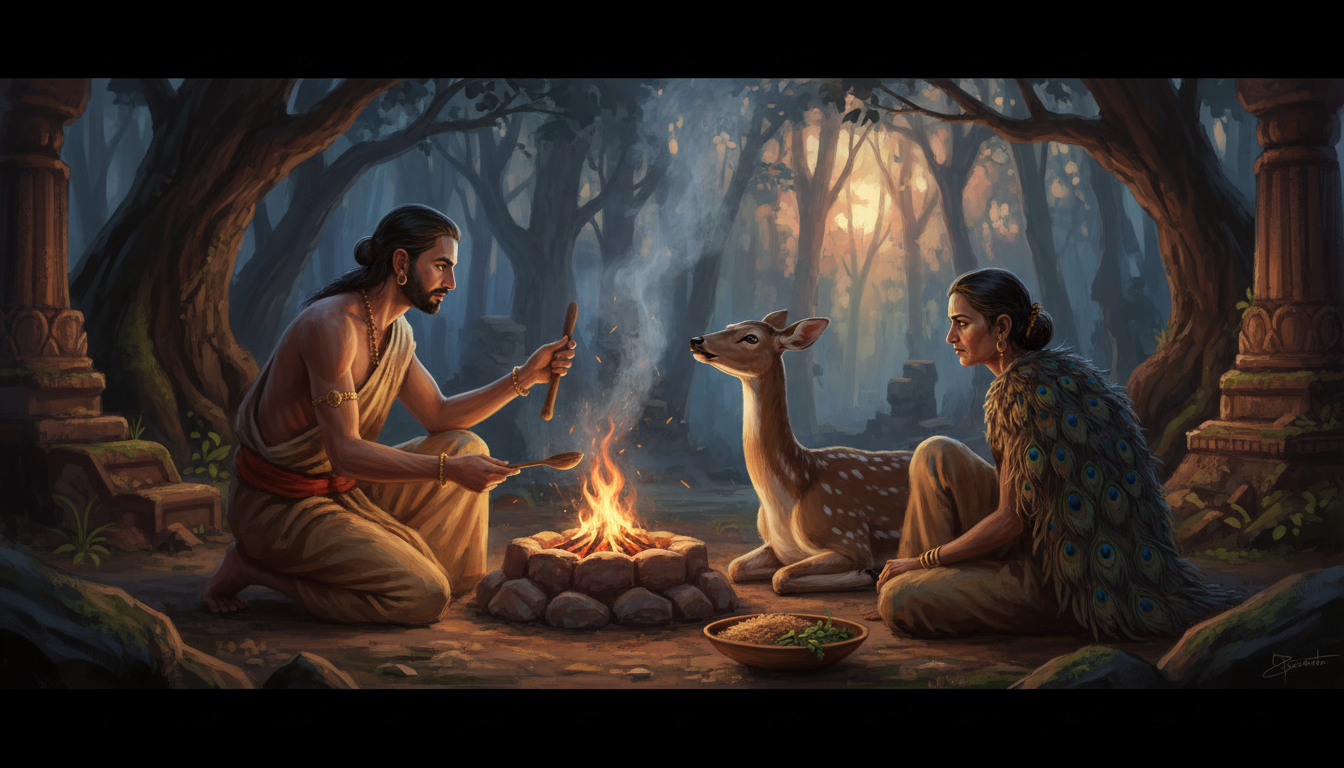
The Deer Who Asked to Be Killed
A poor brahmana's sacrifice and the neighbour who begged for the knife
The Rite That Buys Nothing
Yudhishthira had worked his way down the whole catalogue of sacrifices by then, and the question he asked that morning was the one left over at the bottom of it.
"Amongst the diverse kinds of sacrifices, grandsire," he said, "all of which are of course regarded as having but one object, the cleansing of the heart or the glory of God, tell me what that sacrifice is which has been ordained for the sake only of virtue. Not for the acquisition of heaven. Not for the acquisition of wealth. Which is the rite that a man performs when there is nothing at the end of it for him?"
It is a harder question than it sounds, because nearly every rite in the books is described by its fruit. This one brings rain. That one brings a son. This other one buys a term of residence among the gods, and the books are not shy about stating the length of the term. Yudhishthira was asking whether anything was left standing when the fruits were struck off the list.
Bhishma lay on the arrows and considered it.
"In this connection," he said, "I shall relate to thee a history that was recited formerly by Narada, of a Brahmana who, for the purpose of performing sacrifices, lived according to the unchha mode."
The unchha mode is the narrowest of all the permitted ways of getting food. A man under that vow may not plough, may not trade, may not keep a store against tomorrow, and may not ask. He goes down to the reaped field after the reapers and the gleaners and the birds have all finished with it, and he picks up what was dropped, one grain at a time, and what he has gathered by evening is what there is. A man who lives that way and then spends what he has gathered on a sacrifice is spending the only thing he owns.
"Listen, son of Kunti," said Bhishma, "to what Narada said."
"In one of the foremost of kingdoms," Narada had said, "which was distinguished again for its virtue, there lived a Brahmana."
The Bitter Herbs That Turned Sweet
He was devoted to penances and he lived by the unchha mode, and he was earnestly engaged in adoring Vishnu in sacrifices. That is the whole of his description, and every clause of it is a hardship except the last.
His food is named. He had Syamaka for his food, as also Suryaparni and Suvarchala and other kinds of potherbs, and Narada does not leave the character of those herbs to the imagination. They were bitter and disagreeable to the taste. This was not the plain fare of a poor man who would have eaten better if he could. These are the leaves that are left growing at the edge of a field because nobody wants them, and a man who is living on them is living on what even the hungry have walked past.
And then the one line in the account that is a mercy.
In consequence, however, of his penances, all these tasted sweet.
Not that he ceased to mind them. That the herbs themselves changed in his mouth. His austerities had gone on long enough and deep enough that the punishment in his diet had been quietly taken out of it, and he sat down every evening to a bitter meal that had become a good one, and nobody watching him would have been able to tell.
He abstained from injuring any creature. He led the life of a forest recluse, and in that manner he attained to ascetic success. With roots and fruits, and with nothing else, he adored Vishnu in sacrifices.
But Narada is precise about those sacrifices, and the precision is the hinge of the story. They were sacrifices intended to confer heaven upon him.
So the man was not yet the answer to Yudhishthira's question. He was performing rites for a reward, exactly as everyone else does, and the fact that his rites were poor and his diet was bitter did not change the account he was keeping. He was buying something. He had simply found the cheapest currency in the world to buy it with.
His name, Narada said, was Satya, which is to say Truth.
The Wife in Cast Off Plumes
The Brahmana had a wife, and her name was Pushkaradharini.
She was pure-minded, and she had emaciated herself by the observance of many austere vows, so that whatever else may be said about her, nothing can be said about her comfort. She had given up as much as he had. She was of a benevolent disposition. And her husband was addicted to sacrifices that were cruel, and she did not approve of the conduct of her lord.
That is put down plainly and then it is left alone, which is how such things are usually recorded about wives.
She was summoned to take her seat by his side, as a wife must be, since there is no such thing as a sacrifice performed by a married man alone. The rite requires her. She sat where she was told to sit. She feared to incur his curse, and therefore she comforted herself with his conduct, which is a careful way of saying that she made her peace with what she was watching because the alternative was to be cursed by an ascetic who had the power to do it and the temper of a man who thought he was right.
The garments that invested her body consisted of the cast off plumes of peacocks.
That is the detail to hold. There was no cloth in the hermitage and there was nothing to buy it with, so she went about dressed in feathers, and the feathers were the ones the birds had already let fall and left lying in the grass. Not a bird had been touched for her clothing. She had taken only what was dropped, which is the unchha vow applied to a wardrobe, and she had made herself into a walking argument against her husband's altar without opening her mouth once.
Although unwilling, she performed that sacrifice at the command of her lord, who had become its Hotri.
She knew what was wrong with it. He was the priest of it, and he did not.
The Neighbour Who Came as a Deer
In that forest, near to the Brahmana's asylum, there lived a neighbour.
He was the virtuous Parnada, of Sukra's race, and he had assumed the form of a deer, and he had been living in those woods in that shape for years. He was not a stranger. He grazed within sight of the fire. The man and his wife knew the animal the way people in a lonely place know the one other living thing that shares the clearing with them.
One day the deer walked up to the sacrifice and addressed the Brahmana whose name was Satya, in articulate speech, in words that a man could understand.
"Thou wouldst be acting very improperly," said the deer, "if this sacrifice of thine were accomplished in such a manner as to be defective in mantras and in the other particulars of ritual."
He had begun with the one charge that could not be waved away. A rite that is short of its parts is not a small rite. It is a broken one, and a broken rite is worse than none, and every man who has spent his life on the fire knows it and lies awake over it. The deer had found the seam in Satya at the first attempt.
Then he named the missing part.
"I therefore ask thee to slay me, and to cut me in pieces, for making libations therewith upon thy sacrificial fire. Do this, and becoming blameless, ascend to heaven."
The neighbour was offering himself as the victim, and he was offering it as a kindness, and he was using the word blameless of the man who would have to hold the knife.
Pushkaradharini sat in her feathers on the other side of the fire and said nothing, because she had been forbidden nothing and had been asked nothing, and because a woman who speaks at that moment is a woman who is cursed at that moment.
The Goddess Steps Out of the Sun
Then the presiding goddess of the solar disc came down to that sacrifice.
Savitri came in her own embodied form, and stood in a forest clearing beside a fire that had been fed with roots and fruits by a man who owned nothing, and she insisted upon the Brahmana doing what the deer had asked him to do.
Understand what has now been placed on both sides of the scale. On the one side there is a deer that talks, which might be a trick, and a request that any sane man would refuse. On the other side there is the sun. Not a messenger of the sun and not a voice out of the air. The goddess herself, present, embodied, standing in the smoke, telling him that the animal is right and the rite is short and the remedy is in his hand.
"The sacrifice is defective," was the sense of what she pressed on him, "and the victim is willing, and the victim has asked. Complete it."
This is the part of the story that is easiest to read past, and it should not be read past, because it is the reason the story exists. A man is not tested by being tempted with something disgraceful. He is tested by being told to do the disgraceful thing by an authority he has revered every morning of his life, on grounds that are technically correct, with the consent of the one who will be harmed, in front of a fire he lit himself. There is no argument left to make against it. Everything that could be said for it has been said, and by the sun.
Satya stood with the ladle in his hand and the deer waiting in front of him and the goddess insisting, and he gave his answer.
He Lives With Me in This Same Neighbourhood
"I shall not slay this deer," the Brahmana said, "who lives with me in this same neighbourhood."
That is the whole of the refusal, and it is worth reading twice for what is not in it.
He did not quote a text. He did not tell the goddess that injury forms no part of sacrifice, though the story will say exactly that before it is over, and though he had lived his whole life abstaining from injury to any creature. He did not argue about the mantras or dispute her competence or ask her by what right she instructed him. He gave a reason that would be understood in any village in the world by anybody at all.
The animal is my neighbour. He lives here. I know him.
Against the sun in her own body, that was all he had, and it held. It is the argument of a man who has been looking at the same deer at the edge of the same clearing for years, and who finds, when he is finally handed the knife, that he cannot use it on something he has been seeing every day.
Thus addressed by the Brahmana, the goddess Savitri desisted.
And then she did something that tells more about the state of that sacrifice than any speech could have. She entered the sacrificial fire, from a desire to survey the nether world, and wishing to avoid the sight of other defects in that rite.
Other defects. She had come to correct one fault and had found the place full of them, and rather than stand there and look at the rest of it she went down through the flames and out of the world.
She had not been wrong about the sacrifice. She had been wrong about the remedy.
Go
The deer was not finished. With his forelegs folded and his head bent in the attitude of joined hands, he begged of Satya once more to be cut in pieces and poured into the fire.
This is a thing to sit with. The animal was pleading, and what he was pleading for was the knife, and he had adopted the posture that a suppliant takes when he asks a favour of a man who has the power to grant it. Everything in the scene is inverted. The one who stands to lose his life is the petitioner. The one who is refusing is the one being begged.
And Satya did not argue with him either.
He embraced him. Narada says it in four words and does not enlarge on it, and there is nothing to enlarge. The Brahmana put his arms round the neck of the deer that had asked him to butcher it, and he embraced him in friendship, and then he let him go and said one word.
"Go."
He did not say it in anger and he did not say it in fear. He said it the way a man says it to a friend who has offered something that cannot be accepted and who will not stop offering it, when the only kindness left is to end the conversation.
At this, the deer seemed to leave that place.
That word, seemed, is doing work. He turned and went off toward the trees like an animal that has finished with a clearing, and the fire went on burning, and the wife sat in her feathers, and the man who had just refused the sun stood at his altar with his hands empty and his penances entire, and the story could have ended there.
It did not end there, because the test was not over. It had not properly begun.
Eight Steps, and the Cars of the Gandharvas
After he had gone eight steps, he returned.
Eight. Narada counted them, and the count is the most quietly frightening detail in the whole history, because it means the deer had never intended to leave and had only wanted the refusal to be complete before he tried the thing that would work.
"Verily, do thou slay me," he said. "Truly do I say, slain by thee I am sure to attain to a righteous end."
And then, having failed with duty, having failed with defect and mantra and ritual and the insistence of a goddess, having failed with the entreaty of a friend, he offered the one thing that had not yet been offered.
"I give thee vision. Behold the celestial Apsaras, and the beautiful vehicles of the high-souled Gandharvas."
The sky opened for the Brahmana who lived on bitter leaves. He saw the Apsaras. He saw the cars of the Gandharvas, which are not described because they do not need to be described to anyone who has ever wanted anything. He had been performing sacrifices all his life that were intended to confer heaven upon him, and he had been paying for them a grain at a time out of a reaped field, and now he was being shown the merchandise.
And he beheld that sight for a protracted space of time, with longing eyes.
He did not glance and look away. He stood and looked, and Narada names what was in the look. Longing. Then he turned his eyes back to the deer, who was still standing there solicitous of sacrifice, still asking, still willing, and he thought the thought that the whole apparatus had been built to produce in him: that residence in heaven is attainable by slaughter and by no other means.
And he approved of it.
He had not moved. He had not lifted the knife. He had not touched the animal. His hand was exactly where it had been when he refused the goddess.
And the penances of that Brahmana, which had been of very large measure, diminished greatly in consequence of that thought itself.
The Deer Stands Up
It was Dharma himself who had become a deer and had lived in those woods for many years.
Not a demon sent to ruin him. Not a rival ascetic. The god of righteousness had taken the shape of a browsing animal and had grazed at the edge of that clearing season after season, waiting for the man to be ready to be shown something, and the thing he had come to show him was not a reward.
Seeing the Brahmana tempted by the prospect that had been spread out over his head, Dharma provided for his salvation, and counselled him.
"This," he said, meaning the slaughter of living creatures, "is not conformable to the ordinances about sacrifices."
That was the answer to the accusation the deer had opened with, delivered by the same mouth that had made the accusation. The rite had never been defective for want of a victim. The injuring of living creatures forms no part of sacrifice at all, and the deer had spent the morning saying the opposite in order to find out what the man would do with it.
And he had found out. The measure of the man was not taken at the moment of refusal, when he was strong, and it was not taken at the altar. It was taken eight steps later, when nobody was watching but a deer, and a wish went through him that he never acted on, and something was subtracted from him for it that he had spent his whole life accumulating.
Then the illustrious Dharma assumed his real form.
And having assumed it, he did not depart, and he did not pronounce a curse, and he did not leave the man standing in a wrecked clearing with his life's merit gone. He stayed and discharged the priestly office. The god took the place of the Hotri at that poor fire and himself assisted the Brahmana to perform a sacrifice, and there was no blood in it anywhere, and it was complete.
The Brahmana afterwards, in consequence of his renewed penances, attained to that state of mind which was his spouse's.
Read that slowly, because it is the verdict of the whole history on the woman in the peacock feathers. She had been right from the first day, sitting where she was told to sit, saying nothing for fear of a curse. Her husband spent the rest of his life climbing back up to where she had been standing all along.
"Abstention from injury," said Narada, "is that religion which is complete in respect of its rewards. The religion of cruelty is beneficial only thus far, that it leads to heaven, and heaven has a termination."
And Bhishma, on the bed of arrows, gave the king his answer.
"That, son of Pandu, is the sacrifice ordained for the sake of virtue only. It is the one in which nothing is killed and nothing is bought, and the man who performs it may be known by this, that when he was offered the sky he wanted it, and did not take it."
Dharma Lesson
A sacrifice is spoiled by the willingness to kill and not only by the killing. Satya never lifted the knife, and the merit of a whole lifetime shrank in him the moment he looked at the sky he had been offered and wished the deer dead for it. The measure of a man is taken where nobody is watching, eight steps after the refusal.