The Guest Nobody Could See
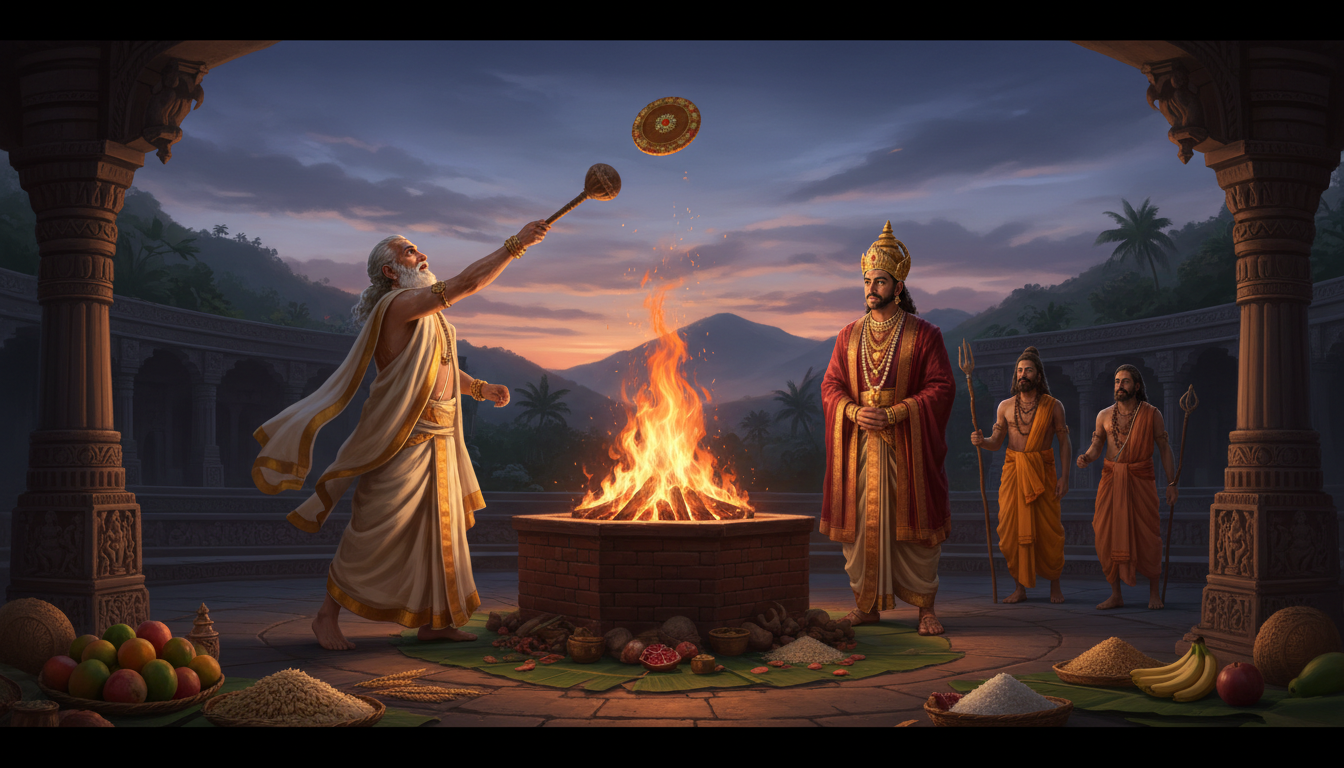
Brihaspati throws down the ladle at a sacrifice where no animal was killed
The Priest Born in the Race of Angiras
"Then, upon the expiration of the great Kalpa," Bhishma said, "when the celestial Purohita Vrihaspati was born in the race of Angiras, all the deities became very happy."
He was lying where he had been lying since the tenth day, and the son of Dharma was sitting in the sand beside him, and the question on the table that morning was about worship: who gets seen, and who does not, and why.
"The words Vrihat, Brahma and Mahat all bear the same sense," the old man said. "The celestial Purohita came to be called Vrihaspati because he was endued with all these attributes. Now there was a king, Uparichara, who was otherwise called Vasu, and he became a disciple of Vrihaspati, and soon he became the foremost of his disciples."
That is a considerable sentence. The priest of the gods took pupils, and the best of them was not a god or a rishi but a king with a kingdom to run at Chedi.
"Admitted as such, he began to study at the feet of his preceptor that science which was composed by the seven Rishis who were otherwise known by the name of Chitrasikhandins. With his soul cleansed from all sorts of evil by sacrifices and other religious rites, he ruled the Earth like Indra ruling the Heaven."
Yudhishthira did not interrupt. He had been listening to a great deal about how to rule the earth that season, most of it about spies and revenue and the correct treatment of a defeated enemy, and this was the first time in a long while that the answer had begun with a school.
Sixteen Men in the Enclosure
The illustrious king performed a great Horse-sacrifice, and his preceptor Vrihaspati became the Hota in it.
The sadasyas, the men who sit and watch and rule on whether a rite has been done rightly, were not ordinary men either. The sons of Prajapati themselves, Ekata, Dwita and Trita, took those seats. And there were others, and the text names every one of them, in the way a man names guests he was proud to have had under his roof.
Dhanusha. Raivya. Arvavasu and Parvavasu. The Rishi Medhatithi. The great Rishi Tandya. The blessed Rishi Santi, who was otherwise called Vedasiras. Kapila, foremost of Rishis, who was the father of Salihotra, the first Kalpa. Tittiri, the elder brother of Vaishampayana. Kanwa. Devahotra.
Sixteen in all, counting the three sons of Brahman among them.
In that great sacrifice all the requisite articles were collected, and they were collected in a particular way, and that particular way is the whole reason this story is remembered rather than merely recorded. The king had a rule for his sacrifice, and the rule was this.
No animals were slain in it.
The king had ordained it so. He was full of compassion, of pure and liberal mind, he had cast off all desires, and he was well conversant with all rites, which matters, because a man who does not know the rites cannot depart from them safely. The requisites of that sacrifice all consisted of the products of the wilderness. Whatever was poured and offered and burned had been gathered from what grows, and not taken out of anything that had been breathing that morning.
A horse-sacrifice in which no horse dies is a strange object. It is the largest and bloodiest of the royal rites and the king of Chedi performed it as a thing made entirely out of grain and root and fruit and forest gum, and did not think he had performed anything less.
The Portion That Was Taken
The ancient God of gods became highly gratified with the king on account of that sacrifice.
And here the account does something careful with its verbs, and it is worth going slowly, because everything that follows turns on it.
Hari came. Incapable of being seen by any one else, the great God showed himself to his worshipper. He accepted the share that had been offered to him by taking its scent, which is how a god eats. And he himself took up the Purodasa, the cake of offering, with his own hand.
The great God took up the offerings without being seen by any one.
So the god was present, the god was pleased, the god had shown himself, and the god had physically lifted the cake off the altar in front of a full enclosure of the most accomplished ritualists then alive, and not one of them saw a thing except the space where the cake had been.
There is nothing hidden in this. It is not a trick and it is not a test. It is simply the case that Narayana is incapable of being seen by anyone to whom he does not choose to be visible, and on that morning he chose one man in the enclosure, and the one he chose was the king, who was neither the officiating priest nor a son of Brahman nor any of the fourteen great Rishis sitting in judgment on the rite.
The king said nothing about it. Kings at their own sacrifices generally do not talk.
The Hota, however, was standing at the fire with the ladle in his hand, and the Hota had watched a portion of his own offering leave the altar without a hand on it.
Brihaspati Throws the Ladle at the Sky
At this, Vrihaspati became angry.
Taking up the ladle, he hurled it with violence at the sky, and began to shed tears in wrath.
It is one of the few completely undignified moments granted to a great being in this entire book, and nobody in the telling apologises for it. The preceptor of the gods, the man for whom a planet is named, the teacher who had taught this king everything the king knew about how to conduct exactly this rite, threw his instrument up into the air like a child and stood at his own fire crying with rage.
And then he spoke, and what he said is worse than the throwing, because it is deliberate.
"Here," he said to king Uparichara, "I place this as Narayana's share of the sacrificial offerings. Without doubt, he shall take it before my eyes."
That is not a prayer. That is a man setting out food and standing over it with his arms folded. He had gone from officiating at a sacrifice to laying a condition on a god, and the condition was that the god be looked at.
On the field at Kurukshetra, Yudhishthira stopped his grandsire there and put in the question that any listener would have.
"In the great sacrifice of Uparichara," the king said, "all the deities appeared in their respective forms for taking their shares of the sacrificial offerings, and were seen by all. Why is it that the puissant Hari only acted otherwise, by invisibly taking his share?"
Which is precisely Brihaspati's grievance, stated politely, by a man lying at a safe distance of many thousand years from the fire in question. Everyone else had come and been looked at. Only one guest had refused to be a guest in the ordinary way.
Cool Heads Around a Burning Priest
When Vrihaspati gave way to wrath, Bhishma said, the great king Vasu and all his Sadasyas sought to pacify the great Rishi.
They did not do it by agreeing with him and they did not do it by scolding him. With cool heads, all of them addressed him, and what they said has three parts, and each of the three takes something away from him.
"It behoveth thee not to give way to anger. In this Krita age, this anger to which thou hast given way should not be the characteristic of any one."
That is the first part, and it is an appeal to the calendar. This is the Krita age, the first and best of the four. Wrath is not yet a normal feature of the world. What Brihaspati has just done at the altar is, in the strictest sense, out of period.
"The great deity for whom the share of the sacrificial offerings was designed by thee is himself free from anger."
That is the second, and it is the sharper one. You are standing here in a fury at a being who has none, holding a portion out toward him as a challenge. Whatever the two of you are doing, only one of you is doing it.
"He is incapable of being seen either by ourselves or by thee, O Vrihaspati. Only he can see Him to whom He becomes gracious."
And that is the third, and it removes the whole ground of the complaint. The priest's outrage rested on an assumption he had never examined, which was that seeing is a thing a qualified person is owed. It is not. It is a thing that is given. Nobody in that enclosure had earned it, including the fourteen Rishis and the three sons of Brahman, and the king who did receive it had not earned it either; he had simply been the one to whom the god chose to become gracious.
That argument might have ended it. It did not, because arguments of that shape rarely persuade a man who is crying. What ended it was three men standing up and telling him where they had been.
Ekata, Dwita and Trita Tell Where They Went
Then the Rishis Ekata, Dwita and Trita, who were well conversant with the science of morality and duties compiled by the seven Rishis, addressed that conclave.
"We are the sons of Brahman," they began, "begotten by a fiat of his will, and not in the ordinary way."
They were, in other words, the three men in the enclosure with the least excuse for being refused anything.
"Once on a time we repaired to the north, for obtaining what is for our highest good. Having undergone penances for thousands of years and acquired great ascetic merit, we again stood on only one foot, like fixed stakes of wood."
Note the again. The thousands of years were the preparation. The standing on one foot came after.
"The country where we underwent the austerest of penances lies to the north of the mountains of Meru, and on the shores of the Ocean of Milk. The object we had in mind was how to behold the divine Narayana in his own form."
So the whole enormous labour had exactly the aim that Brihaspati had just tried to obtain with a ladle.
"Upon the completion of our penances, and after we had performed the final ablutions, an incorporeal voice was heard by us, O puissant Vrihaspati, at once deep as that of the clouds and exceedingly sweet, and filling the heart with joy. The voice said: Ye Brahmanas, well have ye performed these penances with cheerful souls. Devoted unto Narayana, ye seek to know how ye may succeed in beholding that god of great puissance.
"On the northern shores of the Ocean of Milk there is an island of great splendour, called by the name of White Island. The men that inhabit that island have complexions as white as the rays of the Moon, and they are devoted to Narayana. Worshippers of that foremost of all Beings, they are devoted to Him with their whole souls. They all enter that eternal and illustrious deity of a thousand rays. They are divested of senses. They do not subsist on any kind of food. Their eyes are winkless. Their bodies always emit a fragrance. Indeed, the denizens of White Island believe and worship only one God.
"Go thither, ye ascetics, for there I have revealed myself."
Blind on the White Island
"All of us, hearing these incorporeal words, proceeded by the way indicated to the country described. Eagerly desirous of beholding Him, and our hearts full of Him, we arrived at last at that large island called White Island.
"Arrived there, we could see nothing."
They had been sent by a voice from the sky, to a named place, with an assurance that the god had revealed himself there. They walked onto the ground he had named and their vision was blinded by the energy of the great deity, and accordingly they could not see Him.
"At this, the idea, due to the grace of the great God Himself, arose in our minds that one that had not undergone sufficient penances could not speedily behold Narayana."
Thousands of years, and one foot, and the stakes of wood, and it had not been sufficient. Under the influence of this idea they set themselves once more to the practice of some severe austerities, suited to the time and to the place, for a hundred years.
"Upon the completion of our vows, we beheld a number of men of auspicious features. All of them were white and looked like the Moon in colour, and possessed of every mark of blessedness. Their hands were always joined in prayer. The faces of some were turned towards the North and of some towards the East. They were engaged in silently thinking on Brahma. The Yapa performed by those high-souled persons was a mental Yapa, and did not consist of the actual recitation of any mantras in words.
"In consequence of their hearts having been entirely set upon Him, Hari became highly pleased with them. The effulgence emitted by each of those men resembled the splendours which Surya assumes when the time comes for the dissolution of the universe. Indeed, we thought that Island was the home of all Energy. All the inhabitants were perfectly equal in energy. There was no superiority or inferiority there among them."
That last detail is the one to hold on to. Not one of those white men outranked another. There was no chief among them, no Hota, no sadasya, no man with a better seat.
A Thousand Suns and the Word Namas
"We then suddenly beheld once more a light arise, that seemed to be the concentrated effulgence of a thousand Suns, O Vrihaspati.
"The inhabitants, assembling together, ran towards that light, with hands joined in reverential attitude, full of joy, and uttering the one word Namas. We then heard a very loud noise uttered by all of them together. It seemed that those men were employed in offering a sacrifice to the great God.
"As regards ourselves, we were suddenly deprived of our senses by his Energy. Deprived of vision and strength and all the senses, we could not see or feel anything."
So they stood in the middle of a crowd of worshippers at the exact moment of the arrival, with a thousand suns in front of them, and were struck deaf to everything except one thing, which was the crowd.
"We only heard a loud volume of sound uttered by the assembled inhabitants. It said: Victory to thee, O thou of eyes like lotus-petals! Salutations to thee, O Creator of the universe! Salutations to thee, O Hrishikesa, O foremost of Beings, O thou that art the First-born! Even this was the sound we heard, uttered distinctly and agreeably to the rules of orthoepy.
"Meanwhile a breeze, fragrant and pure, blew, bearing perfumes of celestial flowers, and of certain herbs and plants that were of use on the occasion. Those men, endued with great devotion, possessed of hearts full of reverence, conversant with the ordinances laid down in the Pancharatra, were then worshipping the great deity with mind, word and deed.
"Without doubt, Hari appeared in that place whence the sound we heard arose. As regards ourselves, stupefied by His illusion, we could not see him."
Smell, they were left. Hearing, they were left. They knew where in the air he was standing, by the direction the shouting came from, and that was the whole of what a hundred years and thousands of years before it had bought them.
"After the breeze had ceased and the sacrifice had been over, our hearts became agitated with anxiety, O foremost one of Angira's race."
Nobody Looked at Them
"As we stood among those thousands of men, all of whom were of pure descent, no one honoured us with a glance or nod."
That is the coldest line in the story, and it is the one the three of them chose to say out loud in front of a full enclosure at a royal sacrifice, which cannot have been easy.
"Those ascetics, all of whom were cheerful and filled with devotion, and who were all practising the Brahma-frame of mind, did not show any kind of feeling for us. We had been exceedingly tired. Our penances had emaciated us."
Three sons of Brahman, worn to the bone, standing in a crowd on the far shore of the Ocean of Milk, and nobody turned a head.
"At that time an incorporeal Being addressed us from the sky and said unto us these words: These white men, who are divested of all outer senses, are competent to behold Narayana. Only those foremost of regenerate persons whom these white men honour with their glances become competent to behold the great God."
So the glance nobody gave them was not rudeness. It was the door. The thing they had walked to the end of the world for had been in the gift of the men standing next to them, and it had not been given.
"Go hence, ye Munis, to the place whence ye have come. That great Deity is incapable of being ever seen by one that is destitute of devotion. Incapable of being seen in consequence of his dazzling effulgence, that illustrious Deity can be beheld by only those persons who in course of long ages succeed in devoting themselves wholly and solely to Him.
"Ye foremost of regenerate ones, ye have a great duty to perform. After the expiration of this the Krita age, when the Treta age comes in course of the Vivaswat cycle, a great calamity will overtake the worlds. Ye Munis, ye shall then have to become the allies of the deities, for dispelling that calamity."
"Having heard these wonderful words, that were sweet as nectar, we soon got back to the place we desired, through the grace of that great Deity."
They had been sent home with an errand instead of a sight, and they had taken it.
The Ladle Picked Up Again
Then Ekata turned the whole account on the man it had been told for.
"When with the aid of even such austere penances, and of offerings devoutly given in sacrifices, we failed to have a sight of the great Deity, how, indeed, can you expect to behold Him so easily?"
So easily. At your own fire, in the middle of your own rite, in one morning, because you are the Hota and you asked.
"Narayana is a Great Being. He is the Creator of the universe. He is adorned in sacrifices with offerings of clarified butter and other food dedicated with the aid of Vedic mantras. He has no beginning and no end. He is Unmanifest. Both the Deities and the Danavas worship Him."
Induced by these words spoken by Ekata and approved by his companions Dwita and Trita, and solicited also by the other Sadasyas, the high-minded Vrihaspati brought that sacrifice to a completion, after duly offering the accustomed adorations to the Deities.
That is all the resolution there is, and it is enough. He picked the ladle up. He did not receive an explanation that satisfied him, he did not get the sight he had demanded, and the portion he had set down as a challenge is not mentioned again. He finished the work in front of him and gave every god his adorations, including the one who had already eaten without being watched.
King Uparichara, having completed his great sacrifice, began to rule his subjects righteously. At last, casting off his body, he ascended to heaven.
"And after some time," Bhishma said, "through the curse of the Brahmanas, he fell down from those regions of felicity and sank deep into the bowels of the Earth. King Vasu was always devoted to the true religion. Although sunk deep into the bowels of the Earth, his devotion to virtue did not abate. Ever devoted to Narayana, and ever reciting sacred mantras having Narayana for their deity, he once more ascended to heaven through Narayana's grace. Ascending from the bowels of the Earth, king Vasu, in consequence of the very highest end that he attained, proceeded to a spot that is even higher than the region of Brahman himself."
The man who had been given the sight without asking for it was also the man who went on reciting from inside the ground, where there was nothing to see at all.
Dharma Lesson
Being answered is not the same as being shown, and a priest who demands proof of the god he serves has misunderstood what service is. The sight is a gift and not a wage, and the three sons of Brahman who walked to the end of the world learned that it lay in the gift of the men standing beside them.