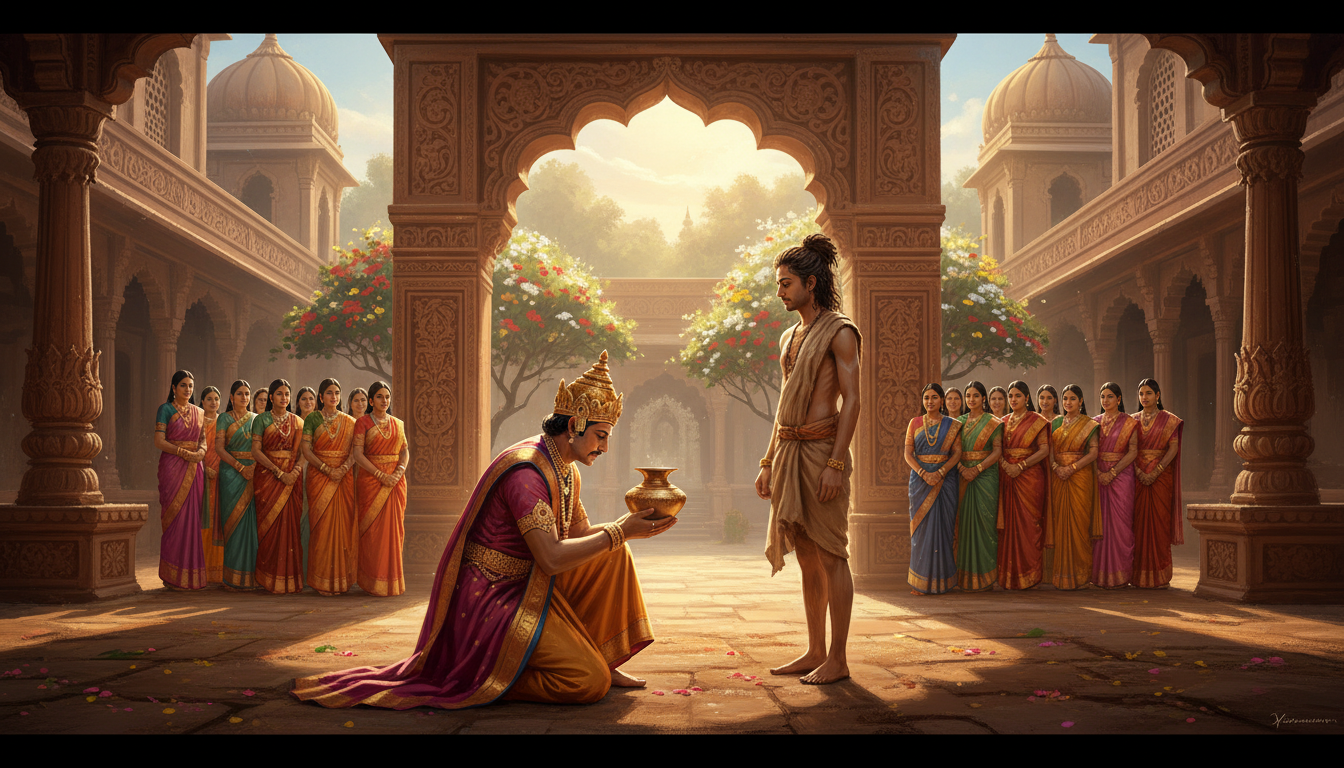
Three Doors and Fifty Women
The son of Vyasa is made to walk, and then made to wait
The Question a Father Would Not Answer
"Grandsire," said Yudhishthira, "you have told me what a king must do. Tell me now about the men who want out of it altogether. Did any of them ever get a straight answer?"
"One did," said Bhishma from the bed of arrows, "and he had to walk a long way for it. Hear about Suka, the son of Vyasa, who was born of the fire-sticks, and about what his father did to him when he asked the plainest question a son can ask."
Arjuna and Bhima and the twins settled where they were sitting, and Krishna, a little apart, did not settle at all, being one of the two people on that field who already knew how the story ended.
Thinking of Emancipation (said Bhishma), Suka approached his sire. He was humble by nature and he wanted his highest good, and he saluted that great preceptor and said, "You are well versed in the religion of Emancipation. Discourse to me upon it, illustrious one, so that supreme tranquillity of mind may be mine."
Hearing this from his son, the great Rishi said, "Study, my son, the religion of Emancipation, and all the diverse duties of life."
So at his father's command Suka, that foremost of righteous men, mastered every treatise on Yoga and the science that Kapila promulgated. And when Vyasa saw that his son had the resplendence of the Vedas in him, and the energy of Brahma, and was fully conversant with the religion of Emancipation, he did not answer the question. He said something else.
"Go to Janaka, the ruler of Mithila. The king of Mithila will tell you everything for your Emancipation."
The Conditions Laid on the Road
Suka bore the command of his sire and turned to go, and before he had gone his father laid conditions on him, which was the second part of the answer.
"Go there by the path that ordinary human beings take. Do not have recourse to your Yoga power and proceed through the skies."
Suka was not at all surprised, for he was humble by nature, and he was able to traverse the sky over the whole Earth with her seas, and he simply put the ability aside as a man puts down a tool he will not need.
"Go with simplicity," his father said, "and not from any desire of pleasure. Along your way do not seek for friends or for spouses, since friends and spouses are the causes of attachment to the world. And although the ruler of Mithila is one in whose sacrifices we officiate, you shall not indulge in any feeling of superiority while you are living with him. Live under his direction and in obedience to him. He is well versed in all duties and well acquainted with the scriptures on Emancipation, and he will dispel every doubt of yours. Whatever he bids you do, do it without scruple."
There is nothing in those instructions about doctrine. A priest's son was being sent to a king, told to walk when he could fly, told to obey a man his own family served, and told not to acquire a friend on the way. Suka took the instructions exactly as they were given and set out on foot.
The Walk Across the Varshas
He crossed many hills and many mountains. He crossed rivers, and waters, and lakes, and woods and forests full of beasts of prey and of other animals. He crossed the two Varshas of Meru and of Hari, one after the other, and then the Varsha of Himavat, and came at last into the Varsha known by the name of Bharata. He saw many countries inhabited by Chinas and by Hunas, and the great ascetic came at length to Aryavarta.
He did all of it in obedience to the commands of his sire, bearing them constantly in his mind, and he passed along his way upon the Earth like a bird passing through the air.
He went through delightful towns and populous cities, and he saw diverse kinds of wealth in them and did not wait to observe any of it. He passed through delightful gardens and open plains and by many sacred waters. None of it stopped him. A man walking that distance with his eyes open will collect a hundred reasons to stay somewhere, and Suka collected none, not because he despised what he passed but because he was carrying one thing in his mind the whole way and had no hand free to pick up anything else.
The sun did not tire him. The distance did not tire him. He was going to a house where nobody had yet been told he was coming.
Videha, and the Gate
Before much more time had passed he reached the country of the Videhas, which was protected by the virtuous and high-souled Janaka. There he saw many populous villages, and many kinds of food and drink and viands, and habitations of cowherds swelling with men, and many herds of cattle. He saw fields abounding with paddy and with barley and with the other grains, and lakes and waters inhabited by swans and by cranes and adorned with beautiful lotuses. It was a country that showed at a glance what sort of man was keeping it.
Passing through the Videha country, which teemed with well-to-do people, he arrived at the delightful gardens of Mithila, rich with many species of trees, full of elephants and horses and cars, peopled with men and women. He walked through the middle of all of it without waiting to observe a single thing that was presented to his eye.
Arrived at the gate of the city, he did not walk in. He sent word through the keepers, and stood outside until permission came back, and only then entered. Then he went along the principal street, which was crowded with prosperous men, and came to the king's palace and went in without any scruples, since he had been given leave.
And at the inner door the porters forbade him with rough words.
The Man Who Simply Stopped
They were rough with him. He was a man on foot, dusty, with nothing about him to make a porter careful, and they told him where he could stand and what he could not do.
At that, Suka, without any anger, stopped and waited.
Neither the sun nor the long distance he had walked had fatigued him in the least. Hunger had not weakened him, nor thirst, nor the exertion he had made. The heat of the sun had not scorched him or pained him or distressed him in any degree. He stood where he had been told to stand and waited, and the waiting cost him nothing, because he had not brought with him the thing that waiting injures.
Among those porters there was one who felt compassion for him, seeing him standing there like the midday sun in his effulgence. That man worshipped him in due form and saluted him properly, and with joined hands he led him into the first chamber of the palace.
Seated there, Suka began to think of Emancipation and of nothing else. The chamber had a part in shade and a part where the sun came in, and he looked at the one and at the other with an equal eye, and it did not occur to him to move.
The Garden and the Fifty
Very soon after, the king's minister came to that place with joined hands and led him from the first chamber into the second. From the second chamber a door opened upon a spacious garden that formed a portion of the inner apartments of the palace, and it looked like a second Chaitraratha. Beautiful pieces of water occurred here and there at regular intervals. Delightful trees stood in it, all of them in their flowering season. Bevies of damsels of transcendent beauty were in attendance there.
The minister led Suka to that delightful spot, ordered the damsels to give the ascetic a seat, and left him there.
They were fifty. They were well dressed and of beautiful features, possessed of excellent hips, young in years, clad in red robes of fine texture and decked with many ornaments of burnished gold. They were skilled in agreeable conversation and in maddening revelry, and they were thorough mistresses of the arts of dance and of singing. They opened their lips always with smiles, and they were equal to the very Apsaras in beauty. They were well skilled in all the acts of dalliance, and they were competent to read the thoughts of the men upon whom they waited. They were of a very superior order and of easy virtue, and the king had put them in a garden with one guest.
They presented him with water for washing his feet and worshipped him respectfully with the offer of the usual articles, and they gratified him with excellent viands agreeable to the season. After he had eaten, those damsels, one after another, singly led him through the grounds, showing him every object of interest. They sported and laughed and sang. Knowing, as they did, the thoughts of all men, they entertained that auspicious ascetic of noble soul the whole evening.
He who was born on the fire-sticks, observant of his duties without scruples of any kind, having all his senses under complete control and being a thorough master of his own wrath, was neither pleased by any of it nor angered by any of it.
The Night He Was Left Alone With It
Then those foremost of beautiful women gave him an excellent seat. He washed his feet and his other limbs and said his evening prayers, and sat down upon that seat, and began to think of the object for which he had come to that place.
In the first part of the night he devoted himself to Yoga. The middle portion of the night the puissant ascetic passed in sleep. He woke very soon out of that slumber and went through the necessary rites of cleansing his body, and then, surrounded by those beautiful women, he devoted himself once more to Yoga.
That is how the son of the Island-born Krishna passed the latter part of that day and the whole of that night in the palace of King Janaka: fed, sung to, walked about the grounds, watched all the while by fifty women who could see what was in his mind, and left, from the gate onward, entirely without an answer to his question.
The king had not come. Nobody had said when the king would come. It had begun with rough words at a door and gone on to red robes and burnished gold and excellent viands agreeable to the season, and in the whole arrangement there was not one thing that a man could take hold of and be offended by or be pleased by without giving himself away. It was a question, put in three parts, by a man who had not yet spoken a word to him.
The King Comes on Foot
The next morning King Janaka came to Suka, accompanied by his minister and by the whole of his household, and placing his priest in the van. He brought with him costly seats and diverse kinds of jewels and gems, and he carried the ingredients of the Arghya upon his own head.
So the monarch approached the son of his reverend preceptor. Taking with his own hands, from the hands of his priest, a seat adorned with many gems, overlaid with an excellent sheet, beautiful in all its parts and exceedingly costly, he presented it with great reverence to Suka. When the son of Krishna the Island-born had taken his seat upon it, the king worshipped him according to the prescribed rites, offering him first water to wash his feet, and then the Arghya, and then kine.
The ascetic accepted that worship, offered with the due rites and mantras, and took the kine also that were presented to him, and saluted the monarch. Then he enquired after the king's welfare and prosperity, and he did not stop with the king; his enquiry took in the welfare of the monarch's followers and of his officers as well.
Only when Suka gave him permission did Janaka sit down, and having sat down, that high-souled monarch of high birth sat upon the bare ground with his hands joined, and asked after the welfare and unabated prosperity of Vyasa's son. Then, at last, he asked his guest the object of his visit.
"My sire told me," said Suka, "that his Yajamana, the ruler of the Videhas, known all over the world by the name of Janaka, is well versed in the religion of Emancipation. He commanded me to come to him without delay if I had any doubts requiring solution in the matter of the religion of Pravritti or of Nivritti, and he gave me to understand that the king of Mithila would dispel all my doubts. I have come here at the command of my sire, to take lessons from you. Instruct me, foremost of all righteous persons. What are the duties of a Brahmana, and what is the essence of those duties that have Emancipation for their object? How is Emancipation to be obtained? Is it obtainable by the aid of knowledge, or by that of penances?"
The Boat and the Helmsman
"Hear what the duties of a Brahmana are, from the time of his birth," said Janaka. "After his investiture with the sacred thread he should devote his attention to the study of the Vedas. By practising penances, by dutifully serving his preceptor, and by observing the duties of Brahmacharyya, he should pay off the debt he owes to the deities and to the Pitris, and cast off all malice. Having studied the Vedas with close attention and subjugated his senses, and having given his preceptor the tuition fee, he should return home with his preceptor's permission. Returning home, he should betake himself to the domestic mode of life, and wedding a spouse confine himself to her, and live free of every kind of malice, having established his domestic fire. Living in the domestic mode he should procreate sons and grandsons. After that he should retire to the forest and continue to worship the same fires and entertain guests with cordial hospitality. Living righteously in the forest, he should at last establish his fire in his own soul, and freed from all pairs of opposites, and casting off all attachments, pass his days in the mode called Sannyasa, which is otherwise called the mode of Brahma."
Suka did not accept it as it stood. "If a man has succeeded in attaining an understanding cleansed by the study of the scriptures, and true conceptions of all things, and if his heart has succeeded in freeing itself permanently from the effects of all pairs of opposites, is it still necessary for such a person to adopt, one after another, the three modes of life called Brahmacharyya and Garhastya and Vanaprastha? That is what I ask you. Tell me according to the true import of the Vedas."
"Without an understanding cleansed by the study of the scriptures," said Janaka, "and without that true conception of things which is known by the name of Vijnana, Emancipation is impossible. And that cleansed understanding is unattainable without one's connection with a preceptor. The preceptor is the helmsman, and knowledge is the boat. Having acquired that boat one becomes crowned with success, and having crossed the ocean, one may abandon both of them.
"For preventing the destruction of all the worlds, and for preventing the destruction of the acts upon which the worlds depend, the duties of the four modes of life were practised by the wise of old. But that man who through penances performed in the course of many births has obtained a cleansed mind and understanding and soul is certainly able to attain Emancipation in a new birth in even the very first mode, in Brahmacharyya itself. When a cleansed understanding has been attained, and Emancipation with it, and through it a knowledge of all visible things, what desirable object is left to be gained by observing the other three?
"There is a saying sung of old by King Yayati, which everybody conversant with the scriptures on Emancipation keeps in his memory. The effulgent ray exists in one's own Soul and nowhere else, and it exists equally in all creatures, and a man can see it himself if his heart is devoted to Yoga. When a person lives in such a way that no other is inspired with fear at the sight of him, and he himself is not inspired with fear at the sight of others, when he has ceased to cherish desire and hate, then he is said to attain to Brahma. Let him cast an equal eye upon praise and dispraise, gold and iron, happiness and misery, heat and cold, good and evil, the agreeable and the disagreeable, life and death. Let him restrain his senses and his mind as a tortoise withdraws its outstretched limbs. As a house enveloped in darkness can be seen by the aid of a lighted lamp, so can the soul be seen by the aid of the lamp of the understanding."
You Came Here Carrying It
Then the king said the thing he had brought him all that way to hear.
"Foremost of intelligent persons, I see that all this knowledge that I am communicating to you dwells in you already. Whatever else should be known by one desirous of learning the religion of Emancipation is already known to you. I am convinced that through the grace of your preceptor, and through the instructions you have received, you have already transcended all objects of the senses. Great ascetic, through the grace of that sire of yours I have attained to omniscience, and so I have succeeded in knowing you.
"Your knowledge is much greater than what you think you have. Your perceptions that come of intuition are much greater than what you think you have. Your puissance also is much greater than you are conscious of. Whether it is because of your tender age, or of the doubts you have not been able to dispel, or of the fear that comes of not having attained Emancipation, you are not conscious of that knowledge, though it has already arisen in your mind. After a man's doubts have been dispelled by persons like us, he succeeds in opening the knots of his own heart, and then, by a righteous exertion, he attains that knowledge and becomes conscious of it.
"You see no distinction between happiness and misery. You are not covetous. You have no longing for dancing and song. You have no attachments and no attachment to friends. You have no fear in things that inspire fear. Blessed one, I see that you cast an equal eye upon a lump of gold and a clod of earth. What else have you to ask me?"
Suka had nothing else to ask. Having heard those words, he began to stay in his Soul by his Soul, having seen Self by Self, and his object being accomplished he became happy and tranquil, and without putting a single further question to Janaka he went away northward to the mountains of Himavat, with the speed of the wind and like the wind. Approaching his father in that asylum at the foot of the mountains where Vyasa taught the Vedas to Sumanta and Vaisampayana and Jaimini and Paila, he touched his feet, accosted the disciples with becoming formalities, and cheerfully detailed to his father every particular of his conversation with the king.
"Consider what the father did," said Bhishma. "He would not answer, and he made his son walk the whole earth to be handed the answer he already had. And consider what the king did. He kept a rishi standing at a door, then in a bare room, then in a garden with fifty women trained to read what a man is thinking, and asked nothing and offered nothing until the morning, and then came on foot with the arghya on his own head and sat down on the bare ground. Neither of them taught him a word he did not know. Between them they arranged the only examination that discovers whether a man knows it: rough words, and then honey, and then a whole night with no answer coming."
Dharma Lesson
A teacher's real examination is not the question he asks but the waiting, the comfort and the discourtesy he arranges before he asks it. Rough words at a door, a whole night with no answer coming, and fifty women trained to read what a man is thinking found out more about Suka than any doctrine could. What the king finally gave him was the news that he had been carrying the answer the entire way.