The Son Struck From the Fire Sticks
A hundred years of penance, a parrot on a branch, and a child born of friction
A Question About a Boy
The bed of arrows had not softened in any of the nights Bhishma had lain upon it, and the grandsire had learned to speak without moving anything but his mouth. Yudhishthira came at the hour when the ground was still cool from the dark, and sat down in the dust beside the three arrows that propped the old man's head, and his brothers arranged themselves behind him without a word.
For a while the king asked nothing at all. Then he said, "Grandsire, there is a name that will not let me alone. Tell me how the high-souled Suka of austere penances took birth as the son of Vyasa, and how he came at last to the highest success. Upon what woman did the Island-born beget him? We do not know who Suka's mother was. We know nothing whatever of the birth of that ascetic, and yet men speak his name as though every child knew the story."
"A birth is a small thing to ask after," Bhishma said.
"It is not only the birth." Yudhishthira leaned nearer. "He was a boy, grandsire. A boy, and already his whole mind was turned toward the knowledge of the subtle Brahman. In all this world I cannot find a second person in whom such a leaning showed itself so early. Where does a child come by that? I would hear the whole of it in its proper order and in detail, for I am never satiated with your words. They are nectar, and I drink and am thirsty again."
Bhishma's eyes went up to the sky above the field, where the kites had finally stopped their circling.
"Then sit," he said, "and do not hurry me, for the tale has in it a mountain, a god at play, a hundred years, an apsara, two sticks of ordinary wood, and a fire that nobody kindled. And when I am finished you will notice that the greatest ascetic of our age got the son he had asked for by means of an accident he could not prevent."
What the Rishis Would Not Count
"First understand what kind of thing you are asking about," Bhishma said. "The rishis of the old time did not make a man's merit depend upon his years, nor upon his decrepitude, nor upon his wealth, nor upon the number of his friends. They said among themselves that he was great who had studied the Vedas. That was the whole of their reckoning, and they kept to it.
"All of this that you are asking after has penance for its root. And penance itself has a root, son of Pandu, and the root of penance is the subjugation of the senses. There is no doubt in this matter. A man who gives his senses the reins incurs fault by that alone; it is only by restraining them that anyone succeeds in earning success. Hear how the old accounting runs. The merit that attaches to a thousand Horse-sacrifices, and the merit that attaches to a hundred Vajapeyas, cannot come up to a sixteenth portion of the merit that arises out of Yoga."
"A sixteenth," Yudhishthira said.
"Not even. It cannot come up to it. Kings pour out rivers of gold and thousands of cattle and the labour of half a country to buy what a man sitting still with his senses gathered in obtains without spending anything but himself. I tell you this before the story because the story is otherwise not intelligible. What I shall recite to you now is the circumstance of Suka's birth, the fruit he won from his penances, and the foremost end he achieved by his acts, and these are topics incapable of being understood by persons of uncleansed soul.
"I did not see any of it. The illustrious Markandeya it was who told it to me. He used always to be reciting to me the acts of the deities, and he came to this one often, because he had a fondness for it."
The Summit Adorned With Karnikara
On the summit of Meru, where the karnikara trees flower and the air itself is bright, Mahadeva was at play.
He had his own about him, the terrible spirits who are his companions, and they went up and down that summit as they pleased, and nothing on the mountain objected to them. The daughter of the king of mountains was there also, the goddess Uma, and where she sat the grass did not bend. Rudra himself wore an excellent garland of karnikara blossoms, and he blazed with effulgence in the middle of that company as the moon blazes in the middle of its rays.
It is a place, Bharata, where the deities go for their pleasure and where the celestial rishis walk in the woods for the sake of the woods. And in the near vicinity of that summit, close enough that the sound of the god's laughter must have reached him, the Island-born had sat down to undertake extraordinary austerities.
He was already Vyasa then. He had already divided the Veda into four, and arranged the histories, and fathered kings upon the widows of a dead brother at his mother's asking. There was very little left in the world that he had not either done or written down. And he had come up onto the mountain of the god because there was one thing he wanted and could not get by any of the means he was master of.
He wanted a son.
So he withdrew himself by Yoga into his own Soul, and fixed his mind in Dharana, and set himself to practise austerities for the sake of obtaining that son, in the near neighbourhood of the god who was at play.
A Hundred Years Living on Air
The prayer he made was not spoken. He was too far into Yoga for words, and he addressed the great God by his Yoga-resolution alone, which is the only speech the deities are obliged to hear. But the resolution had a shape, and its shape was this:
"O puissant one, let me have a son who will have the puissance of Fire, and of Earth, and of Water, and of Wind, and of Space."
He asked for the five elements in a child, nothing smaller, and he asked it of a God who is not approachable by persons of uncleansed soul. Then he stayed where he was.
He remained on that summit for a hundred years, subsisting on air alone, adoring Mahadeva of multifarious form, the lord of Uma. In all that hundred years his strength suffered no diminution, and he felt no pain, and at this the three worlds were much amazed, for the three worlds understand what a hundred years without food does to a body.
By degrees the mountain filled with watchers. The regenerate rishis came, and the royal sages, and the Regents of the world; the Sadhyas came with the Vasus, and the Adityas, and the Rudras; Surya came and Chandramas came, and the Maruts; the Oceans came and the Rivers came in their own forms; the Aswins came, and the deities generally, and the Gandharvas. Narada came, and Parvata with him. The Gandharva Viswavasu came. The Siddhas came, and the Apsaras came in their tribes, and stood about in those delightful and celestial woods to look at a man who was doing nothing but sitting.
And in the middle of them all sat Rudra in his karnikara garland, letting himself be adored, and saying nothing for a hundred years.
The Locks That Went On Burning
While the rishi of immeasurable energy sat in Yoga, his matted locks were seen to blaze. It was not a fire lit from outside. The energy in him had nowhere else to go, and it went up through the hair of his head, and his locks burned like flames of fire without being consumed, and the light of them lay along the snow.
"Markandeya was careful about this detail," Bhishma said. "He would say to me: that is why, to this day, the matted locks of the high-souled Island-born Krishna appear to be endued with the complexion of fire. What you have seen on Vyasa's head when he comes into your tent, son of Kunti, is the leftover of that hundred years."
At last the great God was gratified with such penances and such devotion, and resolved to grant the wish. The Three-eyed deity turned toward the seated man and smiled with pleasure, and spoke, and every watcher on that mountain heard him.
"O Island-born one, you shall get a son such as you have wished for. He shall be possessed of greatness. He shall be as pure as Fire, and as Wind, and as Earth, and as Water, and as Space. He shall be possessed of the consciousness of his being Brahma's own self; his understanding and his soul shall be devoted to Brahma; and he shall depend upon Brahma so completely as to be identifiable with it."
That was the boon, and it was exact, and Vyasa had asked for every word of it. What the god did not say, and what Vyasa did not think to ask, was by what road such a son would arrive.
The Two Sticks and the She-Parrot
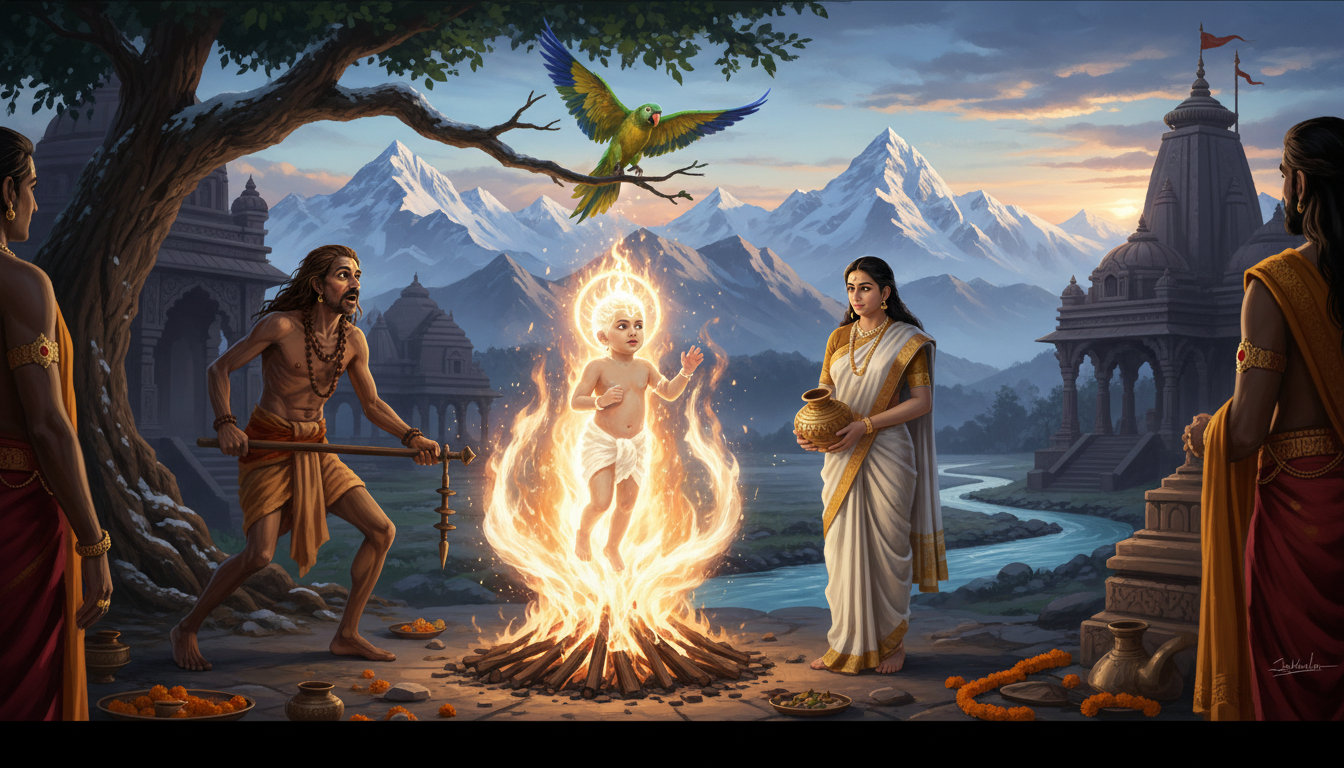
The son of Satyavati came down from his hundred years with a boon in his possession and went back to ordinary work, and one day he was employed in rubbing his sticks together to make a fire.
It is the plainest labour a brahmana does. One stick lies flat and one is turned in it, and a man leans his weight on the turning and watches the little dust in the socket for the moment it begins to smoke.
While he was thus engaged the illustrious rishi looked up and saw, going through the wood, the Apsara Ghritachi, who by her own energy was at that season possessed of great beauty.
He was smitten suddenly with desire. There was no interval in it and no warning; he had spent a hundred years on air on a mountain, and it came upon him at his own fireside in the time it takes to raise the eyes.
She saw it. The Apsara saw the rishi's heart troubled with desire, and being no fool, and having some notion of what an angry ascetic can do to a woman he wants, she transformed herself into a she-parrot and came on toward that spot in the shape of a bird.
It made no difference. Although he beheld the Apsara disguised in another form, the desire that had risen in his heart did not go away with her face; instead it spread itself out over every part of his body. He summoned all his patience. He endeavoured to suppress it. With all his effort Vyasa did not succeed in controlling his agitated mind, and his heart was drawn after Ghritachi's fair form, because what was to happen was inevitable.
So he set himself more earnestly to the task of making the fire, hoping to work the emotion out of himself through his hands, and leaned harder on the turning stick.
And in spite of all his efforts his vital seed came out and fell among the kindling.
"He did not stop," Bhishma said. "That best of regenerate ones continued to rub his stick, feeling no scruple whatever for what had happened. Mark that, Yudhishthira. He did not run away from the place, and he did not sit down and lament, and he did not curse the bird. He kept turning the stick."
The Child Born of Friction
From the seed that had fallen, a son was born to him among the two sticks.
He came out of that kindling the way a blazing fire sheds its effulgence all around when libations of clarified butter are poured upon it: not lit, but already burning, with nobody's flame but his own. He took the excellent form and the complexion that belonged to his sire, and stood there of cleansed soul, shining like a smokeless fire, in the place where a moment before there had been nothing but wood and dust and a man's shame.
And because of the circumstance that attended his birth, because of the bird that had crossed the wood, they called him Suka.
"Thus," Bhishma said, "that great ascetic, that foremost of rishis and highest of Yogins, took his birth out of the two sticks his father kept for making fire. There is no other birth like it that I know of. He had no mother, Yudhishthira. You asked me upon what woman Vyasa begot him, and I have given you the whole answer: upon none. He was struck out of dry wood by friction, as fire is."
The foremost of rivers did not wait to be asked. Ganga came to the breast of Meru in her own embodied form, walking, and took the new child up and bathed him with her waters as any woman washes a newborn, and the mountain let her pass.
Then there fell from the welkin, for the use of the high-souled Suka, an ascetic's staff and a black deerskin, dropping out of the empty sky onto the rock beside him: the two possessions of a man who has already decided what he is going to be with his life, delivered before he had spoken a word.
The Sky Empties Itself of Gifts
After that the mountain lost its composure entirely.
The Gandharvas sang, and sang again, and would not leave off. The diverse tribes of the Apsaras danced on the summit. Celestial kettledrums of loud sound began to beat where there was nobody beating them. The Gandharva Viswavasu eulogised the birth, and Tumvuru eulogised it, and Varada, and those other Gandharvas who are called Haha and Huhu, all of them praising a child not an hour old.
The Regents of the world came with Sakra at their head, and the deities came, and the celestial rishis and the regenerate rishis came. The Wind-god poured showers of celestial flowers down upon the spot until the rock was covered. The entire universe, mobile and immobile, became filled with joy, and nobody on that mountain that day was thinking about the manner of the conception.
Then the high-souled Mahadeva of great effulgence came, accompanied by the Goddess, moved by simple affection, and so soon after the birth that the water of Ganga was hardly dry on the child he invested the muni's son with the sacred thread with his own hands.
Sakra, chief of the gods, gave him out of affection a celestial Kamandalu of excellent form and some celestial robes, so that the boy had now a staff, a deerskin, a water-pot and clothing, and owned nothing else and would never own anything else.
Overhead the birds would not disperse. Swans wheeled there, and Satapatras, and cranes by the thousand, and many parrots, and Chasas, turning above his head in the bright air. Endued with great splendour and great intelligence, Suka, who had obtained his birth from the two sticks, went on living in that place, engaged the while in the attentive observance of many vows and many fasts.
The Boy Who Took a Teacher Anyway
"Now here is the thing about him that I would have you keep," Bhishma said, "because it is the whole of his character in one act.
"As soon as Suka was born the Vedas came to dwell in him. All of them, with all their mysteries and all their abstracts, exactly as they dwell in his sire. He did not learn them. He possessed them from the first breath, the way you possess your own hands.
"And for all that, he went and selected Vrihaspati for his preceptor."
Yudhishthira looked up.
"He chose a teacher," Bhishma said, "who could tell him nothing he did not already contain. He sat down before Vrihaspati, who was conversant with all the Vedas together with their branches and their commentaries, and he asked to be taught, remembering the universal practice. That is what the account says: remembering the universal practice. Knowledge had been given to him free and entire, and he judged that a man does not take such a thing without going through the door that other men go through.
"So he studied all the Vedas with all their mysteries and abstracts, and the histories besides, and the science of government, which is your own study, son of Pandu. And when he had finished he gave his preceptor the tuition fee, every part of it, as though he had been an ordinary pupil who had received an ordinary favour, and then he went home.
"After that he adopted the vow of a Brahmacharin and commenced to practise the austerest penances, concentrating all his attention upon them. And while he was still in his childhood, while he was still a boy, he had become an object of respect to the gods and to the rishis for his knowledge and his penances. That is the answer to the second half of your question. You asked where a child gets such a leaning. He did not get it. He arrived with it, and then he went to school anyway."
What the Father Had Actually Asked For
"And then?" Yudhishthira said.
"And then the mind of that great ascetic took no pleasure in the three modes of life," Bhishma said, "the domestic among them. He looked at the householder's life, which is the one his father had gone to a mountain for a hundred years in order to fill, and it held nothing for him. He kept in view the religion of Emancipation, and nothing else, from a boy."
The king was quiet for a while. Behind him someone shifted in the grass.
"Then Vyasa asked for a son who would be as pure as fire and wind and earth and water and space," Yudhishthira said slowly, "and he was given exactly that, and exactly that is a son who cannot be kept."
"The god did not cheat him," Bhishma said. "Every word of the boon was honoured. A man asks for the five elements in a child and then is surprised when the child behaves like the elements, which belong to nobody and stay nowhere. What Vyasa wanted was an heir. What he specified was a Yogin. He got what he specified."
"And the manner of it," said Yudhishthira. "A hundred years of penance on air, and then a bird crossing a wood."
"That is the part I would not have you pass over," the old man said. "He asked with the whole of his strength, and the answer came to him through an accident he was ashamed of, in the middle of a common chore, without dignity of any kind. It was not less of a gift for that. The stick was still turning in his hands when the gift arrived. Do not despise the road a thing comes by, son of Pandu. You will be given a good deal in your reign, and very little of it will arrive in the shape you were expecting."
"And afterwards?" Yudhishthira asked. "What became of the boy?"
"Afterwards he went away from his father," Bhishma said, "and his father ran after him through the world calling his name, and it was the trees that answered. But that is a longer telling, and the sun is high, and you have a kingdom waiting on you that will not govern itself while we sit here admiring a man who renounced one."
Dharma Lesson
A gift asked for with the whole of one's strength may still arrive by an accident one is ashamed of, and be no less a gift. Vyasa was granted exactly the son he specified, pure as fire and wind and space, and then found that such a son belongs to nobody and stays nowhere. Do not despise the road a thing comes by, and do not expect the answer in the shape you asked it.