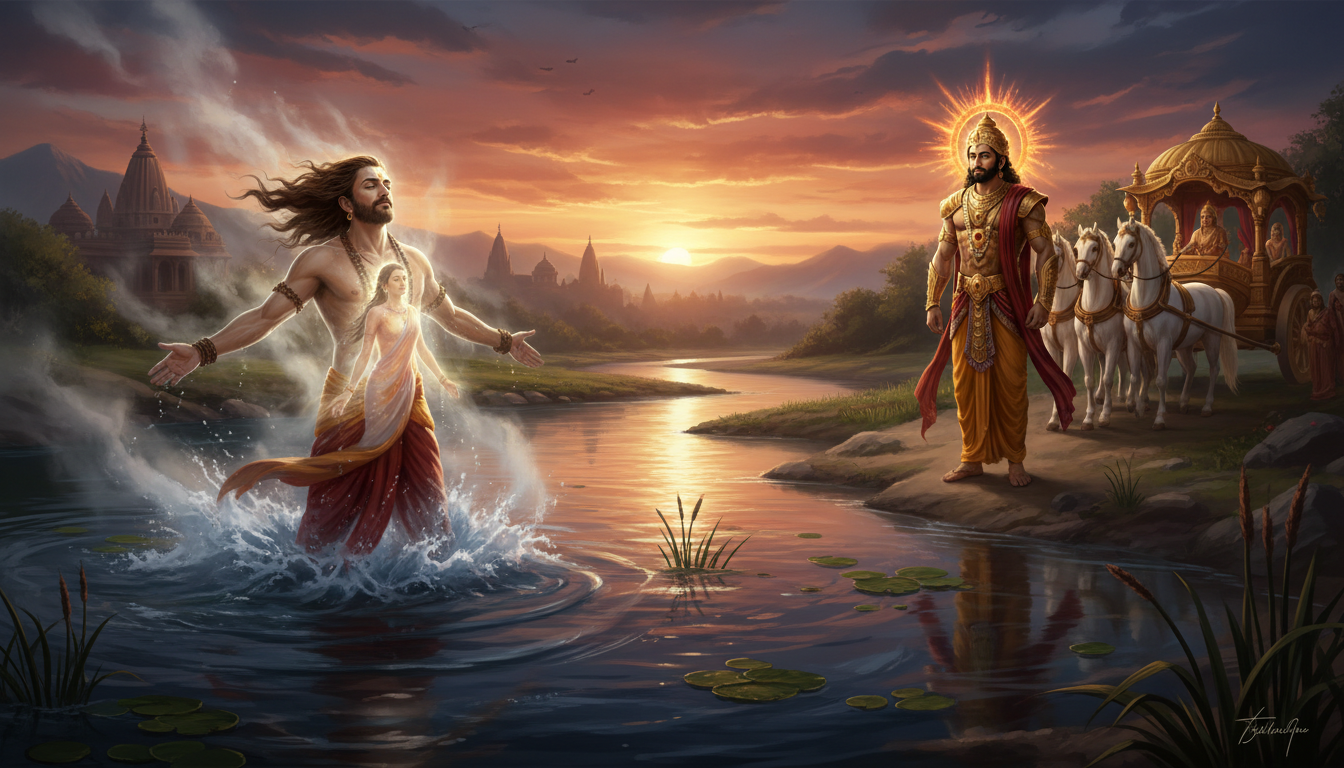
The Yajus Taken From the Sun
A goddess entering a man's mouth, and the fee split in two
The Question About the Unmanifest
Bhishma lay on the bed of arrows with his head hung back over the shafts, and Yudhishthira sat on the ground by his shoulder and asked him what it was that resided in the Unmanifest, and whether a living man could come to know it.
"You are not the first king to ask that," the grandsire said. "A ruler of Mithila named Daivarati asked it in almost your words, and he asked it of Yajnavalkya, and the answer came down to me through Janaka. Hear it as it was given in that hall."
The king of Mithila had asked and then sat still, in the way of men who have waited a long time to ask something. Yajnavalkya did not answer at once.
"You have asked me, O monarch," he said, "of that Supreme Brahma which resides in the Unmanifest. Your question relates to a deep mystery. Listen to me with close attention."
Then he did what the king had not expected. Instead of beginning with Brahma he began with himself.
"Before I tell you what I know, you should know how it came to me, because it did not come the way you imagine. You think of a boy sitting at a preceptor's feet and repeating what he hears until it sticks. That is how most of it is got, and it is a good way. But the Yajushes I did not get so. I got them out of the sky, from Surya, and it cost me more than a boy's years of repetition. Conducting myself with humility, according to the ordinances laid down by the Rishis, I obtained the Yajushes from the heat-giving deity himself."
"Then tell me that first," said Daivarati.
"I intend to," said the sage.
Adoring the Heat-Giving Deity
"In my youth," said Yajnavalkya, "there was a gap in me, and I knew exactly where it was. I had the hymns and I had the chants, but the Yajushes I had not, and a man who lacks the Yajushes cannot conduct a sacrifice from beginning to end without borrowing another man's mouth for the middle of it. I could have gone and asked for them. I did not. I went instead to the one who has never yet had to ask anybody for anything.
"Without the austerest of penances I formerly adored the heat-giving deity. Understand what I am saying. I did not torment my body. I stood before him at his rising and at his setting and I praised him, and I did that for so long that the praise stopped being an act I performed and became simply what I was. It is very difficult to incline Surya to grace. He looks at everyone every day. Nothing is hidden from him, and nothing much impresses him.
"Then one morning the light did not pass over me. It stopped.
"The puissant Surya, gratified with me, said, 'Solicit, O regenerate Rishi, the boon upon which you have set your heart, however difficult it may be of acquisition. I shall grant it to you with a cheerful soul. Know that it is very difficult to incline me to grace.'
"He said the last part twice over, once as a statement and once as a warning, so that I should not waste on some small comfort a thing that had taken me half my life to obtain. I bowed to him with a bend of my head. I did not have to think about what to ask for. I had been carrying the question so long that it came out of me the moment there was somebody to hear it."
Open Thy Mouth
"'I have no knowledge of the Yajushes,' I told him. 'I desire to know them, and without loss of time.'
"There was no bargaining. He did not ask me why, or what I meant to do with them, or whether I was fit. The holy one, thus solicited, told me, 'I shall impart the Yajushes to you. Made up of the essence of speech, the goddess Saraswati will enter into your body.'
"Consider what that sentence contains. I had asked for a text. He did not offer me a text. He offered me the goddess who is the substance out of which all texts are cut, and he proposed to put her not into my memory but into my body, as one puts fire into a vessel that was made for water.
"Then the deity commanded me to open my mouth.
"I want you to see me standing there, O king, an ascetic of no great age, on a bank at the hour when the light comes level along the ground, with the lord of all luminaries waiting in front of me for me to do a thing that any child does a hundred times a day without thinking. I did as I was commanded. I opened my mouth.
"The goddess Saraswati then entered into my body.
"I have taught for a great many years and I have never found the words for what followed, so I use the plainest ones I have. At this, I began to burn."
The Man Who Grew Angry With His Benefactor
"It was not the burning of fever and it was not the burning of fire on the skin. It was inside, everywhere at once, as though every word I had ever spoken and every word I had never learned were being pressed into a body sized for neither.
"Unable to endure the pain I plunged into a stream. I ran to it. The rishi you are looking at, the one whose composure your court remarks upon, went down the bank and into the water like a man whose clothes are alight, and the water did nothing at all.
"And there, standing in the river with the goddess of speech burning in me, I did the thing I am least proud of in my whole life. Not understanding that what the high-souled Surya had done for me was for my good, I became angry with him. I had asked. He had given. And because the gift hurt, I stood in the water and blamed the giver, which is what men always do and what I had thought myself past doing.
"He did not withdraw the gift. He did not rebuke me either. While I was burning with the energy of the goddess, the holy Surya said only this: 'Endure this burning sensation for a little while. That will soon cease, and you will be cool.'
"That was all. No explanation, no reproach for my anger. Only the assurance that it had an end, which was the one thing I needed and the one thing I could not have found out for myself.
"And indeed I became cool. The heat went out of me the way weather goes, and I was standing in a river up to my chest with a thing in me that had not been there in the morning."
What the Maker of Light Promised at Parting
"Seeing me restored to ease, the Maker of light said to me, 'The whole Vedas, with even those parts that are regarded as their appendix, together with the Upanishads, will appear in you by inward light, O regenerate one. The entire Satapathas also you will edit. After that, your understanding will turn to the path of Emancipation. You will also attain to that end which is desirable and which is coveted by both Sankhyas and Yogins.'
"Mark the order of those four promises, O king, because I did not mark it at the time and I have thought about it ever since. First the Vedas by inward light, which is knowledge received. Second the editing of the Satapathas, which is labour, years of it, the work of a man's hands and mornings. Third the turning of the understanding toward Emancipation, which is neither knowledge nor labour but a change in what a man wants. And only fourth the end that Sankhyas and Yogins both covet and neither can hand to the other.
"He did not promise me that the first would produce the fourth. He promised me all four in sequence, and left me to find out that each of them has to be walked.
"Having said these words to me, the divine Surya proceeded to the Asta hills. He had a day to finish. I stood on the bank and watched the light go down off the water and off the far trees, and when he had gone from the spot where I was I came home in joy.
"And walking home I remembered the goddess."
The Goddess Adorned With All the Vowels
"Thought of by me, the auspicious Saraswati appeared instantly before my eyes. She was adorned with all the vowels and the consonants, and she had placed the syllable Om in the van, walking before her as a king's word walks before the king.
"I did the ordinary thing, which was the only right thing. I did not fall down and weep. According to the ordinance I offered the goddess the usual Arghya, water and what goes with water, the same welcome a householder gives a guest at his door, and I dedicated another to Surya, that foremost of all heat-giving deities, because a man who thanks the messenger and forgets the sender has learned nothing. Then I took my seat, devoted to both those deities, and waited.
"And the whole of it came.
"The entire Satapatha Brahmanas, with all their mysteries and with all their abstracts, and their appendices after them, appeared of themselves before my mental vision. Not a line at a time as a pupil gets it. All of it, standing there complete, the way a landscape stands complete when the mist goes off it, and I saw at once both that it was very large and that I now held every part of it.
"I became filled with great joy, O king. I will not pretend otherwise. I sat in an empty hut with the entire Yajus in me and no one to tell."
A Hundred Disciples and an Angry Uncle
"I did not keep it. I taught it to a hundred good disciples, and by doing so I did what was disagreeable to my high-souled maternal uncle.
"You know his name. Vaisampayana, with his own disciples gathered round him, holding the Yajus as it had always been held, in a line, from mouth to ear. And here was his sister's son, who had gone round the whole of that line to the sky, coming back with a Yajus of fifty branches that no one had given him, and teaching it to a hundred men at once. I say plainly that this displeased him, and I say plainly that I did it anyway.
"Then, shining in the midst of my disciples like the Sun himself with his rays, I took the management of the sacrifice of your high-souled sire, O king, in this country.
"And in that sacrifice a dispute arose between my maternal uncle and me as to who should be permitted to appropriate the Dakshina that was paid for the recitation of the Vedas. Look at the smallness of it. Two men who between them held everything that is worth holding, standing in a sacrificial enclosure and arguing over a fee.
"In the very presence of Devala I took half of that Dakshina, and the other half went to my uncle. Your sire agreed to it. Sumantra agreed, and Paila, and Jaimini, and the others assembled there. Nobody had to be persuaded. I think they were all relieved that a thing which could have split the Vedas in two was settled by the oldest arithmetic there is.
"So I had from Surya the five times ten Yajushes. Afterwards I studied the Puranas with Romaharshan, and then, keeping the original mantras before me and the goddess with them, aided by the inspiration of Surya, I set myself to compile the Satapatha Brahmanas, and succeeded in a task never before undertaken by anyone."
Four and Twenty Questions From a Gandharva
"Having established for the use of others this knowledge of fifty branches, I turned to meditating on the one object of it. And it was then that the Gandharva Viswavasu came to me.
"He was no idler. He was well versed in the Vedanta scriptures and he wanted to know what in this knowledge is beneficial for Brahmanas, what truth occurs in it, and what its excellent object is. He put to me four and twenty questions relating to the Vedas, and then a twenty-fifth that stood apart from the others and concerned the branch of knowledge that proceeds by inference and reasoning.
"Here are some of them. What is universe and what is not-universe? What is Aswa and what Aswa? What is Mitra? What is Varuna? What is Knowledge and what is the Object of knowledge? What is Unintelligent and what Intelligent? Who is Kah? Who possesses the principle of change and who does not? What is it that devours the Sun, and what is the Sun? What is Vidya and what Avidya? What is Immobile and what Mobile? What is without beginning, what indestructible, and what destructible?
"I did not answer at once. I said, 'Wait for a brief space of time, till I reflect on your questions.' He said, 'So be it,' and sat in silence, which is a rarer courtesy than you would think in a questioner who has prepared twenty-five.
"I then thought once again of the goddess Saraswati in my mind. And the replies to those questions arose in me naturally, like butter from curds. That is exactly the image, O king. Nothing was added. The answers were already dissolved in what I had been given years before on a riverbank, and the thinking only gathered them."
The Fish Is Not the Water
"I gave him the answers as they came. The Universe is unmanifest and original Prakriti, endued with the principles of birth and death, possessed of the three attributes, because everything she produces carries them. That which is not-universe is Purusha, divested of all attributes. By Aswa and Aswa are meant the female and the male: the first is Prakriti, the second Purusha. Mitra is Purusha and Varuna is Prakriti. Knowledge is Prakriti; the object to be known is Purusha. Kah is Purusha. That which changes is Prakriti; that which does not is Purusha. What is mobile is Prakriti, which by undergoing modification becomes the cause of creation and destruction; what is immobile is Purusha, who assists at creation and destruction without himself being modified. The attributes that reside in Prakriti are destructible, but not Prakriti herself.
"Then Viswavasu said the honest thing. 'You have said that the Jiva-soul is indestructible and truly undistinguished from the Supreme Soul. This, however, is difficult to understand. Discourse on it once more. I have heard Jaigishavya and Devala and Parasara and Bhrigu and Panchasikha and Kapila and Suka and Gautama and Narada and my own sire Kasyapa on this subject, and Rudra after them, and I have acquired all that they say. I wish to hear what you say.'
"So I gave him the fish. Prakriti, which is unintelligent, is apprehended by Jiva; Jiva cannot be apprehended by Prakriti. The fish lives in water and goes where its own nature drives it. Though it lives in the water it is to be regarded as separate from the water. So is the twenty-fifth to be apprehended, existing in contact with the twenty-fourth and in its real nature independent of her. When a man is overwhelmed with the consciousness of self and cannot understand his identity with the twenty-sixth, the Jiva-soul always sinks down; when freed from that consciousness, it goes upward.
"He was satisfied. 'You have said what is true and excellent,' he told me. 'May inexhaustible blessings always attend you, and may your mind be ever united with intelligence.' Then the prince of Gandharvas took the accustomed turns round my person and went toward heaven, shining, and afterwards taught what he had from me to the dwellers in the regions of Brahman, and to those on Earth, and to the denizens of the nether regions."
What the King of Mithila Did With It
"Emancipation flows from Knowledge, O king, and without Knowledge it can never be attained. So one should strive for it in all its details. And take it wherever it is found. Obtaining knowledge from a Brahmana or a Kshatriya or a Vaisya, or from a Sudra of low birth, a man endued with faith should always show reverence for that knowledge. Birth and death cannot assail one who is endued with faith. All orders of men are Brahmanas. All are sprung from Brahma. All men utter Brahma.
"Your questions were good ones. Cast off all grief. Go to the other end of this enquiry. Blessings on your head for ever."
"Thus instructed by the intelligent Yajnavalkya," said Bhishma, "the king of Mithila became filled with joy. He honoured that foremost of ascetics by walking round his person, and dismissed him, and Yajnavalkya departed from his court.
"Then Daivarati sat down and did the arithmetic of a man who has decided. He touched and gave away to Brahmanas a million kine, and a quantity of gold, and a measure of gems and jewels. He installed his son in the sovereignty of the Videhas. And the old king began to live adopting the practices of the Yatis, casting off ordinary duties and their derelictions, virtue and vice, truth and falsehood, birth and death, and everything else appertaining to the principles produced by Prakriti, regarding himself as Infinite and reflecting only on the Eternal and Independent One.
"I had all this from Janaka, and Janaka had it from Yajnavalkya. Knowledge is very superior, O Yudhishthira. Sacrifices cannot compare with it. Men attain to heaven through sacrifices and penances and vows and observances, and they have again to fall down from there upon the Earth. With the aid of Knowledge a man crosses the world's ocean, which is full of difficulties and dangers, and no sacrifice will ever carry him over it."
Dharma Lesson
Knowledge that comes directly, without a preceptor's line to carry it, still has to be paid for, and the price is pain at the moment of receiving and resentment among those it passes over. Yajnavalkya blames the giver while the gift is still burning in him, and quarrels with his own uncle over a fee. The teaching he ends with is that knowledge should be taken from anyone who has it, of any birth, which is exactly the rule that made his own life difficult.