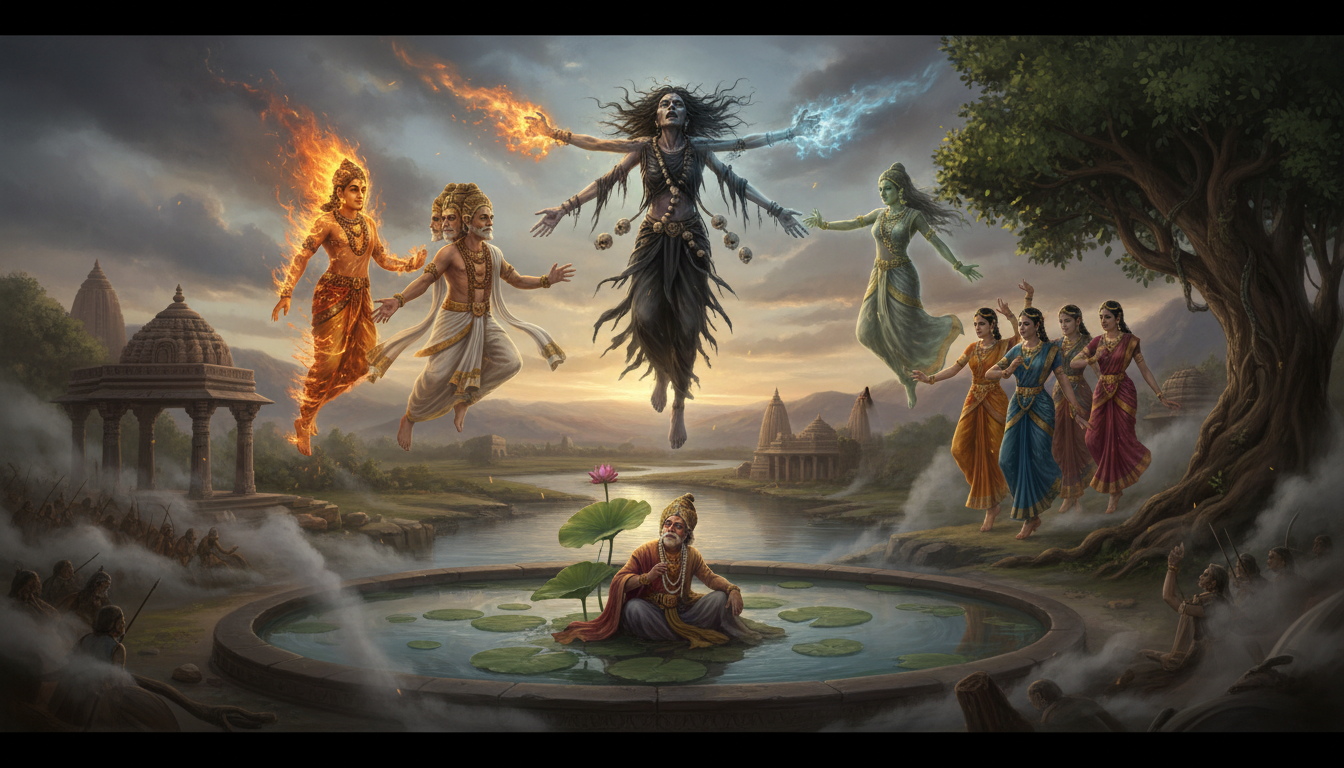
The Four Shares of a Sin
Who agreed to carry a quarter of Indra's guilt, and what it cost them
The Symptoms of a Fever
"You have told me how the fever went into him," Yudhishthira said. "Tell me what it did."
He had asked for the story of Vritra three days running, and the old man had noticed which part of it the king kept circling back to. It was not the battle. Yudhishthira had been at a battle. It was the killing of a brahmana, and what becomes of the man who does it, and whether anything in the whole apparatus of sacrifice and gift and penance can be made to take such a thing off a person; and Bhishma knew perfectly well that somewhere behind the question stood a chariot on the seventeenth day, and an old teacher sitting down in it to die, and a true sentence spoken in a voice pitched to be misheard.
Bhishma lay on his arrows with his head tilted back on the three shafts, and did not open his eyes to answer. "Listen then, king, to the symptoms that appeared on the body of Vritra when he was overtaken by that fever, which was born of the energy of Mahadeva.
"The heroic Asura's mouth began to emit flames of fire. He became exceedingly pale, he who had been the colour of a storm. His body trembled all over and could not be made to stop. His breath came hard and thick. The hairs of his body stood on end. And then his memory issued out of his mouth, Bharata, in the form of a jackal, fierce and dreadful and inauspicious, and went away from him across the field, and he did not know afterwards what he had known before.
"Burning and blazing meteors fell on his right hand and on his left. Vultures gathered, and kanakas, and cranes, and they wheeled over Vritra's head uttering fierce cries, as birds do over a thing that is finished but has not yet been told so.
"And in that encounter Indra, adored by the gods and armed with the thunderbolt, looked hard at the Daitya as the latter sat there on his car. He did not strike. He watched, the way a man watches a wall he has undermined, waiting for the crack to run.
"Then the mighty Asura, possessed by that violent fever, yawned. He yawned, monarch, and uttered cries that were not the cries of anything human."
"And Indra struck while his mouth was open," Yudhishthira said.
"While his mouth was open," said Bhishma.
The Bolt Pervaded by Vishnu
The thunderbolt that Sakra hurled was not merely his own. Vishnu had entered it and lay along its length, and it went out from the god's hand endued with exceedingly great energy, resembling the fire that destroys the creation at the end of the Yuga.
It overthrew Vritra of gigantic form in a trice. There was no second blow. The Asura who had swallowed the waters and shut up the rivers and stood over the three worlds like weather went down in the time it takes a stone to fall, and the field was suddenly very quiet.
Then loud shouts were uttered by the gods on all sides, once more, as they had shouted at the beginning of the war and had not shouted since. Having slain Vritra, Maghavat, that foe of the Danavas, possessed of great fame, went up into heaven with the thunderbolt still in his hand.
"He had won," Bhishma said. "Understand that clearly, son of Kunti, because everything that follows depends on it. He had not lost. The gods were cheering him. The enemy of the worlds was dead on the ground, and every deity in the sky agreed that the deed was necessary and rightly done, and there was no one anywhere to accuse him of anything.
"And just then, out of the body of the slain Vritra, something stood up."
What Stood Up Out of the Corpse
The sin of Brahmanicide came out of the dead demon in her embodied form, fierce and awful and inspiring all the worlds with dread.
She had terrible teeth. She was hideous for ugliness, and her colour was dark and tawny together; her hair hung dishevelled about her, and her eyes were dreadful to look into. Round her neck she wore a garland of skulls. She was covered all over with blood, and clad in rags and in the barks of trees, and she looked, Bharata, exactly like an Atharvan incantation that had been given a body and told to walk.
Of such form and such mien she came out of Vritra's body, and she looked about the field for the wielder of the thunderbolt, because a sin does not attach itself to the thing that was killed. It attaches to the hand.
A little while afterward the slayer of Vritra was proceeding toward heaven upon some errand connected with the good of the three worlds. That is the detail I want you to hold, Yudhishthira: he was on an errand for the benefit of everyone alive when she found him. She beheld Indra of great energy going by upon his business, and she seized the chief of the deities, and from that moment she stuck to him.
He could not shake her off. He was the king of the gods, and he had killed the enemy of the gods with the approval of the gods, and he walked into his own heaven with a hag of skulls fastened to his back, and the shouting stopped.
The Fibre of a Lotus Stalk
When the sin of Brahmanicide had thus stuck to his person and filled him with terror, Indra did what the king of the gods would not have believed himself capable of. He ran, and then he hid.
He entered the fibres of a lotus stalk and dwelt there, small as a thread inside a green tube in the water, and he stayed there many long years while heaven went on without its king.
It did him no good. The sin of Brahmanicide pursued him closely into the water and into the stalk and into the fibre. Seized by her, the chief of the deities became deprived of all his energies; the puissance went out of him as heat goes out of a room. He made great efforts to drive her from him, one after another, and every one of those efforts proved abortive.
"Consider what he tried," Bhishma said. "He is Sakra. He had the thunderbolt. He could not strike her, for what would he strike? He could not out-run her, for she was on him. He could not out-wait her; he had already spent years being a thread in a plant. There is nothing in the armoury of the king of heaven that answers a thing like that."
So at the last, seized by her still, he came out of the water and presented himself before the Grandsire, and bent his head low, and worshipped him, saying nothing about it at all.
Brahman understood without being told that Sakra was possessed by the sin of Brahmanicide. And the Grandsire began to reflect upon the means of freeing his suppliant.
The Grandsire Does Not Destroy Her
He could have unmade her. That was the first thing Yudhishthira thought of, and he said so.
"He could," Bhishma agreed. "He is the Self-create. He made the ordinance under which she exists. And he did not do it, and he never explains why, and I have thought about that for a great many years."
What the Grandsire did instead was to speak to her in a sweet voice, as one speaks to a person one intends to bargain with, from the desire of pacifying her.
"O amiable one," said Brahman, "let the chief of the celestials, who is a favourite of mine, be freed from you. Tell me what I shall do for you. What wish of yours shall I accomplish?"
And Brahmanicide answered him with perfect courtesy, and every word of her answer was a knife.
"When the Creator of the three worlds, the illustrious god adored by the universe, has been pleased with me," she said, "I regard my wishes as already accomplished. Let my residence be now appointed. It was from a desire of preserving the worlds that this rule was made by you. It was you, O lord, who introduced this important ordinance. As you have been gratified with me, O righteous Lord, O puissant Master of all the worlds, I shall certainly leave Sakra. But grant me an abode to dwell in."
"She did not ask to be spared," Bhishma said. "She asked for an address. She reminded the Creator that she was his own law walking about, made for the preservation of the worlds, and that a law cannot simply be told to stop existing because its operation has become inconvenient to the king of heaven.
"And the Grandsire replied unto Brahmanicide, saying: So be it."
The First Quarter: Fire
The Self-create recollected the high-souled Agni, and Agni immediately presented himself, because that is what happens when the Grandsire remembers you.
"O illustrious and divine Lord, O you that are without any defect," said the eater of oblations, "I have appeared before you. It behoves you to say what I shall have to accomplish."
"I shall divide this sin of Brahmanicide into several portions," said Brahman. "For the freeing of Sakra, do you take a fourth portion of that sin."
Agni did not refuse. He also did not agree. What he said was the question that every one of the four asked in turn, and it is the most practical question in the whole of this story.
"How shall I be rescued from her, O Brahman? O puissant Lord, do you appoint the way. I desire to know the means of my own rescue, and I desire to know it in detail, O adored of all the worlds."
"Hear it, then," said Brahman. "There is a man who, overwhelmed by the quality of Tamas, will look upon you in your blazing form and will not offer you seeds and herbs and juices as an oblation. Into that man the portion of Brahmanicide that you take upon yourself shall immediately enter. It shall leave you, and it shall dwell in him. O carrier of oblations, let the fever of your heart be dispelled."
Thus addressed by the Grandsire, the eater of oblations and sacrificial offerings accepted his command, and a fourth part of that sin then entered his person, O king, and he stood there carrying it, and burning as he had always burnt.
"Hear what he was actually given," Bhishma said. "He was not given a cure. He was given a debtor. Somewhere in the world there is a man who will sit before a fire in its blazing form and grudge it the handful of seed and herb and juice that is its due, and on the day he does it, a quarter of the death of a brahmana will get up out of Agni and go and live in that man, and Agni will be clean again, and the man will never know what has moved into him or that he has performed the office of a drain."
The Second Quarter: The Trees
Then the Grandsire summoned the trees, and the herbs, and all the kinds of grass, and asked them to take upon themselves a fourth of that sin.
They became as much agitated as Agni had been, and they answered him together, and theirs is the only reply in the story with any bitterness in it.
"How shall we, O Grandsire of all the worlds, be ourselves rescued from this sin? It behoves you not to afflict us who have already been afflicted by the fates. O god, we have always to endure heat, and cold, and the showers of the clouds driven upon us by the winds; and in addition to all that we endure the cutting and the tearing that we suffer at the hands of men. We are willing, O Lord of the three worlds, to take a portion of this sin of Brahmanicide at your command. Let the means, however, of our rescue be pointed out to us."
"They said yes first," Yudhishthira observed. "They complained, and then they said yes."
"They are trees," said Bhishma. "They have been saying yes to everything since the beginning, and being cut for it."
"This sin that you shall take," said Brahman, "shall possess the man who, through stupefaction of judgment, cuts or tears any of you when the Parva days come."
Thus addressed by the high-souled Brahman, the trees and the herbs and the grasses adored the Creator, and then went away without tarrying there, carrying their quarter with them into every wood in the world; and from that day the axe laid to a tree on a sacred day has been a different act from the axe laid to it on any other.
The Third Quarter: The Apsaras
The Grandsire of all the worlds then summoned the Apsaras, and he gratified them first with sweet words before he asked them for anything, which he had not troubled to do with the trees.
"This foremost of ladies, Brahmanicide, has come out of Indra's person," he said. "Solicited by me, do you take a fourth portion of her into your own persons, for the saving of the Chief of the deities."
"O Lord of all the gods, at your command we are fully willing to take a portion of this sin," said the Apsaras. "But, O Grandsire, do you think of the means by which we ourselves may be freed from the effects of this understanding that we make with you."
"Let the fever of your hearts be dispelled," said Brahman. "The portion of this sin that you take upon yourselves shall leave you instantly, and shall possess that man who seeks the company of women in their season of uncleanness."
Thus addressed by the Grandsire, the diverse tribes of the Apsaras went back with cheerful souls to their several places, and began again to sport in delight, and were no more troubled about it than a merchant is troubled by a contract he has read and understood.
"They bargained like the others," Bhishma said. "Note the shape of it, Yudhishthira, for it is the same shape four times. Nobody accepts the sin. Each of them accepts a rule. The Grandsire is not asking these beings to bear the guilt; he is asking them to hold it, and every one of them requires him to name the door by which it will leave them, and every door he names is a human act."
The Fourth Quarter: The Waters
The illustrious Creator of the three worlds, endued with great ascetic merit, then recollected the Waters, and the Waters immediately came to him. They bowed before Brahman of immeasurable energy and said, "We have come before you, O chastiser of foes, at your command. O puissant Master of all the worlds, tell us what we are to accomplish."
"This dreadful sin has taken possession of Indra in consequence of his having slain Vritra," said Brahman. "Take you a fourth part of Brahmanicide."
"Let it be as you command, O master of all the worlds," said the Waters. "It behoves you, however, O puissant Lord of ours, to think of the means by which we may in our turn be rescued from the consequence of this understanding. You are the Lord of all the deities and the supreme refuge of the universe. Who else is there to whom we may pay our adorations, that he may relieve us from distress?"
"There is a man," said Brahman, "who, stupefied in his understanding and regarding you lightly, will cast into you phlegm and urine and excrement. Into that man this portion shall immediately go, and thenceforth it shall reside in him. It is in this way, verily I say to you, that your rescue shall be accomplished."
And so the account was closed. Fire held a quarter, and the trees and herbs held a quarter, and the Apsaras held a quarter, and the Waters held the last, and every quarter had a door standing open in it, and behind each door a man going about his ordinary carelessness.
Then the sin of Brahmanicide left the chief of the deities and proceeded to the abodes that had been ordained for her at the Grandsire's command, and Indra stood up straight for the first time in many years.
The Cocks Born From the Blood
With the Grandsire's permission Indra then resolved to perform a Horse-sacrifice, and it is heard, monarch, that he who had been possessed by the sin of Brahmanicide was afterward cleansed of her through that sacrifice. He regained his prosperity. He slew his thousands of foes again as he had done before, and great was the joy that Vasava obtained.
"And out of the blood of Vritra, son of Pritha, there were born high-crested cocks," Bhishma said. "For that reason those fowls are unclean as food for the regenerate classes and for ascetics who have undergone the rite of initiation. Everything in that story left something behind it. Nothing in it was simply cancelled."
Yudhishthira sat still on the trampled ground. Somewhere behind him a horse shifted its feet.
"Then the sin was never destroyed," he said. "It was housed."
"It was housed," said Bhishma. "Four quarters, four keepers, and four rules by which it comes out again. The Creator did not abolish his own ordinance for the sake of the king of heaven; he only found it lodgings, and he made the lodgings temporary, and he wrote into each lease the name of the act by which some man not yet born would take the burden off the fire and the tree and the dancer and the river and carry it away in his own body. That is what a sacrifice does and what it does not do. It moves what is on you. It does not unmake it."
"Then a man in my position," Yudhishthira said, "should be told plainly what he is carrying."
"You are being told," the old man said. "And you also, son of Kunti, unvanquished on earth, will become another Indra, and the slayer of all your foes, and you will find the office heavier than the war was. Those men who on every Parva day recite this narrative of Vritra in the midst of Brahmanas are never stained by any sin. I have given you one of the greatest and most wonderful of the feats of Indra. What else do you wish to hear?"
Dharma Lesson
Guilt is not erased by ritual; it is redistributed, and the price of another's absolution is a rule that binds you. The Creator would not unmake his own ordinance even to free the king of heaven, and every quarter of the sin was lodged with a door standing open in it. What a sacrifice does is move what lies on a man. It does not unmake it.