The Household They Built Around a Blind Man
"After they had got their kingdom," said Janamejaya, "how did my grandsires behave towards Dhritarashtra? He had lost every counsellor and every son. He had no refuge left and his wealth was gone. How did that king conduct himself, and how did the famous Gandhari conduct herself? For how many years did my grandsires rule?"
"They ruled the earth with Dhritarashtra placed at their head," said Vaishampayana. "For ten and five years they did everything under the advice of the old king."
It was not a form of words. Vidura waited on him, and Sanjaya, and Yuyutsu, the son Dhritarashtra had by his Vaisya wife, the one who had walked over to the Pandava side on the first morning of the war and lived. Kripa, Drona's brother-in-law, that great bowman, attended on him too. Vyasa came often and sat with him and recited the histories of the old rishis and the celestial ascetics and the fathers and the Rakshasas, which is what one recites to a man who cannot sleep.
The Pandavas took the old king's opinion in every matter. They came to him constantly, worshipped his feet, and sat down beside him, and he smelled their heads in affection, and they did what he told them. Vidura, under his orders, superintended every act of religious merit and everything to do with the administration of the law, and managed it so shrewdly that a small outlay bought the new government a great deal of willing service from its feudatories.
Kunti, the daughter of Kuntibhoja, obeyed Gandhari in everything and behaved towards her as towards a senior. Draupadi and Subhadra and all the women of the Pandava house treated the old king and the blind queen as their own father-in-law and mother-in-law.
There was one exception, and Vaishampayana named it at once, before he named anything else that happened in those fifteen years.
The exception was Bhimasena. Everything that had followed from that game of dice, which the old king's wicked understanding had brought about, had never once left his heart.
Everything He Had Before
Yudhishthira's method was to give the old man back the exact texture of his old life and hope he would not notice which parts of it were missing.
Costly beds, costly robes, ornaments, food and drink, every enjoyable article in profusion and of the kind fit for royal use, went to Dhritarashtra from the king. The cooks stayed: the aralikas, the juice-makers, the men who made the Ragakhandavas, all of them waiting on him exactly as they had done before. Maireya wines were brought, and fish of several kinds, and sherbets and honey, and the elaborate compounded dishes he had liked in his days of prosperity. Pandu's son collected costly garlands and offered them to him himself. Kings arriving from other countries were sent first to the old monarch and waited on him as they always had.
And the women of the victorious house attended on Gandhari, the daughter of Suvala, like maids of all work. Kunti did it. Draupadi did it, and Subhadra of the Sattwata line, and Ulupi the snake chief's daughter, and queen Chitrangada, and the sister of Dhrishtaketu, and the daughter of Jarasandha, and many others.
Dhritarashtra was allowed to keep the powers a king keeps. He liberated prisoners. He pardoned men who had been condemned to death. Yudhishthira the just never once said anything about it. When the son of Amvika went out on a pleasure excursion, Yudhishthira saw to it that every article of enjoyment went with him.
Gandhari, for her part, performed the shraddha rites over and over and gave the Brahmanas gifts of every enjoyable kind, and by that means she got free of the debt she owed to a hundred slain children.
And Dhritarashtra, watching these young men behave towards him as pupils behave towards a preceptor, took up in return the affection a preceptor has for his pupils. He was gratified. He could not find any ill-will in Yudhishthira anywhere, and he looked.
The Order Yudhishthira Gave His Brothers
The king put it to his brothers and his councillors in a form nobody could mistake.
"King Dhritarashtra is to be honoured, by me and by all of you," he said. "He is a well-wisher of mine who is obedient to Dhritarashtra's commands. He who behaves otherwise towards him is my enemy, and such a man should certainly be punished by me."
So it became an offence in the Kuru kingdom to remember out loud. Whatever wrongs the sons of Dhritarashtra had done him, Yudhishthira forgot them and reverenced his uncle, and if any man did a thing that was not agreeable to the son of Amvika, that man became an object of hatred to the son of Kunti. Through fear of Yudhishthira, nobody in Hastinapura could speak of the evil deeds of Duryodhana or of Dhritarashtra. The dice, the dragging of Draupadi into the hall, the house of lac, the thirteen years: all of it went out of public speech, not because it was forgiven but because it was forbidden.
The old king rose every day at early dawn, purified himself, went through his recitations, and blessed the Pandavas by wishing them victory in battle. He made the usual gifts to Brahmanas and had them utter benedictions, and poured libations on the sacred fire, and prayed for long life for the sons of Pandu. He had never got from his own hundred sons the happiness he got from these five, and he said so.
Gandhari cast off her sorrow for her children and began to show the Pandavas the affection she would have shown her own. Vidura was pleased. Gandhari was pleased. They were both pleased, above everything, with the capacity for bearing wrongs that Ajatasatru had shown.
They were not pleased with Bhima.
Reverence With an Unwilling Heart
The people who lived in the Kuru kingdom could not see any crack in the cordiality between king Yudhishthira and the father of Duryodhana. There was nothing to see. The old king came out on the terrace and was bowed to. The young king came in the evening and touched his feet. The court functioned.
Underneath, two men were failing at the same thing from opposite directions. When Dhritarashtra remembered his wicked son, he could not help feeling unfriendly in his heart towards Bhima, the man who had killed him. And Bhima, impelled by a heart that had gone bad in him, could not put up with Dhritarashtra at all. He became cheerless at the sight of him. Seeing Dharma's son reverence the old king, he reverenced him too, outwardly, with a very unwilling heart, which is a thing that can be kept up for a week and is ruinous over fifteen years.
So he found other ways.
Vrikodara did many things in secret that were disagreeable to the old man. He used servants who could be relied on to be dishonest, and through them he caused his uncle's commands to be disobeyed: an order given in the morning that was somehow not carried out by evening, a request that reached nobody, a gift that did not arrive, a name struck off a list. Nothing that could be pointed at. Nothing that a blind man could prove to a court that had been instructed to treat any complaint against him as sedition.
Dhritarashtra could not see who was doing it. He could feel, day after day, that he was being made a fool of inside his own house, and he had nowhere to take that feeling, because the young king who would have punished it was the brother of the man doing it.
These Two Arms
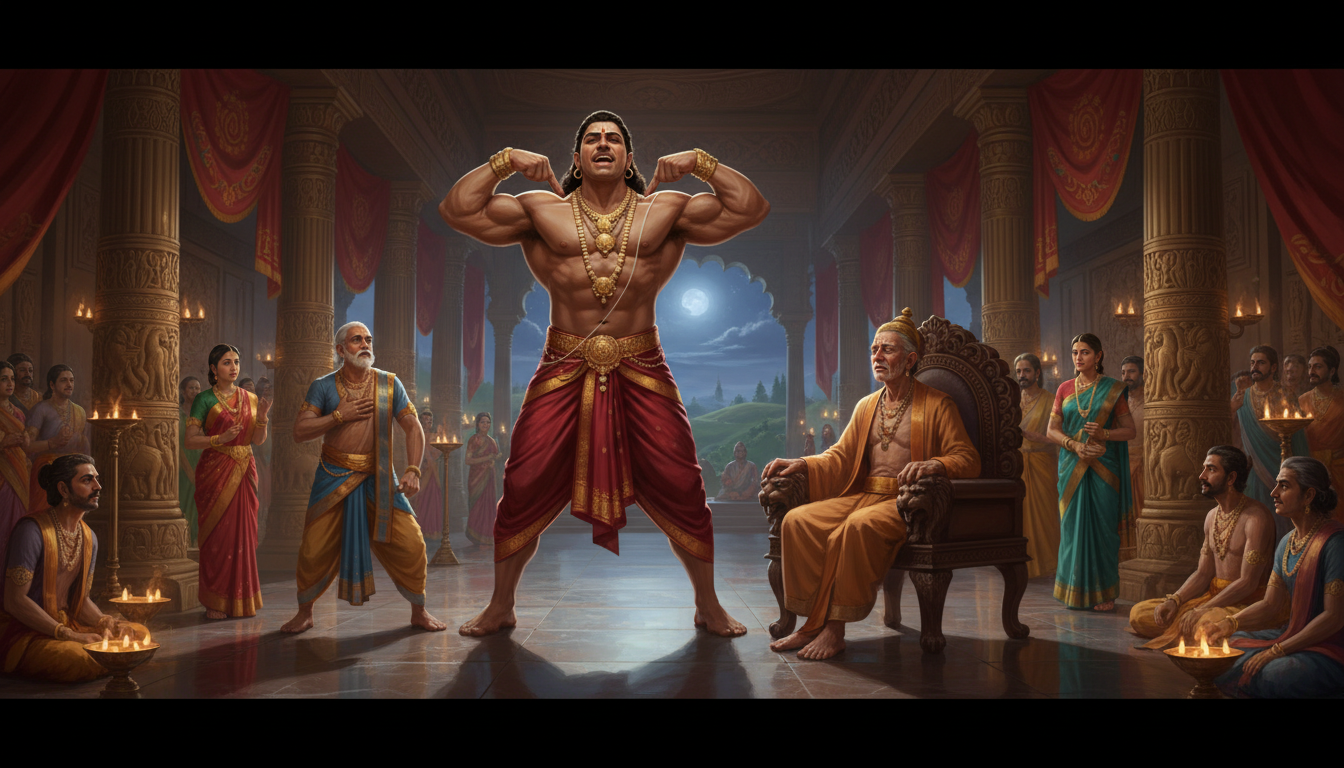
Then one day Bhima was among his friends, and Dhritarashtra was within hearing, and Gandhari was within hearing, and he remembered his enemies: Duryodhana, and Karna, and Dussasana.
He slapped his armpits. It is the sound a wrestler makes before a bout, and everyone in that hall knew it, and the blind king knew it best of all, because he had heard it in the arena at Hastinapura when these two boys were young and had heard it again reported to him from a plain where his hundred sons were dying.
And then, in a transport of passion, he said this.
"The sons of the blind king, who could fight with every kind of weapon, have all been sent to the other world by me, with these arms of mine that look like a pair of iron clubs. These are those two arms of mine, like maces of iron, that no enemy could get past. The sons of Dhritarashtra came within their clasp and were destroyed. These are those two well-developed round arms of mine, like a pair of elephants' trunks. The foolish sons of Dhritarashtra came within their clasp and were destroyed. These two arms of mine are smeared with sandal-paste and they deserve the sandal-paste, for by these Duryodhana was sent to the other world along with all his sons and all his kinsmen."
He said a great deal more of the same kind. The old king sat through it and gave way to cheerlessness and sorrow, and said nothing at all, then or afterwards.
Gandhari, who was conversant with every duty and possessed of great intelligence, and who knew what Time brings along in its course, decided the words were untrue and set them aside. She had buried a hundred sons and she was not going to be broken by a man boasting about his arms.
Her husband was not so strong. Vaishampayana called what Bhima said that day by a name that stuck to it: veritable darts, wordy darts, and a dart that is only made of words still has to be carried in the body of the man it is thrown at.
Fifteen Years, and Nobody Knew
After ten and five years had gone by, the old king, afflicted constantly by the wordy darts of Bhima, became penetrated with despair.
And this is the part that condemns the whole arrangement: Yudhishthira did not know it.
He did not know. Arjuna of the white steeds did not know. Kunti did not know, who saw Gandhari every day. Draupadi of great fame did not know. The twin sons of Madri, who were conversant with every duty and spent those years doing whatever the old king wanted done, and who never in fifteen years said one disagreeable word to him, did not know either.
The house had been built so carefully that no information could travel through it. Complaint had been made an act of enmity to the crown. The one man who might have brought a grievance forward was the man causing it. The old king could not tell Yudhishthira, because Yudhishthira would have been hurt, and because a guest who complains of his host has already lost the argument. So for fifteen years the government of the Kuru kingdom, which was mild and just and admired in every quarter of the realm, went on above a cellar it did not know it had.
What Dhritarashtra had begun doing instead, quietly, was punishing himself.
The Confession to His Friends
One day he honoured his friends with his confidence. He spoke with tears in his eyes.
"How the destruction of the Kurus happened is well known to all of you. It was brought about by my fault, though the Kauravas approved of all my counsels. Fool that I was, I installed the wicked-minded Duryodhana, that enhancer of the terrors of kinsmen, to rule the Kurus. Vasudeva said to me, 'Let this sinful wretch of wicked understanding be killed, along with all his friends and counsellors.' I did not listen to words of that gravity. Every wise man gave me the same beneficial advice. Vidura said it. Bhishma said it, and Drona, and Kripa. The holy Vyasa said it again and again, and Sanjaya said it, and Gandhari said it. Being overwhelmed by love for my son, I could not follow that advice, and bitter repentance is my lot now for neglecting it.
"I repent also that I did not settle that blazing prosperity, which came down to me from sires and grandsires, on the Pandavas, who deserved every part of it. So many divisions of my troops have been destroyed. My heart is pierced with thousands of darts because of it.
"Of wicked understanding as I am, now, after fifteen years, I am trying to expiate my sins. At the fourth division of the day, or sometimes the eighth, with the regularity of a vow, I eat a little food, only enough to conquer my thirst. Gandhari knows. All my attendants are under the impression that I eat as I always did. I concealed it, and I concealed it through fear of Yudhishthira alone, because if the eldest son of Pandu came to know of my vow he would feel great pain. I lie down on the earth in a deer-skin, spreading a little kusa grass, and pass my time in silent recitations. Gandhari of great fame keeps the same vows. That is how the two of us live, we who have lost a hundred sons, not one of whom ever retreated from a battle.
"I do not grieve for those children. They died in the observance of Kshatriya duties."
Asking Leave to Go
Then he turned and addressed Yudhishthira in particular.
"Blessed be you, son. Cherished by you, I have lived these years very happily. With your help I have made large gifts and performed the shraddhas over and over, and to the best of my power I have earned merit. This Gandhari, though she has no sons left, has lived with great fortitude, looking at me all the while. The men who wronged Draupadi and robbed you of your wealth, those cruel wights, have all left the world, killed in battle according to the practice of their order. There is nothing further I can do for them. They fell with their faces towards the fight, and they have gone to the regions kept for men who die holding weapons.
"What is left is what is good for me and for Gandhari. Grant me permission, great king. You are the foremost of righteous persons. The king is the preceptor of all creatures, and it is for that reason that I ask you and not another. With your leave I shall go into the woods in rags and bark, alone with this Gandhari, and live there blessing you. It is proper for the men of our race to hand the sovereignty to their children when old age comes and take up the forest life. Living on air, or on nothing at all, I shall practise severe austerities with my wife. You will be a sharer in those penances, son, because you are the king, and kings share in every act done in their kingdom, the auspicious and the inauspicious alike."
Yudhishthira answered him out of the middle of the shock.
"When you are in this grief, sovereignty gives me no pleasure at all. Fie on me, of wicked understanding, devoted to the pleasures of rule and utterly heedless of my real concerns. All of us, all my brothers with me, had no idea that you had been afflicted so long, wasted with fasts, going without food, lying on the bare ground. Fool that I am, I have been deceived by you, who have such deep intelligence: you gave me confidence at the start and then went and suffered like this afterwards.
"What need have I of a kingdom, or of things to enjoy, what need of sacrifices, what need of happiness, when you have undergone so much? I regard my kingdom as a disease and myself as a sick man. You are our father, you are our mother, you are the foremost of our superiors. How shall we live without you? Let Yuyutsu, the son of your own loins, be made king, or anyone else you like. I will go into the woods and you shall rule. Do not burn me when I am already burned by infamy. I am not the king. You are the king; I depend on your will, and how can I presume to grant permission to my own preceptor?
"I keep no resentment in my heart for the wrongs Suyodhana did us. It was ordained. We and they alike were stupefied by fate. We are your children as much as Duryodhana was, and my settled conviction is that Gandhari is my mother as much as Kunti is. If you go to the woods and leave me, I shall follow you. I swear it by my soul."
The King Leans on His Wife
"My mind is fixed on penances, son," the old king said. "It is proper for our race that I should go into the woods. I have lived long under your protection. I have been served by you with reverence for many years. I am old now. Grant me permission."
Then he turned, trembling, with his hands joined together, to Sanjaya and to Kripa, the two men who had stood beside him longest.
"I wish to solicit the king through you," he said. "My mind has become cheerless. My mouth has gone dry, from the weakness of age and the exertion of speaking."
And having said that, the old king leaned over on Gandhari and looked suddenly like a man with the life gone out of him.
Yudhishthira saw it and the grief went through him like a blade.
"He whose strength was equal to a hundred thousand elephants," he said aloud, "that king sits today leaning on a woman. He who once broke the iron image of Bhima into fragments with his arms leans today on a weak woman. Fie on me, who am so unrighteous. Fie on my understanding. Fie on my knowledge of the scriptures. Fie on me, for whom the lord of the earth lies today in a way that does not become him. I too shall fast, exactly as my preceptor does. I shall fast, if this king and the famous Gandhari go without food."
The wailing of the assembled warriors rose all round the hall, and none of them could say a useful word.
The Hour of His Food
The Pandava king used his own hand. He rubbed the old man's breast and face softly with cold water, and at the touch of that hand, which was auspicious and fragrant and carried jewels and medicinal herbs on it, Dhritarashtra came back to his senses.
"Touch me again with your hand, son of Pandu," he said, "and embrace me. O you of eyes like lotus petals, it is the auspicious touch of your hand that has restored me. I wish to smell your head. The clasp of your arms gratifies me greatly.
"This is the eighth division of the day, and therefore it is the hour of my food. Because I have not eaten, child of Kuru's race, I am too weak to move. It cost me a great effort to put my request to you, and it left me cheerless, and I fainted. Receiving the touch of your hand, which works like nectar, I think I have been brought back."
So the son of Kunti, out of affection, touched every part of his body gently, and the old king got his breath back and put his arms round him and smelled his head.
Vidura and the others wept aloud, and because their sorrow was so sharp they said nothing to the old king and nothing to the son of Pandu either. Gandhari, conversant with every duty, held her sorrow up with fortitude and, loaded as her heart was, kept silent. The other women, Kunti among them, were greatly afflicted, and sat in a ring around the old king shedding tears.
And Dhritarashtra asked once more, from inside that circle. "Grant me permission to practise penances, king. My mind grows weak from repeating it. Do not afflict me any further."
Yudhishthira looked at his royal father, emaciated and pale, reduced to a state that did not become him, worn out with fasts, a skeleton with skin over it, and shed tears.
"I do not desire life," he said, "and I do not desire the earth. I shall employ myself in doing whatever is agreeable to you. If I deserve your favour, if I am dear to you, eat something. Then I shall know what to do."
"I wish to take some food, son," said Dhritarashtra, "with your permission."
And while he was saying it, Satyavati's son Vyasa came in at the door.
Dharma Lesson
Obedience performed with a resentful heart is a second injury, and it does its damage where nobody is permitted to look. A court that forbids complaint does not end the grievance; it only guarantees that the harm will be discovered too late.