The City Comes Out to Look
The gates of Hastinapura stood open, and by the time the cars of the Pandavas came through them the streets had filled so densely that the crowd swelled at every moment, the way the ocean swells at the rising of the moon. The squares had been watered and swept and hung with cloth. The tall mansions along the street sides, decked with every ornament, were so crammed with ladies leaning out from their terraces that the houses themselves seemed to shift under the weight of them.
They praised the brothers as the procession passed, in the soft and modest voices of women who had waited a long while for something to be glad about. Yudhishthira first, then Bhima, then Arjuna, then the two sons of Madri. But the sharpest praise of that morning went to the one woman riding among them, and it came from the women.
"Worthy of all praise are you, blessed princess of Panchala," they called down to Draupadi, "who wait at the side of those foremost of men as Gautami waited at the side of the seven Rishis. Your acts and your vows have borne their fruit, lady."
Draupadi rode on and did not answer. The last time these streets had carried her, they had carried her toward a hall where she was dragged by the hair.
The men shouted, and the ladies talked over the shouting, and between them the city filled with one enormous sound. Yudhishthira passed through it with the bearing that befitted him, neither hurrying nor lingering, and came at last to the palace of the Kurus, and the people of the city and of the provinces pressed against the gate to say what they had come to say.
"By good luck you have vanquished your enemies, foremost of kings. By good luck you have recovered your kingdom through virtue and through prowess. Be our monarch for a hundred years, and protect your subjects as Indra protects the dwellers in heaven."
Benedictions at the Palace Gate
He came down from the car and went in. Before he would take anything for himself he sought out the household gods of the Kurus, the images his fathers had worshipped and Duryodhana after them, and honoured them with gems and with scents and with wreaths of flowers. Then he came out again into the forecourt.
It was full of brahmanas. Thousands of them stood waiting with the auspicious articles in their hands, the curds and the honey and the fried grain and the brimming jars, every one of them a man of penances and vows, and in the middle of them the king looked like the spotless moon standing among its stars.
Dhaumya was at his elbow, the priest who had followed him through thirteen years of forest and one year of hiding, and his eldest uncle stood with him. Yudhishthira went along the ranks and worshipped them with due rites, cheerfully, with sweets and gems and gold in profusion, with kine and with robes, and with whatever else each man named as his desire, because a king who has just come to a throne over the bodies of his cousins does not stint.
Then the cry went up from every side, "This is a blessed day," and it filled the whole sky, and it was sweet to the ear and very welcome to the friends and well wishers of the Pandavas. The king stood and listened to that sound, as loud and as clear as a flock of swans passing overhead, and to the speeches after it, which were melodious in their words and grave in their meaning, from men who knew the Vedas.
Then the drums were beaten and the conchs blared, the notes that mean triumph.
And then the brahmanas fell silent, all of them together, in the way a great crowd sometimes does. In that silence one voice went on speaking.
The Mendicant Who Cursed the King
He stood in the middle of them in the garb of a religious mendicant, with a rosary in his hand and a tuft of hair on his head and the triple staff of the wandering ascetic, and he was neither shy nor humble. He had consulted nobody. His name was Charvaka. He was a rakshasa, and he had been a friend of Duryodhana.
"All these brahmanas," he said, "have made me their spokesman, and this is what they say. Fie on you. You are a wicked king. You are a slayer of your own kinsmen. What have you gained, son of Kunti, by exterminating your race? You have killed your superiors and your preceptor as well. It would be proper for you now to throw away your life."
The brahmanas were stung to the heart. They made a loud uproar, all speaking at once, but the words came out as noise and not as denial, and in that confusion Yudhishthira stood among them and could not say anything at all. Shame and anxiety struck him dumb. Every man there watched the new king's face and saw the thing he had been carrying since the eighteenth day come up into it.
When he could speak, he said only this, with his hands joined: "I bow to you and I beg you humbly, be gratified with me. It does not become you to cry fie on me. I shall lay down my life soon enough."
Then the brahmanas found their voices together. "These are not our words," they cried. "Prosperity to you, monarch." And, their understanding made clear by penance, they turned their spiritual sight upon the speaker and went straight through his disguise.
"This is the rakshasa Charvaka, the friend of Duryodhana. He has put on the robe of a mendicant to serve his friend. We said nothing of the kind. Let this anxiety of yours be dispelled. Let prosperity attend you and your brothers."
Then, insensate with rage, cleansed of all sin, they uttered one syllable at him. Hun. It was a censure and it was a weapon, and Charvaka fell down dead where he stood, consumed by the energy of the utterers of Brahma, like a tree whose every sprout has been blasted by the thunder of Indra.
What Krishna Knew About Charvaka
The brahmanas were worshipped and went away pleased, leaving their blessings behind them, and the thing on the flagstones was carried off. But Yudhishthira had heard the accusation, and having heard it he could not unhear it, and Krishna knew that better than anyone in the court.
"In this world," said the son of Devaki, "brahmanas are always objects of worship with me. They are gods upon the earth. They carry poison in their speech, and they are exceedingly easy to please. Now listen, and learn who it was that spoke to you.
"In the Krita age a rakshasa named Charvaka performed austere penances for many years at Vadari. Brahma came to him again and again and pressed him to ask for a boon, and at last he asked for immunity from fear at the hands of every being in the universe. The Lord of the universe granted it, with one limitation only: that he should be careful never to offend the brahmanas. Having that boon, he began to torment the gods, and there was nothing they could do to him. They assembled and went to the Grandsire for the destruction of their enemy, and the eternal and unchangeable god answered them.
"He said: I have already arranged the means. There will be a king named Duryodhana, and among men he will be this creature's friend. Bound by affection for him, the rakshasa will insult the brahmanas. Stung by the wrong he does them, the brahmanas, whose might lies in their speech, will censure him in anger, and at that he will be destroyed.
"That was arranged before your grandfathers were born," Krishna said, "and it happened this morning, in your forecourt, and there he lies with the life gone out of him. So do not give way to grief on his account, bull of Bharata's race. Your kinsmen perished in the observance of Kshatriya duty. They were bulls among Kshatriyas and high souled heroes, and they have gone to heaven. Attend now to your duties. Let no grief be yours. Restrain your foes, protect your subjects, and worship the brahmanas."
The Seats of the New Court
Freed from grief and from the fever of his heart, the son of Kunti took his seat facing east upon a chair of gold.
Opposite him, facing him, on another seat of gold that blazed as it caught the light, sat two chastisers of foes together: Satyaki and Vasudeva. The king was placed between them and his brothers. On his two sides, on beautiful seats adorned with gems, sat Bhima and Arjuna. Upon a white throne of ivory decked with gold sat Pritha, with Sahadeva on one side of her and Nakula on the other. Sudharman the priest, and Vidura, and Dhaumya, and the Kuru king Dhritarashtra, each had his own separate seat, and each seat shone like fire. And where Dhritarashtra sat, there sat also Yuyutsu, who had crossed over on the first morning of the war, and Sanjaya, who had watched all of it, and Gandhari of great fame, with the cloth still bound across her eyes.
Before Yudhishthira they had laid out white flowers and swastikas and vessels full of many things, and earth, and gold, and silver, and gems, and the righteous souled king reached out and touched each of them in turn, as the rite requires.
Then the subjects came in, the priest at their head, bringing what was needed, and the floor of the hall filled up with it: golden jars filled to the brim with water, and jars of copper and of silver and of plain baked earth; flowers; fried paddy; kusa grass; the milk of cows; sacrificial fuel cut from the sami and the pippala and the palasa; honey; clarified butter; ladles carved from the wood of the udumvara; and conchs mounted in gold.
It was the same equipment that had been used for Dhritarashtra, and for Pandu, and would be used for men not yet born. Only the hall was emptier than at any coronation in living memory, because most of the people who should have filled it were dead.
Water From the Sanctified Conch
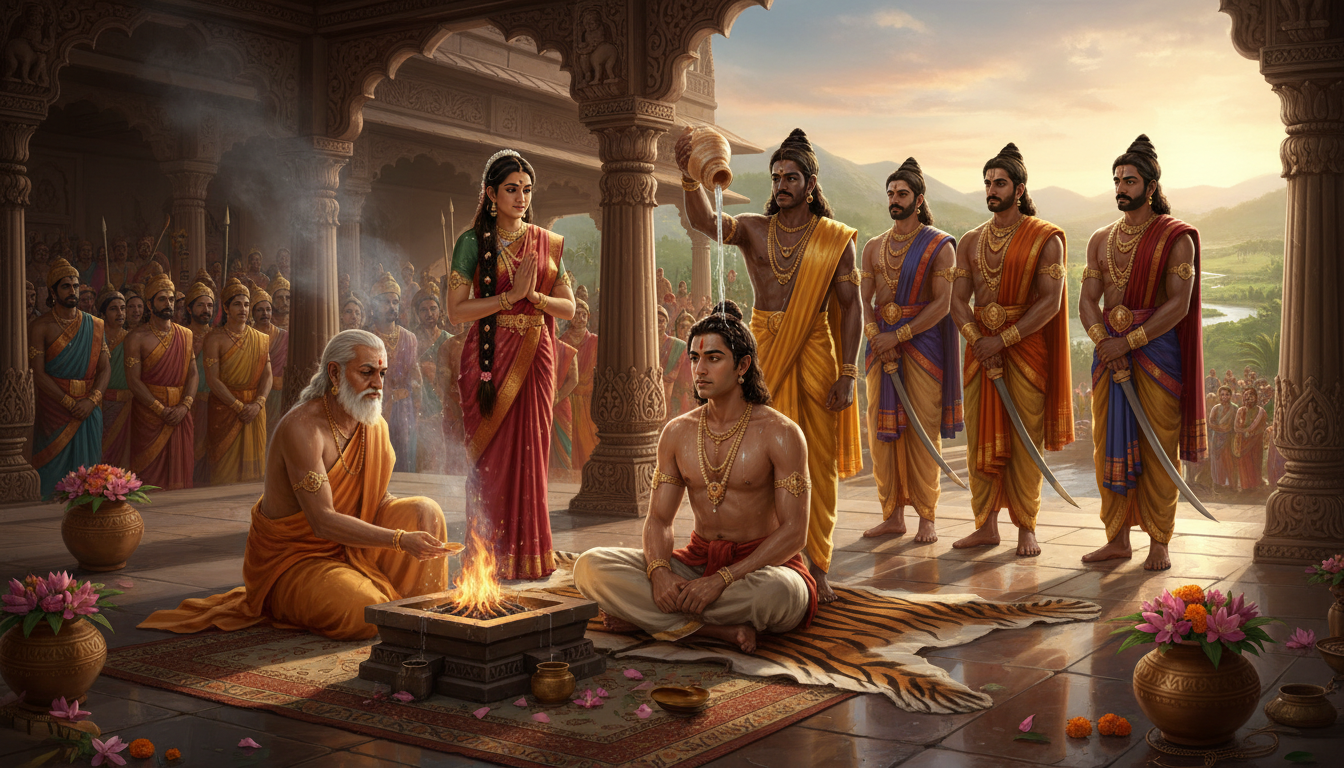
At Krishna's request the priest Dhaumya built the altar, constructing it according to the rule so that it inclined gradually toward the east and the north. Then he had Yudhishthira brought to it, and with him Krishna the daughter of Drupada, and the two of them were seated together upon the handsome seat that is called Sarvatobhadra, firm on its feet and covered with a tiger's skin. Dhaumya began to pour libations of clarified butter into the fire with the proper mantras, and the smoke went up straight.
Then he of Dasarha's race rose from his own seat.
Krishna took up the sanctified conch, the one that had been filled and blessed, and he poured the water in it over the head of the lord of the earth, Yudhishthira, the son of Kunti. The water ran down over the king's face and shoulders and darkened the tiger skin beneath him, and that was the anointing.
After him, at Krishna's asking, the royal sage Dhritarashtra came forward and did the same. He could not see the head he was pouring over. He was helped to it, and he poured, and the water went over the head of the man whose brothers his sons had tried for a lifetime to destroy. Then the subjects came, one after another, and each poured, until it was done.
The panavas and the anakas and the great drums were beaten. Yudhishthira accepted the gifts his subjects made him, and, as he had done at every sacrifice of his life, he honoured them in return with presents given away in profusion. To the brahmanas who had uttered the special benedictions he gave a thousand nishkas, and they were men who had studied the Vedas and were endowed with wisdom and good behaviour.
Gratified, they wished him prosperity and victory, and in voices melodious as swans they said: "By good luck, victory has been yours. By good luck you have recovered your position through your own prowess. By good luck the wielder of Gandiva and Bhimasena and you yourself and the two sons of Madri are all alive, having slain your foes and come out of that battle which was so destructive of heroes. Now attend, Bharata, without delay, to the things that should be done next."
Our Father and God
Yudhishthira heard them out, and what he said in answer was not what a new king usually says.
"Great indeed must the sons of Pandu be," he said, "if such foremost of brahmanas, assembled together, will recite their merits like this, whether the merits are true or false. There is no doubt that we are objects of your favour, since you so freely describe us as possessing such qualities.
"But king Dhritarashtra is our father and our god."
The hall went quiet. The blind man sat where they had put him, with Gandhari beside him, the father of the hundred sons who were all in the ground.
"If you wish to do what is agreeable to me," Yudhishthira went on, "then render your obedience to him always, and to whatever is agreeable to him. Having slaughtered all my kinsmen, I live for him alone. My great duty from this day is to serve him in every respect, and watchfully. If you and my friends think that I should be an object of favour with you, then let me ask this of you all: show the same behaviour toward Dhritarashtra that you used to show before. He is the lord of the world, and of you, and of me. The whole world, and the Pandavas with it, belongs to him. Bear these words of mine always in your minds."
He had taken the kingdom that morning and given it away again before the water was dry on him. It was not a formality and the court knew it. He had come out of a war he had won and found that winning had cost him the taste for it, and the only arrangement he could live inside was one in which he governed as another man's servant, and that man the father of the enemy.
Then he told the citizens and the people of the provinces that they might go wherever they liked, and dismissed them, and turned to the business of the kingdom.
The Offices of a Kingdom
The delighter of the Kurus gave out the offices one by one, and there was a logic in every appointment that anyone who had watched the war could read.
He made his brother Bhimasena the Yuvaraja, the heir apparent, the second man in the realm: the one who had sworn the oaths and kept them, given the place next to the throne. He appointed Vidura of great intelligence to assist him with his deliberations and to oversee the sixfold requirements of the state, because there had never been a mind in Hastinapura clearer than Vidura's or a tongue that his brother had heeded less. He appointed Sanjaya, mature in years and accomplished in everything, as general director and supervisor of the finances, and so the man who had narrated the destruction of the Kurus was set to count what was left of them.
He gave Nakula the register of the forces, the feeding and the paying of them and the supervision of the army's other affairs. He gave Phalguna the task of resisting hostile forces and chastising the wicked, which was the work Arjuna had been made for and the only work he had. He appointed Dhaumya, foremost of priests, to attend daily upon the brahmanas and to see to all rites in honour of the gods and every other act of a religious kind.
And Sahadeva he appointed to remain always by his side, and would hear nothing else about it, because the king had decided that under all circumstances he was to be protected by that brother.
Others he cheerfully employed in other work, according as he judged them fit. Then he called Vidura and the high souled Yuyutsu before him and gave them a standing order.
"You are to do everything that my royal father Dhritarashtra wishes, always, with alacrity and attention. And whatever must be done in respect of the citizens and the people of the provinces, you will accomplish in your own departments after you have taken the king's permission."
The king he meant was the blind one.
Rites for Everyone Who Fell
After that, the king of magnanimous soul caused the sraddha rites to be performed for every one of his kinsmen slain in the battle. Not some. Every one.
Dhritarashtra gave away, for the good of his sons in the other world, excellent food and kine and much wealth and many beautiful and costly gems to the brahmanas. And Yudhishthira, with Draupadi beside him, gave for the sake of Drona, and for the high souled Karna, and for Dhrishtadyumna, and for Abhimanyu, and for the rakshasa Ghatotkacha the son of Hidimva, and for Virata, and for Drupada, and for the five sons of Draupadi. For each single name he gratified thousands of brahmanas with wealth and gems and kine and clothes.
Some of those names had killed the others. Drona had burned through the ranks that Dhrishtadyumna commanded, and Dhrishtadyumna had taken Drona's head, and Karna's arrow had opened the way that ended with Abhimanyu on the ground inside the wheel formation, and the five small sons of Draupadi had been killed in their sleep. Yudhishthira paid for all of them out of the same treasury on the same day, and did not rank them.
He performed the rites also for those kings who had fallen in the battle leaving behind them no kinsman and no friend to do it, because a man who dies without anyone to pour water for him is the most abandoned thing on a battlefield, and there had been thousands.
And for the good of the souls of all his friends he caused houses to be founded where food would be distributed, and places where water would be given out, and tanks to be dug in their names, so that the dead would go on feeding the living. In this way he paid off the debt he owed them and avoided the censure of the world, and he became content, and protected his subjects religiously.
He showed the same honour as before to Dhritarashtra and to Gandhari and to Vidura and to all the superior Kauravas and all the officers. He honoured and protected the ladies who had been deprived of their husbands and their sons by the battle, and there was hardly a house in the city that had not lost one. To the destitute and the blind and the helpless he extended his favour with great compassion, giving them food and clothes and shelter.
The Palaces of Dead Men
When the installation was over, Yudhishthira joined his hands and turned to the lotus eyed Krishna of Dasarha's race.
"Through your grace, Krishna, through your policy and your might and your intelligence and your prowess, I have got back this ancestral kingdom of mine. I bow to you again and again. They call you the One only Being and the refuge of all worshippers, and the twice born adore you under names past counting. You are Vishnu, you are Jishnu, you are Hari, you are Vaikuntha. You are the soul of the universe and the universe has sprung from you. In the beginning it is you who create it, and you are its dissolution. Salutations to you, wielder of the Sarnga and the discus and the sword."
Krishna was pleased, and began to gladden the eldest son of Pandu with agreeable speech, which was a thing he had been doing since Indraprastha and would not have to do much longer.
Then the king dismissed the rest of his subjects, and comforted his brothers. "Your bodies have been mangled in the great battle with every kind of weapon," he said to Bhima of terrible prowess and to Arjuna and to the twins. "You are greatly fatigued. Grief and anger have scorched your hearts. Through my fault, bulls of Bharata's race, you suffered the miseries of exile in the forest like common men. Now enjoy this victory in delight and in happy ease. Rest, regain the full use of yourselves, and come to me again in the morning."
And then he gave out the houses, and they were not empty houses.
Vrikodara entered the palace of Duryodhana, with its many excellent buildings and rooms, adorned with gems of every kind, teeming with servants both male and female. Yudhishthira had assigned it to him with Dhritarashtra's approval, which is to say that the blind king had been asked whether Bhima might have the rooms of the son Bhima had killed, and had said yes.
Arjuna, at the king's command, took the palace of Dussasana, which was no smaller, with its gateway of gold and its abundance of wealth and attendants. Nakula, who had been worn thin by the forest years, was given the palace of Durmarshana, which was finer still and looked like the mansion of Kuvera. Sahadeva, who was always doing what pleased his eldest brother, was given the foremost of the palaces, which had belonged to Durmukha.
Yuyutsu and Vidura and Sanjaya and Sudharman and Dhaumya went back to the houses they had owned before. And Saurin, that tiger among men, went with Satyaki into Arjuna's palace as a tiger goes into his cave in the hills.
They feasted that night on the food and drink that had been kept ready, and slept, and woke in the morning with well pleased hearts, and presented themselves before king Yudhishthira.
Dharma Lesson
A crown taken from the dead is only bearable if the man who takes it keeps giving precedence to the people he defeated. Yudhishthira pays for the funerals of the enemies who killed his friends and the friends who killed his enemies out of one treasury on one day, ranking none of them. Victory is not finished until the victor has counted the cost aloud.