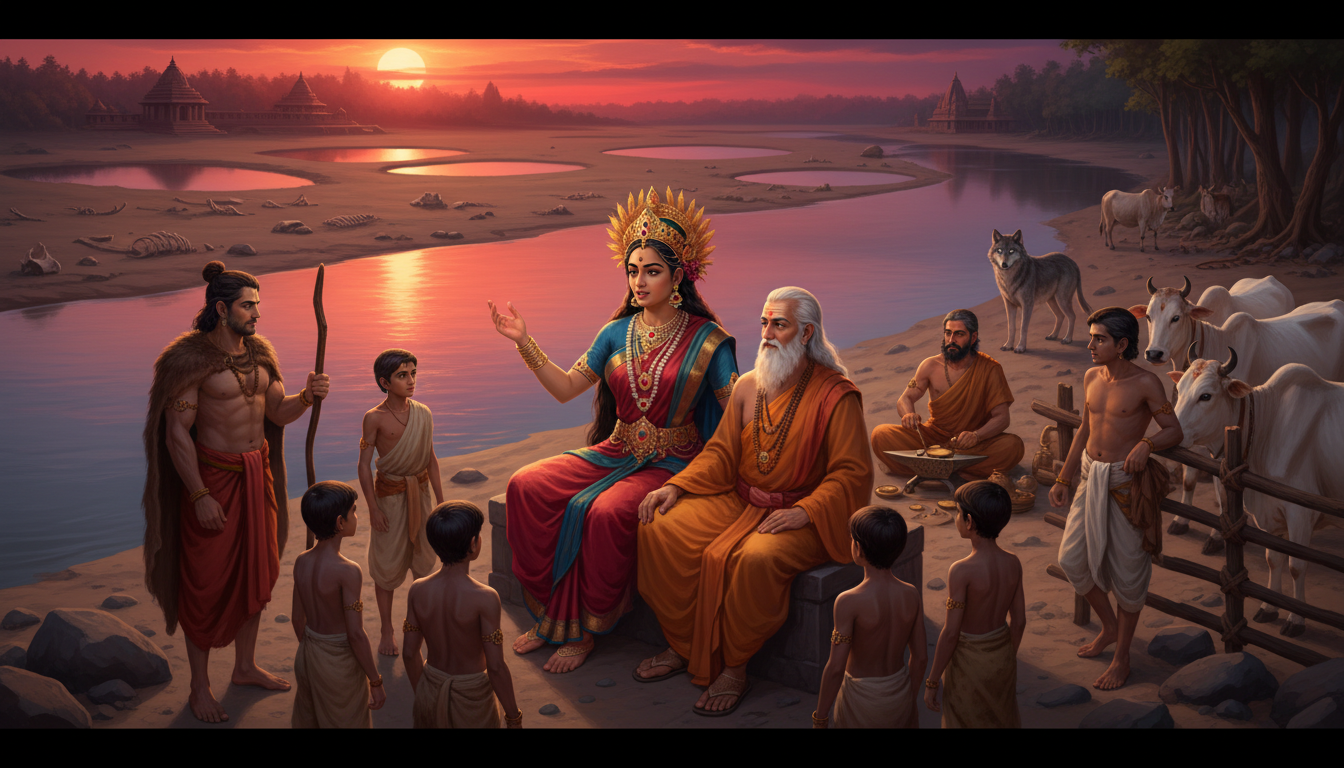
The Five Lakes at a Distance
They were driving across Kurukshetra to find Bhishma, and the road went over the place where the war had been.
Hrishikesa and king Yudhishthira, with Kripa and the others, and the four brothers, came down onto a field covered with hair and marrow and bones, where millions of Kshatriyas had cast away their bodies. There were hills on it made of the carcasses of elephants and horses. Human skulls lay stretched over the ground like conch-shells. The plain was variegated with the thousands of funeral pyres that had been lit on it and was heaped with armour and weapons, so that it looked like the drinking garden of the Destroyer himself, used once and abandoned. Crowds of spirits haunted it, and the Rakshasas were thick over it, and the cars went quickly.
It was Krishna who broke the silence, and what he chose to talk about was somebody else's slaughter.
"Yonder, at a distance, Partha," he said, "are seen the five lakes of Rama. There Rama offered oblations of Kshatriya blood unto the manes of his ancestors. It was hither that the puissant son of Jamadagni, having freed the earth of Kshatriyas for thrice seven times, gave up his task."
Yudhishthira looked at the water and then at the man driving him, and what came out of him was not awe. It was arithmetic.
"I have great doubts in what thou sayest," the king said, "about Rama having thrice seven times exterminated the Kshatriyas in days of old. When the very Kshatriya seed was burnt by Rama, how was the Kshatriya order revived? How was it exterminated, and how did it again grow? In frightful car-encounters millions of Kshatriyas were slain, and the earth was strewn with their corpses. For what reason was the order thus exterminated in days of yore? Remove this doubt of mine, O Krishna."
He had a reason for asking, and everybody in that chariot knew what it was. He had just done the same thing himself, on the ground they were rolling over, and he wanted to know what happens to a world after somebody empties it.
As Soon as They Were Born
Krishna told him the whole of it from the beginning, from the two bowls of sanctified food that were exchanged by mistake between a mother and a daughter, so that the son who should have been born tranquil was born terrible, and the wrong energy went into the wrong womb. He told of Jamadagni, and of the thousand-armed Kritavirya of the Haihayas who gave the earth away in a horse-sacrifice and afterwards fed the god of fire with kingdoms until a curse was laid on his arms. He told of the calf taken from the hermitage without leave, and of the lopped arms, and of the head of Jamadagni carried off with lances while his son was out fetching fuel and sacred grass.
And then he came to the part the king had asked about.
Rama slaughtered the sons and grandsons of Kritavirya. He slaughtered the Haihayas by thousands, and made the earth miry with blood, and then, filled with compassion, he retired into the woods, and for some thousands of years that was the end of it.
It was a taunt that started it again. Paravasu, the grandson of Viswamitra, began casting imputations on him in public, saying that righteous men of the Kshatriya order had sat at sacrifices unharmed and that Rama's was an empty boast, and that he had gone to the mountains through fear. The descendant of Bhrigu heard it, and took up arms again, and strewed the earth with hundreds of bodies.
And the Kshatriyas that he had spared, counting by hundreds, multiplied in time and became mighty monarchs, because that is what a spared hundred does. So he came back and killed them again, and this time he did not spare the very children, and the earth was strewn with Kshatriya children of premature birth.
Then Krishna said the sentence that the rest of the history hangs from, and he said it without raising his voice.
"As soon as Kshatriya children were born, Rama slaughtered them. Some Kshatriya ladies, however, succeeded in protecting their children."
That is all that is said about them. No names. No account of how it was done, or where they went, or what it cost. A line that could be read past in a moment, set down between two massacres, and the entire future of the ruling order of the world is inside it.
The Earth Given Away at a Horse-Sacrifice
Having made the earth destitute of Kshatriyas for thrice seven times, the puissant Bhargava performed a horse-sacrifice, and at the completion of it he gave away the earth as the sacrificial present unto Kasyapa.
Consider what that means as a transaction. A horse-sacrifice is the rite of a conqueror, and its final act is the giving of the fee, and the fee must be commensurate with the man giving it. Rama had nothing left that was smaller. He had taken the whole earth twenty-one times and he had no use for a square foot of it, and he was standing at a fire with an obligation to hand something over, so he handed over the world, to a Brahmana, exactly as a lesser man hands over a herd of cattle.
And Kasyapa took it.
This is the moment that the survivors of the Haihayas and the sons hidden by their mothers all depend upon, though not one of them knew it at the time. The earth had passed out of the hands of the man who was clearing it, and into the hands of a sage who had received it as a priest receives a fee, and who was therefore now, in the plain language of gift, its owner.
He did not wait to think about the consequences. He worked them out standing there, with the rite hardly cold.
For preserving the remnant of the Kshatriyas, Kasyapa pointed with his hand, and the hand still held the sacrificial ladle.
That is the picture. Not a decree from a throne, not a curse, not an army. An old Brahmana at the edge of a fire, with the ladle he had been pouring butter from a minute before still in his fingers, using it to point at the man who had just made him master of the world.
It Behoveth Thee Not to Reside Within My Dominion
"Repair to the shores of the southern ocean," said Kasyapa. "It behoveth thee not, O Rama, to reside within what is my dominion."
It was said quietly and it was unanswerable, and the whole force of it lies in the two words at the end. My dominion. The gift had been made. The giver had witnessed it himself and had made it before the fire with the mantras spoken, and a man who gives away the earth has no standing to remain on it. Rama could have killed Kasyapa with a gesture and everyone present knew it. He could not argue with him, because the argument was one he had constructed himself, out of his own piety, an hour before.
So the exterminator of the Kshatriyas was told to leave the world, and went.
And at those words, Ocean suddenly created for Jamadagni's son, on his other shore, a region called Surparaka.
There was nowhere for him to go, so somewhere was made. The sea threw up a strip of land beyond its own edge, outside the dominion that had been given away, and the man with the axe walked out onto ground that had not existed that morning and had been raised for no other purpose than to hold him where he could do no further harm. It is the gentlest banishment in the books and the most complete. He was not chained, not cursed, not defeated. He was simply put outside, on land that belonged to nobody, by a Brahmana with a ladle.
Kasyapa, having accepted the earth in gift, then made a present of it unto the Brahmanas, and entered the great forest.
He kept nothing. He had held the world for the length of a conversation, and he used it for one purpose only, and then he gave it away in turn and walked into the woods, which is why the next thing that happened was not his fault and was entirely his doing.
Nobody Is Master of His Own Property
There were now no Kshatriyas.
That had been the object of a very great deal of labour, and it had been achieved, and the world that resulted is described in five short clauses that Krishna repeated to Yudhishthira as they crossed the burnt field.
The Sudras and the Vaisyas, acting most wilfully, began to unite themselves with the wives of Brahmanas. When anarchy sets in on earth, the weak are oppressed by the strong. No man is master of his own property. The earth, unprotected duly by Kshatriyas observant of virtue, and oppressed by the wicked in consequence of that disorder, quickly sank.
The middle sentence is the one to keep. No man is master of his own property. Not that the poor were robbed, though they were. That the idea of a thing being yours had stopped working, and stopped working for everybody, including the strong, who could hold what they had taken only for as long as they could go on holding it, and who therefore owned nothing either and merely occupied it.
This is the part of the account that ought to be uncomfortable, and it is meant to be. The order that had been destroyed was the order that had earned its destruction. Kritavirya's sons had taken a calf out of a hermitage because they wanted it. Kings had burnt the retreats of sages for sport. There was not one crime charged against the Kshatriyas in the whole history that had not actually been committed. And with them gone, root and branch, twenty-one times over, the world did not become gentle. It became a place where a woman was not safe in a Brahmana's house and a man could not keep his own field.
The earth sank from fear, quickly, to the lowest depths.
The word is fear. Not weight, and not shame. She was frightened, and she went down.
Held on a Lap
Beholding the earth sinking from fear, the high-souled Kasyapa held her on his lap.
He had gone into the great forest and he came out of it for this. The man who had given the world away twice in one afternoon, once to the Brahmanas and once by refusing to keep it, put out his hands and caught it as it went down, and held it the way a man holds a child that has run to him, and there is a plain and homely word in the language for the part of the body he held her on, and the earth has been called by that word ever since. Since the great Rishi held her upon his lap, which is uru, therefore is the earth known by the name of Urvi.
The name of the world is a record of the day somebody caught it.
And the goddess Earth, for protection's sake, gratified Kasyapa, and begged of him a king.
Not a protector in the abstract. Not a guarantee, not a boon, not an age of peace. She asked for a king, by that name, of a Brahmana who had just watched a Brahmana empty the world of kings and had approved of enough of it to accept the fee.
And then, before he could answer, she told him something that nobody in the three worlds had known, and that she had been keeping to herself through twenty-one exterminations while the ground was being made miry with blood.
"There are, O regenerate one," said the Earth, "some foremost of Kshatriyas concealed by me among women."
Concealed by me. She had been hiding them. All that time, while she was being cleared and cleared again and finally given away as a priest's fee, the earth had been quietly keeping back a portion of the thing that was being destroyed, and now she opened her hand and began to name them one at a time.
The Boy Among the Bears
"They were born in the race of the Haihayas," she said. "Let them, O sage, protect me."
The Haihayas. The house of Kritavirya, the house whose sons had stolen the calf, the house whose extermination had begun the whole business. The first names she offered were of the family that had deserved it most, and she offered them without apology, because the goddess who carries everybody is not in a position to be particular about whose children she saves.
"There is another person of Puru's race, the son of Viduratha, who has been brought up among bears in the Rikshavat mountains."
A prince of the line of Puru, which is the line that Yudhishthira himself was riding across the field in, raised by bears in the hills. The Earth says it in one clause and moves on.
"Another, the son of Saudasa, has been protected, through compassion, by Parasara of immeasurable energy, who is ever engaged in sacrifices. Though born in one of the regenerate orders, yet like a Sudra he does everything for that Rishi, and he has therefore been named Sarvakarman."
Sarvakarman. Servant of all work. That is not a name a mother gives a child. It is what the household ended up calling the boy who carried the water and swept the enclosure and fetched the fuel for the sage's fire, and he answered to it for years, and he was the heir of Saudasa, and Parasara had taken him in out of compassion and had then had the wit to give him a name that would make nobody look at him twice.
"Sivi's son of great energy, Gopati by name, has been brought up in the forest among kine. Let him, O sage, protect me."
Her refrain does not change. She names a boy raised among cattle and then says the same six words she has said about all of them. Let him protect me. She is not asking for pity for these children. She is asking for a government, and she is telling a Brahmana where the government has been living.
Wolves, Goldsmiths and the Sea
"Pratardana's son, named Vatsa, of great might, has been brought up among calves in a cowpen. Let that one of the royal order protect me."
Vatsa means calf. He had been put in among the calves and had been called what the calves were called, and it had worked.
"Dadhivahana's grandson and Diviratha's son was concealed and protected on the banks of Ganga by the sage Gautama. His name is Vrihadratha. Possessed of great energy and adorned with numerous blessed qualities, that blessed prince has been protected by wolves, and by the mountains of Gridhrakuta."
By wolves. The Earth does not explain it, any more than she explains the bears, and there is nothing in the account to suggest she thinks it needs explaining. A prince of a house that had been hunted to the last child was kept alive on a riverbank by a sage, by a mountain, and by animals that eat men.
"Many Kshatriyas belonging to the race of Maratta have been protected. Equal unto the lord of the Maruts in energy, they have been brought up by Ocean."
The same Ocean that had made a country out of nothing to hold Rama at the far edge of the world had also been raising the children Rama was looking for.
"These children of the Kshatriya order have been heard of as existing in different places. They are living among artisans and goldsmiths."
And that is the end of the list, and it is the part of it that a king listening from a chariot would feel the most. The last of them were not with bears or wolves or the sea. They were in workshops. They were apprenticed. They were the quiet boy at the bench in the goldsmith's row who was good with his hands and never talked about his family, in a town where a man with a bow had ridden through twenty-one times looking for exactly him, and had looked straight at him, and had seen an artisan.
Their Funeral Rites Are Owing
Then she gave her reason, and it is not the reason anybody would predict.
"Their sires and grandsires have been slain for my sake by Rama of great prowess," said the Earth. "It is my duty, O great sage, to see that their funeral rites are duly performed."
For my sake. She takes the whole war onto her own account. The Kshatriyas had died protecting her, or fighting over her, or being cleared off her, and she does not distinguish, and the debt she recognises is not owed to the living boys in the cowpens. It is owed to the dead men who had nobody left to pour water for them. Somebody has to perform the rites, and rites are performed by sons, and the sons had been hidden among artisans, which is why she wanted them found. She was not raising an army. She was settling an obligation to the men whose bones she was carrying.
And then one flat sentence about the men in power at that moment.
"I do not desire that I should be protected by my present rulers. Do thou, O sage, speedily make such arrangements that I may exist as before."
The sage Kasyapa then sought out those Kshatriyas of great energy whom the goddess had indicated, and installed them duly as kings.
He went and got them. The boy from the bears, the boy from the cowpen, the servant of all work in Parasara's hermitage, the sons the women had hidden, the ones the wolves had kept, the ones the sea had raised, the apprentices in the goldsmiths' rows. They were fetched out and washed and crowned by an old Brahmana who had already given the earth away and had nothing to gain by any of it.
"Those Kshatriya races that are now extant," Krishna said, "are the progeny of those princes. That which thou hast questioned me about, son of Pandu, happened in days of yore even thus."
Every royal house in the world, including the one in that chariot. Yudhishthira had asked how an order comes back after it has been burnt to the seed, and the answer was that it was never burnt to the seed, because the destruction had been carried out by a man with an axe and the preservation had been carried out by women, bears, wolves, a sage, the sea, and a goddess who never once told him what she was doing.
Conversing thus with Yudhishthira, that foremost of righteous persons, the high-souled Yadava hero proceeded quickly on that car, illumining all the points of the compass like the divine Surya himself, and the field of bones went on going past on either side of them.
Dharma Lesson
No purge is ever complete, because the thing being destroyed is always being quietly kept alive by people with no stake in the quarrel. Women, a sage, a mountain, wolves and the sea between them preserved what twenty-one exterminations were meant to end, and every royal house alive descends from those hidden boys. Destruction is loud and easy to count; preservation is done by nobody in particular and leaves no record.