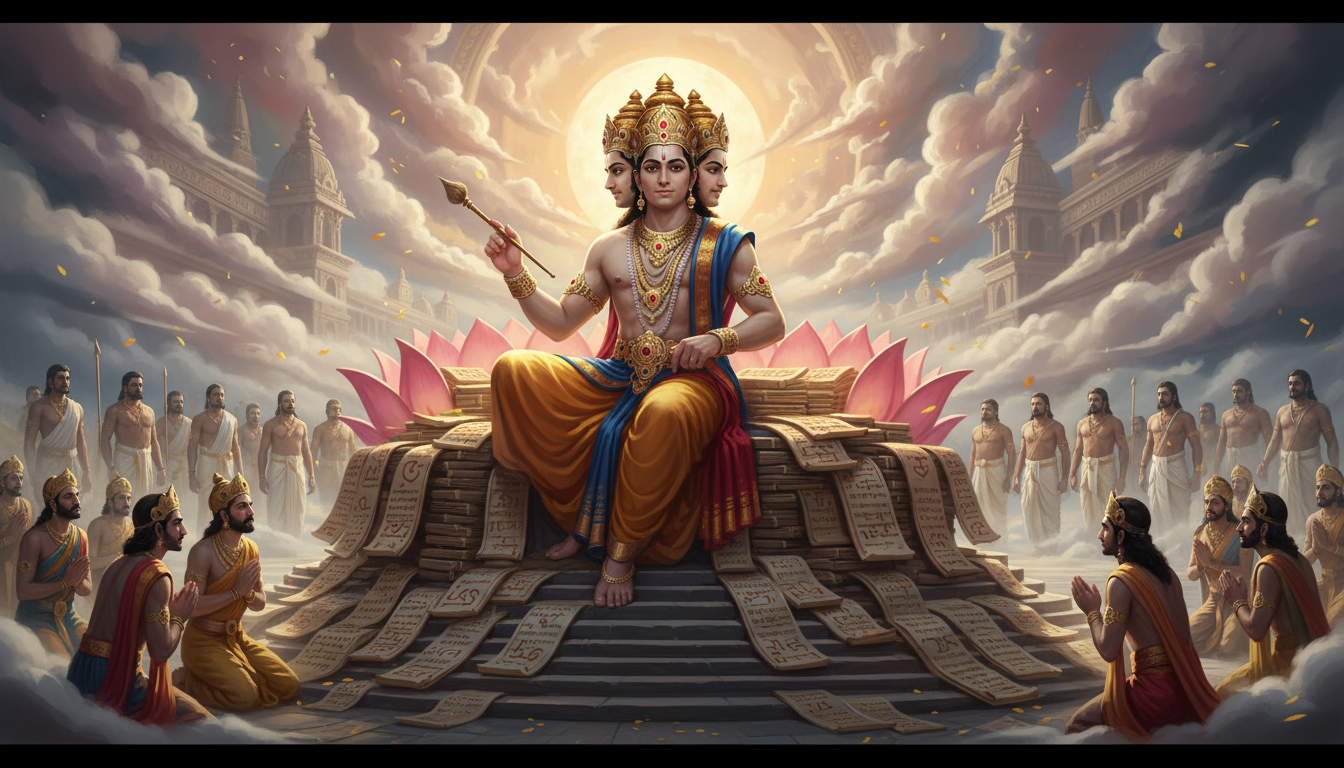
The Age Before Kings
How men who protected one another stopped, and what had to be written
The Question About the Word King
They rose the next day, the Pandavas and the Yadavas together, and performed the morning rites laid down in the scriptures, and then set out for the field of Kuru on cars that looked like fortified towns moving over the plain. It had become the shape of their days. Bhishma lay where he had fallen, on the bed of arrows that held him a hand's breadth above the ground, and every morning they came out to him and asked whether he had passed the night happily, and every morning he answered that he had, and then they saluted the Rishis sitting around him and took their places on the trampled earth.
Then Yudhishthira the just worshipped the old man duly, and joined his hands, and asked the question he had been carrying since the water of the anointing dried on his head.
"Where did the word Rajan come from, Bharata? Where did the word king come from on this earth? Tell me. A king has hands and arms and a neck like anybody else. He has understanding and senses like other men. He is subject to the same joys and the same griefs. He has a back and a mouth and a stomach the same as the rest of the world, and the same vital fluids, and bones, and marrow, and flesh, and blood. He breathes in and breathes out as others do. He is born as others are born and he dies as others die. In every attribute of humanity he is exactly like the rest.
"Then for what reason does this one man govern the whole world, which is full of men of great intelligence and bravery? Why does one man rule a wide earth teeming with brave and energetic and high born people of good behaviour? Why do they all seek his favour? Why is it that if this one man is delighted the whole world is delighted, and if this one man is troubled the whole world is troubled?
"There cannot but be a grave reason for it, since the whole world bows down to one man as it bows to a god. Discourse to me on this fully, foremost of speakers."
When No One Ruled
"Listen with a concentrated mind, tiger among kings," Bhishma said, "and I will tell you in detail how sovereignty first began in the Krita age.
"At first there was none of it. There was no sovereignty. There was no king. There was no chastisement, and there was no chastiser. Understand what that means before you hear the rest of it, because you have never seen such a world and neither have I. There was no man whose business it was to punish, and no punishment, and no need of either. All men used to protect one another righteously. That was the whole arrangement, and for a long age it was enough."
Yudhishthira, who had spent the last eighteen days of his life inside the opposite of that arrangement, did not interrupt.
"So they lived," Bhishma said, "protecting one another, each keeping watch over the rest as a matter of course, and nobody appointed to it and nobody paid for it. And then, Bharata, after some time had passed, they found the task painful.
"That is all that happened at the beginning. It was not wickedness. It was tiredness. The work of guarding one another is real work, and it is unending, and it has no reward that anyone can see, and after some ages of it men began to feel the weight of it and to wish it off their shoulders.
"Then error began to assail their hearts. Having become subject to error, the perceptions of men were clouded, and once their perceptions were dimmed, their virtue began to decline. That is the order of it, prince, and the order matters. Nobody chose to be wicked. They grew weary, and then they grew careless, and then they could no longer see straight, and only after that did they begin to do wrong."
How It Came Apart
"When their perceptions were dimmed and they had become subject to error," Bhishma went on, "all of them became covetous. And because men sought to obtain things they did not have, another passion took hold of them, which is called lust, the lust of acquisition. And when they had become subject to that, a third passion soiled them, and that one was anger.
"Once they were subject to wrath they lost all consideration of what should be done and what should not be done. Sexual indulgence went unrestrained. Men began to say whatever they chose. The distinction between food that is clean and food that is unclean disappeared, and after that the distinction between virtue and vice disappeared with it, which is the same collapse working at a deeper level.
"And when that confusion had set in among men, the Vedas disappeared."
He let that stand a moment. The Rishis around the arrow bed were very still.
"Not burned. Not forbidden. Nobody suppressed them. There was simply no longer anybody whose mind was clear enough to hold them, and so they went out of the world of men the way a lamp goes out when there is no oil left in it. And upon the disappearance of the Vedas, righteousness itself was lost.
"Now understand what that meant in heaven. The gods were possessed by fear.
"Men used to pour libations upward, and the gods used to pour rain downward. That was the exchange the world ran on. When the pious rites ceased among men, the upward half of it stopped, and the gods who lived on it began to starve. Overcome with fear, tiger among men, they went for protection to Brahman."
The Gods Go to the Grandsire
They gratified the divine Grandsire of the universe first, as suppliants must, and then they stood before him afflicted with grief, with their hands joined, and said what they had come to say.
"God, the eternal Vedas have been afflicted in the world of men by covetousness and by error. We have been struck with fear because of it. Through the loss of the Vedas, Supreme Lord, righteousness also has been lost. And for that reason, Lord of the three worlds, we are about to descend to the level of human beings.
"Men used to pour libations upward while we poured rain downward. Now that all pious rites among men have ceased, great distress will be our lot. Think, Grandsire, of something that would benefit us, so that this universe, which was created by your power, does not meet with destruction."
It is worth noticing what the gods were afraid of. They did not ask for men to be punished. They asked not to fall, and they asked for the world not to end, and the two requests were the same request.
The Self born and divine Lord answered them: "I shall think of what will do good to all. Let your fears be dispelled, foremost of gods."
And then he sat down and wrote.
A Hundred Thousand Chapters
"The Grandsire composed, by his own intelligence, a treatise consisting of a hundred thousand chapters," said Bhishma, "and there has never been another book like it, and I want you to hear what was in it, because you are about to govern with the last thin remnant of it.
"In it he treated Virtue and Profit and Pleasure, which he called the triple aggregate, and then a fourth subject, Emancipation, with opposite meaning and attributes to the other three. He treated the aggregate of six: the hearts of men, place, time, means, overt acts, and alliances. He set down the religious rites of the three Vedas, and knowledge, and the plain acts by which life is supported, which is to say agriculture and trade, and the very extensive branch of learning called punitive legislation.
"He wrote on how to behave toward your counsellors. On spies. On the indications by which a prince may be read. On secret agents of every kind, and envoys, and the four instruments, conciliation, the fomenting of discord, gifts, and chastisement, with toleration as a fifth. On deliberation and its errors, and on treaties of three kinds, bad and middling and good, made through fear, through good offices, and through gifts of wealth. On the three kinds of victory: the one secured righteously, the one bought with wealth, and the one obtained by deceit.
"He wrote on cars, elephants, horses and foot soldiers, on impressed labourers and crews and paid attendants and guides taken from the country that is the seat of war. On movable and immovable poison in respect of apparel, food, and incantations. On the roads to be taken and the soil to encamp on, on battle arrays and manoeuvres, on planetary conjunctions foreboding evil, on earthquakes, on the disorders of troops and how to be rid of them, and on the means of inspiring an army with joy and confidence.
"And he wrote the vices down, all ten of them. Four are born of lust: hunting, gambling, drinking, and sexual indulgence. Six are born of wrath: rudeness of speech, fierceness, severity of chastisement, the infliction of pain on the body, suicide, and the frustrating of one's own objects."
Yudhishthira heard the word gambling go past in the list and said nothing.
Four Men Who Cut the Book Down
"Having composed that highly beneficial treatise," Bhishma said, "the divine Lord spoke cheerfully to the deities with Indra at their head.
"'For the good of the world, and for establishing the triple aggregate, I have composed this science, which is the very cheese of speech. Assisted by chastisement, it will protect the world. Dealing out rewards and punishments, it will operate among men. And because men are led to the objects of their existence by chastisement, because chastisement governs everything, this science will be known in the three worlds as Dandaniti.'
"Then it began to shrink, and it shrank for one reason only: that the lives of human beings were growing shorter, and a book no one lives long enough to read is no use to anybody.
"The lord of Uma, the divine and multiform Siva of large eyes, the source of all blessings, was the first to study and master it. Then he abridged that grave work into ten thousand lessons, and called it Vaisalakasha. Indra, devoted to Brahman and endued with great ascetic merit, received it and abridged it again into five thousand, and called it Vahudantaka. After him the puissant Vrihaspati, by his intelligence, cut it down to three thousand and called it Varhaspatya. And last, that preceptor of Yoga of great celebrity, Kavi of immeasurable wisdom, whom you know as Sukra, reduced it to a thousand.
"A hundred thousand chapters to a thousand lessons, king, and the great Rishis did it for our benefit and not out of carelessness. Everything you will ever be taught about ruling is the ash of that fire. Remember, when a counsellor quotes you a rule and cannot tell you why it exists, that the reason was in a chapter somebody had to cut."
The Line That Would Not Rule
"Now there was a science of government," said Bhishma, "and still no governor. So the gods went to that lord of creatures, Vishnu, and said, 'Indicate to us, god, the one among mortals who deserves to have superiority over the rest.'
"The divine and puissant Narayana reflected a little. Then, by a mere fiat of his will, he created a son born of his own energy, and named him Virajas.
"And Virajas, highly blessed, did not want it. His mind inclined to renunciation, and he would not take sovereignty over the earth.
"Virajas had a son named Krittimat, and he too renounced pleasure and enjoyment and would not take it. Krittimat had a son named Kardama, and Kardama practised severe austerities instead. So it went, three generations of men fit to rule who looked at the throne and walked past it, and I have often thought that their refusal was itself a kind of judgment on the office.
"Kardama begot a son named Ananga, and Ananga at last consented. He became a protector of creatures, pious in behaviour, and fully conversant with the science of chastisement, and for a while the thing worked as the Grandsire had designed it.
"Ananga begot Ativala, who was well versed in policy. He obtained an extensive empire on his father's death and became a slave of his own passions.
"And Mrityu, who is Death, had a daughter born of his mind, named Sunita, celebrated over the three worlds. She was married to Ativala. Of that marriage, of a king who could not master himself and a daughter of Death, was born a son named Vena."
Kusa Blades and a Thigh
"Vena was a slave of wrath and of malice," said Bhishma, "and he became unrighteous in his conduct toward all creatures. This was the first king the world had made for itself, and he was a tyrant, and the world had no instrument for removing him, because the instrument for removing kings had never been needed before.
"So the Rishis made one. Those utterers of Brahma took blades of kusa grass, the same grass they strew for a sacrifice, and inspired them with mantras, and with that they slew him. Grass, king. They killed him with grass and with syllables, and the lesson in it is that the men who wrote the science of chastisement kept a power in reserve against the chastiser himself.
"Then, uttering mantras still, they pierced the right thigh of the dead Vena. Out of that thigh came a person onto the earth: short of limb, resembling a charred brand, with blood red eyes and black hair. The utterers of Brahma looked at him and said one word to him. 'Nishida.' Sit down. And from him have sprung the Nishadas, the tribes that have the hills and the forests for their home, and those hundreds and thousands of others called Mlechchhas who live upon the Vindhya mountains. All the wrath and the malice of the father had come out of him first, and been given a name, and sent to sit down in the woods.
"Then the great Rishis pierced the right arm of Vena. And out of that arm sprang a person who was a second Indra to look at. He came out clad in mail, armed with scimitars and bows and arrows, well versed in the science of weapons, and acquainted with the Vedas and their branches. And all the ordinances of the science of chastisement, in their embodied forms, came and stood before him."
The Oath of Vena's Son
"The son of Vena joined his hands to the great Rishis and said, 'I have been given an understanding that is very keen and observant of righteousness. Tell me in detail what I am to do with it. Whatever useful task you are pleased to indicate, I shall accomplish it without hesitation.'
"And the gods and the Rishis who were present answered him, and what they said is the oath of every king who has sat on any throne since.
"'Fearlessly accomplish all those tasks in which righteousness resides. Disregard what is dear to you and what is not, and look upon all creatures with an equal eye. Cast far away from you lust and wrath and covetousness and pride, and, always observing the dictates of righteousness, punish with your own hands the man, whoever he may be, who deviates from the path of duty. Swear that in thought and word and deed you will always maintain the religion that the Vedas have taught on earth. Swear that you will maintain those duties fearlessly with the aid of the science of chastisement, and that you will never act with caprice.'
"He swore it. Then Sukra, that vast receptacle of Brahma, became his priest. The Valakhilyas became his counsellors and the Saraswatas his companions, and the great Rishi Garga became his astrologer. Two men called Suta and Magadha had come into being a little before, and they became his bards, and when he was gratified he gave Suta the land along the sea coast and gave Magadha the country that has been called Magadha ever since.
"The surface of the earth in those days was very uneven. Vena's son went over it with the horn of his bow and pushed the rocks and the rocky masses aside until it was level, and the hills and the mountains grew larger where he heaped them. Then Vishnu and the deities and the Rishis and the Regents of the world and the Brahmanas assembled and crowned him. The Earth herself came to him in her embodied form with a tribute of gems. Ocean gave him inexhaustible wealth, and Himavat did, and Sakra did; Meru, that mountain of gold, gave him heaps of gold; and the divine Kuvera gave him enough for religion and profit and pleasure together.
"He drew from the earth, as a milker draws from a cow, seventeen kinds of crops, for the food of Yakshas and Rakshasas and Nagas and every other creature. In his time there was no decrepitude and no famine and no calamity and no disease, and nobody had anything to fear from reptiles or from thieves. And because he gratified all the people, he was called Rajan. Because he healed the wounds of the Brahmanas, he was called Kshatriya. And because the earth in his reign became celebrated for the practice of virtue, men began to call her Prithvi, after him."
No Difference Between a God and a King
"That is where the word came from," said Bhishma. "Not from any quality in the bones or the breath, which are the same as yours and the same as any man's. It came from an office that was invented after a good age had already ended, by people who had watched restraint fail and were trying to build a replacement for it out of ink.
"So your kingdom must always be protected by the aid of the science of chastisement, and you must protect it also by careful observation through the movements of your spies, so that no one is able to injure it. The conduct of a king should be regulated by his own intelligence and by the opportunities and the means that offer themselves. What other cause is there, tell me, for a multitude to live in obedience to one, except that the office itself is divine?
"He who once beheld Prithu's face became obedient to him, and thenceforward thought him handsome and wealthy and highly blessed. That is what a sceptre does when it is held straight. Through the might of it, the practice of morality and just behaviour became visible on earth, and the earth was overspread with virtue."
The old man shifted a little on his arrows, which he could do very slightly and never without cost.
"Everything is in that treatise of the Grandsire, Yudhishthira. The histories of all past events, the origin of the great Rishis, the holy waters, the planets and the stars and the asterisms, the duties of the four modes of life, the four kinds of Homa, the characteristics of the four orders, the four branches of learning. Penances and knowledge, and abstention from injury toward all creatures, and truth, and falsehood, and high morality. The worship of persons old in years, gifts, purity of behaviour, readiness for exertion, and compassion toward all creatures, all very fully described. There is no doubt in this.
"And ever since that time the learned have begun to say that there is no difference between a god and a king. I have now told you everything about the greatness of kings. Upon what other subject shall I discourse next?"
Yudhishthira looked at the ruined field around them, which the science of chastisement had also produced, and asked his next question.
Dharma Lesson
Government is not the enemy of a good age but the repair made after one ended. The science of restraint was written by people who had already watched restraint fail, and every rule in it is the ash of a chapter somebody had to cut.