A History of Both Morality and Profit
Bhishma had been talking about the duties of kings for so long that the shadows of the Rishis sitting around the arrow bed had moved a full hand's breadth across the ground.
"Know that as the footprints of every other animal are engulfed in the footprint of the elephant," he had just said, "so all the duties of the other orders, under every circumstance, are engulfed in the duties of the Kshatriya. If the science of chastisement disappears, the Vedas disappear. If these ancient duties of the Kshatriya are abandoned, the duties of every mode of life go with them."
Yudhishthira sat with his hands on his knees. He had heard the argument. He had not yet been given a reason to feel it, which is a different thing, and the old man on the arrows knew the difference as well as any teacher who has ever lived.
"I have told you, monarch," Bhishma said, "how many brave kings in days of old went to that lord of all creatures, the divine and puissant Vishnu of great prowess, to have their doubts resolved about the science of chastisement. Mindful of the declarations of the scriptures and of the examples that enforce them, they waited upon Narayana, after they had weighed each of their own acts against the duties of each of the modes of life.
"I shall now recite to you a history fraught with the conclusions of both morality and profit. It is about a man who went looking for God and was answered by a clerk."
The Pandavas leaned closer, because when Bhishma began that way there was usually something in it that would sting.
When the Danavas Had Swept Away Every Barrier
"In days of old," said Bhishma, "the Danavas multiplied.
"You must picture what that means, because I do not think you have ever seen it. They did not merely conquer. They swept away all barriers and all distinctions. The lines that hold a world in place, between what may be done and what may not, between one order of men and another, between clean and unclean, between a thing that is yours and a thing that is somebody else's, were rubbed out one after another until there was nothing left standing but appetite. That is what a world looks like when the Danavas have had their run of it.
"Into that age the powerful Mandhatri became king, and he was a ruler of the whole earth.
"He did what a great king does. He restored what could be restored and he punished what had to be punished, and he earned by the exercise of Kshatriya duty many regions of inexhaustible merit in the other world, and his fame went everywhere. And when he had done all that, and had more merit and more fame than any man of his time, he found that he was not satisfied with any of it.
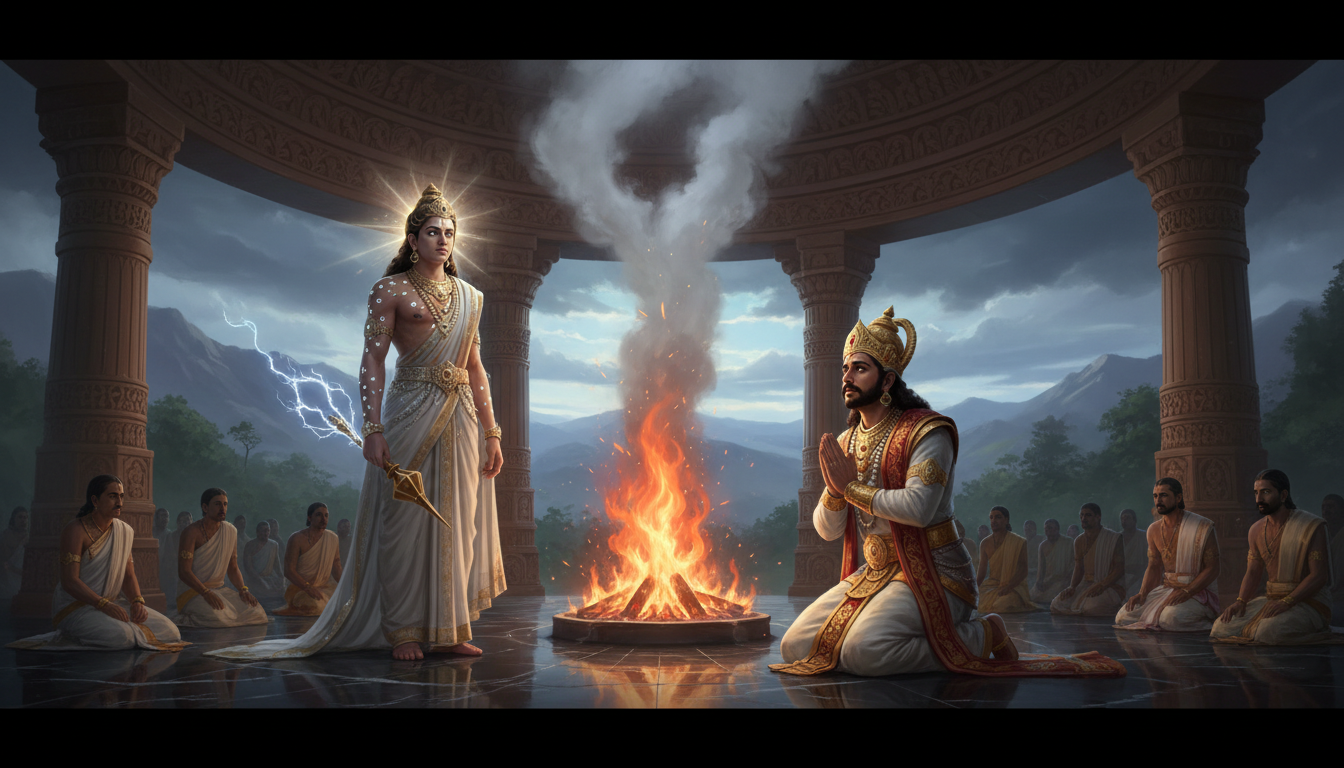
"So king Mandhatri, that ruler of the earth, performed a great sacrifice. He did not perform it for rain, or for a son, or for victory, or for a long life. He performed it from the desire of beholding the puissant Narayana, the god of gods, who is without beginning and without middle and without end. That was the whole object of the rite. He wanted to look at the face of the thing he had been serving.
"And in that sacrifice he worshipped the great Vishnu with humility."
The God Who Came Wearing Another God's Face
"And the Supreme Lord came.
"That is the first thing to hold on to, Yudhishthira, before you hear anything else. The sacrifice worked. He was not ignored, he was not put off, he was not told to come back in another life. The Lord of all came down to the fire of Mandhatri because Mandhatri had asked him to.
"But he came assuming the form of Indra.
"So the king who had spent his treasury and his years to see the face without beginning or end looked up from the altar and saw the king of the gods standing there. A great sight. The greatest sight, very nearly. The best of thrones, the thunderbolt, the Maruts behind him. Everything a devout man could want, except the one thing he had asked for.
"Mandhatri was accompanied at that sacrifice by many good kings, and all of them together offered their adorations to that puissant deity, and none of them knew what they were bowing to. Then a high discourse began between that lion among kings and that illustrious god in the form of Indra, and the subject of it was Vishnu of great effulgence, who was standing in front of them the whole time.
"And the god spoke first.
"'What is your object, foremost of virtuous persons, in seeking like this to behold that Ancient and First of gods, Narayana, of inconceivable energy and infinite illusions?'"
Neither I Nor Brahman Sees That Face
"And then, without waiting for the answer, he refused the request.
"'Neither myself,' he said, 'nor Brahman himself, can obtain a sight of that god of universal form.'
"Consider who is saying it and to whom. The Lord of all, wearing Indra's face, tells a mortal king that Indra cannot see him. He is describing his own inaccessibility in the third person, standing at arm's length from the man who wants him, and every word of it is true.
"'I shall grant you whatever other objects may be in your heart,' he said, 'for you are the foremost of mortals. Your soul abides in peace. You are devoted to righteousness. You have your senses under control and you are possessed of heroism. You seek unflinchingly to do what is agreeable to the gods. For the sake of your intelligence, and your devotion, and your high faith, I shall grant you whatsoever boons you desire.'
"That is a generous refusal, king, and it is still a refusal. The god had counted out the man's virtues one by one, the peace and the self control and the heroism and the faith, and had used the whole tally as the reason why he might have anything at all except the thing he had asked for.
"Now hear what Mandhatri did with an open offer from the Lord of the universe."
What the King Asked For Instead
"Mandhatri said, 'I bend my head for gratifying you.'
"He did not argue. He bent his head first, and only then, with his head down, he said the honest thing.
"'Without doubt, however, I desire to see the first of gods. Divine Lord, casting off all earthly desires, I wish to earn religious merit and to lead the foremost mode of life, that path of the good which is highly regarded by all.'
"He would not pretend the wish had gone away because a god had told him it was impossible. He said plainly that he still wanted it. And then he told the god what he was actually short of.
"'By exercising the high duties of a Kshatriya I have earned many regions of inexhaustible merit in the other world, and through those duties I have also spread my fame. I do not, however, know how to discharge those duties, the foremost in the world, that have flowed from the first of gods.'
"There is the whole of the man in that sentence, Yudhishthira. He had the merit. He had the fame. He had ruled an earth that the Danavas had stripped of its distinctions, and had ruled it well enough that heaven came down to his fire. And what he confessed, with a god standing in front of him and an open boon in his hand, was that he did not know what his own work was for or where it had come from.
"He asked for the duty. Out of everything in the three worlds, he asked to be told his job."
The Duties That Flowed First
"'They that are not kings,' the god answered, 'however observant they may be of their duties, cannot easily attain the highest rewards of duty. Kingly duties first flowed from the original god. Other duties flowed afterwards, from his body. Infinite were those other duties that were created afterwards, with the mode of life of the forest recluse among them, and the fruits of all of them are exhaustible.
"'Kingly duties are distinguished above them, because within them all the other duties are included. For this reason Kshatriya duties are said to be the foremost of all.'
"Then he gave the proof, and the proof was his own history, told about himself as though about somebody else.
"'In days of old, Vishnu, by acting according to Kshatriya duties, forcibly suppressed and destroyed his foes, and so afforded relief to the gods and to the Rishis of immeasurable energy. If the divine Vishnu of inconceivable energy had not slain all his foes among the Asuras, then the Brahmanas, and Brahman the Creator of the worlds, and Kshatriya duties, and the duties that first flowed from the Supreme deity, would all have been destroyed. If that first and foremost of gods had not, by putting forth his prowess, subjugated the earth with all her Asuras, then all the duties of the four orders and all the duties of the four modes of life would have perished together, because the Brahmanas would have perished. The eternal duties of men had all suffered destruction once. It was by the exercise of Kshatriya duties that they were revived.'
"So the God, wearing a borrowed face, explained to the king that God himself had once had to pick up a weapon and do the ugly, ordinary, indispensable work of clearing a world so that scripture could go on being recited in it. In every Yuga the duties of Brahmanas in respect of attaining to Brahma set in first, and in every Yuga they are protected by kingly duties. That is why the latter are regarded as the foremost."
What the Work Actually Is
"And then the god itemized it, because Mandhatri had asked to be told his job and a job is a list.
"'Casting away life in battle. Compassion for all creatures. Knowledge of the affairs of the world. The protection of men. Rescuing them from danger. Relieving the distressed and the oppressed. All these occur among the Kshatriya duties practised by kings.
"'Persons who do not regard wholesome restraints, who are governed by lust and by wrath, refrain from committing overt acts of sin only from fear of kings. Others, who are docile and of righteous behaviour, succeed in performing all their duties in consequence of the same influence. For this reason Kshatriya duties are regarded to be righteous. Without doubt, all creatures live happily in the world when they are protected by kings, like children protected by their parents.'
"He went further, in the way of a man who has decided to leave nothing out.
"'A king possessed of compassion for all creatures should regard these as the foremost of his duties: reclaiming land for cultivation and fertilizing it, the performance of great sacrifices for cleansing himself, a disregard for begging, and the protection of his subjects.'
"Mark the first of those, Yudhishthira. Before the sacrifices, before anything that shines, he named the draining and the manuring of ground. And mark the third. A king does not beg.
"'Abandonment is said by the sages to be the foremost of virtues,' the god said, 'and of all kinds of abandonment, that of the body in battle is the foremost. You have seen with your own eyes how the rulers of the earth, ever observant of Kshatriya duties, having duly waited upon their preceptors and acquired great learning, at last cast off their bodies engaged in battle with one another.
"'In adjudicating upon ordinary questions of right between his subjects, a king should be thoroughly impartial.'"
Bhishma stopped there for a moment. The field where he was lying was still marked from one end to the other by exactly the abandonment he had just quoted, and everyone present could see it.
And What of the Robber Tribes
"Now Mandhatri had listened to all of it," said Bhishma, "and the question he asked next is the reason I am telling you this history at all.
"He did not ask about his own house, or his own order, or the good and obedient people at the centre of his kingdom. He asked about the ones at the edges.
"'What duties should be performed,' he said, 'by the Yavanas, the Kiratas, the Gandharvas, the Chinas, the Savaras, the Barbaras, the Sakas, the Tusharas, the Kankas, the Pathavas, the Andhras, the Madrakas, the Paundras, the Pulindas, the Ramathas, the Kamvojas, and the several castes that have sprung up from Brahmanas and Kshatriyas, and the Vaisyas, and the Sudras, that reside in the dominions of Arya kings?
"'And what are the duties to the observance of which kings like ourselves should force those tribes that subsist by robbery? I desire to hear all of this. Instruct me, illustrious god. Chief of all the deities, you are the friend of us Kshatriyas.'
"He named sixteen peoples out loud and did not leave one of them out, and then he asked, not how to hunt the robbers down, but what duties a king should hold them to.
"And the god answered him in the same key.
"'All the robber tribes should serve their mothers and their fathers, their preceptors and their other seniors, and the recluses living in the woods. All the robber tribes should also serve their kings. The duties and rites inculcated in the Vedas should be followed by them as well. They should perform sacrifices in honour of the Pitris. They should dig wells and dedicate them to the use of everyone. They should give water to thirsty travellers, and give away beds, and make other seasonable presents to Brahmanas.
"'Abstention from injury. Truth. The suppression of wrath. The supporting of Brahmanas and of kinsmen by giving them their dues. The maintenance of wives and children. Purity. Peacefulness. These are the duties that should be practised by every person of this class who desires his own prosperity. These and similar duties were laid down for such persons in olden days. All those acts which have been laid down for everybody else are to be done by persons of the robber class also, O king.'"
Men in Disguise
"Mandhatri heard that and made one dry observation, which is the only time in the whole discourse that the king sounds like a man who has actually governed.
"'In the world of men,' he said, 'such wicked men may be seen living in disguise among all the four orders and in all the four modes of life.'
"He had been given a rule for the tribes on his frontier and he answered that the same character sits inside his own capital wearing a respectable coat, and that a king who thinks lawlessness lives only at the edges of the map has not looked at the middle of it.
"The god did not contradict him. He widened it.
"'Upon the disappearance of kingly duties and of the science of chastisement, all creatures became exceedingly afflicted, sinless one, through the tyranny of kings. After the expiry of this Krita age a confusion will set in regarding the different modes of life, and innumerable Bhikshus will appear with sectarian marks of many kinds. Disregarding the Puranas and the high truths of religion, men, urged by lust and by wrath, will deviate into wrong paths.
"'When sinful men are restrained from wicked acts by high souled persons with the aid of the science of chastisement, then religion, which is superior to everything and eternal and the source of everything good, becomes firmly established.
"'The gifts and the libations and the offerings to the Pitris of a man who disregards the king, who is superior to everyone, become fruitless. The very gods do not disregard a virtuous king, who is truly an eternal god. The divine Lord of all creatures, having created the universe, intended the Kshatriya to rule men in respect of their inclinations and their disinclinations regarding duty. I respect and worship that person who, aided by his understanding, watches the course of the duties performed by men. Upon such supervision rest the Kshatriya duties.'"
Then the God Went Home
"Having said those words," Bhishma finished, "the divine and puissant Narayana in the form of Indra, accompanied by the Maruts, repaired to his eternal abode of inexhaustible felicity.
"He did not put off the borrowed face at the end. There was no unveiling, no flowers falling, no true form blazing out over the altar for the good kings to fall down before. He talked about land reclamation and impartial judging and the wells that robbers ought to dig, and then he went home, and Mandhatri was left standing at a spent fire with a kingdom to run.
"The king never saw what he had asked to see. He was, however, the only man of his age who had been told directly by the first of gods what his own work was and where it had come from, which is not the same gift and is a larger one. He had asked for a face and had been handed a mandate, and the mandate was the face. That was the whole of the darshan he was going to get, and it was enough to rule an emptied world with.
"When duties as practised by the good had such a course in days of old, sinless one, what man of cleansed soul and of learning is there who would disregard the Kshatriya? Like blind men lost on the way, creatures who act and abstain unrighteously meet with destruction.
"Tiger among men, adhere to that circle of duties which was first set going and to which the ancients had recourse. I know, sinless one, that you are quite competent to do this."
Yudhishthira did not answer for a while. He had come out to the field every morning hoping, in some part of himself, for a word that would lift the thing off him, and had been given instead a list of tasks and an old man's flat assurance that he was capable of them.
Dharma Lesson
The vision a devout ruler asks for is usually refused and replaced with instructions, because the work is the darshan. A king who wants to know what he is serving is told to drain land, judge impartially, and hold even the robbers on his frontier to duties rather than merely hunt them.