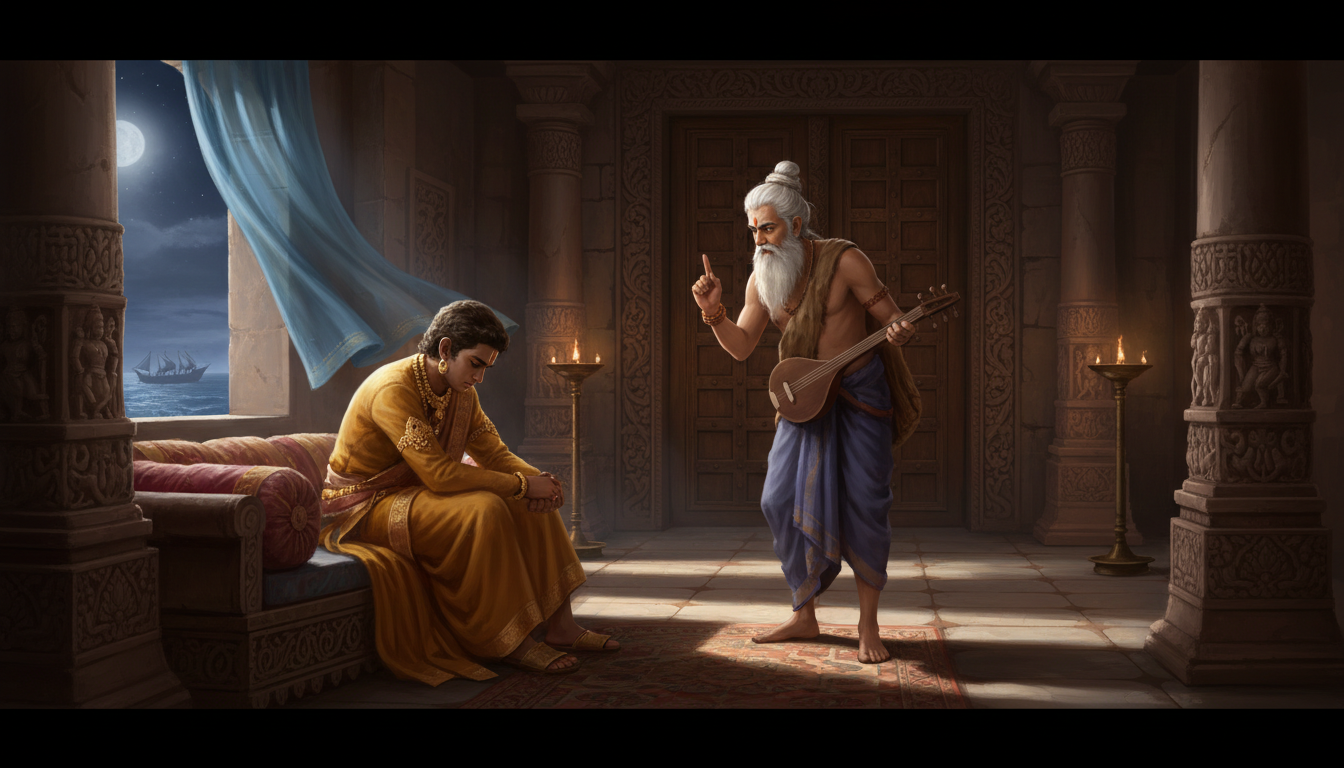
The Weapon Not Made of Steel
Krishna tells Narada what his own kinsmen do to him
The Question About Kinsmen
Bhishma lay on the bed of arrows with the winter sun coming down on him, and the sons of Pandu sat in the dust around him, and the questions went on. Yudhishthira had been asking about how a king should hold his friends, and the old man had just finished telling him about kinsmen, which is a different subject and a worse one.
"Thou shouldst fear thy kinsmen as thou shouldst fear death itself," Bhishma had said. "A kinsman can never bear a kinsman's prosperity, any more than a feudatory chief can bear to see the prosperity of his overlord. Nobody but a kinsman feels joy at the destruction of a kinsman who is adorned with sincerity and mildness and liberality and modesty and truthfulness of speech. And yet they that have no kinsmen cannot be happy either. No men are more contemptible than they that are destitute of kinsmen. A person who has no kinsmen is easily overridden by his foes, and when a man is afflicted by other men it is his kinsmen who are his refuge, because kinsmen cannot bear to see a kinsman injured by outsiders. In kinsmen, therefore, there are both merits and faults. Honour them in words and in acts. Do them agreeable offices and never injure them. Mistrusting them at heart, behave towards them as if you trusted them completely."
Yudhishthira had listened to all of that, and it had not satisfied him, because it did not cover the case he was actually afraid of.
"Grandsire," he said, "suppose a man does not succeed in winning over his own kinsmen and relatives by that course. Suppose the people who were intended to become his friends become his foes instead, and the enmity is inside the house. How should such a man conduct himself then, so that the hearts of both friends and foes may be won?"
The old man did not answer at once. When he did, he chose an example that must have cost him something, because the man in it was sitting a few feet away, and everyone present had spent thirteen years believing that particular man could not be defeated by anything.
"On this," said Bhishma, "the old history is cited of a discourse between Vasudeva and the celestial sage Narada. It was not spoken in an assembly. It was spoken between two men, and one of them was Krishna, and he was asking for help."
Krishna said nothing. Yudhishthira looked at him, and then back at the grandsire, and Bhishma began.
Who Deserves to Hear a Secret
Narada came to Dwaraka, as he came everywhere, and Krishna received him and sent the attendants out. When the two of them were alone he did not begin with the matter itself. He began by establishing, carefully, that he had thought about whom he was going to tell it to.
"Neither an illiterate and foolish friend," said Krishna, "nor a learned friend of fickle soul, deserves to know one's secret counsels. A man should speak to another only if he is convinced of that other's intelligence. Relying on your friendship for me, sage, I am going to say something to you. You can go to heaven at your pleasure. There is nowhere you cannot carry this and nobody you need it from."
Narada waited. He had heard confessions from kings, from Rishis, from the regents of the quarters, and he understood that a man who spends this long on the preface is a man who has never said the thing aloud before.
"I never behave with slavish obsequiousness towards my kinsmen," Krishna said. "I do not flatter them with speeches about their own prosperity. I give them half of whatever I have. I forgive their evil speeches. I have done all three of those things for years and they have bought me nothing."
"Go on," said Narada.
"As a fire-stick is ground by a man who wants fire out of it," said Krishna, "so is my heart ground by my kinsmen with their cruel speeches. That is what it is like. Not a blow, which ends. A grinding, done a little every day by somebody who has the right to be in the room, until something in the middle of it takes light.
"Those cruel speeches burn my heart every day, celestial Rishi. Every day. And there is no one in Dwaraka I can say that to, because everyone in Dwaraka is one of them."
There is an expression that Bhishma used elsewhere on that same field, when he was telling Yudhishthira what a king must never do to a man he has beaten: he must not cause wounds by wordy darts and shafts. And of a man cast off by his friends and companions he said that such a one is pierced repeatedly by the wordy darts of others, and has to burn with grief on that account. That was the weapon in use in Dwaraka. Nobody in that city had ever drawn steel on Krishna. They did not need to.
The Man Who Could Be Told
It is worth stopping on the preface, because Krishna once explained at length what he saw in the man he had chosen, and the person who asked him to explain it was Ugrasena.
That is the same Ugrasena who held half of the kingdom Krishna had given away.
"All persons seem to be very solicitous of speaking of the merits of Narada," Ugrasena said to him on that occasion. "I think that celestial Rishi must really be possessed of every kind of merit. Tell me this, Kesava."
And Krishna, chief of the Kukkuras, listed them, and the list is not what a man usually praises in a sage.
"Narada is as learned in the scriptures as he is good in his conduct," he said, "and on account of that conduct he never cherishes the sort of pride that makes a man's blood hot. Discontent, wrath, levity and fear do not exist in him. He never falls back from his own words through desire or through cupidity. He is free from guile and truthful in speech. He is free from envy and malice. He never rejoices at other people's misfortunes. He has never quarrelled with any man over anything connected with profit or with pleasure. He casts an equal eye upon all, and therefore there is nobody whom he loves and nobody whom he hates. He always speaks what is agreeable to the hearer. He observes the hearts of all men, which differ from one another, without blaming any of them. He never lets his time pass away fruitlessly, and he is never satiated with yoga."
Read that back with the trouble in mind. A man surrounded by kinsmen who grind him daily with cruel speeches chose, to confide in, the one being he knew of who did not rejoice at other people's misfortunes, who had never quarrelled about profit, who had no favourites and no enemies, and who could look into a heart without passing sentence on it. Krishna did not send for a strategist. He sent for the only person in the three worlds who had nothing to gain from the answer.
The Mother of Two Gamblers
He went through the house he had, naming its strengths one by one, the way a man counts what he owns when he is about to explain that none of it is any use to him.
"Might resides in Sankarshana," he said. "My brother has strength that no one in the three worlds can stand against. Mildness resides in Gada. As for Pradyumna, my own son surpasses even me in beauty of person. And with all these on my side I am helpless, Narada.
"There are many others among the Andhakas and the Vrishnis possessed of great prosperity and might and courage and constant perseverance. He on whose side they do not range themselves meets with destruction. He on whose side they do range themselves achieves everything. That is the plain arithmetic of my city, and it is why nothing in it can be settled by being right.
"And I am dissuaded by both of them in turn, so I side with neither. Ahuka comes and tells me to have nothing to do with Akrura. Akrura comes and tells me to have nothing to do with Ahuka. Each of them loves me. That is the difficulty. If either of them hated me I would know what to do. What can be more painful for a man than to have both Ahuka and Akrura on his side? And what can be more painful than not to have either of them?"
He stopped, and then he found the comparison he wanted, and it was not a warrior's comparison at all.
"I am like the mother of two brothers who are gambling against each other," he said, "and who invokes victory for both of them. Whichever way the dice fall she has lost a son's fortune, and she has to be glad about it in front of the winner. I am afflicted by both, sage. It behoves you to tell me what is for the good of myself and of my kinsmen together, because I cannot at present see how those two can be the same thing."
This One Is Internal
"Calamities, Krishna, are of two kinds," said Narada. "External and internal. They arise either from one's own acts or from the acts of others. The calamity that has now overtaken you, son of the Vrishni race, is an internal one, and it is born of your own acts. I am going to say the second part plainly, because you did not send the attendants out in order to be flattered.
"Valadeva and the others of the Bhoja race are partisans of Akrura. They have taken up his side, some of them for the sake of wealth, some out of mere caprice, some because they were moved by things that were said to them, and some out of hate. That is how such parties are always made, and there is nothing in that list you can argue with. A man who has joined a side for wealth can at least be outbid. A man who has joined it out of caprice cannot be reasoned off it, because there was never a reason there to begin with.
"Now consider your own part in it. You had men about you who should have been your friends. You have given away to another the wealth that came into your hands, and by that act, your own act, you have brought this calamity down upon your own head."
Krishna did not deny it. Narada went on, and put the thing beyond remedy in a single sentence.
"You cannot take that wealth back. A man cannot swallow again the food he has vomited up himself. The kingdom cannot be taken back from Babhu and Ugrasena now that it has been given to them, and you least of all can take it back, for fear of producing dissension inside your own walls."
Suppose the Attempt Succeeds
"Suppose you tried," said Narada. "I will grant you the best case. Suppose the endeavour succeeds. It will succeed only after much trouble and after the accomplishment of the most difficult feats. There will be a great slaughter and a great loss of wealth, and perhaps, at the end of it, total destruction. You will have won back a city with nobody left in it worth ruling.
"You are the one man in Dwaraka who could do it. That is exactly why you must not. The others may quarrel and be contained, because none of them is strong enough to break the thing beyond mending. You are."
Krishna sat with that a while. "Then what is left to me?" he said. "You have taken away the kingdom, which I gave away myself. You have taken away the sword, since I may not use it inside my own house. You tell me the parties are fixed and cannot be reasoned out of their positions, and you are right, because I have tried it. What is left?"
"Use a weapon that is not made of steel," said Narada. "It is very mild, and it is capable of piercing all hearts. Sharpen it, and sharpen it again, and with it correct the tongues of your kinsmen."
Krishna looked at him. "What weapon is that, sage," he said, "which is not made of steel, which is mild, which still pierces all hearts, and which I must use for correcting the tongues of my kinsmen? Name it."
The Weapon Named
"The giving of food to the best of your power," said Narada. "Forgiveness. Sincerity. Mildness. And honour paid to whoever honour is due to. These five constitute a weapon that is not made of steel.
"With soft words alone turn away the anger of kinsmen who utter cruel speeches. Mollify their hearts and their minds and their slanderous tongues. You have been doing part of this already, giving them half of what you have and forgiving what they say, and it has not worked, and you conclude that it does not work. It has not worked yet. That is a different statement, and the difference between the two is the whole of your remaining life.
"Hear the rest of it, because the giving is only half. Nobody who is not a great man with a cleansed soul, possessed of accomplishments and of friends, can bear a heavy burden. Take up this great weight, the governing of the Vrishnis, and bear it upon your own shoulders. All oxen can carry a heavy load on a level road. Only the stronger ones among them can carry such a load on a difficult road. You have been on a level road until now, and you have mistaken the road for your own strength."
He said the last part slowly, because it was the reason he had come.
"From disunion, destruction will spring, and it will overtake all the Bhojas and all the Vrishnis. You are the foremost one among them. Act in such a way that the Bhojas and the Vrishnis do not meet with destruction. Nothing but intelligence and forgiveness, restraint of the senses and liberality, is present in a man of wisdom. The advancing of one's own race is always praiseworthy and glorious and conducive to long life. Act, Krishna, in such a way that destruction does not overtake your kinsmen."
There Is Nothing Unknown to You
"There is nothing unknown to you in respect of policy and the art of war," Narada said. "I have not come here to teach you either one. The Yadavas, the Kukuras, the Bhojas, the Andhakas and the Vrishnis are all dependent upon you, as the worlds and the regents of the worlds are. The Rishis always pray for your advancement. You are the lord of all creatures. You know the past, the present and what is coming. You are the foremost one among all the Yadavas, and relying upon you, they expect to live in happiness."
It is a strange thing to say to a man who has just described himself as helpless, and Narada meant it exactly as it sounded. Every name in that list was a name of somebody entitled to speak to Krishna however he liked at dinner. The dependence and the insolence were the same relationship seen from two ends.
"That is what makes your position what it is," he said. "A smaller man in your place could take a side, and the city would survive it. You cannot take a side, and this is not a limitation upon your power. It is the shape your power takes inside your own house."
And Krishna, who had been beaten by no enemy in the field and by no weapon anywhere, took the counsel of the man who had told him to go on being patient with people who spoke ill of him at his own table. The sage went away, going where he pleased, as he did. The city stayed as it was. Ahuka and Akrura kept their parties, and Krishna gave away half of what he had, and forgave what was said, and paid honour where it was due, and Dwaraka stood.
What Bhishma Meant By It
"That is the history," said Bhishma from the bed of arrows. "Now consider why I told you that one and not another.
"You asked what a man should do when the people who ought to have been his friends have become his foes, and when they are his own blood. Every answer you will get from a book on kingcraft assumes that the enemy is outside the wall. Against a man inside the wall the four means fail one after another. Conciliation looks like weakness to a kinsman, because he has known you since you were a child and he will not be impressed by your face. Gifts look like a bribe, and are pocketed, and are remembered afterwards as tribute owed. Sowing dissension is absurd, because the house is already divided and you would only be assisting. And the rod, the fourth means, is the one you cannot lift, because when a king brings down the rod inside his own family, the kingdom is what gets struck.
"So there remains what Narada named. Food given. Insults forgiven. Plain dealing. Mildness. Honour paid where it is owed. Five things, none of them clever, and not one of them will ever be praised by the people it is used on, because to them it will look like nothing happening.
"It looks like doing nothing. It is the hardest of the labours, and the proof of that is the name of the man who had to do it. He was Krishna. He could not think of it himself, and he had to be told, and he had to be told at night with the doors shut."
Yudhishthira had a hundred dead cousins and a small number of surviving kinsmen to govern, including a blind old king who had lost every son to him and would sit at his table every evening for the rest of his life. He understood what he was being handed.
The Warning That Was Not Wrong
There is one more thing to be said about that night in Dwaraka, and the men who heard Bhishma tell the story were not in a position to say it, because it had not happened yet.
Narada had told Krishna plainly that from disunion destruction would spring, and would overtake all the Bhojas and the Vrishnis. He had not said it as a figure of speech, and he had not said it as a threat. He said it the way a physician says a thing when he has seen the disease before and knows its course.
And Krishna took up the burden and carried it on the difficult road, and gave and forgave and paid honour, and it held for a long time. It held for exactly as long as he was willing to keep sharpening a weapon that made no sound. What the sage had described was not a cure. It was a course of treatment that had to be continued daily, forever, by one man, and everything depended on that man not putting it down. Nothing in Narada's answer removed a single cause of the quarrel. Ahuka still hated Akrura on the morning after that conversation, and the Bhojas were still Akrura's, and the cruel speeches were made again at the next meal.
That was what Bhishma was handing Yudhishthira on the field of Kuru, along with the crown. Not a policy that would settle the matter, but a discipline that would postpone it, and the knowledge, stated plainly by a sage to the one man who could not be defeated, that the quarrels a man cannot win are the ones inside his own house, and that against those the only instrument that works is the one which looks, to everybody watching, exactly like giving in.
Dharma Lesson
The quarrels a man cannot win are the ones inside his own house, where the four means of policy all fail and the rod strikes the kingdom that holds it. What is left is food given, insults forgiven, plain dealing and honour paid where it is owed, which looks to every onlooker like giving in. It is not a cure but a treatment, and it holds only for as long as one man keeps taking it up each morning.