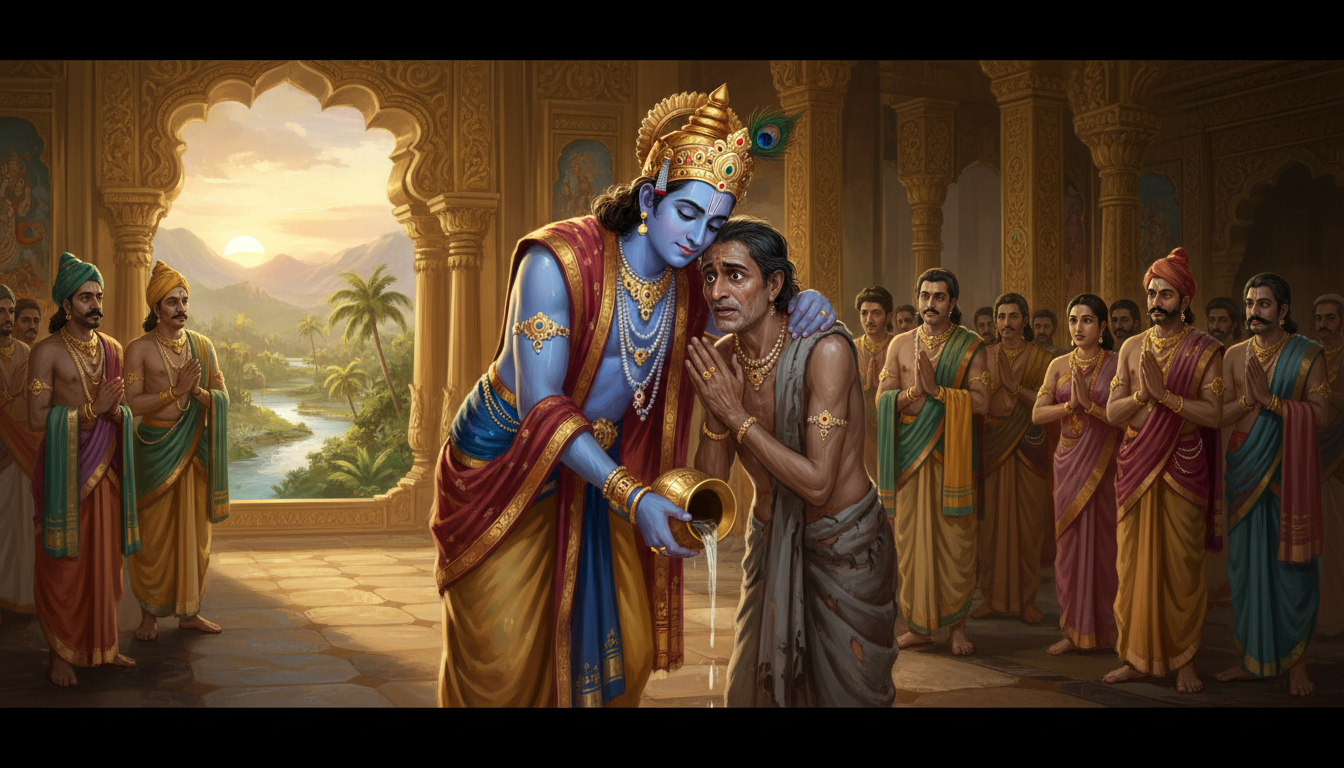
What Narada Told Against Himself
For days after the war Yudhishthira would not eat with his brothers. He sat apart on the bare ground at the edge of the camp, facing the field, and when anyone came near he answered in the fewest words the courtesy of the moment allowed.
Krishna came and sat down beside him on the same ground, without any ceremony, as though the two of them were cowherds resting.
"You are polishing it," he said.
Yudhishthira turned his head.
"Your grief," said Krishna. "You take it out every morning and you polish it, and by evening it shines a little brighter than the day before, and you tell yourself that this is repentance. It is not. Repentance gets up. Grief that never gets up is only another way of being the most important man in the story."
"You are hard today," said Yudhishthira.
"I am tired," said Krishna, "and so are you, and there is a kingdom lying out there with nobody in charge of it. Let me tell you something instead. It is a story Narada told me, and mark this before you hear it: he told it against himself. He tells it that way in every assembly he enters, and he never shortens it. He has been to every world there is. He is honoured at the doors that open for nobody. And the tale he chooses to tell about himself is the one where he behaved worst and looked ridiculous. There is a whole teaching in that before the story even begins."
Yudhishthira drew his knees up and rested his arms on them, which was as close as he had come in a week to sitting like a man listening.
"Tell it, then," he said.
The Vow Between Friends
There were two who wandered the worlds together in those days: Narada, and Parvata, who was his sister's son. They travelled as one man travels with his own shadow. They ate at the same fires, slept under the same trees, went up into heaven together and came down together, and there was no assembly of gods or kings where one was welcome and the other was not.
One evening, in the way of people who love each other and want to make it permanent, they made a compact. Narada spoke it first and Parvata repeated it.
"Whatever thought arises in the mind of either of us," they said, "good or evil, large or small, creditable or shameful, he shall speak it to the other and hide nothing. And whichever of us conceals a thought from the other, let him be cursed by the other, and let the curse hold."
They swore it with water in their hands, and for a long time they kept it, and it was easy to keep, because nothing had yet arisen that either of them minded saying.
In their wandering they came at last to the court of King Srinjaya, who received them as a man receives good fortune walking in at his door. He set aside a house for them, and asked them to stay as long as the world allowed.
"We will stay," said Narada, "on one condition, and you must weigh it before you agree. Sages are not comfortable guests. We ask for strange things at strange hours and we say what we see. You must never be angry with us, whatever we say and whatever we ask. If you cannot promise that, feed us today and let us go tomorrow, and we will part as friends."
"I promise it," said Srinjaya, "and I will hold to it."
The king had a daughter, Sukumari, and to honour his guests he gave her the duty of attending them. She brought their water and their fruit and swept the place where they sat, and she did it with such quiet good grace that neither of them, at first, thought about her at all.
The Thought He Kept
It began the way such things always begin, without an announcement. One morning Narada noticed that he had been watching the door for a while before she came through it. By the next month he knew that he loved her, and knew it as plainly as he knew the hymns.
He should have said so that same hour. That was the whole of the vow, and the vow had cost him nothing until it began to cost him something. He decided to speak in the evening, and in the evening he decided to speak the next day, and the days went by and he carried the thing folded up inside him and told himself that it was too small to matter, which is the lie such things are always told.
Parvata had a sage's eyes. He watched his uncle for a while. Then one afternoon he stood up in the middle of a sentence and his face had changed.
"We swore," he said. "You swore first. I only repeated it after you. Whatever arises, however shameful. And you have sat beside me every night for a month with your heart full of the king's daughter and you have talked to me about the weather."
"Parvata -"
"You lecture gods about truth. Indra listens to you. And you could not say four words to me." His voice was shaking. "Take her, then. The king will give her to you and you know it, and I know it too. But hear this. From the day she becomes your wife you will carry the face of an ape on your shoulders, and every eye that turns to you will see it, and hers first of all."
The air in the room went thin. Narada stood up slowly.
"You have cursed me," he said, "for a thought I never acted on, and you did not ask me once whether I was ashamed. So take mine, and let it hold as long as yours does. For all your penance, for all your truth-telling, for all the vows you have kept and I have not - heaven shall be shut against you. You shall not go up."
Parvata walked out of the house and out of the city, and the friendship of ages ended over a thing that had never been said.
The Wife Who Did Not Flinch
In time King Srinjaya gave his daughter to Narada, and Sukumari came to the fire gladly, for she had watched him a long while and had made up her mind about him without anyone's help.
The rite was finished. The last grain went into the flame. And as Narada turned to take his wife's hand, the whole assembly made a sound and then made no sound at all, for the face above his shoulders was the face of an ape: the low brow, the heavy jaw, the small bright unhuman eyes.
Her women got her away into an inner room and wept over her. "Say the word and the king will undo it," they said. "You were given to a sage, not to that. No one will blame you. Not one person in this hall would blame you."
Sukumari heard them out. Then she said, "I walked round the fire with the sage Narada. I gave myself to him and not to his face. If it is changed, it is changed; I did not marry a face. And if Indra himself were standing in the courtyard this minute with all his beauty on him, I would not lift my eyes to look."
She went back out, and took her husband's hand in front of everybody, and led him to his seat.
What followed was many years of ordinary days, which is where devotion actually lives. She served him his food and never once arranged her expression before she looked up. She went with him on his wanderings, and slept where he slept. In villages the children ran after them and made ape noises, and she walked beside him at exactly the same pace, neither hurrying nor slowing, and did not turn round.
And Narada, who had walked in all three worlds, who had been honoured at the door of every hall that exists, and who had never in the whole of his long life been laughed at, learned by carrying it what one folded, unspoken thought had cost him - and learned, at the same time, from a girl half his age, what it looks like when somebody has decided.
Both Curses Withdrawn
Parvata wandered alone, and his own curse worked in him. He would rise toward heaven out of habit and find the way shut, like a man walking into a door in the dark.
At last he came through a forest and saw, at a hermitage by the water, an ape-faced man sitting on a mat of grass, and a woman coming up the bank with a jar; and the way she set it down told him everything about how the years had gone.
He walked into the clearing and fell at Narada's feet.
"Forgive me," he said. "I cursed you in a rage, for a thought, and made you wear it in front of the world. It is not the shut gate that has been eating me."
Narada raised him up. "You cursed me for a broken vow," he said, "and the vow was broken. I broke it. Forgive me, and take back what you laid on me, and I will take back mine."
"Let it be gone," said Parvata.
"Let it be gone," said Narada.
And the face he was born with came back onto his shoulders.
Just then Sukumari came up from the river and saw a stranger of great beauty sitting on her husband's mat, and her husband nowhere in the clearing. She set her jar down so hard the water jumped, and turned to run.
"Do not run, child," Parvata called after her, laughing. "Come back. That is your husband, wearing the face he was born with."
She came back a step at a time, and knew him.
Parvata took his leave that evening, and went up, and heaven opened for him.
On the field of Kurukshetra, Krishna looked at his friend.
"Two things," he said. "What a man will not say to the one person he swore to tell everything does not stay small. It waits, and it comes back wearing a face. And the second: she never had to decide, that day, whether to be faithful. She had decided long before. So when the face changed, it was only a face."
He stood, and put out a hand.
"You look at what this field made of you and you think it is your face now. Wear it the way she wore his - without arranging your expression, and without slowing down. Get up. There is a kingdom out there with nobody in it."
Dharma Lesson
A vow of openness between friends is broken by silence as surely as by a lie, and what is hidden from a friend does not stay small - it grows until it wears a face. Narada, who taught the gods to speak truly, had to carry an ape's head to learn it in his own body. Sukumari shows the other half of the lesson: love given to a person rather than to a form is not disturbed when the form changes.