The Question on the Field of Arrows
The great war was over, and the plain of Kurukshetra had gone quiet in a way that was worse than noise. Bhishma still lay on the bed of arrows that Arjuna had made for him, waiting for the sun to turn northward, and every day the sons of Pandu came and sat in the dust beside him and asked their questions.
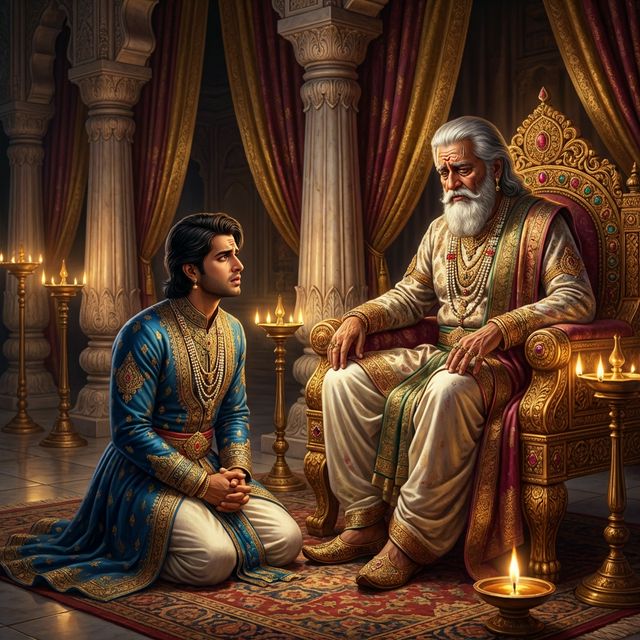
Yudhishthira sat nearest. He had won the earth and could not bring himself to look at it. "Grandsire," he said, "men come to me with garlands and call me king. I have killed my teacher. I have killed the sons of my father's brother, and a brother I did not know was my brother, and boys who had no beard yet. At night I hear the women in the camp. Tell me plainly, and do not comfort me. Is there any water anywhere in the world that washes such a stain out of a man, or must he carry it with him into the fire?"
Bhishma's eyes moved slowly toward him. "You have asked a good question badly," he said. "You want me to tell you that you are innocent. I cannot, and if I could it would do you no good. But there is a thing better than innocence, and it has a name: prayaschitta, the making of amends. A man who does not know he has sinned is past helping, for he has nothing in his hands to work with. A man who knows and hides it is worse off still, because the thing feeds in the dark. But a man who says aloud what he has done, in front of those with the right to judge him, has already turned his face the other way. The road from there is long. It has an end."
"Has anyone walked it?" Yudhishthira asked.
"One of our own house," said Bhishma. "There was a king of the Kurus called Janamejaya - not the child who will one day carry that name in your line, but an elder, long before us. Listen."
The Stain That Would Not Wash
He was, for a while, a good king. He kept the borders, he kept the fires, he fed brahmanas at his gate and heard the cases of poor men without making them wait a second day. The bards had begun to make songs about him.
Then came the moment, and the old tellers never trouble to make it large, because such moments never are. A brahmana crossed the king's will over some small matter that neither of them would have remembered by evening. Janamejaya, who had never learned that a king's hand is heavier than other hands, struck out in a flash of temper. The man fell, and did not get up.
He had not meant to kill. He had meant only to be obeyed. That was the whole of it, and it changed nothing, because a brahmana was dead by a kshatriya's hand, and the sin of brahmahatya does not ask what was intended.
It came upon him the way the tellers describe it, as a shape that walks behind a man and is not there when he turns. His own priest set down the ladle in the middle of a rite and walked out of the fire-house without speaking. The offerings would not take. The ghee sat on the flame and refused to burn. His counsellors found reasons to be in other provinces. His kinsmen sent word that they were ill. And then the people, who had loved him, began to go: first the households near the palace, then the market streets, then whole quarters, until the city stood with its doors open and its lamps unlit and nobody in it but a king.
He rode out of his own capital in the morning. Wherever he went the story had arrived before him. Gates that had been opened to him for years closed while he was still in sight of them. He would say, "I am Janamejaya of the Kurus," and the name that had once been a passport was now only another way of saying: go somewhere else.
Away From My Fire
He wandered a long while, thin, sun-blackened, sleeping where cattle slept. At last, following a smell of sacrificial smoke through the trees, he came to the hermitage of Indrota, the son of Shunaka, who was seated at a great sacrifice with a hundred brahmanas around the fire.
Janamejaya walked in among them and put his forehead on the sage's feet.
Indrota stood up as though something unclean had touched him. "Away," he said. "Do not lay a hand on me. Get back from this fire before you spoil what a hundred men have spent a month building. I know your name and I know your act. You are the killer of a brahmana."
The hundred sat still. Kings had burned hermitages for less.
"You were born of a line that has held the earth," the sage said, and his voice went through the clearing like a whip drawn slowly. "You have burnt that birth to ash. Your ancestors turn their faces from the water you offer. The gods do not eat what you cook. What is your umbrella worth now, and your chariots, and your drums? A dog kills from hunger and is cleaner than you, for you killed from temper, which is hunger with a crown on it. Do you imagine you may come here and stand in the smoke a while and go home clean? Take yourself where no righteous man has to see you. Even the deer will not drink downstream of you. Go."
He stopped. The fire snapped. Everyone in the clearing waited to see the king remember that he was a king.
The King Who Did Not Argue
Janamejaya did not rise. He stayed in the dust with his hands together.
"Every word is true," he said, "and you have said less than the truth, because you did not see his face and I did. I have no defence. I did not intend it - and I have learned what that is worth, and it is worth nothing, since the man is equally dead either way. I did not come here to be told I am innocent. I came because I am guilty and I have carried it from one end of this country to the other and I cannot carry it any further. I do not ask for my kingdom. I do not ask for heaven. I ask whether there is a way for a man like me to be made clean. If there is not, say so, and I will go and lie down somewhere quiet and be finished."
Indrota looked at him for a long time, and the anger went out of his face the way heat goes out of iron.
"Rise," he said. "What I said, I said to learn whether you would answer me with your army. You answered with the truth, unsoftened, and a man who can do that is already half out of the pit. Now hear the work, for it is work and not a word.
"Say what you did. Say it aloud in every assembly you enter, and never let another man tell it for you, and never make it smaller in the telling. Put off the ornaments and the umbrella. Live rough, eat once a day, sleep on the ground, and keep the austerities I set you for their full term without shortening them by a day. Give: land, cattle, gold, grain, to brahmanas and to the hungry - not to buy pardon, for pardon is not sold, but because you owe the world more than you took from it. Then go back and rule. Guard the weak. Hear the cases yourself. And never again lift your hand in anger, not once, not against anyone. A king's expiation is the safety of his subjects.
"And when all that is done, loose the horse. Perform the ashvamedha, and I will stand as your priest. Before the fire is lit you will say your crime in the hearing of every man there."
The Horse Loosed, the Word Spoken
He did all of it, and it took years.
He went back to the empty city and sat in it alone. He kept the austerities. He gave away herds, and wells, and whole villages of revenue, and when the granaries were opened in a bad season he stood at the door himself and counted out grain until his arms shook. The first man to speak to him without turning away was a herdsman who wanted a dispute settled about a calf, and the king heard him out sitting on the ground, and gave judgment against the man's neighbour, and the herdsman went home and told the story. After that the doors began, slowly, to open again. Families came back to the quarters near the palace. The market relit its lamps.
At last the horse was loosed, and it wandered a year with the army behind it. On the day of the sacrifice the ground was full: kings, brahmanas, herdsmen, the widow of the dead man's household, who had been sent for and given a seat where she could see. Indrota stood by the fire and said nothing.
Janamejaya rose and told them what he had done. He did not say that he had been provoked. He did not say that he had been young. He said what he did, and to whom, and in what temper, and then he sat down.
Then the fire was lit, and it took the offering, and it burned clean and upward. When the rite was finished the thing that had walked behind him for so many years was not behind him any more. He ruled a long time after that, and he never struck a man again.
On the field of Kurukshetra, Bhishma stopped speaking.
"You asked for water," he said. "There is no water. There is only the whole of the rest of a life, offered up."
Yudhishthira was quiet for a while. "Then what is my horse sacrifice, grandsire?"
"Rule," said Bhishma. "Feed people. Hear the cases yourself, and hear the ones you will not enjoy hearing. And when the poets come to ask what happened on this field, tell them the truth, and do not make yourself smaller in it than you were."
Yudhishthira lifted his head. What came into his face was not comfort. It was the look of a man who has been given something to do.
Dharma Lesson
No act is beyond amends, but amends are not a word - they are the rest of a life. Janamejaya was not purified by insisting that he had not meant it; he was purified by saying plainly what he had done and then spending years repairing the world he had damaged. Confession before those with the right to judge is where expiation begins, and the protection of the weak is where a ruler's expiation ends.