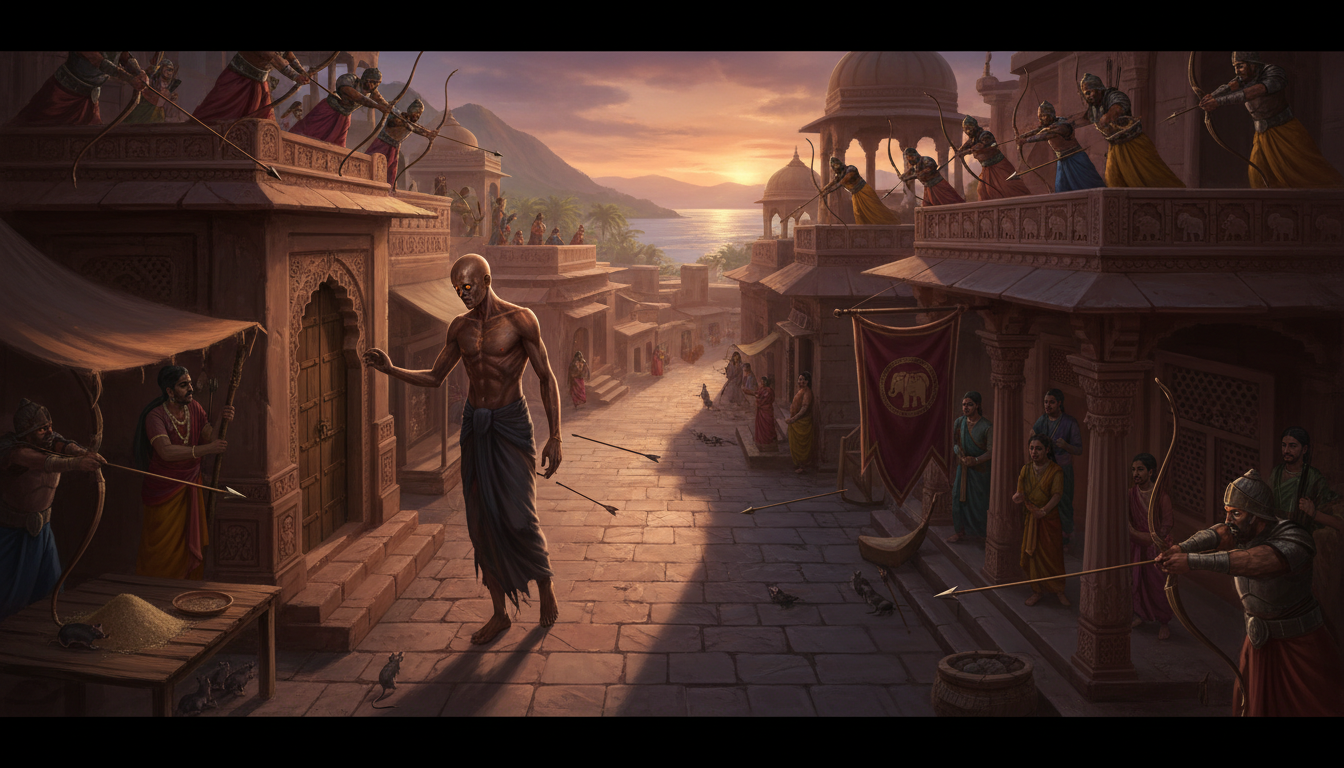
The Man Who Could Not Be Shot
Vaishampayana said: While the Vrishnis and the Andhakas were still trying to get out from under the curse, the embodied form of Time walked their streets every day.
He looked like a man of terrible and fierce aspect. His head was bald. He was black, and of a tawny complexion, and he went along the lanes of Dwaraka at his own pace, and at the houses he stopped and put his face to the openings and looked in.
Sometimes a Vrishni saw him doing it. Then the word went through the quarter, and the mighty bowmen of that race, men who had broken the armies of Kalinga and Magadha and had made the king of Kasi sit down, came out into the street with their bows already strung.
They shot hundreds of shafts at him. They shot thousands. Not one of them succeeded in piercing him. He stood there while the arrows came off him and fell around his feet like water off a roof, and when the quivers were empty he turned and walked on to the next house and looked in at that one.
He was none else than the Destroyer of all creatures. There is no arrow made that will go into him.
Janamejaya said: "Indeed, O holy one, how was it that the Andhakas along with the Vrishnis, and those great car-warriors the Bhojas, met with destruction in the very sight of Vasudeva? He was among them. He was standing in that city. How did such a thing happen while he watched it?"
Vaishampayana continued: "When the thirty-sixth year was reached after the great battle, a great calamity overtook the Vrishnis. Impelled by Time, they all met with destruction in consequence of an iron bolt. But before the bolt, O king, hear who made it, and what was said over it, and what they did to be rid of it, and what it did to them anyway."
The Boy in the Veil
One day the Vrishni heroes, with Sarana among them, saw that Vishvamitra had come to Dwaraka, and Kanwa with him, and Narada.
They were young men, and they had been afflicted by the rod of chastisement wielded by the deities, though none of them knew it yet, and what occurred to them was a joke. They took Samba, the son of Krishna and Jambavati, and dressed him as a woman. They put bangles on him and a veil over his face and bound a cushion under the cloth at his waist so that he stood in front of the three ascetics looking heavy with child.
"This one," they said, "is the wife of Vabhru of immeasurable energy, who is desirous of having a son. You Rishis know for certain what is hidden. Tell us what this one will bring forth."
The three looked at the veiled figure, and then at each other, and their eyes went red with wrath.
"This heir of Vasudeva, by name Samba," they said, "will bring forth a fierce iron bolt for the destruction of the Vrishnis and the Andhakas. You wicked and cruel ones, intoxicated with pride, through that iron bolt you will become the exterminators of your own race, with the exception of Rama and Janardana. The blessed hero armed with the plough will enter the ocean, casting off his body. And a hunter of the name of Jara will pierce the high-souled Krishna while he is lying upon the ground."
Then they walked past the young men, who were no longer laughing, and went to see Keshava.
Krishna heard what had been done and what had been answered. He summoned all the Vrishnis and told them of it himself, in his own voice, so that no man of that race could ever say he had not been informed. Then he said the only thing he was going to say about it, which was that that which was destined would surely happen. And he entered his mansion.
The Lord of the universe did not wish to ordain otherwise.
When the next day came, Samva actually brought forth an iron bolt.
Powder Cast Into the Sea
The thing was reported to the king, and Ugrasena, in great distress of mind, did what any sensible ruler would have done. He had the bolt brought in and examined. It was a fierce shaft of iron that looked like a gigantic messenger of death, and it had come out of the body of a young man of his own house, and it had a curse spoken over it by three of the greatest Rishis alive.
So he caused it to be reduced into fine powder. Not broken. Not buried. Ground down to dust, so that there should be nothing left of it that could be picked up and used. Then men were employed to carry that powder out and cast it into the sea, and they did, and came back and reported that it was done.
After that came the second measure. At the command of Ahuka, of Janardana, of Rama, and of the high-souled Vabhru, it was proclaimed throughout the city that from that day forward, among all the Vrishnis and the Andhakas, no one was to manufacture wines or intoxicating spirits of any kind. The penalty was set out so that no one could mistake it. Whoever secretly made wine or spirits would be impaled alive, and all his kinsmen with him.
They knew what the Rishis had said. They knew that the destruction was to come by the iron bolt. They had put the iron bolt into the sea and put drink under sentence of death, and they were a people who obeyed their king and revered Rama of unimpeachable deeds, and so all the citizens bound themselves by that rule and abstained.
It is possible to grind a curse into powder. It is not possible to repeal it. The sea keeps what is given to it, and gives it back on its own schedule, in its own form, and the men who cast the powder in were themselves standing on the shore when it came back.
And while all this was being arranged, in the streets behind them, the bald man with the tawny skin went on looking in at the windows.
Rats in the Roads
Day by day strong winds blew, and many were the evil omens that arose, awful and foreboding the destruction of the Vrishnis and the Andhakas.
The streets swarmed with rats and mice. They came up out of nothing, in the daylight, in numbers no cat could work through, and they went over the roads of the richest city in the world like a moving floor. At night they got into the houses, and men who slept woke to find their hair gnawed away in patches and their nails eaten down, and nothing but the rats to blame for it.
Earthen pots showed cracks, or broke outright, from no apparent cause. A woman would set a jar down on a level floor and it would come apart in her hands.
The Sarikas chirped inside the houses, and the noise those birds made did not cease for even a short while, by day or by night. The Sarasas were heard imitating the hooting of the owl. Goats imitated the cries of jackals. Many birds appeared, impelled by Death, that were pale of complexion but that had legs red of hue, and they came into the courtyards and would not be driven off. Pigeons disported themselves in the houses of the Vrishnis as though they had been invited.
And the animals stopped bringing forth their own kind. Asses were born of kine. Elephants were born of mules. Cats were born of bitches, and mice of the mongoose. A herdsman would go out at dawn to a cow that had calved in the night and find a thing standing there on the wrong legs, and would come back and say nothing about it, because by that time every man in the city had seen something he did not wish to describe.
The Signs That Were in the People
The worst of the omens were not in the sky and not in the byres. They were in the Vrishnis themselves.
They committed sinful acts and were not seen to feel any shame at them. They showed disregard for the Brahmanas, and for the Pitris, and for the deities. They insulted and humiliated their preceptors and their seniors, the men who had taught them the use of the bow and the order of the sacrifice, and they did it in the open and thought nothing of it afterwards. Wives deceived their husbands, and husbands deceived their wives, and both sides carried it lightly.
Only Rama and Janardana acted differently. In the whole of that shining city, two men.
And the world around them answered. Fires, when they were ignited, cast their flames towards the left; sometimes they threw out flames whose splendour was blue and red. The Sun, whether rising or setting over the city, seemed to be surrounded by headless trunks of human form. In the cook rooms, upon food that was clean and well boiled, when it was served out for eating, there were seen innumerable worms of diverse kinds, crawling out of a dish that a moment before had been fit for a king.
When Brahmanas, receiving gifts, blessed the day or the hour fixed for an undertaking, and when high-souled men sat engaged in silent recitation, there was heard all around them the heavy tread of innumerable men running, and no one could be seen to whom the sound of that running could be ascribed.
The constellations were repeatedly seen to be struck by the planets. And no Yadava, looking up on any night of that year, could find in the sky the constellation of his own birth. It had gone out of the heavens, or it had gone out of him. Each man discovered it alone, standing in his courtyard with his head back, and it is likely that most of them did not mention it either.
When the Panchajanya was blown in their houses, asses of dissonant and awful voice brayed aloud in answer from every direction.
The Fourteenth Made the Fifteenth
Hrishikesa had been reading the calendar.
The day of the new moon that year fell where it should not have fallen. The thirteenth lunation and the fourteenth had come together in the same fortnight, so that the day that ought to have been the fifteenth from the first lunation arrived two days early, and the eclipse would come on a day that had never been meant to carry one.
He summoned the Yadavas and told them what he had found.
"The fourteenth lunation has been made the fifteenth by Rahu once more," he said. "Such a day had happened at the time of the great battle of the Bharatas. It has once more appeared, it seems, for our destruction."
They knew what he meant. Every man in that hall had heard how Yudhishthira had stood and noted such awful omens when the two armies were arrayed against each other in order of battle, thirty-six years ago, on the field where the Kurus went into the ground.
The slayer of Keshi, thinking upon the omens that Time was showing him, understood that the thirty-sixth year had come, and that what Gandhari had said was now about to transpire. She had said it burning with grief for her hundred sons, standing over the bodies with her eyes bound and her kinsmen gone, and she had said it to him, because he had been able to stop the war and had not. Thirty-six years, she had told him. Then your own people, and by each other's hands, and you standing among them.
He did not attempt to bend it. Vasudeva, having understood all of it, endeavoured instead to bring about those very occurrences which would make Gandhari's words true.
That chastiser of foes commanded the Vrishnis to make a pilgrimage to some sacred water. The messengers went out through the city that same day and proclaimed at the command of Keshava that the whole race should journey to the sea coast, and bathe in the sacred waters of the ocean.
What They Dreamed at Night
At that time the Vrishni ladies dreamed the same dream, every night, in every house.
A woman of black complexion and white teeth entered their abodes. She laughed aloud, and then she ran through Dwaraka, going from room to room and street to street, snatching from their wrists as she passed the auspicious threads that a married woman wears while her husband is alive. They woke with their hands at their wrists.
The men had a different one. They dreamt that terrible vultures came into their houses and into their fire-chambers, the rooms where the household fire is kept, and settled there, and gorged themselves upon their bodies.
And in those dreams their ornaments and their umbrellas and their standards and their armour were carried off by terrible Rakshasas, who took them away without hurry, the way servants clear a hall after the guests have gone.
There was no one left to interpret any of it. Uddhava, the wisest of men, who was besides well versed in Yoga, heard where they had gone and came to Prabhasa only to take his leave. Krishna, with joined hands, saluted him. Seeing him bent on departing from the world, and knowing what was at hand for the Vrishnis, he did not feel any disposition to prevent him. The mighty car-warriors of the Vrishnis and the Andhakas, whose hour had come, stood on the sand and watched Uddhava proceed on his great journey, filling the whole sky with his splendour, and going away from them.
The Weapons Go First
Then, in the very sight of the Vrishnis, the discus of Krishna left him.
It was the discus given to him by Agni, made of iron, having its nave composed of the hardest adamant, and it had cut down Sisupala in the middle of a hall full of kings. It rose off its place of its own accord and ascended into the firmament and did not come down again, and the men standing in that courtyard watched it go up until it was too small to see.
In the very sight of Daruka, who had held the reins of it through the whole of the Bharata war and had never once been thrown, the excellent car of Vasudeva, of solar effulgence and properly equipped, was taken away by the horses that were yoked to it. There were four of them, and every child in Dwaraka knew their names: Saivya, Sugriva, Meghapushpa and Valahaka, endued with the speed of thought. They fled, dragging the car after them along the surface of the ocean, and Daruka stood where they had left him with nothing in his hands.
The two great standards went last. The standard of Krishna's car, that bore the device of Garuda, and the standard of Valadeva's car, that bore the device of the palmyra, which those two heroes had reverently worshipped all their lives, were taken up and carried off by Apsaras. And those Apsaras, day and night, called upon the Vrishnis and the Andhakas to set out on a pilgrimage to some sacred water.
So they went. They prepared diverse kinds of viands and edibles, and diverse kinds of wines and meat, which was the one prohibition of Ugrasena that nobody now troubled to enforce. The troops of the Vrishnis and the Andhakas, blazing with beauty and endued with fierce energy, set out from the city on cars and on steeds and on elephants, with their wives beside them, and came down to Prabhasa on the shore of the sea, and took up their residence there, each in the temporary habitation assigned to him, all of them having an abundance of provisions consisting of edibles and drink.
The entire field echoed with the blare of hundreds of trumpets, and abounded with actors and dancers plying their vocations. They had come to bathe away an omen. What they had brought with them was the wine.
The Same Sky Over Hastinapura
Far to the north, in the thirty-sixth year after the battle, the delighter of the Kurus beheld many unusual portents, and did not at first know what they were for.
Winds, dry and strong and showering gravel, blew from every side. Birds began to wheel, making their circles from right to left. The great rivers ran in opposite directions. The horizon on every side seemed always to be covered with fog. Meteors, showering blazing coals, fell on the Earth out of the sky. The Sun's disc seemed always to be covered with dust, and at its rise the great luminary of day was shorn of splendour and seemed to be crossed by headless trunks. Fierce circles of light were seen every day around both the Sun and the Moon, and those circles showed three hues, their edges black and rough and ashy red.
Yudhishthira had seen this sky once before, from a chariot, with two armies drawn up in front of him. He knew the look of it. He simply did not know, yet, whose turn it was.
A little while afterwards the news came up the road: the wholesale carnage of the Vrishnis in consequence of the iron bolt, and only Vasudeva and Rama escaped alive out of the whole race. He summoned his brothers and took counsel with them. They could not believe it. The death of Vasudeva was to those heroes like the drying up of the ocean, and the destruction of the wielder of Saranga was simply not a thing the mind would accept.
So they sat down together, utterly cheerless, penetrated with blank despair, and understood at last what had been written across their own sky for weeks while they went about their business under it.
The city was warned for a year. The doom had walked its streets in a body, looked in at its windows, spoiled its food, emptied its heavens of its birth-stars and taken its weapons out of its hands one at a time, and the Vrishnis had answered by grinding a bolt into powder and forbidding wine, and had then carried the wine down to the beach themselves.
Dharma Lesson
A doom that has been earned announces itself for a long time before it arrives, and it announces itself in daylight, in the street, where anyone may look at it. No amount of pilgrimage or prohibition buys back the years in which it was ignored. The Vrishnis obeyed every rule they made that week and none of the ones they had broken for thirty-six years.