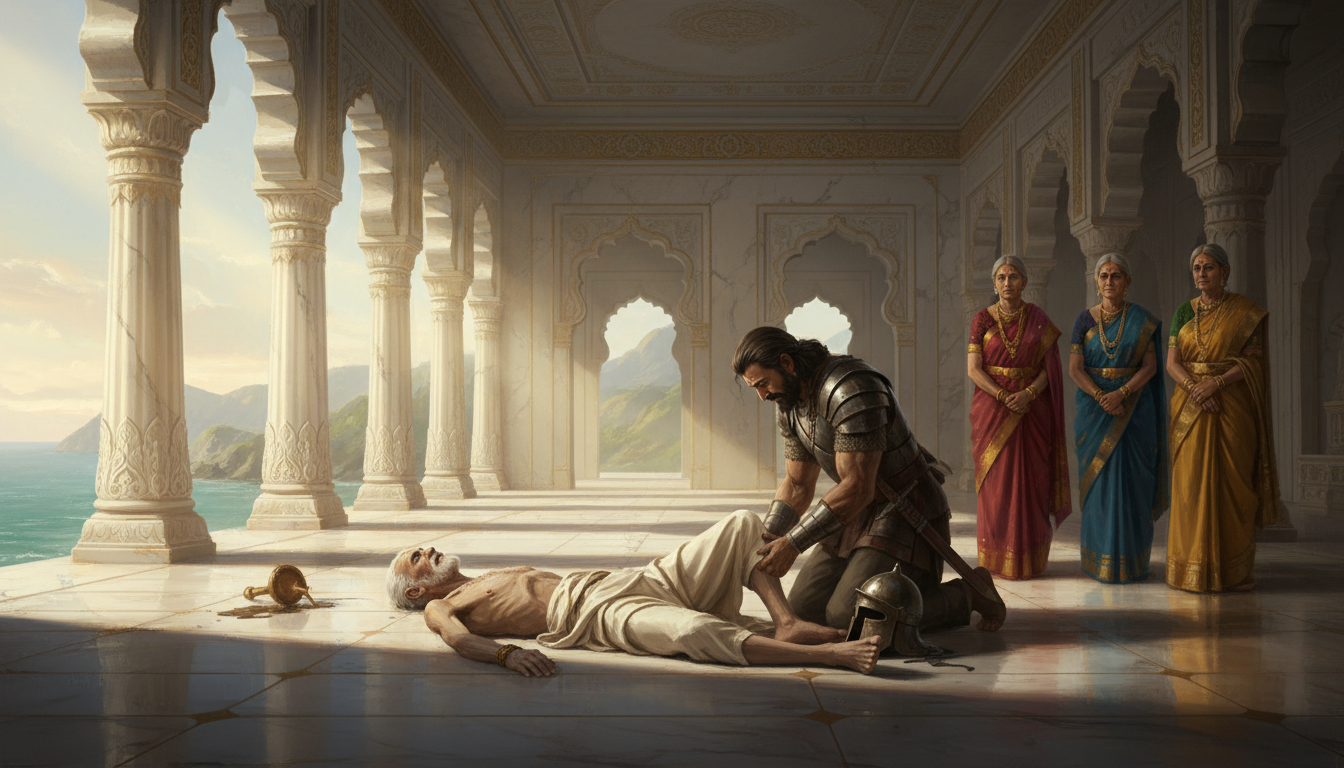
A City Like a Woman Bereft of Her Husband
Vaishampayana said: Proceeding to the city of the Vrishnis with Daruka in his company, that hero beheld that Dwaraka looked like a woman bereft of her husband.
Arjuna had been in that city many times. He had been married out of it. He knew the sound it made. Dwaraka had always run like a river: the Vrishnis and the Andhakas for its water, steeds for its fishes, cars for its rafts, the noise of instruments and the rattle of wheels for its waves; houses and mansions and public squares for its lakes, gems for its moss, the walls of adamant like garlands of flowers floating on the surface of it; the streets its currents, the great open squares its still deep pools, and Rama and Krishna the two mighty alligators lying in it.
What he rode into now was the Vaitarani, the river of the dead, bound up in Time's net. It was shorn of beauty and perfectly cheerless, and it presented the aspect of a lotus flower in winter.
The women came out. Sixteen thousand had been wedded to Vasudeva's son, and every one of them was now lordless, and had been so for four days, and had had nobody to say it to. When they saw the son of Pritha at the gate they set up a loud wail, all together, and the sound of it went up over the walls and out to sea.
Arjuna could not look at them. His vision was obstructed by tears, and he got down off the car and went a few steps into that crowd of Krishna's widows and fell on the earth.
Then Satya, the daughter of Satrajit, and Rukmini fell down beside him, and wailed aloud. Between them they raised him up and set him on a golden seat, and the ladies sat around him on the floor, giving expression to their feelings, praising Govinda, telling him things about their husband that he already knew.
He comforted them as well as a man can who has come three hundred leagues to be comforted himself. Then he asked where his uncle was, and went to see him.
He Could Not Lift His Head
The Kuru prince beheld the heroic and high-souled Anakadundubhi lying on the ground, burning with grief on account of his sons.
He was not in a bed. He had put himself down on the floor of his own house, the way a man does who has stopped intending to get up, and he was so wasted that when Arjuna came in he could not raise his head.
Arjuna, broad-chested and mighty-armed, more afflicted than his uncle was, with his eyes bathed in tears, went the length of the room and touched his uncle's feet.
And the old man tried to do the thing an elder does. He wished to smell the head of his sister's son. It is the oldest greeting there is in that house: the hand behind the neck, the mouth to the crown of the head, the breath drawn in. He had done it to this boy when the boy was small and had come from Hastinapura with Kunti, and he had done it at the wedding, and he tried to do it now, and failed, because he could not lift himself far enough off the floor to reach.
So the mighty-armed Anakadundubhi, deeply afflicted, put his arms round Partha instead and held on to him and wept aloud, remembering his sons, and his brothers, and his grandsons, and his daughters' sons, and his friends: the whole roll of them, name after name, out loud, into the shoulder of the only man who had come.
Methinks I Have No Death
"Without beholding those heroes, O Arjuna," he said, "who had subjugated all the kings of the Earth and the Daityas a hundred times, I am still alive. Methinks, I have no death."
That was where he began. Not with grief for the dead but with outrage at his own continuing.
"Through the fault of those two heroes who were your dear disciples and who were much regarded by you, O Partha, the Vrishnis have been destroyed. Those two, who were reckoned Atirathas among the foremost of the Vrishnis, and referring to whom in the course of conversation you were wont to indulge in pride, and who were ever dear to Krishna himself: alas, those two, O Dhananjaya, have been the chief causes of the destruction of the Vrishnis."
He meant Satyaki and Kritavarma, and he was saying to their teacher's kinsman that the quarrel that started it had been between the two best men in the city, over what each of them had done at Kurukshetra, in a war that had ended thirty-six years ago and had evidently not ended at all.
Then, having said it, he took it back, because he was a just man even at the bottom of his life.
"I do not censure the son of Sini or the son of Hridika, O Arjuna. I do not censure Akrura, or the son of Rukmini. No doubt the curse of the Rishis is the sole cause."
Nobody in that room contradicted him, and nobody could. Satyaki had been Arjuna's own pupil, and Kritavarma had learned in the same yard, and Arjuna had boasted about both of them in company for years, and had gone on boasting after Kritavarma helped Drona's son into a sleeping camp at night and after Satyaki cut down an unarmed man sitting in prayer on the field. Every charge the old man laid had been argued out on that beach, by those two, with wine in them, thirty-six years late.
And having cleared every living man, he had exactly one person left to bring the case against.
A Father's Case Against a Son Who Was God
"How is it," said Vasudeva, "that that lord of the universe, the slayer of Madhu, who had put forth his prowess for achieving the destruction of Kesin and of Kansa, and of Chaidya swelling with pride, and of Ekalavya the son of the ruler of the Nishadas, and of the Kalingas and the Magadhas, and the Gandharas and the king of Kasi, and of many rulers assembled together in the midst of the desert, and many heroes belonging to the East and the South, and many kings of the mountainous regions: alas, how could he remain indifferent to such a calamity as a curse denounced by Rishis?"
It was a list, and he went through the whole of it, and every name on it was a thing his son had done for other people.
"Yourself, and Narada, and the Munis, knew him to be the eternal and sinless Govinda, the Deity of unfading glory. Alas, being puissant Vishnu himself, he witnessed, without interfering, the destruction of his own kinsmen."
Then he said the thing he had been working toward, and it was the sharpest sentence spoken in that book.
"In your very sight, O hero, your grandson, who had been slain by Ashvatthama, was revived through his energy."
Parikshit. Dead in the womb, dead in his mother's body from the weapon of Drona's son, and Krishna had walked into that room and put the child back into life with everyone watching, including Arjuna, including the boy's mother, including the women of two houses.
"That friend, however, of yours," said the old man on the floor, "did not wish to protect his kinsmen."
He could do it. He had done it. He did it for a Kuru child in Hastinapura and he would not do it for his own city, his own sons, his own grandsons, or for the man who had fathered him and raised him and lost every other child he had ever had.
"My son must have himself allowed all this to happen," he said. "He was the Lord of the universe. He did not, however, wish to falsify the words of Gandhari and the Rishis."
He had the answer. He had had the answer the whole time. He stated it himself, correctly, in the middle of his own accusation, and it did not help him in the slightest, and he went on.
The Message He Was Left With
"Beholding his sons and grandsons and brothers and friends lying dead," said Vasudeva, "he said unto me these words."
And then the old man repeated them, exactly, the way a man repeats the last thing that was said to him by someone who is not coming back, having gone over it in his head a hundred times in four days.
"The destruction of this our race has at last come. Vibhatsu will come to this city, Dwaravati. Tell him what has occurred, this great carnage of the Vrishnis. I have no doubt that as soon as he hears of the destruction of the Yadus, that hero of mighty energy will come here without any loss of time. Know, O father, that I am Arjuna and Arjuna is myself. That should be done by you which he would say."
The old man stopped there for a moment, because that sentence had been said about the man now kneeling on his floor, and it was the whole of the inheritance he had been left.
"The son of Pandu will do what is best for the women and the children," he went on. "Even he will perform your funeral rites. This city of Dwaravati, after Arjuna's departure, will, with its walls and edifices, be swallowed up by the ocean without any delay. As regards myself, retiring to some sacred place, I shall bide my hour, with the intelligent Rama in my company, observing strict vows all the while."
"Having said these words unto me, Hrishikesa of inconceivable prowess, leaving me with the children, has gone away to some spot which I do not know."
That was the last conversation between them. A set of instructions about the disposal of property and the conduct of a funeral, delivered by a son to a father, with no farewell in it at all, and then a door and a road and no address.
I Shall Neither Eat, Nor Live
"Thinking of those two high-souled brothers of yours," said Vasudeva, meaning his own two sons, "as also of the terrible carnage of my kinsmen, I have abstained from all food, and am emaciated with grief. I shall neither eat, nor live."
He had made the decision before Arjuna arrived. That was why he was on the floor and could not lift his head. It was not the illness of an old man; it was a Kshatriya of the Vrishni line doing the one thing still available to him, deliberately, with his priests in the next room and his four wives in the house.
"By good luck you meet me, O son of Pandu. Do you accomplish all, O Partha, that Krishna has said. This kingdom, with all these women, and all the wealth here, is yours now, O son of Pritha. As regards myself, O slayer of foes, I shall cast off my life-breaths, dear though they be."
Dear though they be. He had been the father of Krishna and the father of Balarama and the husband of Devaki, and he had spent years in Kansa's prison counting the children carried out of it, and had lived to be the last man of his generation standing in an empty house, and at the end of it he did not pretend that he was glad to go. He said the life was dear to him and that he was putting it down anyway.
He gave Arjuna a kingdom, a treasury and sixteen thousand widows in a single sentence, and asked for nothing back.
The Seventh Day From This
That scorcher of foes, thus addressed by his maternal uncle, replied with great cheerlessness of heart to an uncle who was equally cheerless.
"O uncle, I am unable to look at this Earth when she is reft of that hero of the Vrishni race and of those my other kinsmen. The king, and Bhimasena, and Sahadeva, and Nakula, and Yajnaseni numbering the sixth, are of the same mind with myself in this matter. The time has come for the departure of the king also. Know this, that the hour of our departure too is at hand. You are the foremost of those that are well conversant with the course of time."
It was not consolation. It was one dying house telling another that it would not be far behind.
"I shall, however, O chastiser of foes, first remove to Indraprastha the women of the Vrishni race, as also the children and the aged."
Then he stood up and went out and did the work. He asked Daruka for the chief officers of the Vrishni heroes, and entered Sudharma, the great hall where that race had held its court, and took his seat in it, and the citizens and the Brahmanas and the ministers of state came in and stood around him. They were more dead than alive. Every one of them had lost somebody at Prabhasa, and most of them had lost everybody.
"I shall take away with me the remnants of the Vrishnis and the Andhakas," he told them. "The sea will soon engulf this city. Equip all your cars and place on them all your wealth. This Vajra, the grandson of Krishna, will be your king at Shakraprastha. On the seventh day from this, at sunrise, we shall set out. Make your preparations without delay."
Seven days to empty the richest city in the world. They went out and began, and Arjuna passed that night in the mansion of Keshava, in the rooms of the man who was not there, and was suddenly overwhelmed with great grief and stupefaction, and did not sleep.
When Morning Dawned
When morning dawned, Vasudeva of great energy and prowess attained, through the aid of Yoga, to the highest goal.
He did it quietly, in the same room, on the same floor, without sending for anybody. He had said he would neither eat nor live, and he had been as good as his word within a day of the man arriving whom he had been waiting for.
The sound came afterwards. A loud and heart-rending wail was heard in Vasudeva's mansion, uttered by the weeping ladies, and they came into that room with their hair dishevelled and their ornaments and their floral wreaths thrown off, beating their breasts with their hands.
And four of them went and threw themselves on the body of their lord: Devaki, and Bhadra, and Rohini, and Madira.
Devaki, who had borne eight children in a prison in Mathura and had six of them killed in front of her, and had been given the last two back only by giving them away. Rohini, who had carried Balarama when he was taken out of Devaki's womb and put into hers, and had raised him among the cowherds. Bhadra and Madira, whose names the epic gives here and almost nowhere else, and who had shared that house for a lifetime.
They did not have to be persuaded of anything. They had already decided, in the way the women of that house decided things, without a discussion that anyone recorded.
The Umbrella From the Horse Sacrifice
Then Partha caused the body of his uncle to be carried out on a costly vehicle, borne on the shoulders of men, and all the citizens of Dwaraka and the people of the provinces followed it, deeply afflicted, for they had been well affected toward him while he lived.
Before that vehicle two things were carried.
The first was the umbrella that had been held over his head at the conclusion of the horse sacrifice he had performed while living. A man who completes that rite is a sovereign, and the umbrella is the proof of it, and it went out in front of him now over nobody, held up in the ordinary way above an empty space in the road.
The second was fire: the blazing fires he had worshipped daily all his life, carried in their vessels, with the priests who had attended to them walking alongside.
Behind the body came his wives, decked in ornaments, surrounded by thousands of women and thousands of their daughters-in-law.
The last rites were performed at the spot that had been agreeable to him while he was alive. The four wives of that heroic son of Sura ascended the funeral pyre and were consumed with the body of their lord, and attained to those regions of felicity that were his. The son of Pandu burnt his uncle together with those four wives, using diverse kinds of scents and perfumed wood, and as the pyre blazed up there was a loud sound of burning timber under the clear chant of the Samans and the wailing of the citizens who stood and watched it.
After it was all over, the boys of the Vrishni and Andhaka races, headed by Vajra, and the ladies with them, offered oblations of water to the high-souled hero.
Then Arjuna, who was careful in observing every duty, went on to the place where the Vrishnis had been slaughtered, and performed the last rites for all of them according to the order of seniority, and searched out the bodies of Rama and Vasudeva's son and had them burnt by persons skilled in that work. There was nobody else left to do it. Krishna had said so himself, in the instruction he left with his father, and it was the only part of the whole message that anyone was in a position to carry out.
Dharma Lesson
There is a grief that no theology answers, and a father is allowed to state it plainly even when he already knows the reply. Vasudeva gives the correct explanation of his son's silence in the middle of his own accusation, and it does not comfort him at all. Understanding why a thing had to happen is a different faculty from being able to bear it, and the epic does not pretend otherwise.