Arjuna Empties Dwaraka
One bowman escorts a dead city inland, and the sea walks behind him
The Hall Called Sudharma
Vaishampayana told Janamejaya that when the old man had finished speaking there was nothing cheerful left in that room for either of them to give the other.
Anakadundubhi, whom the world called Vasudeva, had laid it all out: the carnage at Prabhasa, the curse, Krishna's last instructions repeated word for word, and his own decision to take no more food. He had ended by handing his nephew a kingdom.
"O uncle, I am unable to look at this Earth when she is reft of that hero of Vrishni's race and those my other kinsmen. The king and Bhimasena and Sahadeva and Nakula and Yajnaseni, numbering the sixth, are of the same mind with myself in this matter. The time has come for the departure of the king also. Know this, that the hour of our departure too is at hand. Thou art the foremost of those that are well conversant with the course of time."
Then, having said that the Pandavas were finished, he said what he would do before he finished.
"I shall, however, O chastiser of foes, first remove to Indraprastha the women of the Vrishni race as also the children and the aged."
He turned from his uncle and called for Daruka, who had driven Krishna's car for as long as there had been a car to drive, and who was now a charioteer without a master and one of the few grown men left in the city.
"I wish to see without any delay the chief officers of the Vrishni heroes."
So he went to Sudharma, the great hall where the Yadavas had held their court, grieving as he walked for the car-warriors who used to fill it. He sat down in it. The citizens came in, and the Brahmanas, and every minister of state, and stood around him in a ring, and Vaishampayana says of them only that they were more dead than alive.
Partha was more grieved than any of them. He said the things suited to the occasion, which is to say the only things that were of any use.
"I shall take away with me the remnants of the Vrishnis and the Andhakas. The sea will soon engulf this city. Equip all your cars and place on them all your wealth. This Vajra will be your king at Shakraprastha. On the seventh day from this, at sunrise, we shall set out. Make your preparations without delay."
Vajra was Krishna's grandson, a boy standing somewhere in that hall while it was settled over his head that he was a king.
Nobody argued. They went out and began to load the carts.
In the Order of Seniority
Arjuna passed that night in the mansion of Keshava, in a standing house with its rooms as they had been and the man gone out of them, and was suddenly overwhelmed with great grief and stupefaction.
When morning dawned, Vasudeva attained through the aid of Yoga to the highest goal. Devaki and Bhadra and Rohini and Madira went with their lord into the fire, and the Samans were chanted over the burning wood, and afterwards the boys of the Vrishni and Andhaka races, headed by Vajra, went down to the water with the women and offered the oblations for the dead. Boys and widows. That was the whole funeral party of the house of Sura, and there were six days left.
Phalguna was careful in observing every duty, and there was one duty left that nobody else in the world was in a position to perform.
He went out to the place where the Vrishnis had been slaughtered.
He had heard it described twice, and neither telling had prepared him for the sight of it. They were lying all around him, in the tide-line and in the grass above it, the Bhojas and the Andhakas and the Vrishnis together, men whose arms looked like maces of iron, and every one of them had been killed with a blade of grass. The Eraka had grown up out of the powdered iron of the bolt, and the curse of the Brahmanas had made it into weapons in their hands, and they had used it on one another until there was nobody left standing to use it on.
Beholding them lying slaughtered all around, the Kuru prince became exceedingly cheerless. He did, however, what was required to be done in view of what had happened.
The rites were performed in the order of seniority. That is the detail to hold, because it is the whole of Arjuna's answer to the field. Not by the heap, but each man taken in his proper place in the line, elder before younger, as though the Yadava order still existed and he were only its executor. It took time he did not have. He spent it.
Then he went looking, with men to help him, for two bodies in particular, and they searched until they found them: Rama, and Vasudeva's son.
Arjuna caused them to be burnt by persons skilled in that act. He did not do it himself. He had the rite done properly, by men who knew the work, and stood there while it was done, and then performed the sraddha offerings that are made to the dead, and got up on his car on the seventh day, because the tide was coming.
A Cavalcade Destitute of Heroes
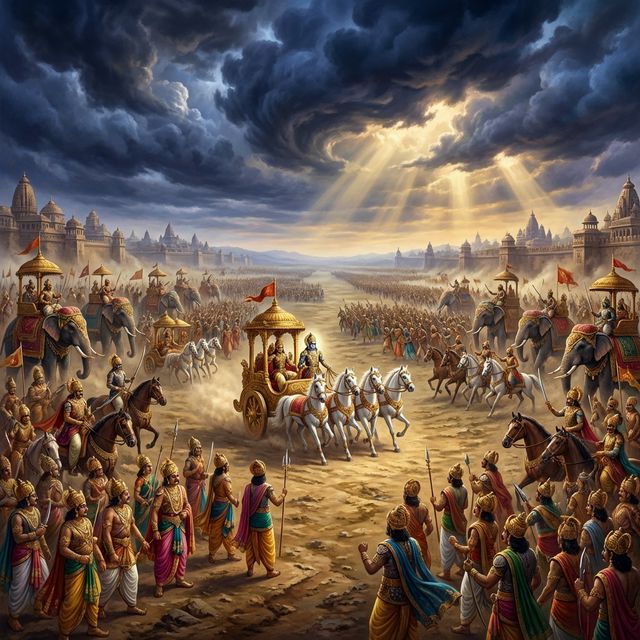
They came out of Dwaraka at sunrise on the seventh day, and there was one bowman at the head of them.
The widows of the Vrishni heroes came first behind him, wailing aloud, riding on cars drawn by bullocks and mules and camels, because the horses of that city had gone to Prabhasa and had not come back. The servants of the Vrishnis followed them, and their horsemen, and their car-men. The citizens and the people of the provinces set out at the same hour at Partha's command and spread out around the column on every side.
What was left of the army came too. The men who fought from the backs of elephants brought out their elephants, huge as hills, and the foot-soldiers marched with the reserves behind them, and Vaishampayana, who is not usually cruel about such things, calls the whole of it a cavalcade destitute of heroes, numbering only women and the aged and the children.
The children of the Andhaka and the Vrishni races walked where they could see Arjuna.
Brahmanas went, and Kshatriyas, and Vaisyas, and the wealthy among the Sudras, and they kept two things at the front of the procession where everybody could see them. One was the sixteen thousand women of Vasudeva's house. The other was Vajra, the grandson of Krishna, who was going to be a king in a city he had never seen.
The widows of the other heroes of the Bhoja and the Vrishni and the Andhaka races, lordless now, who set out that morning with Arjuna, numbered many millions.
That conqueror of hostile towns, that foremost of car-warriors, escorted this vast procession of the Vrishnis, which still abounded with wealth of every kind, and which looked, from any high ground behind it, like a veritable ocean.
Which was the wrong thing for it to look like, that morning, and nobody said so.
Whatever Ground Was Passed Over
After all the people had set out, the ocean, that home of sharks and alligators, flooded Dwaraka.
It did not come as a wave. It came the way a tide comes, and it came behind them, and it kept exact pace with them. Whatever portion of the ground was passed over, ocean immediately flooded over with his waters. The last cart cleared a lane and the water was in the lane. The column left the gate and the water was at the gate. The city was still full of wealth of every kind, because there had not been carts enough for all of it, and the sea took the wealth with the walls and the edifices and the streets that had been laid out by Vishvakarman.
The people looked back at it while they walked, and Vaishampayana records what they said to one another, and it is not a lament.
"Wonderful is the course of fate."
Then they walked faster. That is the sentence that stays: beholding this wonderful sight, the inhabitants of Dwaraka walked faster and faster.
Dhananjaya, after abandoning Dwaraka, proceeded by slow marches. He was escorting women who had buried their husbands six days ago and children who did not understand what had happened, so he made short days of it, and he chose the halts himself. He caused the Vrishni women to rest in pleasant forests, and on mountains, and by the sides of delightful streams. There is no hurry in that part of the account at all. The one man in the party who knew exactly how little time was left was the one arranging the rests.
They came at last to the country of the five waters, the land between the rivers, and the puissant Dhananjaya planted a rich encampment in the midst of it, in a country that abounded with corn and kine and other animals.
It was good ground. It fed them. It also had people living on it, and those people came down to look at what had arrived: a great deal of gold, a great many unguarded women, and one man with a bow.
The Consultation of the Abhiras
The robbers of that country were Abhiras, herdsmen, and they felt a great temptation.
They did not rush in on the sight of it. They went away and assembled and held a consultation, sitting down together like a council of state to work out whether one man could be taken, and Vaishampayana gives their reasoning in their own words, which is the only speech the herdsmen of the five waters get in the whole epic.
"Here there is only one bowman, Arjuna. The cavalcade consists of children and the old. He escorts them, transgressing us. The warriors of the Vrishnis are without energy."
Every clause of it was true. That is what makes it hard to read. They were not deceived about anything. They had counted the escort correctly, they had judged the temper of the surviving Vrishni troops correctly, and the one figure in their arithmetic they had no way of checking was the value they had assigned to the name Arjuna, and they had guessed at it and their guess was right.
There were thousands of them and they were armed with clubs. Not with bows, not with darts, with the sticks they carried anyway for the cattle. Urged by the perverse course of time they fell upon that vast concourse with loud leonine shouts, frightening it, desirous of plunder and of slaughter.
The son of Kunti was up ahead on the road. He stopped the advance, turned with his followers, and went back down the column to the place where the herdsmen had struck it.
Then the mighty-armed warrior addressed the assailants, and Vaishampayana notes that he was smiling while he did it, because he had done this before in more places than he could count and it had always ended the same way.
"You sinful wretches, forbear, if ye love your lives. Ye will rue this when I pierce your bodies with my shafts and take your lives."
Though thus addressed by that hero, they disregarded his words. He dissuaded them again, repeatedly, giving them more warning than he had ever given a king. And they came on, and he reached back for the Gandiva.
The Horns of the Bow
The bow would not string.
It was the large, indestructible, celestial bow, and Arjuna endeavoured to bend it, and it did not answer his hands. He got the loop over the horn at last with great difficulty, and by the time he had done it the battle was already furious around him.
Then he began to think of his celestial weapons, and they would not come to his mind.
Gods had given them to him and he had held them for a lifetime, and they had always been there in the place where a man reaches for such things, and now that place was empty. Beholding the furious battle, and the loss of the might of his arm, and the non-appearance of his weapons, Arjuna became greatly ashamed.
The concourse was very large and the robbers assailed it at many points at once. The Vrishni foot-soldiers and the elephant-warriors and the car-men failed to rescue the women who were being snatched away. Arjuna tried his best to protect them and could not succeed. In the very sight of all the warriors, many of the foremost of the ladies were dragged off, and others went away with the robbers of their own accord.
That last clause is in the text and it cannot be softened. Some of them chose to go. They had watched their city drown and their husbands burn, and a herdsman with a club was, to them, a life.
He struck the robbers with shafts sped from Gandiva while there were shafts. In former days his quivers had been inexhaustible. Now they proved otherwise, and when he found them empty the son of Indra began to strike the robbers with the horns of his bow, which is what a boy does with a stick.
The Mlecchas retreated in his sight, taking with them many of the foremost ladies of the Vrishnis and the Andhakas.
Then Dhananjaya stopped. He regarded it all as the work of destiny, and breathed long and heavy sighs, and ceased to make further efforts, saying that he had not the power which he had before.
He took the remnant of the women and the wealth still with them to Kurukshetra, and settled the survivors across the north in pieces: Kritavarma's son at Marttikavat with the widows of the Bhoja king, the son of Yuyudhana with his old men and children on the banks of the Sarasvati, and the rest at Indraprastha, whose rule he gave to Vajra as he had promised in the Sudharma hall.
I Am Arjuna
The widows of Akrura went into the woods and would not be talked out of it. Rukmini and the princess of Gandhara and Saivya and Haimavati and queen Jamvabati went into the fire. Satyabhama and the other dear wives of Krishna crossed beyond the Himavat to a place called Kalpa and lived on fruits and roots, contemplating Hari.
When there was nobody left to settle, Arjuna, with his eyes bathed in tears, entered the retreat of Vyasa, and found the Island-born Rishi seated in a secluded spot, and gave his name.
"I am Arjuna."
Then he waited, which is not how the third Pandava had entered a place in forty years.
"Welcome," said the son of Satyavati. "Take thy seat."
Vyasa looked at him: cheerless, breathing heavy sighs, filled with despair. The questions he asked are a list of the things that can strip a man of his lustre.
"Hast thou been sprinkled with water from anybody's nails or hair, or the end of anybody's cloth, or from the mouth of a jar? Hast thou had sexual congress with any woman before the cessation of her functional flow? Hast thou slain a Brahmana? Hast thou been vanquished in battle? Thou lookest like one shorn of prosperity. I do not know that thou hast been defeated by anyone. Why then, O chief of Bharata's race, this exceedingly dejected aspect?"
So Arjuna told him.
"He whose complexion was like that of a newly risen cloud, he whose eyes were like a pair of large lotus petals, Krishna, has, with Rama, cast off his body and ascended to Heaven. At Prabhasa, through iron bolts generated by the curse denounced by Brahmanas, the destruction has taken place of the Vrishni heroes. Not even a single hero has escaped. The death of the wielder of Sarnga is as incredible as the drying up of the ocean, the displacement of a mountain, the falling down of the vault of heaven, or the cooling property of fire.
"Another incident has happened that is more painful than this. In my very sight thousands of Vrishni ladies were carried away by the Abhiras of the country of the five waters. Taking up my bow I found myself unequal to even string it. The might that had existed in my arms seemed to have disappeared, and my weapons of diverse kinds failed to make their appearance. He who used to stalk in advance of my car, consuming as he proceeded all hostile warriors, can no longer be seen by me. I am now a wanderer with an empty heart, despoiled of my kinsmen and of my possession."
He had come for directions, like a man who had lost the road.
Time Is the Seed of the Universe
Vyasa did not comfort him about Krishna. He explained the arithmetic instead.
"The mighty car-warriors of the Vrishni and the Andhaka races have all been consumed by the Brahmanas' curse. It behoveth thee not to grieve for their destruction. That which has happened had been ordained. Krishna suffered it to take place although he was fully competent to baffle it. Govinda was able to alter the very course of the universe with all its mobile and immobile creatures. What need then be said of the curse of even high-souled Brahmanas? He who used to proceed in front of thy car, armed with discus and mace, through affection for thee, was the four-armed Vasudeva, that ancient rishi. Having lightened the burthen of the Earth and cast off his human body, he has attained to his own high seat. By thee also, with Bhima for thy helpmate and the twins, has the great work of the gods been accomplished.
That was the answer to the first half. The second half, the one about the bow, he answered with a general law rather than a consolation.
"Understanding and prowess and foresight arise when days of prosperity have not outrun. These very acquisitions disappear when the hour of adversity comes. All this has Time for its root. Time is, indeed, the seed of the universe. It is Time, again, that withdraws everything at its pleasure. One becomes mighty, and, again, losing that might, becomes weak. One becomes a master and rules others, and, again, losing that position, becomes a servant for obeying the behests of others.
"Thy weapons, having achieved success, have gone away to the place they came from. They will, again, come into thy hands when the Time for their coming approaches. The time has come, O Bharata, for you all to attain to the highest goal."
Nothing in that is an excuse offered to Arjuna, and nothing in it is a rebuke. The weapons were never his property. They were lent to a man for a piece of work, and the work is over, and the lender has taken them back, and the shame he felt at the roadside with a stick in his hand was the shame of a man who had mistaken a loan for a possession for about fifty years.
Arjuna took his permission and went back to the city named after the elephant. He found Yudhishthira and told him everything that had happened with reference to the Vrishnis, and Vaishampayana, having brought him that far, stopped.
That is the end of the Mausala Parva.
Dharma Lesson
Arjuna does everything correctly and loses anyway. He burns the dead in their proper order, keeps the seventh-day promise, sets the boy on the throne and settles every survivor in a place where they can live, and in the middle of all that competence the herdsmen take the women out of his hands. Vyasa does not tell him he failed; he tells him that understanding and strength arrive with prosperity and leave with it, and that the weapons have gone back where they came from and will return when Time returns them. What a man is owed for his past service is nothing. What he can still do this morning for the people in front of him is everything, and Arjuna keeps doing it all the way to Indraprastha with an empty quiver.