Turn Now to Where Rama Has Gone
Vaishampayana said: When it was over on the sand at Prabhasa, the wielder of Sarnga stood still in the middle of it with a blade of grass in his fist.
The grass had gone hard in his hand the way it had gone hard in every hand on that beach. Every blade a man tore up in anger became a bolt of iron with the force of the thunder in it, and would go through things that were utterly impenetrable, and so son had killed sire and sire had killed son all afternoon among the tents and the wine jars, and the Kukuras and the Andhakas had met their destruction like insects rushing at a blazing fire. Not one of them had thought of escaping by flight.
His own were lying in it. Samba was dead. Charudeshna was dead. Pradyumna, who had been carried off as an infant and come back a man, was dead in the sand near Satyaki, whom he had run forward to rescue. Aniruddha was dead. Gada was lying on the ground with his face turned up.
Two men were still standing near him, and both of them were men who drove or guarded rather than commanded: Daruka, who held his reins, and Vabhru of mighty energy, who was unsteady with drink and cheerless with grief and had somehow not been given a bolt to hold.
It was Vabhru who said it, and Daruka who agreed.
"O holy one, a very large number of men has been slain by thee. Turn now to where Rama has gone. We wish to go there where he has proceeded."
They did not say, come away from this. They said, go to your brother. It was the only direction left on that shore in which there was still a living Yadava.
Where He Had Been While It Happened
He had been sitting with them at the beginning. That was the part nobody afterwards liked to say aloud.
In the very sight of Krishna, Rama had begun to drink, with Kritavarma and Yuyudhana and Gada around him, and Vabhru drinking too. It was Rama who had joined in proclaiming the law against wine in Dwaraka, with the penalty of impalement for a man and all his kinsmen, and here on the shore of the sea, at a pilgrimage, the law was thirty leagues behind them and everyone had brought a jar.
Then Yuyudhana, inebriated, laughed across the circle at Kritavarma.
"What Kshatriya is there," he said, "who, armed with weapons, will slay men locked in the embraces of sleep and therefore already dead? For that, O son of Hridika, the Yadavas will never tolerate you."
Pradyumna applauded it. Kritavarma pointed at Satyaki with his left hand, which is the insult before the words are even out.
"Professing yourself a hero, how could you so cruelly slay the armless Bhurishrava, who on the field of battle gave up all hostile intentions and sat down in praya?"
After that it went the way such things go. Satyaki told Keshava what Kritavarma had done to Satrajit over the gem called Syamantaka. Satyabhama, in tears, came and sat in Krishna's lap and made his anger worse. Satyaki stood up and swore by Truth that he would send this one after the five sons of Draupadi, and Dhrishtadyumna, and Shikhandi, whom this sinful wretch had helped to butcher in their sleep with the son of Drona. Then he crossed the circle and took Kritavarma's head off with a sword in front of everybody.
Somewhere between the pointing finger and the sword, the elder brother put down what he was holding, got up, and walked away up the beach.
He had done it before. He had walked out of Kurukshetra rather than choose between two pupils and had spent forty-two days going up the Sarasvati while the world burned. He had a way of leaving a room that was neither cowardice nor judgment, and the men in the room never noticed it until they needed him.
Nobody called after him. There were perhaps forty men on that stretch of sand who would have followed him if he had said one word, and he did not say one, because the word would have had to be a side, and he had spent his whole life refusing to take one between people he loved.
The Solitary Spot of Earth
Then Daruka and Keshava and Vabhru left that spot, following in the wake of Rama, to find where he had gone.
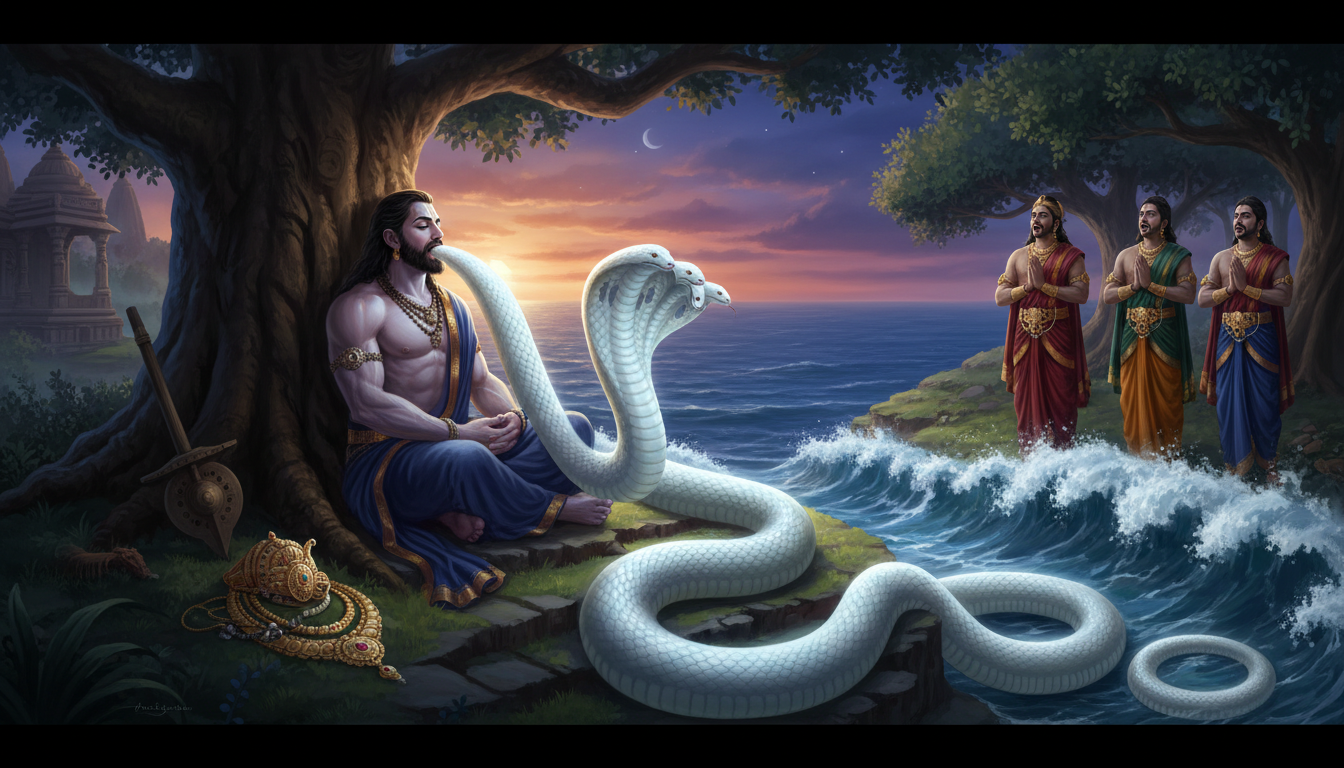
They came up off the sand into the trees at the edge of the shore, where the noise of the sea was still audible but the noise of the camp was not, and there they beheld that hero of infinite energy sitting thoughtfully, alone, reclining his back against a tree.
He was not asleep and he was not drunk any longer. He had his eyes half open and he was breathing in a way the three of them recognised, because everyone in that house had been taught the practice as children, and had mostly forgotten it. His plough was not with him. The standard with the palmyra device had already been carried off by Apsaras days before, and he had not asked where it went.
Krishna looked at his brother for a while and understood exactly what was being done and how long it would take.
The elder had been born first, and had been carried out of one womb and put into another, which is not the ordinary way of coming into the world, and had been called by many names by many people, and had been drunk on that beach two hours ago. He was now going home, and going home meant something particular in his case, and there was time enough for one instruction before it happened.
It is worth saying what the Rishis had promised on this point, because they had been exact about it, and everything else they said that day had already come true on the sand below. The blessed hero armed with the plough, they had said, will enter the ocean, casting off his body. Not die. Not fall. Enter the ocean. The three of them had stood in a courtyard in Dwaraka with their eyes red and had named the manner of it a year in advance, and here it was, being carried out under a tree by a man who had heard the prophecy and had made no arrangements against it whatever.
Go and Tell Partha
Finding Rama of great soul in that condition, Krishna turned to his charioteer and gave him an order, which was the last order Daruka ever took from him.
"Going to the Kurus, inform Partha of this great slaughter of the Yadus. Let Arjuna come here quickly, hearing of the destruction of the Yadavas through the Brahmanas' curse."
Not come and help. Not come and save anything. Come here quickly, because there would be sixteen thousand widows and a city full of children and old men, and because Arjuna was the only person on the earth to whom Krishna was willing to hand them.
Daruka went. He was deprived of his senses by grief and he got up on a car and drove north out of Prabhasa with the whole shore behind him full of dead men he had known by name, and he did not look back at the two brothers under the tree, and he did not see either of them again.
So the message that would eventually bring Arjuna down to Dwaraka, and empty the city, and put a boy named Vajra on a throne in Indraprastha, was carried by a driver who had been left with nothing to drive.
Vabhru and the Mallet
After Daruka had gone away, Keshava saw Vabhru still waiting on him, the last grown Yadava alive on that beach who was not of his own blood.
"Do you go quickly for protecting the ladies," he told him. "Let not robbers do them any injury, tempted by the wealth that is with them."
Thus commanded, Vabhru went. He was still helpless with wine and cheerless at the slaughter of his kinsmen, and he had rested a while by the side of Keshava, which had perhaps felt like safety. As soon as he had proceeded to a distance, the iron bolt found him.
It had been ground into powder and thrown into the sea a year before. It had come back as grass on that shore, and now the last of it had attached itself to the head of a mallet in the hands of a hunter, and it sprang of itself upon that solitary survivor of the Yadava race and killed him where he walked, because he too had been included in the curse of the Brahmanas.
The curse had been very precise. Except Rama and Janardana, it had said. Vabhru had been named in it by his own name, in a way, on the day the three Rishis were shown a boy in a veil and told the boy was Vabhru's wife.
Beholding Vabhru slain, Keshava of great energy went back up the beach to his brother and said, "Do you wait for me here, O Rama, till I place the ladies under the care of kinsmen."
And the man under the tree, who was some way along the road already, waited.
The Errand in the City
Entering the city of Dwaravati, Janardana went to his father and did not sit down.
"Do you protect all the ladies of our house, till Dhananjaya comes," he said. "At the skirts of the forest Rama is waiting for me. I shall meet him today. This great carnage of the Yadus has been beheld by me, even as I beheld before the carnage of those Kshatriyas who were the foremost ones of Kuru's race. It is impossible for me to see this city of the Yadavas without the Yadus beside me. Know that, proceeding to the woods, I shall practise penances with Rama in my company."
Then he touched the feet of his father with his head, and quickly left his presence.
A loud wail of sorrow rose from the ladies and the children of the house behind him, and he heard it in the passage, and it stopped him. He came back into the room he had just left, to women who by then knew what had happened at Prabhasa and what was about to happen to him, and he gave them the only comfort he had, which was the name of a man.
"Arjuna will come here," he said. "That foremost of men will relieve you of your grief."
Then he went out of Dwaraka for the last time, and no one followed him, and he took the road back toward the shore, where his brother was sitting against a tree with his back straight, waiting for him as he had been asked to.
The Snake Comes Out of His Mouth
Proceeding then to the forest, Keshava beheld Rama sitting in that solitary spot as he had left him. He also saw that Rama had set himself to Yoga, and that from out of his mouth was issuing a mighty snake.
The colour of that snake was white.
It came out slowly and it did not stop coming. Leaving the human body in which he had dwelt so long, that high-souled naga of a thousand heads, having a form as large as that of a mountain and endued besides with red eyes, uncoiled itself out of the shape of a man who had once dragged the Yamuna out of her bed with a plough and taught two boys the use of the mace.
A thousand heads. The number is given plainly, and it is the same number that is given elsewhere for the serpent on whom the world is laid, and that is not a coincidence, and the man sitting three paces away was the only witness in the world who had known it all along.
When the last of it was clear of the tree, the great naga turned its heads toward the water and proceeded along that way which led to the ocean, going down over the sand of Prabhasa where the dead of his own house were lying, and not one of the thousand heads turned to look at them, because that was no longer his business.
Krishna did not get up and he did not speak. There is nothing to say to a brother who is in the act of putting off a body, and in any case the being going down the sand was older than the relationship, older than the house of Yadu, older than the shore. What had been walking beside him for a hundred and twenty years had been a portion, on loan, wearing a name; and the loan was now being called in, in daylight, in front of one witness.
The Sea Comes Up to Meet Him
The sea did not simply receive him. It came up to the edge to fetch him in.
Ocean himself was there in a body, and many celestial snakes, and many sacred Rivers, all of them standing on the shore for the receiving of him with honour. Karkotaka was there, and Vasuki, and Takshaka, and Prithusravas, and Varuna, and Kunjara, and Misri and Sankha and Kumuda and Pundarika, and the high-souled Dhritarashtra, and Hrada and Kratha, and Sitikantha of fierce energy, and Chakramanda and Atishanda, and that foremost of Nagas called Durmukha, and Amvarisha, and king Varuna himself.
They advanced forward and offered him the Arghya, and water to wash his feet, exactly as a household offers them to an honoured guest at the door, and they worshipped that mighty Naga with diverse other rites and then saluted him by making the usual enquiries after his welfare, the way relatives do when somebody has been a very long time away.
That was the whole of the ceremony. There were no drums. There was no shower of flowers out of the sky. A serpent of a thousand heads came down a beach in Saurashtra and the kings of the serpents washed his feet and asked him how he had been, and the sea took him in, and closed.
And behind him on the shore stood his younger brother, who had watched the entire thing without moving, and who now had nobody left in the world to wait for.
He wandered for some time in that lonely forest, thinking. He had thought before this of everything that had been foreshadowed by the words of Gandhari, and he recollected also what Durvasas had said to him in his own house, long ago, on the day the sage smeared him with the remnant of the payasa he had eaten and Krishna did not smear his feet. Endued with great energy, he then sat down on the bare earth. Conversant with the truth of every topic, he restrained his senses and his speech and his mind, and laid himself down in high Yoga, and his own hour came for him not long after, in the ordinary shape of a hunter who had mistaken him for a deer.
Below the Earth
Long afterwards, at the snake sacrifice, Janamejaya asked what had finally become of them all, and whether their places in heaven were eternal, and what end was attained by those foremost of men when their acts came to an end.
Vaishampayana said: "Every one, O king of men, is not capable of returning to his own nature at the end of his deeds. Hear this, which is a mystery of the gods, and which was explained to us by Vyasa of mighty energy, who is the son of Parasara, and who knows the end attached to all acts."
And among the accountings he then gave, of Bhishma going back among the eight Vasus and Drona entering into Brihaspati and Karna entering into Surya, there was one line about the elder brother.
The holy and illustrious Ananta, who had taken birth as Balarama, proceeded to the region below the Earth. Through the command of the Grandsire, aided by his Yoga power, he supported the Earth.
He did not go to a heaven and rest there. He went underneath, and put his heads to the load, and took the weight of the ground back onto himself, which is the work he had been doing since before there were Yadavas to be born among and before there was a sea at Prabhasa for them to drink beside.
The king listening to this was in the middle of burning serpents alive by the thousand, and had been persuaded to stop only by a boy named Astika. He was told, in the same breath, that the field he was sitting on was held up by one.
That is the sequel the Mausala Parva does not stay to give. On the beach it looks like an ending: a drunk man walks away from a quarrel, sits down against a tree, and dies of yoga while his family kills itself two hundred paces off. Set beside the last book of the epic it is not an ending at all. It is a man finishing an errand and going back to the work he had been doing before he was ever asked to come up and be somebody's elder brother.
Dharma Lesson
Every incarnation is a loan taken against an older identity, and the end of a life is simply the moment the loan is called back in. Balarama does not die in the ordinary sense; he stops holding a shape that was never his, and goes back to the labour he was doing before anyone gave him a name. What looks from the beach like a man losing everything is, from underneath the earth, a workman returning to his post.