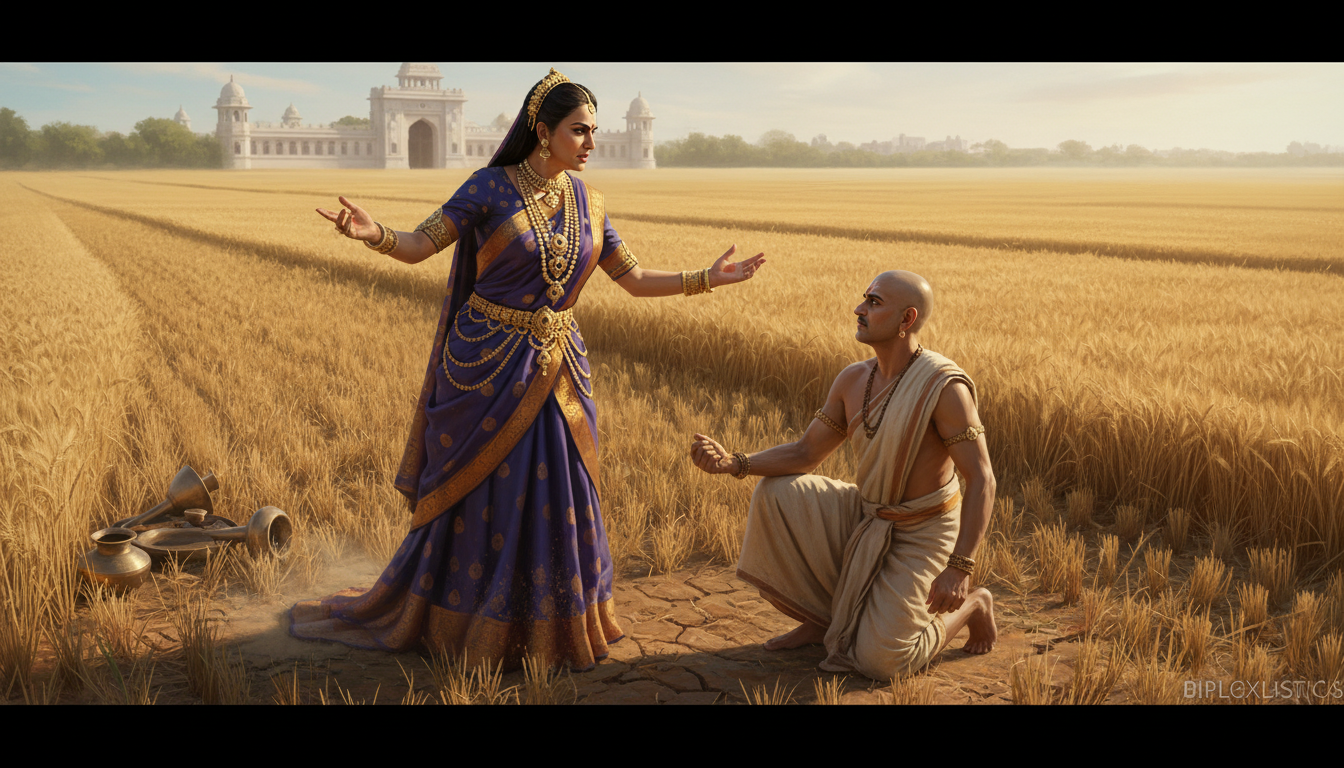
The Queen's Answer to the Beggar King
Janaka shaves his head, and his wife takes his renunciation apart
An Old History About a Wife
"When Yudhishthira had said his words and become silent," said Vaishampayana, "Arjuna sat afflicted by that speech, burning with sorrow and grief, and he addressed his eldest brother once again.
"He had already argued about wealth, and about the gods, and about what a Kshatriya is for, and none of it had touched the king. So this time he did not argue. He told a story instead, and he chose it with care, because the man in it was the one man his brother could not dismiss.
"'People recite an old history, Bharata,' Arjuna said, 'about a discourse between the ruler of the Videhas and his queen. It has to do with what that grief-stricken woman said to her lord when he abandoned his kingdom and resolved to live by begging.
"'You know whom I mean. Janaka. The one man in the memory of the world whom nobody accuses of confusion about the self. Sages travel to Mithila to put questions to him and go home instructed. Hear then what was said to him, in his own house, by his own wife, when he had shaved his head and had nothing in his hand but grain.'
"There was a reason he chose that history and not another. Yudhishthira had just told them, on the field where the ashes were still warm, that he would shave his head, take up the vow of silence, and walk away into the woods, and that Arjuna could have the earth. Arjuna had answered with wealth and with the gods and with the duty of kings, and none of it had moved his brother by the width of a finger. So he went and found the one precedent in the world for a great king laying down a great kingdom to live on grain picked out of the dirt, and he brought it back and set it down in front of the king, and it was not a happy precedent.
"The brothers turned to listen, and Draupadi with them, for the case was near enough to their own that nobody needed it explained. Arjuna told it plainly, without ornament, in the manner of a man who intends a story to be used as an argument and does not care whether it is enjoyed."
The King Shaves His Head
"King Janaka of Videha, the ruler of Mithila, cast off everything that a man can cast off, and he did it in order.
"He cast off wealth. He cast off his children, and his wives, and his precious possessions of every kind. He cast off the established path by which religious merit is acquired, which is to say the whole calendar of rites his house had kept for generations. And last he cast off his fire, the household fire that had been fed morning and evening since before he was born, and that a man of his order is not supposed to outlive.
"Then he shaved his head clean and put on the garb of a mendicant. He set aside vanity of every kind. He resolved that he would inflict no injury of any sort upon any creature. And he settled it in his mind that from that day forward he would subsist upon a handful of barley: not barley given to him, and not barley bought, but the loose grain that falls from the stalk at the reaping and lodges in the cracks of the field afterwards, to be picked out one seed at a time by a man who kneels down to it.
"His dear wife saw him so. She saw the ruler of the Videhas deprived of wealth, installed in the observance of the vow of mendicancy, without ornament, without perfume, without a garland, his scalp bare to the sun."
What Is Left in the Cracks of a Field
"The thing he had chosen was harder than it sounds when it is said quickly. A field that has been reaped has already been walked over by the reapers, and after them by the gleaners who are entitled to glean, and after them by the birds. What is left is what has worked its way down into the cracks the sun opens in the ground: single grains, lodged, to be got out with the fingers. A man at that work from sunrise has a handful by the afternoon if the harvest was a good one.
"He would not take grain that was put into his hand, because that is a gift, and a gift makes a bond between two people. He would not take grain that had been set aside against his coming, because that is provision for tomorrow, and provision for tomorrow was the very thing he had renounced along with the fire. He would injure no creature, which in a reaped field means minding where the foot goes down. He was free of vanity. He was free of the whole apparatus of a king, the garland and the parasol and the men who walk in front calling out who is coming.
"The queen of Videha watched this for as long as she could bear to watch it. She was not a woman who wept in public and she did not weep. She said nothing at all while there were people about, because she understood exactly how a thing said in front of ministers becomes a position that has to be defended afterwards, and she did not want him defending anything. She wanted him listening.
"So she waited until she could approach him at a time when no one was with him. Then she came to him across the stubble, and she was not gentle. She spoke fearlessly and in wrath, and what she said was fraught with reason from the first word of it."
A Handful Will Not Feed the Gods
"'Why have you adopted a life of mendicancy,' she said, 'abandoning a kingdom full of wealth and corn? A handful of fallen barley cannot be proper for you. Your resolution does not tally with your acts. Having abandoned a large kingdom, you now covet a handful of grain.
"'Consider what is in your hand. With that handful of barley, will you succeed in gratifying your guests? Will you gratify the gods? The Rishis? The Pitris, who wait upon their portion and have no other way in the world of getting it, since the dead cannot glean?
"'This labour of yours is bootless. You are not feeding them and you are not feeding yourself. Abandoned by the gods, abandoned by the guest at your door, abandoned by your own fathers, you lead a life of wandering mendicancy, having cast off all action, and you call the emptiness of your hands a virtue.
"'Before this you were the supporter of thousands of Brahmanas versed in the three Vedas, and of many more besides. Those men ate because you gave. How is it that you now desire to beg your own food from them? Abandoning a blazing prosperity, you cast your eyes about you like a dog, looking to see who is holding something.'
"The king did not answer her. It is not recorded anywhere that he answered her, and this is one of the reasons the history has been remembered."
The Lake and the Tree
"'Why do you lead this life,' she went on, 'abstaining from all action, after having abandoned garlands and perfumes and ornaments and robes of every kind? Not one of those things was the thing you should have been ashamed of.
"'You were a large and sacred lake to all creatures. Whoever came thirsty came to you, and none of them was asked what he had brought. You were a mighty tree, worthy of adoration, that granted its shelter to everything that stood under it, and did not choose whom it sheltered. Alas, how is it that you now wait upon others and worship them, and stand at the edge of another man's threshold to see whether he will come out?
"'Consider even the beast. If an elephant desists from all work and stands still, carnivorous creatures come in packs, and worms without number come, and they eat it up where it stands. What need be said of yourself, who are so much less powerful than an elephant?
"'And how could your heart have been set upon a mode of life that recommends an earthen pot, and a stick with three heads, and that forces a man to abandon his very clothes, and that permits him, after he has abandoned everything he had, to accept a handful of barley from the ground? You have gone through the whole of that renunciation to arrive at a smaller possession. You have not stopped owning. You have only owned something contemptible.'"
A Sonless Mother and a Living Widow
"Then she turned from the argument about gods and guests to the argument that was hers by right, and her voice did not rise for it.
"'Your mother has today been made sonless by you,' she said, 'and she has no corpse to weep over, because you are standing in front of her. And your wife, the princess of Kosala, has been made a widow by you, and her husband can hear every word she says. There is no enemy of Videha who ever did these two things to this house. You did them yourself, in one morning, with a razor.
"'And there are others besides us. These helpless Kshatriyas of yours wait upon you, expectant of fruit and of religious merit, having placed all their hopes in you and having nowhere else to place them. By killing those hopes, to what regions do you propose to go, when salvation is doubtful and creatures depend upon their acts?
"'You wish to live, having cast off your wedded wife. Sinful as you are in that, you have neither this world nor the other. You have given up the one and you have not been given the other, and in the space between them you are kneeling in a field, counting barley.'
"She had been the queen of a rich country and had never had to say any of this before. She said it once, to the only person it could be said to, and she did not soften a syllable of it on the ground that he had renounced the world and might not care to be spoken to sharply."
The Two Things That Cannot Both Be True
"Then she set the trap, and she made it out of his own words, and he could not get out of it.
"'You say that a kingdom and a handful of barley are the same to you. Very well. If they are the same, then why did you abandon the one? A man does not set down what he holds to be equal in weight to the thing he is picking up. The act itself says that you preferred the barley. And a preference is an attachment.
"'And if the handful of barley has become an object of attachment with you, so that you kneel for it and count it and are pleased with the size of it, then your original resolution of abandoning everything has fallen to the ground, and you have renounced nothing whatever. You have exchanged a great possession for a small one and taken a great deal of trouble over the exchange.
"'And if it is true that you can act up to your resolution of abandoning everything, then answer me this, since it is the only question I have. Who am I to you? Who are you to me? And what can your grace to me possibly amount to? If you are inclined to grace, then rule this Earth.
"'They who desire happiness but are very poor and indigent and abandoned by their friends may adopt renunciation, and nobody will find fault with them. That is understood by everyone. But he who imitates such men, having palatial mansions and beds and vehicles and robes and ornaments to abandon first, acts improperly indeed. The poor man's bowl is a necessity. In your hands it is a costume.'"
The Giver of Food Is the Giver of Life
"'One man always accepts gifts,' she said. 'Another always makes them. You know the difference between the two better than any man living. Which of them is to be regarded as the superior?
"'If a gift be made to a man who is always accepting gifts, or to one possessed of pride, that gift becomes bootless, like clarified butter poured upon a forest that is already burning. And as a fire never dies until it has consumed everything that has been thrown into it, so a beggar can never be silenced until he has received his donative. That is the nature of the mouth you propose to become.
"'In this world the food that is given by a charitable person is the sure support of the pious. If, therefore, the king does not give food, where are the pious who are desirous of salvation to go? They that have food in their houses are householders. Mendicants are supported by them. Life flows from food. Therefore the giver of food is the giver of life.
"'Look where they come from, these men whose company you have joined. Mendicants come out from among those who lead a domestic life, and then they depend for their existence upon the very persons from whom they came. Those self-restrained men, by doing this, acquire and enjoy fame and power, and they acquire it out of another man's granary.
"'And you propose to walk out of the house that fed them, and stand in the road beside them, and hold out your hand to whoever is left inside. There will be one fewer giver in Videha tomorrow and one more taker. That is the whole of what your renunciation has accomplished so far.'"
The Cheapest Part Is the Robe
"She was near the end of it now, and she said the thing that a shaved head is least able to argue with.
"'A man is not to be called a mendicant merely for having renounced his possessions, nor merely for having adopted a life of dependence upon charity. He who renounces the possessions and the pleasures of the world in a sincere frame of mind is the true mendicant, and nobody else is.
"'Unattached at heart, though attached in outward show. Standing aloof from the world while living in it, having broken all his bonds, regarding a friend and an enemy in the same way. Such a man is emancipated, and it does not matter in the least what he is wearing when he is emancipated.
"'Men may be seen every day with their heads shaved clean and the brown robe upon their shoulders, betaking themselves to a life of wandering, and they are bound all the while by a dozen ties and are on the lookout for wealth that will do them no good when they get it. They cast off the three Vedas, and their usual occupations, and their children, and they take up the triple-headed crutch and the brown robe, and they are persons of little understanding. Without having cast off anger and the rest of the faults, the adoption of the brown robe is due to nothing in the world but the desire of earning a living. Those persons of clean-shaven heads who have set up the banner of virtue have this one object in life, and it is their dinner.
"'Therefore, king, keep your passions under control, and win the regions of bliss hereafter by supporting those who are truly pious among men, whether they wear matted locks or shaven heads, whether they go naked or in rags or in skins or in brown robes. Who is more virtuous than the man who maintains his sacred fire, who performs sacrifices with animals and the proper gifts to the priests, and who practises charity day and night?'"
Do Not Yield to Stupefaction
"Arjuna stopped there. He did not give the king's reply, because in the history the king makes no reply, and there was nothing to be gained by inventing one for him.
"'King Janaka is regarded to have been a truth-knowing person in this world,' Arjuna said. 'Even he, in this very matter, in the ascertainment of what his duty was, had become stupefied. Do not you yield to stupefaction.
"'The duties of a householder are observed by persons who practise charity. By abstaining from injuries of every kind, by casting off desire and wrath, by being engaged in protecting all creatures, by observing the excellent duty of charity, and by cherishing our superiors and persons of age, we shall attain such regions of bliss as we like. By duly gratifying gods and guests and all creatures, by worshipping the Brahmanas, and by truthfulness of speech, we shall certainly attain to desirable regions.'
"So the argument came back from Mithila to the field of Kuru, and it had lost nothing on the road. A woman had once stood in a reaped field and told the wisest king in the world that a man who walks out of the granary has not stopped eating out of it, and that he has only changed the address of his dependence. The brothers of Yudhishthira meant him to hear that, and he heard it.
"He did not answer Arjuna either. He sat where he was with his hands on his knees, and the field of Kuru went on being quiet around him, and the argument passed to the next brother who had something to say."
Dharma Lesson
Renunciation that still needs somebody else's granary to feed it has changed the address of its dependence, not ended it. The queen's charge is not that begging is shameful but that her husband has moved from the side of the house that feeds to the side that is fed, leaving Videha one giver poorer. A man is unattached at heart or he is only differently dressed.