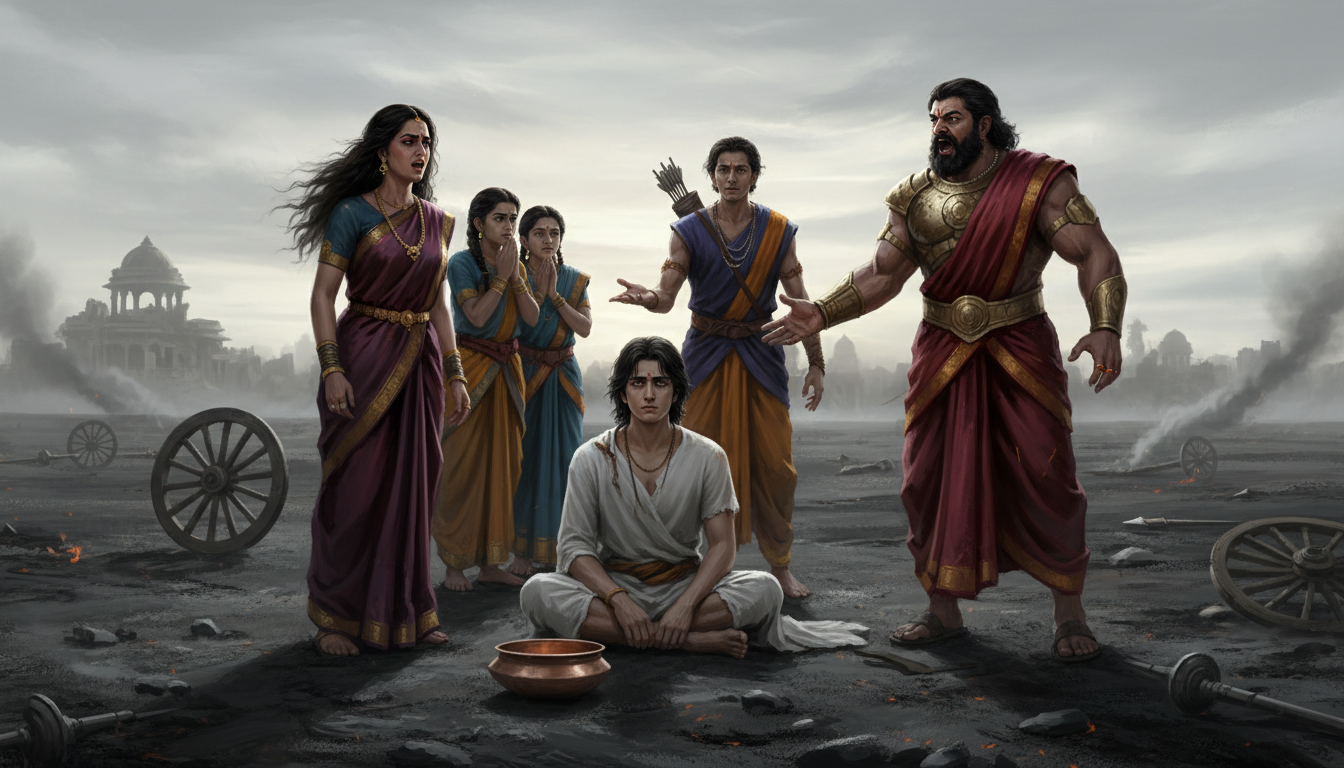
The Victory Nobody Wanted
Five brothers, a wife and a sage argue a king back onto his throne
Fie On the Usages of Kshatriyas
"When the water had been poured for the dead," said Vaishampayana, "and the field of Kuru had gone quiet at last, the righteous-souled Yudhishthira sat down among his brothers with an agitated heart, and would not be comforted. He was grieving for Karna. He sighed and sighed again, and then he turned to Arjuna and began to speak.
"'If we had gone and lived by begging in the cities of the Vrishnis and the Andhakas,' the king said, 'this end would not have been ours. We would not now be men who have exterminated their own kin. Our enemies the Kurus have gained in prosperity, and we have been stripped of every object for which a man lives. What fruit of righteousness can there be for us, when what we have done is self-slaughter?
"'Fie on the usages of Kshatriyas. Fie on strength and valour, and fie on wrath, since it is through these that this calamity has come. We were full of pride. Through covetousness and folly, and from the desire to taste the sweets of sovereignty, we have fallen into this.
"'Like a pack of dogs fighting one another over a piece of meat, a great disaster has overtaken us, and the meat is no longer dear to us. It shall be thrown aside. Mothers held those sons ten months in the womb and asked themselves, Shall these live? Shall they give us happiness in this world and the next? Their sons went out youthful and resplendent in their earrings, and were killed, and every one of those expectations has been abandoned.
"'A sin once committed, Dhananjaya, is expiated by repentance, by alms, by penances, by journeys to the sacred fords. But of all men, he who has practised renunciation is held incapable of committing sin anew. Therefore, with your leave, I shall go to the woods, take up the vow of silence, and walk in the way that knowledge points out. Govern this earth yourself. Her thorns are drawn. I have no need of a kingdom and no need of pleasure.'
"Having said these words, king Yudhishthira the just stopped speaking. And his younger brother Arjuna answered him."
Arjuna Speaks for Wealth
"Arjuna licked the corners of his mouth like a man unwilling to forgive an insult, and he smiled while he spoke, and what he said was heavy.
"'Oh, how painful this is. How distressing. You have achieved a feat beyond the power of men, and now you are bent on throwing the whole of it away. Having killed your enemies, having taken the sovereignty of the earth by the duties of your own order, why should you abandon everything out of fickleness of heart?
"'Where on earth has a eunuch, or a man who puts things off, ever acquired sovereignty? Why then did you, insensate with rage, slay all the kings of the earth? A man who lives by begging can never enjoy the good things of the earth. If you abandon this swelling kingdom and take up the wretched life of a mendicant, what will the world say of you?
"'King Nahusha, having done many wicked things in a state of poverty, cried fie upon that state, and said that poverty is for recluses. Making no provision for tomorrow is a practice that suits the Rishis. But the religion of royalty depends entirely upon wealth, and one who robs another of his wealth robs him of his religion as well. It is seen that a poor man, even standing near, is falsely accused. Poverty is a state of sinfulness. I do not see the difference between a fallen man and a poor man.
"'From wealth spring all religious acts, all pleasures, and heaven itself. The acts of one who lets himself be divested of wealth dry up like shallow streams in the summer season. He that has wealth has friends. He that has wealth has kinsmen. Wealth brings about accessions of wealth, as tame elephants are used to capture wild ones. He who is lean in horses and cattle and servants and guests is truly lean, and not the man whose limbs alone are thin.
"'This earth belonged in her time to Dilipa, and to Nahusha, and to Mandhatri. She belongs now to you. A great sacrifice awaits you, and if you do not perform it, then the sins of this kingdom shall all be yours. Eternal is that auspicious path, and its fruits are never destroyed. Abandoning it, O king, to what other path would you betake yourself?'"
Seven Houses and No More
"Yudhishthira heard him out, and answered without heat.
"'For a little while, Arjuna, fix your mind and your hearing upon your inner soul. If you listen to me in that frame of mind, my words will meet with your approval. I shall not, for your sake, walk the road you recommend. You ask what road is auspicious for a man to tread alone. I shall tell you, and if you do not wish to ask, I shall tell you unasked.
"'I shall wander in the forest with the animals that have their home there, living upon fruit and roots. I shall pour libations on the fire at the due hours, and cover myself with skins, and bear matted locks upon my head. Enduring cold and wind and heat, and hunger and thirst, I shall wear the body down by the penances laid down in the ordinance. I shall do no injury to the smallest creature, and what need is there to speak of men who live in villages and towns?
"'Or else, living alone and keeping the vow of silence, my head shaved clean, I shall beg each day from one tree only. I shall smear my body with ashes and shelter in abandoned houses or lie at the foot of trees. Without conversing with anyone, I shall put on the outward form of a blind and deaf idiot, and take my happiness from my own soul. I shall ask nobody the way. I shall go along whatever road I happen to meet, taking no note of the quarter of the sky towards which I am going, and I shall not look behind me.
"'If pure food, even a little of it, is not to be had at the first house, I shall go to others, and if I fail even by that round, I shall go to seven houses in succession and fill my craving. I shall wait until the smoke of the houses has ceased and the hearth-fires are out, until the husking-rods are put away and all the inmates have eaten. Then I shall choose my moment and beg at two houses, or three, or five at the most.
"'If a man strikes off one arm of mine and another smears the other arm with sandal-paste, I shall not wish evil to the one or good to the other. Tearing off every bond and tie, I shall live as free as the wind.'"
Bhima Calls Him a Reciter
"Then Bhimasena spoke, and he did not soften it.
"'Your understanding, O king, has gone blind to the truth, like the understanding of a foolish reciter of the Veda who has recited those scriptures so often that he no longer hears them. If you mean to censure the duties of kings and then lead a life of idleness, this destruction of the sons of Dhritarashtra was entirely uncalled for. If we had known this was your intention, we would never have taken up arms. We would never have killed a single creature. We would have lived by begging until this body was finished, and this terrible battle between the rulers of the earth would never have taken place at all.
"'What we are doing now is what a man does who digs a well and stops before the water comes, and climbs out smeared with mire. It is what a man does who climbs a tall tree and takes the honey and dies before he has tasted it. "'We are possessed of mighty arms and endued with great energy. Yet we obey the words of a eunuch as though we were helpless. "'It has been laid down that renunciation should be adopted only in times of distress, by kings overcome with age or defeated by their enemies. If success could be got by renunciation, then the mountains and the trees would surely obtain it, for they are always seen to lead lives of renunciation, they injure nobody, and they are all celibate. Behold, the world moves on, and every creature in it is employed in the acts proper to its nature. The man reft of action never obtains success.'"
The Golden Bird in the Woods
"Arjuna took up the argument again, and this time he told a story.
"'A number of well-born Brahmana youths of little understanding, boys whose beards had not yet come, once abandoned their homes and came into the woods to lead a forest life. Indra became compassionate towards them. He took the form of a golden bird and perched near them and said, Of all the acts men can achieve, the most difficult is what is done by those who eat the remnants of a sacrifice. Such an act is highly meritorious.
"'The youths heard it and were delighted. Look, they said to one another, this bird applauds those who subsist upon the remnants of sacrifices, and he is telling us so, because we live upon such remnants.
"'The bird said, I do not applaud you. You are stationed in mire and are very impure. You live upon offal, and you are wicked. You are not persons subsisting upon the remnants of sacrifice at all.
"'That silenced them. Then they said, Tell us, bird, what is good for us. Your words inspire us with faith.
"'And the bird said, Among quadrupeds the cow is foremost, of metals gold is foremost, of words the mantras, and of bipeds the Brahmanas. The mantras regulate every rite of a Brahmana's life, from those that belong to his birth to those that belong to the burning-ground. By what path do those men go who censure action? They abandon the eternal paths of the gods and of the Rishis, and they arrive at paths the Srutis do not approve. Bear the very heavy burden of the duties of a householder. Asceticism itself is obtained through a household life, upon which everything depends. Those are called eaters of the remnants of feasts who eat after having served guests and gods and Rishis and kinsmen, and they attain ends exceedingly hard to attain.
"'Hearing those words, brother, the ascetics abandoned the religion of renunciation, saying, There is nothing in it, and betook themselves to a life of domesticity. Calling that wisdom to your aid, rule the wide world, which is now without an enemy in it.'"
The Twins Answer From the Vedas
"Then Nakula of the broad chest, temperate in speech, his face gone the colour of copper, looked at the king and laid siege to his brother's heart with reason.
"'The gods themselves established their fires in the region called Visakha-yupa. Know therefore that the gods themselves depend upon the fruits of action. "'The four modes of life were once weighed in a balance. When domesticity was placed in one scale, the wise say, it required the three others together to be placed in the other to balance it. He, therefore, who takes up this mode of life thinking it his duty, and abandons all desire for its fruit, is the real renouncer. Not the man of clouded understanding who goes to the woods leaving his house behind him. And a man who, under a hypocritical garb of righteousness, fails to forget his desires even while living in the woods, is bound by the grim King of death with fetters round his neck.
"'I have never seen a king in the observance of a household life renounce his wealth in any way but the Rajasuya, the horse-sacrifice, and the other great rites. If, without giving away horses and cattle and elephants in their trappings, without giving villages and fields and houses to the Brahmanas, we retire into the woods with hearts that hold no friendly feeling towards our kinsmen, then we shall be the Kalis of the kingly order.'
"Then Sahadeva spoke, and he went to the root of it.
"'By casting off external objects only, Bharata, a man does not attain success. By casting off even mental attachments the attainment of success is still doubtful. Let that merit and that happiness which belong to the man who has cast off outward things while his mind still covets them be the portion of our enemies, and let the merit of the man who governs the earth having cast off his inward attachments be the portion of our friends.
"'The word mine, which has two letters in it, is Death himself. The words not mine, which have three, are eternal Brahma. As for the man who lives in the forest upon wild fruits and roots but whose attachment to the things of the earth has not ceased, that man lives inside the jaws of Death. You are my father, you are my protector, you are my brother, you are my teacher. Forgive these incoherent utterances of a person stricken with woe.'"
Draupadi Says the Word Madness
"The king had listened to his brothers reciting these truths of the Vedas, and he remained speechless. Then Draupadi, that foremost of women, of large eyes and noble descent, seated in the midst of brothers who resembled so many lions and tigers, turned her eyes upon her lord and spoke.
"'These brothers of yours, Partha, are crying and drying their palates like chatakas waiting for rain, and you do not gladden them. Why, when we lived beside the Dwaita lake and they sat with you suffering from cold and wind and sun, did you say to them, Rushing to battle from desire of victory, we shall slay Duryodhana and enjoy the earth that grants every wish, and all these sufferings of our exile shall end in happiness? Having said those words to your brothers then, why do you depress our hearts now?
"'A eunuch can never enjoy wealth. A eunuch can never have children, any more than there can be fish in a mire without water. A Kshatriya without the rod of chastisement can never shine. Friendship for all creatures, charity, the study of the Vedas, penances, these are the duties of a Brahmana and not of a king. Restraining the wicked, cherishing the honest, and never retreating from battle, these are the highest duties of kings.
"'It was not by study, nor by gifts, nor by begging that you acquired the earth. That force of the enemy, ready to burst upon you with all its might, abounding in elephants and horse and cars, protected by Drona and Karna and Aswatthaman and Kripa, was defeated and slain by you. It is for that I ask you to enjoy the earth.
"'My mother-in-law, who is possessed of great foresight, said to me, Princess of Panchala, Yudhishthira will keep you always in happiness. Her words cannot be untrue. And yet I see that through your folly you are about to make the whole feat futile. They whose eldest brother becomes mad have all to follow him into madness. Through your madness, king, all the Pandavas are about to become mad. If these brothers of yours were in their senses, they would shut you up with the unbelievers and take the government of the earth upon themselves. A man who treads the path of madness should be treated with incense and collyrium and drugs applied through the nose.
"'I am the worst of all my sex, since I desire to live on even though I am bereaved of my children. You should not disregard what I have said, nor what these brothers of yours have said, who are labouring to turn you back. Protect your subjects righteously and govern the goddess Earth with her mountains and forests and islands. Do not be cheerless.'"
The Battle With No Arrows In It
"After Yajnasena's daughter had spoken, Arjuna took up the argument once more, and this time he spoke of the rod.
"'The man armed with the rod of chastisement governs all subjects and protects them. The rod is awake when everything else is asleep. For this the wise have called it Righteousness itself. "'I do not behold in this world the creature that supports its life without doing injury to others. The mongoose devours mice, the cat devours the mongoose, the dog devours the cat, and the dog in his turn is devoured by the spotted leopard. Behold, all of them are devoured by the Destroyer when he comes. The very ascetics cannot support their lives without killing creatures. There are creatures so minute that their existence can only be inferred, and the mere falling of the eyelids destroys them.
"'Righteously or unrighteously, this kingdom has now become ours. Our duty now is to abandon grief.'
"Then Bhimasena, mustering all his patience, spoke again, and his second speech was quieter than his first.
"'There are two kinds of disease, physical and mental, and each springs from the other, and neither is ever seen existing alone. He who indulges in regret over past woes reaps woe from woe and suffers doubly. But you were never sad in grief nor glad in bliss. You should not now use your memory to make yourself sad in a time of good fortune.
"'Or if you must remember, remember what you saw. Remember Krishna dragged scantily clad into the assembly while she was in her season. Remember our expulsion from the city and our exile in deerskins. Remember Jatasura, and the battle with Chitrasena, and the distress we suffered at the hands of the Sindhu king, and the kick the princess Draupadi took from Kichaka while we were living in concealment.
"'A fierce battle like the one you fought with Bhishma and Drona is before you now, but it must be fought with your mind alone. There is no need in it of arrows or of friends or of kinsmen. If you give up your life-breath before you have won that battle, then, taking another body, you will have to fight these same enemies over again. Fight it today.'"
Conquer the Stomach First
"Yudhishthira was not moved, and he answered Bhima in the language Bhima had used against him.
"'Discontent, heedless attachment to earthly goods, the absence of tranquillity, folly, vanity, anxiety: it is because you are affected by these that you covet sovereignty. That peerless monarch who governs this unbounded earth will still have but one stomach. Why do you applaud this course of life? Fire fed with fuel blazes up, and fire not fed goes out. Extinguish with a little food the fire in your belly when it appears. Conquer your stomach first. Then you will be able to conquer the earth.
"'The tiger, to fill one stomach of his, slaughters many animals, and other animals without strength live upon what the tiger has killed. Between the king who rules this wide earth and the man who regards gold and a pebble as equal, it is the second who is said to have attained the object of his life.
"'There is a verse that was sung long ago by Janaka, who was freed from the pairs of opposites. It runs: My treasures are immense, yet I have nothing. If the whole of Mithila were burnt and reduced to ashes, nothing of mine would be burnt.'
"And to Arjuna he said, 'You are conversant with the science of battle, but you have never waited upon the aged. That which you think, that there is nothing superior to wealth, is an error. As a person on a hill-top looks down upon men on the plain below, so he who has climbed to the top of the mansion of knowledge sees people grieving for things that do not call for grief.'
"He had an answer for each of them, and the answers were good, and still the family sat there unpersuaded, because the thing they were arguing against was not an argument at all but a grief."
The Island-Born Ends It
"Then the great ascetic Devasthana, who was possessed of eloquence, said his piece, and he did not begin by contradicting the king.
"'Phalguna has told you that there is nothing superior to wealth. Four modes of life are indicated in the Vedas, Ajatasatru, and you should pass through them one after another, and not jump. You have righteously won the earth, and having won her, it does not become you to abandon her without cause. King Marutta, the son of Avikshit, defeated Sakra himself by the profusion of his wealth, and in the great sacrifice he performed every vessel was of gold, and Sree came to it in person.'
"And then, because he had heard the king out and knew what the king was really asking, Devasthana recited to him the words that Vrihaspati once spoke to Indra.
"'Contentment is the highest heaven. Contentment is the highest bliss. There is nothing higher than contentment. When a man draws in all his desires as a tortoise draws in its limbs, the natural resplendence of his soul soon shows itself. When he fears no creature and no creature is frightened at him, then he is said to behold his own soul. Observing all this, the conclusion of the learned is that the religion which consists in injuring no creature is the one worthy of the approbation of the righteous. That final emancipation of which you speak is exceedingly difficult to obtain. Take the sovereignty upon yourself, cherish the righteous and restrain the wicked, and at the last transmit your crown to your son and go to the woods.'
"Yudhishthira still said nothing. And then the island-born Vyasa spoke, and it was over.
"'The words of Arjuna are true. A life of retirement in the woods, casting off the duties of a householder, has not been laid down for you. Birds and animals and all manner of creatures are supported by men who live so. It is the most difficult of the four modes of life. Practise that one, Partha, which is difficult to practise for men of unrestrained sense. Bear like an ox the burden of your ancestral kingdom. Vrihaspati sang this verse: Like a snake devouring a mouse, the Earth devours a king who is inclined to peace, and a Brahmana who is too much attached to his house.'
"So the king who had asked leave to take a bowl and walk into the forest was talked back onto the throne by his own household, and he had won a victory that not one of them, and he least of all, had any joy in."
Dharma Lesson
Renunciation chosen in the hour when duty is heaviest is not detachment but desertion, and the people who love you most are the ones obliged to say so. Every speaker in this quarrel is right about something, and none of them can reach the grief underneath the argument. Vyasa ends it by telling him to bear the kingdom like an ox, because the difficult mode of life is the one he is trying to leave.