Karna at Rajapura
A bride carried off, a hundred kings unhorsed, and the city a rival gave away
On the Bank of the Bhagirathi
They had come out of the city to the sacred bank of the Bhagirathi to sit out the days of mourning and impurity, and the rishis had come to them there, and thousands of brahmanas were offering consolation to a king who was not taking any of it.
Yudhishthira had asked his question and would not let it go.
"Twice I have told you what is burning me," he said to Narada. "He had the strength of ten thousand elephants. He was the refuge of the sons of Dhritarashtra, and he overthrew us in encounter after encounter, and he was my mother's eldest son, and nobody told me until I was pouring water for the dead. There is a thing I never understood and now cannot ask him about. In the assembly hall, while he was saying the cruellest words that were said to us that day, my anger cooled when I looked down. His feet were like our mother's feet. I sat there in the middle of my humiliation trying to work out why the feet of a Suta's son should look like the feet of Kunti, and I could not find the reason, and the reason was standing in the room."
"You want the curses," Narada said.
"I want all of it. Why the earth swallowed his wheel. Why my brother was cursed. You know the past and you know what is coming; recite it to me, holy one, from the beginning."
So Narada told him of the Homa cow killed on the sea-shore and the brahmana's curse, and of the worm that bored into a thigh while a preceptor slept on it, and of Rama of Bhrigu's race waking in the blood and taking back the Brahma weapon from a pupil who had lied about his birth.
"And then?" said Yudhishthira.
"And then," said Narada, "having obtained the weapons from him of Bhrigu's race, your brother went back to Hastinapura and passed his days in great joy, in the company of Duryodhana. I shall tell you what they did with those days. You will not like it, and you will not be able to despise it either."
The Kings Assembled at Rajapura
Chitrangada, the ruler of the country of the Kalingas, had a daughter to give away, and he proclaimed a self-choice for her in his capital. The city was full of opulence and it was known by the name of Rajapura, and to Rajapura came hundreds of rulers for the hand of the maiden.
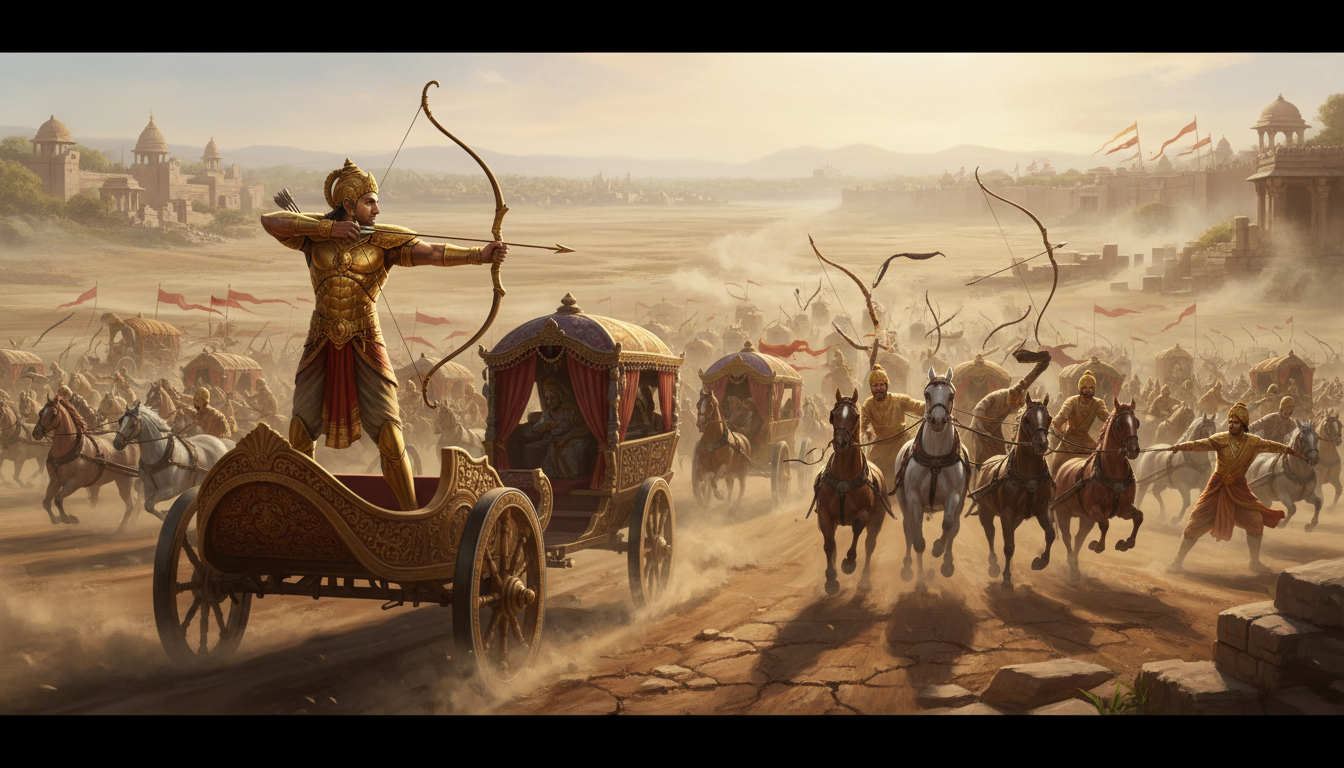
Hearing that so many kings had assembled there, Duryodhana also proceeded thither on his golden car, accompanied by Karna.
"He was not invited to compete and he did not expect to win," Narada said. "He went because everyone was going."
When the festivities commenced, the rulers came in for the hand of the maiden and took their places. Sisupala was there, and Jarasandha, and Bhishmaka, and Vakra, and Kapotaroman, and Nila, and Rukmi of steady prowess, and Sringa who was ruler of the kingdom of females, and Asoka, and Satadhanwan, and the heroic ruler of the Bhojas. Besides these there were many who dwelt in the countries of the South, and many preceptors in arms of the mlechcha tribes, and many rulers out of the East and the North.
All of them were adorned with golden Angadas on their arms and possessed the splendour of pure gold. Their bodies were effulgent. They were like tigers of fierce might, sitting in rows in a hall in their ornaments, waiting to be chosen by a girl.
"You have seen such an assembly," Narada said. "You have seen what it is like when a hall of armed men has been told to sit still and be judged. It only holds so long as the judging goes the way they can bear."
She Passed Him By
After all those kings had taken their seats, the maiden entered the arena. She came accompanied by her nurse and by a guard of eunuchs, and she began her round of the hall.
As she went, the names of the kings were told to her, one after another. Here is such a king, of such a country, son of such a father. She looked, and she heard the name, and she moved on. That is the whole of the ceremony; there is nothing in it but walking and listening, and every man in the hall has agreed beforehand to be looked at.
Of the fairest complexion, she passed by the son of Dhritarashtra.
She had passed others before him and she passed him in the same manner, without insult and without pause, in the way that the rite requires, and she went on toward the next name.
Duryodhana of Kuru's race, however, could not tolerate that rejection of himself.
"Mark the word," said Narada. "Not her choice. His rejection. The girl had made no statement about him at all; she had simply not stopped. And there are men who cannot survive being walked past, and one of them was sitting in that hall with the whole of the Kuru wealth on his arms."
He Commanded the Maiden to Stop
Disregarding all the kings, he commanded the maiden to stop.
It was said aloud, in a hall of a hundred armed rulers, in the middle of another king's ceremony, in another king's city. Intoxicated with the pride of his own energy, and relying upon Bhishma and upon Drona, relying, that is, on two old men eight hundred leagues away who would have to make good whatever he did here, Duryodhana came down, took that maiden up onto his car, and carried her off by force.
And behind him, without a word spoken between them that anyone recorded, Karna moved.
He was armed with a sword. He was clad in mail. His fingers were cased in leathern fences, which is what an archer wears who expects to loose a great many arrows in a short time and does not intend to stop when his hands begin to bleed. That foremost of all wielders of weapons mounted his own car and proceeded along Duryodhana's rear.
"He did not argue with him," Yudhishthira said.
"He never once argued with him," said Narada. "In sixteen years, not once. Your brother had made a single decision in his life and he kept making it. Duryodhana went out of that hall with a stolen bride and a clear road, and the reason the road was clear is that the road behind him had one man standing in it."
Let the Cars Be Made Ready
A great uproar then took place among the kings, and all of them were actuated by the desire for fight.
"Put on your coats of mail!"
"Let the cars be made ready!"
Those were the sounds that were heard in the hall of the self-choice, from men who a moment earlier had been sitting in ornaments waiting to be chosen. The ceremony came apart like a rope. Grooms ran, drivers backed the horses into the traces, and a hundred kings who had come to a wedding went out of the gates of Rajapura in war gear, filled with wrath, and pursued Karna and Duryodhana down the road.
They showered their arrows upon the two of them, and the arrows came the way masses of cloud pour rain upon a pair of hills.
"Two hills," Narada repeated. "That is the figure the account uses and I will not improve it. Not two men fleeing. Two hills standing in weather. Everything that could be thrown at them was thrown, and the road went on, and the car in front kept its speed."
Each With a Single Arrow
As they pursued, Karna felled their bows and their arrows to the ground, and he did it each with a single arrow.
That is the thing to hold on to, Narada said, because it explains why nobody died on that road. He was not shooting at the kings. He was shooting at their equipment. One shaft went out and a bow came apart in a man's hands; the next shaft went out and a fistful of arrows was struck out of the air; and the man was left sitting in his car in his golden Angadas with nothing to do.
Among them some became bowless. Some rushed on still holding the bow, as men do when the string has gone and they have not yet understood it. Some were on the very point of shooting their shafts when the shafts left them. And some came on armed with darts and with maces, having given up on missiles altogether, and those he handled otherwise.
Possessed of great lightness of hands, that foremost of all smiters afflicted every one of them. And then he began upon the drivers. He deprived many kings of their drivers, one after another, and thus vanquished all those lords of earth: not by killing them, but by taking away, piece by piece, everything with which a king fights, until each of them was a man alone in a vehicle nobody was steering.
Go Away, Go Away
They then themselves took up the reins of their steeds.
A hundred rulers of the earth, each stooping in his own car to gather the leather that a dead or wounded or simply absent driver had been holding for him, and finding that they could not drive and fight at once, and that there was nothing left to fight with in any case.
"Go away," they said to one another. "Go away."
And with cheerless hearts they turned away from the battle and went back to Rajapura, where the lamps were still burning in a hall that had been decorated for a wedding.
Protected by Karna, Duryodhana also came away, with a joyous heart, bringing the maiden with him to the city called after the elephant.
"And the girl?" Yudhishthira said.
Narada was quiet a moment. "The account does not give her name," he said, "nor one word that she spoke, from the moment she was told to stop to the moment she arrived in Hastinapura. It gives the names of eleven kings who came to look at her. That is the shape of the thing, son of Dharma, and I am not going to pretend otherwise while I praise the archery."
The King of Magadha Sends a Challenge
The fame of what had been done on that road went out over the country, and it reached Magadha.
Jarasandha had been in that hall himself. He had sat among the suitors and had ridden out with the rest in the pursuit and had come back with the rest, driving his own horses. Now, hearing the fame of Karna's might spoken of everywhere, the ruler of the Magadhas sent to him and challenged him to a single combat.
"He did not send an army," Narada said. "He was the man who had twice emptied his kingdoms against Mathura and he did not send an army. He asked one man to meet him alone, which among kings is the highest compliment there is and also the most dangerous."
Both of them were conversant with the celestial weapons, and the battle that took place between them was fierce. They struck each other with diverse kinds of arms and neither gave ground. In time their arrows were exhausted; then their bows were broken, and then their swords; then their cars were destroyed under them and they were both carless, standing on the ground.
Possessed of might as they were, they began to fight with bare arms.
The Seam Where Jara Had Joined Him
Now Jarasandha had been born in two halves, and a Rakshasi named Jara had put the halves together and made him a living king, and every man in India knew it and no man had ever been close enough to do anything with the knowledge.
While engaged with him in mortal combat with bare arms, Karna took hold of him at the join, and began to sever the two portions of his antagonist's body that had been united together by Jara.
The king of Magadha felt himself very much pained. He was being taken apart along the seam of his own birth by a man's hands, and he understood, in the way that only a wrestler being opened understands anything, exactly how the rest of the afternoon was going to go.
He cast off all desire of hostility.
"I am gratified," he said.
And Karna let him go, and stepped back, and the thing was over as quickly as that; and then, from friendship, Jarasandha gave him the town of Malini.
"Understand what that gift was," said Narada. "Before that day your brother had been king of the Angas only, and he had that from Duryodhana's hand in front of a laughing assembly. From that day the grinder of hostile forces ruled over Champa also, and he ruled it agreeably to the wishes of Duryodhana, as you know. A rival gave him a city because he could not beat him. That is a different kind of possession from a crown thrown to you in a tournament ground, and it was the only one of the two that no one could take back or sneer at."
The Reckoning by the River
"Thus Karna became famous on earth for the valour of his arms," Narada said, "and I have told you this so that you would know what it was that Arjuna had to kill, and by what means it was done.
"When, for your good, the Lord of the celestials came and begged of him his natural coat of mail and his ear-rings, stupefied by celestial illusion, he gave those precious possessions away. Deprived of the ear-rings and divested of the armour he was born in, he was slain by Arjuna in Vasudeva's presence.
"Count what stood against him at the end. The curse of a brahmana whose Homa cow he killed by accident, that the earth should swallow his wheel. The curse of the illustrious Rama, that the Brahma weapon should not come to his mind when he faced an equal. The boon your mother obtained from him, that he would not slay any son of hers but one. The illusion Indra practised on him for your sake. His depreciation by Bhishma, who at the tale of Rathas and Atirathas would count him only half a car-warrior. The destruction of his energy by Salya, who stood behind him holding the reins and cut at him with keen speeches the whole of that last morning. The policy of Vasudeva. And, last, the celestial weapons obtained by Arjuna out of the hands of Rudra and Indra and Yama and Varuna and Kuvera, and of Drona and the illustrious Kripa. With all of that in the scale, the wielder of Gandiva succeeded in slaying Vikartana's son Karna, whose effulgence was like that of Surya himself.
"Even thus had your brother been cursed and beguiled by many. As he has fallen in battle, you should not grieve for that tiger among men."
The river went on past them. The brahmanas had stopped their consoling to listen, and now nobody said anything at all.
"Holy one," said Yudhishthira at last, "you have given me a hundred kings turned back on one road by my brother, so that another man could keep a girl he had no right to. He spent himself covering a disgrace, and the disgrace stayed exactly where it was, and the glory was real. I do not know what to do with that."
"Nothing," said Narada. "There is nothing to be done with it. It is what loyalty buys, and it is what loyalty cannot buy, and your brother knew the price of both and paid it every day for sixteen years without once complaining to anyone. Grieve if you must, king. But do not imagine you were the only thing he lost."
Dharma Lesson
Loyalty spent covering another man's disgrace still buys real glory, and it still leaves the disgrace exactly where it was. Karna turned back a hundred armed kings for a bride Duryodhana had no right to, and won the town of Malini from a rival who could not beat him. The archery was his own; the errand never was.