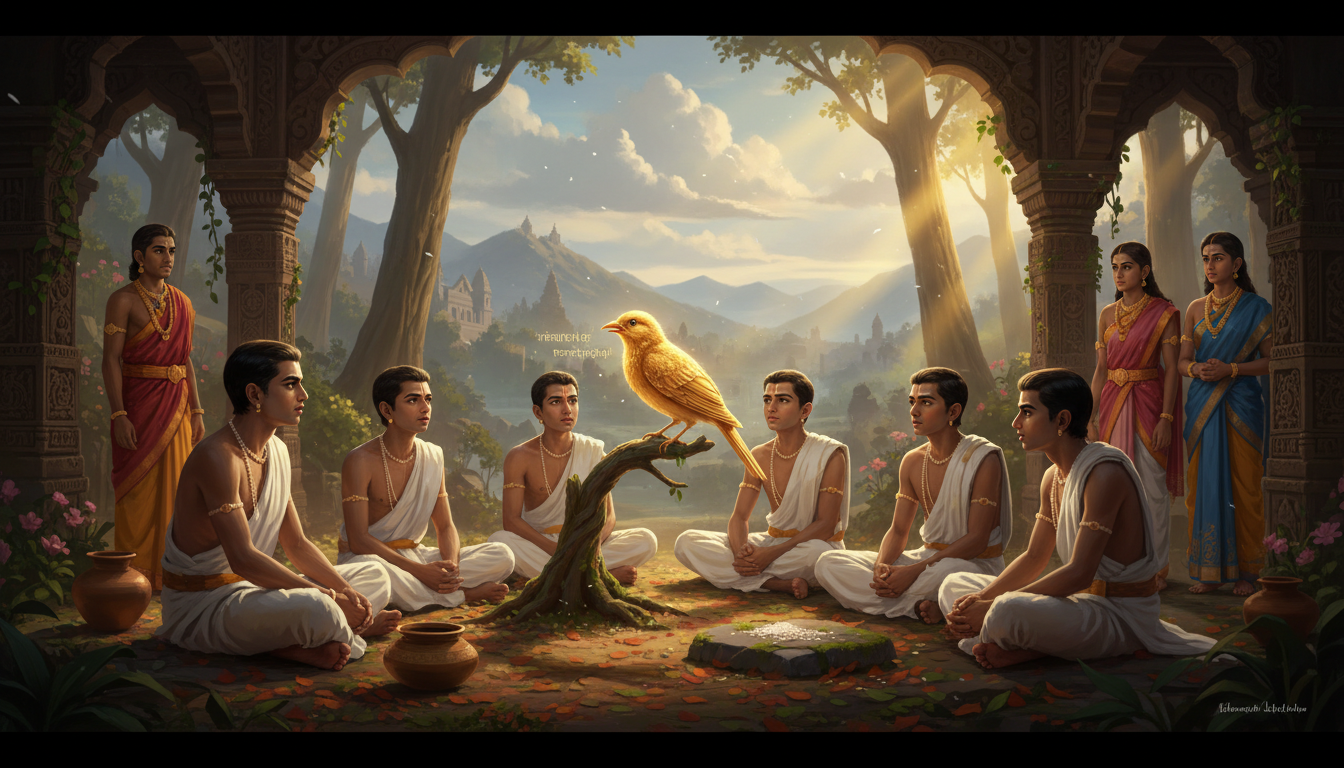
The Bird That Sent the Boys Home
Indra in golden feathers argues young renouncers back to their fathers
The King Who Wanted to Go Into the Woods
They were camped on the bank of the Bhagirathi, outside the Kuru city, passing the month of mourning where the water-rites had been performed, and Yudhishthira had stopped talking about the kingdom and started talking about the forest.
"For a little while, O Arjuna," he said, "concentrate your attention and fix your mind and hearing on your inner soul. If you listen to my words in such a frame of mind, they will meet with your approbation. Abandoning all worldly pleasures, I shall betake myself to that path which is trod by the righteous. I shall not, for your sake, tread along the path you recommend."
And then he described it, at length, the way a man describes a thing he has been building in his head at night for some time.
"I shall wander in the forest with the animals that have their home there, living on fruit and roots. Pouring libations on the fire at due hours, and performing ablutions at morn and eve, I shall thin myself by reduced diet, and covering myself with skins, bear matted locks on my head. Enduring cold and wind and heat, as also hunger and thirst and toil, I shall emaciate my body by penances as laid down in the ordinance. I shall not do the slightest injury to any creature. Living alone and observing the vow of taciturnity, with my head shaved clean, I shall derive my sustenance by begging each day of only one tree. Smearing my body with ashes, and availing myself of the shelter of abandoned houses, or lying at the foot of trees, I shall live, casting off all things dear or hateful. Without conversing with anybody, I shall assume the outward form of a blind and deaf idiot, while living in contentment and deriving happiness from my own soul."
His brothers listened to the whole of it. He had counted out the number of houses he would beg at, and the hour he would choose, and he had thought about what he would do if one arm were struck off and the other smeared with sandal-paste, and he had decided he would wish neither of the two men anything.
The Well Left Before the Water
Bhimasena answered first, and he was not gentle.
"Your understanding, O king, has become blind to the truth, like that of a foolish and unintelligent reciter of the Veda in consequence of his repeated recitation of those scriptures. If, censuring the duties of kings, you would lead a life of idleness, then this destruction of the sons of Dhritarashtra was perfectly uncalled for. If we had known that this was your intention, we would never have taken up arms and slain a single creature. We would have lived by mendicancy till the destruction of this body. This terrible battle between the rulers of the earth would also never have taken place."
Then he gave the pictures, one after another, and they are the pictures of a man who is very angry and very clear.
"This our act is like that of a person who, having dug a well, stops in his work before obtaining water and comes up smutted with mire. Or it is like that of a person who, having climbed up a tall tree and taken honey from it, meets with death before tasting it. Or of a person who, having set out on a long way, comes back in despair without having reached his destination. Or of a person who, having slain all his foes, at last falls by his own hand. Or of a person afflicted with hunger who, having obtained food, refuses to take it.
"If anybody were to obtain success from renunciation, then mountains and trees would surely obtain it. These are always seen to lead lives of renunciation. They do not injure anyone. They are always aloof from a life of worldliness, and they are all Brahmacharins.
"Behold, the world moves on, with every creature on it employed in acts proper to its nature. Therefore one should betake oneself to action. The man reft of action can never obtain success."
Arjuna Cites an Old History
Arjuna waited until his brother had finished, and then took a different road to the same place.
"In this connection an old history is cited, O bull of Bharata's race," he said, "the discourse between certain ascetics and Sakra.
"A number of well-born Brahmana youths of little understanding, without the hirsute honours of manhood, abandoned their homes and came to the woods for leading a forest life."
He had put three things into that sentence and he meant all three to be heard. They were well-born, so nothing had gone wrong for them. They were of little understanding, which at their age is not a fault but is a fact. And they were without the hirsute honours of manhood, which is to say that not one of them was yet old enough to grow a beard.
"Regarding that to be virtue, those youths of abundant resources became desirous of living as Brahmacharins, having abandoned their brothers and sires."
Abundant resources. There was no famine driving them and no creditor. They had left full houses. And what they had abandoned is named exactly: not property, not pleasure, but brothers and fathers, which is to say the living people who had a claim on them and who were now standing in doorways looking down a road.
They went out into the woods and set up the observances, and kept them, and were quite sincere, and were certain that what they were doing was the highest thing a man could do.
A Golden Bird in the Branches
"It so happened," said Arjuna, "that Indra became compassionate toward them."
That is the hinge of the whole story and it is easy to walk past. The lord of the three worlds looked at a group of beardless boys squatting in a wood on their fathers' grain, thoroughly pleased with themselves, and what rose in him was not contempt. It was pity. He did not send a curse or a storm or a rebuke through some passing sage. He came himself.
But he did not come as Indra. A boy who is told by the king of heaven that he is wrong will obey and will not believe. So the holy Sakra took the form of a golden bird, and settled in a branch above them where they were sitting, and began to talk to nobody in particular in the way that birds do.
And what he talked about was not renunciation, and it was not their fathers, and it was not any of the subjects they were braced against.
He praised somebody else.
The Praise of the Eaters of Remnants
"That which is done by persons that eat the remnants of a sacrifice," said the bird, "is the most difficult of acts that men can achieve."
The boys looked up.
"Such an act is highly meritorious. The lives of such men are worthy of every praise. Having attained the object of life, those men, devoted to virtue, obtain the highest end."
He said it as a golden bird says a thing, aloud and to the air, and then he waited.
Now, the eaters of remnants are householders. They are the men who serve the gods and the Rishis and the guests at the door and the kinsmen of the house, morning and evening, and then eat what is left over when everyone else has been fed. It is the most ordinary condition in the world and the least admired. That is why the bird chose it, and that is exactly what the boys did not know.
What the boys heard was a compliment lying unclaimed on the ground.
"Lo," said the Rishis to one another, delighted, "this bird applauds those that subsist upon the remnants of sacrifices. He informs us of it, for we live upon such remnants."
They did live on remnants, in a manner of speaking. They ate what was left at the edges of other people's rites, and what could be gathered, and what was given. They had heard a description of a difficult and meritorious life and had recognized themselves in it within a moment, which is the fastest way there is to find out what a man privately thinks of himself.
The bird let them finish congratulating each other. Then he spoke again.
I Do Not Applaud You
"I do not applaud you."
There was nothing before it and nothing after it to soften it, and the golden bird went straight on to say what he did mean.
"You are stationed with mire and are very impure. Living upon offals, you are wicked. You are not persons subsisting upon the remnants of sacrifice."
It is a hard thing to say to boys. He named the difference between the two lives and refused them the honour of the comparison. The householder eats last, after he has fed everyone he is answerable for. These boys ate leavings too, but they had fed nobody at all, and had left behind them in their houses the very people it was their business to feed. The same food, in the same order, means the opposite thing depending on who has been served first.
The boys did not argue and they did not walk away. That is to their credit, and it is why the story ends the way it does.
"We regard this our course of life to be highly blessed," they said. "Tell us, O bird, what is for our good. Your words inspire us with great faith."
The bird made one condition before he would go on, and it is a condition worth remembering whenever anybody asks to be taught.
"If you do not refuse me your faith by arraying yourselves against your better selves, then I shall tell you words that are true and beneficial."
He was not asking them to agree with him. He was asking them not to take up arms against the part of themselves that already suspected he was right.
"We shall listen to your words, O sire," they said, "for the different paths are all known to you. O you of righteous soul, we desire also to obey your commands. Instruct us now."
The Cow, the Gold, the Mantras and the Brahmanas
"Among quadrupeds the cow is the foremost," said the bird. "Of metals, gold is the foremost. Of words, mantras. And of bipeds, the Brahmanas.
"These mantras regulate all the rites of a Brahmana's life, beginning with those appertaining to birth and the period after it, and ending with those appertaining to death and the crematorium. These Vedic rites are his heaven, his path, and the foremost of sacrifices. If it were otherwise, how could I find that the acts of persons in quest of heaven become successful through mantras?"
He was telling them what they had walked out of. Not a house, not an inheritance. A sequence of observances that begins at a man's birth and does not let go of him until his body is on the fire, and that has a place in it for him at every age he will ever be, including the age they were then.
"He who in this world adores his soul, firmly regarding it to be a deity of a particular kind, obtains success consistent with the nature of that particular deity. The seasons measured by half the months lead to the Sun, the Moon, or the Stars. These three kinds of success, depending upon action, are desired by every creature.
"The domestic mode of life is very superior and sacred, and is called the field for the cultivation of success."
A field, said the bird, and not a granary. Nobody gets anything out of a field by admiring it. It is the place where the work is done and where the crop is possible, and a man who declines to stand in it because it is muddy will be hungry on principle for the rest of his life.
By What Path Do Those Men Go?
Then the bird put the question that the boys had never been asked, because everyone who met them had been too impressed by their vows to ask it.
"By what path do those men go that censure action?"
And he answered it himself.
"Of little understanding and deprived of wealth, they incur sin. And since those men of little understanding live by abandoning the eternal paths of the gods, the paths of the Rishis, and the paths of Brahma, therefore they attain to paths disapproved of by the Srutis.
"There is an ordinance in the mantras which says: You sacrificer, perform the sacrifice represented by gifts of valuable things, and I will give you happiness represented by sons, animals, and heaven. To live in accordance with the ordinance is said to be the highest asceticism of the ascetics. Therefore you should perform such sacrifices and such penances in the shape of gifts.
"The due performance of these eternal duties, the worship of the gods, the study of the Vedas, the gratification of the Pitris, and regardful service to the preceptors, these are called the austerest of penances. The gods themselves, by performing such exceedingly difficult penances, have obtained the highest glory and power. I therefore tell you to bear the very heavy burden of the duties of domesticity."
The very heavy burden. He never once called their forest life easy in order to shame them, and he never once called the householder's life pleasant in order to tempt them. He called it a burden, and heavy, and told them to pick it up.
"Without doubt, penances are the foremost of all things and are the root of all creatures. Asceticism, however, is to be obtained by leading a life of domesticity, upon which everything depends.
"They that eat the remnants of feasts, after duly apportioning the food morning and evening among their kinsmen, attain to ends that are exceedingly difficult of attainment. They are called eaters of the remnants of feasts who eat after having served guests and gods and Rishis and kinsmen."
So there at last was the definition, held back until they could hear it. The praise they had reached for at the beginning had never been out of their reach. It was waiting for them in the houses they had walked out of, and the price of it was to go back and serve at the meal instead of being served at it.
"Free from pride, those achievers of the most difficult feats attain to heaven, and live for unending time in the regions of Sakra."
There Is Nothing In It
"Those ascetics then," said Arjuna, "hearing these words that were beneficial and fraught with righteousness, abandoned the religion of renunciation, saying, 'There is nothing in it,' and betook themselves to a life of domesticity."
They did not debate it. They did not ask for a second discourse, or set a date, or resolve to consider the question after another season of vows. Boys who had left home in a body went home in a body, and the sentence they said as they went was four words long and had no piety in it whatever. There is nothing in it. They had been sitting in the woods living on offal and calling it holiness, and a bird had made them say the compliment out loud, and once they had heard themselves say it they could not go on.
Arjuna turned back to his brother, who had been listening on the bank with his chin down.
"Therefore, O you that are conversant with righteousness, calling to your aid that eternal wisdom, rule the wide world, O monarch that is now destitute of foes."
It was not a subtle application and it was not meant to be. Yudhishthira had described a forest life in every particular, down to the ashes and the shaved head and the seven houses. Arjuna had answered with a company of boys who had described one just as carefully, and had been perfectly sincere, and had been wrong, and had found out that what they were running from was not the world but a duty that had not yet fallen due.
Yudhishthira said nothing. And Nakula, of mighty arms and a broad chest, temperate in speech, rose next to speak.
Dharma Lesson
A young man's renunciation is often only the abandonment of duties he was never yet asked to carry, and a compliment accepted too eagerly is the fastest way to expose it. The bird never called the forest easy or the household pleasant; he called domesticity a very heavy burden and told them to pick it up. The praise they had reached for was waiting in the houses they walked out of, at the price of serving the meal instead of being served at it.