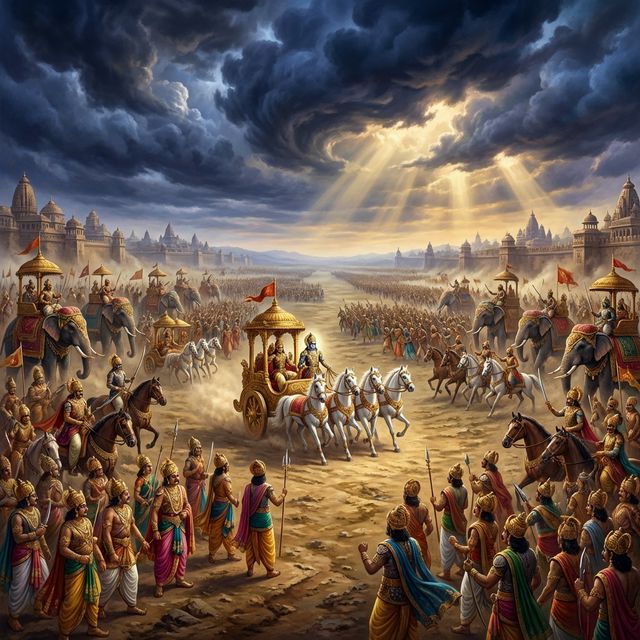
The Names That Cleanse Sin
Asked what destroys sin, Bhishma answers with a litany of gods, rivers, mountains, sages and kings
Four Questions That Were One Question
Vaishampayana said that the perpetuator of Kuru's race, Yudhishthira the son of Pandu, desirous of obtaining such good as is destructive of sins, questioned Bhishma who was lying on a bed of arrows.
The instruction had been going on a long while by then. The king had asked about the duties of kings and about the law in seasons of ruin, about gifts and fasts and the rites owed to the dead, and the old man had answered all of it out of the arrows, in a voice that had to be waited for between sentences. What Yudhishthira brought him that morning was shorter than usual. It was four questions, and they were all one question.
"What, indeed, is beneficial for a person in this world? What is that by doing which one may earn happiness? By what may one be cleansed of all one's sins? Indeed, what is that which is destructive of sins?"
Nothing in the wording says who was asking, and everything about the man asking is in it. He had come out of a war that had emptied his own house and the house of his cousins, and he had spent the months since it ended trying to find out from a dying man whether a person in his position could ever again be clean. He had been given the schedule of expiations already. He had been given the rites and the fasts and the gifts of cows. This was the question underneath all of those, and it was put as a beggar puts a question, without any pretence of scholarship: what actually works.
Vaishampayana continued that in this connection the royal son of Shantanu, foremost of men, duly recited the names of the deities unto Yudhishthira, who was desirous of hearing.
That was the answer. Not an argument, not a story, not a rule. Bhishma turned his head on the arrows and began to say names.
The Terms, and Then the Grandsire
"O son," Bhishma said, "the following names of the deities, with those of the Rishis, if duly recited morning, noon, and evening, become efficacious cleansers of all sins."
He set out the terms first, the way a man states a contract before he reads the schedule attached to it. Acting with the aid of one's senses, whatever sins a man commits by day or by night or at the two twilights, consciously or unconsciously, he is sure to be cleansed of them and to become thoroughly pure by reciting these names. The unconsciously is the part that answers Yudhishthira. There is no way to make a list of what a man did without knowing he was doing it, and no expiation can be prescribed for an injury nobody remembers. The names cover what the catalogues cannot reach.
Then the promises, plain and physical. One that takes those names has never to become blind or deaf. By taking them one always succeeds in attaining to what is beneficial. Such a man is never born among the beasts, never goes to hell, never takes birth in any of the mixed castes. He has never to fear the accession of any calamity. And the last of them, which is the one an old man on a bed of arrows would put last: when death comes, he never becomes stupefied.
Then Bhishma began at the top.
The master of all the deities and Asuras, resplendent with effulgence, worshipped by all creatures, inconceivable, indescribable, the life of all living beings, and unborn, is the Grandsire Brahma, the Lord of the universe. His chaste spouse is Savitri.
Then comes that origin of the Vedas, the creator Vishnu, otherwise called Narayana, of immeasurable puissance. Then the three-eyed Lord of Uma. Then Skanda, the generalissimo of the celestial forces, and Visakha. Then Agni, the eater of sacrificial libations, and Vayu the god of wind, and Chandramas the moon, and Aditya the sun endued with effulgence, and the illustrious Sakra the lord of Sachi.
Then the ones who are named with their wives, because a name is a household. Yama with his spouse Dhumorna. Varuna with Gauri. Kuvera the lord of treasures with his spouse Riddhi. The amiable and illustrious cow Surabhi. The great Rishi Visravas.
Yudhishthira did not interrupt. This was going to take a while.
The Choirs, the Fathers, and the Year
Sankalpa, which is the will itself. Ocean. Ganga, and after her the other sacred rivers, named all together before they are named one at a time. The diverse Maruts. The Valkhilyas, those thumb-sized ascetics crowned with the success of their penances.
Then the singers and the seers who move between the worlds. The island-born Krishna, which is Vyasa, sitting somewhere within earshot as his own name went by. Narada. Parvata. Viswavasu. The Hahas and the Huhus, the Gandharva choirs whose names are the sound they make. Tumvuru. Chitrasena, the celestial messenger of wide celebrity. The highly blessed celestial maidens, and then the Apsaras by name, Urvasi, Menaka, Rambha, Misrakesi, Alamvusha, Viswachi, Ghritachi, Panchachuda, Tilottama.
The Adityas. The Vasus. The Aswins. The Pitris, who are the fathers, and who are owed water every day by every man who has one.
And then, without any change of tone, the list stops being a list of persons.
Dharma, which is Righteousness itself. Vedic lore. Penances. Diksha, the consecration a man undergoes before a sacrifice. Perseverance in religious acts. The Grandsire again. Day and Night.
This is worth stopping on, because it is the shape of the whole recital. Bhishma is not distinguishing between gods and things. A quality that can be practised, a rite that can be undertaken, and the plain alternation of light and dark over a battlefield are set down in the same breath as Varuna and the Aswins, and all of them are addressed, and all of them are asked. Nothing in the world is treated as mere furniture.
Then the sky, which is a calendar as well as a place. Kasyapa the son of Marichi. Sukra. Brihaspati. Mangala the son of Earth. Vudha. Rahu, who is the eclipse. Sanischara, who is slow and heavy and comes to everyone. The Constellations. The Seasons, the Months, the Fortnights, the Year.
Garuda, the son of Vinata. The several Oceans. And the sons of Kadru, which is to say the Snakes, named among the cleansers by a man who was about to be avenged on them at a fire in Janamejaya's court, though he did not know it and would not have cared.
Bhishma took a breath and turned to the water.
The Water, Named One at a Time
The rivers came in a flood, and they are not arranged by size or by holiness. They are arranged the way a man remembers water, which is by where he has been.
Satadru. Vipasa. Chandrabhaga. Saraswati. Sindhu. Devika. Prabhasa. The lakes of Pushkara. Ganga. Mahanadi. Vena. Kaveri. Narmada. Kulampuna. Visalya. Karatoya. Amvuvahini. Sarayu. Gandaki. The great river Lohita. Tamra. Aruna. Vetravati. Parnasa. Gautami, which is the Godavari, and then the Godavari again by her own name, because the recital does not mind repeating itself and neither did the men who kept it. Vena. Krishnavena. Dwija. Drishadvati. Kaveri once more. Vankhu. Mandakini.
Some of these are great rivers that a kingdom is built along. Some are streams that no one outside one district has ever heard of. Bhishma does not rank them. Satadru, which waters the five rivers country, stands next to Amvuvahini, which is a name and little else now. That is the working principle of the whole recital: what makes water holy is not its volume.
Then Prayaga, where two rivers meet. Prabhasa. The sacred Naimisha, that forest where the sages sit and where this very story would one day be told again to men who had never seen any of these people. The spot sacred to Visweswara, that is, to Mahadeva, namely Kasi, that lake of crystal water. Kurukshetra, full of many sacred waters.
He was naming the ground he was lying on. The bed of arrows stood in the middle of the tirtha he had just recited as a cleanser of sin, which is a fact the text does not point out and does not need to.
The foremost of oceans, the ocean of milk. Penances. Gifts. Jamvumarga. Hiranwati, the little river that had run past both camps all through the war. Vitasta. The river Plakshavati. Vedasmriti. Vedavati. Malava. Aswavati. All sacred spots on Earth, named at one stroke so that none should be left out. Gangadwara, where the Ganga comes down out of the hills. The sacred Rishikulya. The river Chitravaha. The Charmanwati. The sacred river Kausiki. The Yamuna. The river Bhimarathi. The great river Vahuda. Mahendravani. Tridiva. Nilika. Saraswati again. Nanda, and the other Nanda. The large sacred lake. Gaya. Phalgutirtha. Dharmarayana, the sacred forest that is peopled with the deities. The celestial river. And the lake created by the Grandsire Brahma, sacred, celebrated over the three worlds, auspicious, and capable of cleansing all sins.
Named and Unnamed
Then the mountains, and the mountains are described where the rivers were only named, because a mountain has contents.
The Himavat mountain endued with excellent herbs. The Vindhya mountain variegated with diverse kinds of metals, containing many Tirthas and overgrown with medicinal herbs. That is what the recital notices about them: what grows on them and what is dug out of them. These are not scenic objects. They are the storehouses that keep a country alive, and a man who has ever been sick has reason to bless them.
Meru. Mahendra. Malaya. Sweta, endued with silver. Sringavat. Mandara, which the gods and Asuras once used for a churning stick. Nila. Nishada. Dardurna. Chitrakuta. Anjanabha. The Gandhamadana mountains. The sacred Somagiri. And the various other mountains, all of them, unnamed.
Then the recital opens out until there is nothing left outside it. The cardinal points of the compass. The subsidiary points. The Earth. All the trees. The Viswedevas. The Firmament. The Constellations. The Planets. And the deities.
"Let these all," Bhishma said, "named and unnamed, rescue and cleanse us."
That clause is the hinge of the whole thing, and it is the reason the catalogue does not need to be complete. Named and unnamed. Bhishma had just spent a long time saying that a river nobody has heard of counts as much as the Ganga, and now he says that the ones he has left out count too. A man reciting this list cannot fail by forgetting something. The omission is provided for in the text.
"The man who takes the names of these becomes cleansed of all his sins," he said. "By hymning their praises and gratifying them, one becomes freed from every fear. Verily, the man who delights in uttering the hymns in praise of the deities becomes cleansed of all such sins as lead to birth in impure orders."
Freed from every fear. Yudhishthira had not asked about fear. He had asked about sin, four times over, in four ways. The old man had answered the question the king had not managed to put, which was why he could not sleep.
The Sages of the Four Quarters
"After this recital of the deities," Bhishma said, "I shall name those learned Brahmanas crowned with ascetic merit and success and capable of cleansing one of every sin."
He named them by the quarter of the world they lived in, which is how a man travelling would meet them, and it turns the list into a map.
The eastern region first. Yavakrita and Raibhya, whose quarrel is a story in itself. Kakshivat. Aushija. Bhrigu. Angiras. Kanwa, who raised Shakuntala in his hermitage and gave the Bharatas their name-father. The puissant Medhatithi. And Varhi, possessed of every accomplishment.
Then the south. Unmuchu and Pramuchu, both highly blessed. Swastyatreya of great energy. Agastya of great prowess, the son of Mitra and Varuna, who is the reason the south has any brahmanas in it at all. Dridhayu and Urdhavahu, those two foremost and celebrated of Rishis. These live in the southern region.
"Listen now to me as I name those Rishis that dwell in the western region," he said. Ushango with his uterine brothers. Parivyadha of great energy. Dirghatamas, the blind sage who fathered a line of eastern kings. Gautama. Kasyapa. Ekata, Dwita, Trita, the three brothers, of whom the third was thrown into a well by the other two and made a sacrifice of it. The righteous-souled son of Atri, that is, Durvasa, whose temper is the most famous thing in the epic after Bhishma's vow. And the puissant Saraswat.
"Listen now to me as I name those Rishis that worship the deities in sacrifices, dwelling in the northern region."
Atri. Vashishtha. Saktri. Parashara's son Vyasa of great energy, who was sitting there. Vishvamitra. Bharadwaja. Jamadagni, the son of Richika. Rama, meaning Parashurama, who had once fought the man now reciting his name for three and twenty days on the field at Kurukshetra and could not beat him. Auddalaka. Swetaketu. Kohala. Vipula. Devala. Devasarman. Dhaumya, who had walked into the forest with the Pandavas when nobody else would. Hastikasyapa. Lomasa. Nachiketa, who went to the house of Death and came back with three answers. Lomaharsana. Ugrasravas. And Bhrigu's son Chyavana.
"This is the tale of Rishis possessed of Vedic lore," Bhishma said. "They are primeval Rishis, O king, whose names, if taken, are capable of cleansing one of every sin."
The Kings, and the Prayer at Both Twilights
"After this I shall recite the names of the principal kings."
That is the third and last of the divisions, and it is the one meant for the man listening. Yudhishthira had been crowned over a burnt country and could not believe that the throne was a clean place to sit. Bhishma gave him the roll of everyone who had sat on one.
Nriga. Yayati. Nahusha. Yadu. Puru of great energy. Sagara. Dhundhumara. Dilipa of great prowess. Krisaswa. Yauvanaswa. Chitraswa. Satyavat. Dushmanta. Bharata, who became an illustrious Emperor over many kings and whose name the family still carried. Yavana. Janaka. Dhrishtaratha. Raghu, that foremost of kings. Dasaratha. The heroic Rama, that slayer of Rakshasas. Sasavindu. Bhagiratha, who brought the river down. Harischandra. Marutta. Dridharatha. The highly fortunate Alarka. Aila. Karandhama. Kasmira. Daksha. Amvarisha. Kukura. Raivata of great fame.
Kuru, after whom the field itself was named, and the field was where they were.
Samvarana. Mandhatri of unbaffled prowess. The royal sage Muchukunda. Jahnu, who was much favoured by Janhavi, the Ganga. The first in point of time of all kings, Prithu the son of Vena. Mitrabhanu. Priyankara. Trasadasyu. Sweta, that foremost of royal sages. The celebrated Mahabhisha. Nimi. Ashtaka. Ayu. The royal sage Kshupa. Kaksheyu. Pratardana. Devodasa. Sudasa. Kosaleswara. Aila. Nala. The royal sage Manu, that lord of all creatures. Havidhara. Prishadhara. Pratipa.
Shantanu, who was his father.
Aja. The senior Varhi. Ikshwaku of great fame. Anaranya. Janujangha. The royal sage Kakshasena. And many others not named in history.
Half of them are men whose stories the Pandavas had heard on the road in exile, and some are men who lost everything, and Yayati fell out of heaven, and Nahusha was turned into a snake, and none of that disqualifies them. They are in the list because they ruled and because they can be called on.
"That man who, rising at early dawn, takes the names of these kings at the two twilights, at sunset and sunrise, with a pure body and mind and without distracted attention, acquires great religious merit," Bhishma said. "One should hymn the praises of the deities, the celestial Rishis, and the royal sages, and say this:
"These lords of the creation will ordain my growth and long life and fame. Let no calamity be mine, let no sin defile me, and let there be no opponents or enemies of mine. Without doubt, victory will always be mine, and an auspicious end hereafter."
Dharma Lesson
A man who has done wrong wants a procedure, and Yudhishthira had already been given several. What Bhishma hands him instead is a habit: stand up at dawn, say the names, say them again at noon and at dusk. The list is deliberately impossible to hold in one head, and it says so, asking the named and the unnamed alike to cleanse us, so that nobody can fail it by forgetting. Its comfort lies in what it includes. Small rivers stand beside the Ganga, kings who fell out of heaven stand beside Bharata, and a man who cannot account for everything he has done is told that the recital covers what he did unconsciously as well.