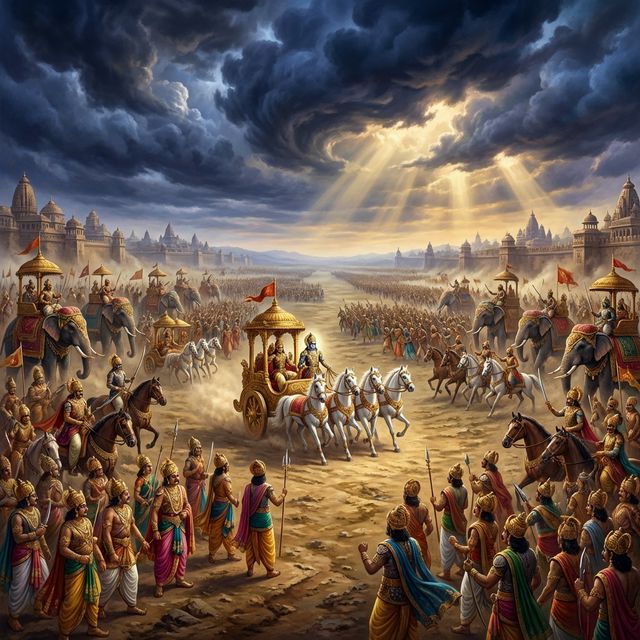
The Savitri Mantra of Salutations
Bhishma gives Yudhishthira the roll of names to be said at dawn
The Question After the Thousand Names
The thousand names of Vishnu had just been recited from beginning to end, and there was a pause on that field while everybody took in what had been said.
Then Yudhishthira asked for something a man could carry.
"O grandsire, O thou of great wisdom, O thou that art conversant with all branches of knowledge," he said, "what is that subject of silent recitation by reciting which every day one may acquire the merit of righteousness in a large measure?"
He was specific about the occasions he had in mind, and the list is the list of an ordinary life rather than of a sacrifice. "What is that Mantra for recitation which bestows success if recited on the occasion of setting out on a journey, or in entering a new building, or at the commencement of any undertaking, or on the occasion of sacrifices in honour of the deities or of the Pitris?"
And he named the conditions it had to satisfy. It must propitiate all malevolent influences. It must lead to prosperity or growth. It must protect from evil, destroy foes, dispel fears. And it must, at the same time, be consistent with the Vedas, which is to say that it could not be a charm picked up somewhere.
Bhishma lay on the arrows and answered him, and the first thing he did was name its authorship, because a mantra without a lineage is worth nothing.
"Hear, O king, with concentrated attention, what that Mantra is which was declared by Vyasa. It was ordained by Savitri and is possessed of great excellence. It is capable of cleansing a person immediately of all his sins."
Savitri is the presiding power of the solar disc, and it is from her that these recitations take their name. They are the Savitri Mantras.
"One who recites this Mantra day and night becomes never stained by sin," Bhishma said. "Indeed, the man that hears it becomes endued with long life, O prince, and attaining to the fruition of all his wishes, sports in felicity both here and hereafter."
Then he said the thing that made it Yudhishthira's business in particular.
"This Mantra, O king, was daily recited by the foremost of royal sages devoted to the practice of Kshatriya duties and steadily observant of the vow of truth. Indeed, O tiger among kings, those monarchs who, with restrained senses and tranquil soul, recite this Mantra every day, succeed in acquiring unrivalled prosperity."
It was a king's prayer. And the man he was handing it to was about to have to be a king.
Salutations to Vasishtha, and to the Snake
The mantra itself begins, and it does not begin with a god.
"Salutations to Vasishtha of high vows," Bhishma said, "after having bowed with reverence unto Parasara, that Ocean of the Vedas!"
Two men, and the second of them saluted before the first. Vasishtha is among the oldest of the rishis and the sternest of them, a keeper of vows in a family that suffered for keeping them. Parasara is his grandson, the father of Vyasa, and the epithet given to him here is worth holding on to. Ocean of the Vedas. Not a student of them and not a teacher of them. The place where all of it collects.
So the prayer opens by bowing to a scholar and then to an ascetic, in that order, and only afterwards lifts its eyes.
"Salutations to the great snake Ananta, and salutations to all those who are crowned with success, and who are of unfading glory!"
Ananta is the endless one, the serpent on whose coils the earth is steadied and on whose hood the Lord sleeps between the dissolution of one world and the making of the next. He is saluted in the same breath as every ordinary person who ever finished what he set out to do, which is what "all those who are crowned with success" means, and there are a great many of them and they are not named.
"Salutations to the Rishis, and unto Him that is the Highest of the High, the god of gods, and the giver of boons unto all those that are foremost."
Now the ascent is complete. From two named men, to the snake that holds up the world, to the whole body of the rishis, to the one above all of it.
"Salutations unto Him of a thousand heads, Him that is most auspicious, Him that has a thousand names, viz., Janardana!"
That is the hinge between this section and the one before it. The thousand names that Bhishma had spent the whole morning reciting are here folded up into a single bow and set down as one line of a longer prayer, and the prayer goes on.
Because after the salutations comes the roll. And the roll is the mantra.
The Eleven Rudras
What follows is a naming, and it has to be understood as a naming rather than as a list, because the reciter is not learning theology. He is standing in his own doorway at dawn saying the names of the powers that govern the place he lives in, one after another, until he has left none of them out.
Bhishma began with the fierce ones.
"Aja, Ekapada, Ahivradhna, the unvanquished Pinakin, Rita, Pitrirupa, the three-eyed Maheswara, Vrishakapi, Sambhu, Havana, and Iswara. These are the celebrated Rudras, eleven in number, who are the lords of all the worlds."
Read the names slowly and the shape of the group comes out of them. Aja, the unborn. Ekapada, the one-footed. Ahivradhna, of the serpent depths. Pinakin, who carries the bow called Pinaka and has never been beaten with it. Rita, which is the order of things itself. Pitrirupa, who wears the form of the fathers. Maheswara with three eyes, the great lord. Vrishakapi. Sambhu, the benign one, which is the name a man uses when he wants the fierce god to be kind. Havana, who is the offering. Iswara, the lord.
Eleven, and every one of them is the same terrible power looked at from a different side, which is why the prayer does not choose among them. It takes them all.
Then Bhishma added the line that tells you the count is not a limit.
"Even these eleven high-souled ones have been mentioned as a hundred in the Satarudra."
The Satarudriya of the Vedas gives a hundred where this gives eleven, and neither number is wrong, and neither number is the true number. Whether you say eleven or a hundred, you are pointing at the same thing and admitting that you have not finished pointing.
This is the pattern of the whole mantra, and it starts here. Count them. Know that the count is short. Say them anyway.
Twelve, Eight, and Two
Next came the bright ones, and Bhishma named the twelve.
"Ansa, Bhaga, Mitra, Varuna the lord of waters, Dhatri, Aryaman, Jayanta, Bhaskara, Tvashtri, Pushan, Indra and Vishnu, are said to comprise a tale of twelve. These twelve are called Adityas and they are the sons of Kasyapa as the Sruti declares."
Twelve, and the number is the year. One Aditya to a month, each of them a face the sun wears while it crosses a particular stretch of sky. Among them are Mitra who is friendship, Aryaman who is the guardian of contracts and marriages, Bhaga who is the portion a man is allotted, Tvashtri the artificer who shapes forms, Pushan the nourisher who keeps travellers on the road, and at the end of the tale, standing in the ranks like the rest, Indra and Vishnu.
Then the eight.
"Dhara, Dhruva, Soma, Savitra, Anila, Anala, Pratyusha, and Prabhava, are the eight Vasus named in the scriptures."
These are the Vasus, the good ones, the substance of the world set out under eight names. Dhara is the earth that holds. Dhruva is the pole star that does not move. Soma is the moon. Savitra is the impelling light. Anila is the wind and Anala is the fire. Pratyusha is the daybreak and Prabhava is the beginning. Anyone on that field who had heard the story of Shantanu and Ganga knew that eight brothers under those names had once come down and been born and gone back again, and that one of them had been made to stay, and was lying on the arrows saying their names.
Then the last two.
"Nasatya and Dasra are said to be the two Aswins. They are the sons of Martanda born of his spouse Samjna, from whose nostrils they came out."
The physicians of the gods, the twin horsemen who come at dawn and at the end of every hopeless case, and even their birth is odd and is reported without apology.
Eleven and twelve and eight and two. Three and thirty deities, which is the old count of heaven, complete.
The Ones Who Watch and Are Not Seen
"After this," said Bhishma, "I shall recite the names of those who are the witnesses of all acts in the worlds."
He was careful about what these ones do. "They take note of all sacrifices, of all gifts, of all good acts. Those lords among the deities behold everything although they are invisible. Indeed, they behold all the good and bad acts of all beings."
Then the names. "They are Mrityu, Kala, the Viswedevas, the Pitris endued with forms, the great Rishis possessed of wealth of penances, the Munis, and others crowned with success and devoted to penances and emancipation."
Death is on that list, and Time is on it, and the fathers are on it in bodily shape, and they are grouped not by what they can do to a man but by what they see. They are the audience. Every act performed anywhere is performed in front of them.
And then, having said that the witnesses of every bad deed are permanently present and invisible, Bhishma described their faces.
"These of sweet smiles bestow diverse benefits upon those men that recite their names. Verily, endued with celestial energy, they bestow diverse regions of felicity created by the Grandsire upon such men. They reside in all the worlds and attentively note all acts."
Then the prayer widens until it can hardly be held. The three and thirty deities are joined by Nandiswara of huge body, and by that pre-eminent one who has the bull for the device on his banner, and by the followers and associates of him called Ganeswara, and by those called Saumyas, and the Rudras, and the Yogas, and those known as the Bhutas.
And then it leaves the company of persons altogether. The luminaries in the firmament. The Rivers. The sky. Garuda, prince of birds. All those on earth who have become crowned with success by their penances, whether they exist in a mobile or an immobile form. The Himavat. All the mountains. The four Oceans. The followers of Bhava, who are as strong as Bhava himself. The ever-victorious Vishnu, and Skanda, and Ambika.
"These are the great souls," said Bhishma, "by reciting whose name with restrained senses one becomes cleansed of all sins."
By the end of that sentence the man reciting has saluted the mountains and the sea.
The Rishis of the East and the South
Then Bhishma came to the rishis, and he did not give them as a crowd. He gave them by the compass.
"After this I shall recite the names of those foremost Rishis who are known as Manavas. They are Yavakrita, and Raibhya, and Arvavasu, and Paravasu, and Aushija, and Kakshivat, and Vala the son of Angiras. Then comes Kanwa the son of the Rishi Medhatithi, and Varishada."
Some of those names carry stories the Pandavas had already heard in the forest. Yavakrita is the man who tried to get the Vedas without a teacher and paid for it. Raibhya was his father's friend and then his father's grief. Arvavasu and Paravasu are Raibhya's sons, and what happened between those four households is one of the hardest tales in the epic. Kanwa is the sage who raised Shakuntala in his hermitage on the Malini and gave the line of Bharata its beginning.
"All these are endued with the energy of Brahma," Bhishma said, "and have been spoken of as creators of the universe. They have sprung from Rudra and Anala and the Vasus. By reciting their names people obtain great benefits. Indeed, by doing good deeds on earth, people sport in joy in heaven, with the deities."
Then the placement. "These Rishis are the priests of Indra. They live in the east. That man who, with rapt attention, recites the names of these Rishis, succeeds in ascending to the regions of Indra and obtaining great honours there."
Then he turned the reciter a quarter of the way round.
"Unmachu, Pramchu, Swastyatreya of great energy, Dridhavya, Urdhvavahu, Trinasoma, Angiras, and Agastya of great energy, the son of Mitravaruna. These seven are the Ritwiks of Yama the king of the dead, and dwell in the southern quarter."
Agastya is the one everybody knows, the small sage who drank the ocean dry and made the Vindhya bow down and stay bowed. He is a priest of the lord of the dead, and he faces south, which is the direction of the dead, and nobody in the recitation finds that strange.
Every quarter of the horizon has its seven, and each seven serves a different lord.
West, North, and the Rishis of No Direction
"Dridheyu and Riteyu, and Pariyadha of great fame, and Ekata, and Dwita, and Trita, the last three endued with splendour like that of the sun, and Atri's son of righteous soul, viz., the Rishi Saraswata. These seven who had acted as Ritwiks in the great sacrifice of Varuna have taken up their abodes in the western quarter."
Ekata, Dwita and Trita are the one, the two and the three, brothers whose names are numbers, and Trita is the one who was thrown into a well by the other two and performed a whole sacrifice down there out of nothing.
Then the north, and here the names need no gloss at all.
"Atri, the illustrious Vasishtha, the great Rishi Kasyapa, Gotama, Bharadwaja, Viswamitra, the son of Kusika, and Richika's fierce son Jamadagni of great energy. These seven are the Ritwiks of the Lord of treasures and dwell in the northern quarter."
That is the constellation men look up at, the seven of the northern sky, and the mantra sets them to work as priests for Kubera.
"There are seven other Rishis that live in all directions without being confined to any particular one. They, it is, who are the inducers of fame and of all that is beneficial to men, and they have been sung as the creators of the worlds. Dharma, Kama, Kala, Vasu, Vasuki, Ananta, and Kapila. These seven are the upholders of the world. Rama, Vyasa, Drona's son Aswatthaman, are the other Rishis that are regarded as the foremost."
Ashwatthama's name is in the mantra. He was alive when Bhishma said it, on the other side of the field, and there was very little left of him but the wound he was about to make. He is counted here among the deathless.
Then Bhishma gave the practical instruction, which is the only piece of ritual technique in the whole section.
"One should turn one's face to that direction in which one of these Rishis live if one wishes to worship him."
The prayer has a geography. You aim it.
"Samvarta, Merusavarna, the righteous Markandeya, and Sankhya and Yoga, and Narada and the great Rishi Durvasa. These are endued with severe penance and great self-restraint, and are celebrated over the three worlds. There are others who are equal to Rudra himself. They live in the region of Brahman."
And then, with no change of tone: "By naming them with reverence a sonless man obtains a son, and a poor man obtains wealth."
The Kings Who Are Named With the Gods
Then the mantra does something that no other hymn in the Anushasana does. It takes six kings and puts them in with the rishis and the powers of the sky, and it names them by their deeds.
"One should also take the name of that celebrated king who was Emperor of all the earth and equal to a Prajapati, viz., that foremost of monarchs, Prithu, the son of Vena."
And the reason is given in one line that is worth the whole passage. "The earth became his daughter."
That is what a good reign looks like when it is put into a single phrase. Not that he conquered the earth or held it or taxed it. That she took him for her father.
"One should also name Pururavas of the Solar race and equal unto Mahendra himself in prowess. He was the son of Ila and celebrated over the three worlds. One should, indeed, take the name of that dear son of Vudha."
"One should also take the name of Bharata, that hero celebrated over the three worlds."
Bharata, after whom every man on that field was named, the son of Shakuntala who was raised among lion cubs and counted their teeth. Yudhishthira is called Bharata a dozen times a day by the man reciting this, and here is the origin of the address, set down as a name to be spoken at dawn.
"He also who in the Krita age adored the gods in a grand Gomedha sacrifice, viz., Rantideva of great splendour, who was equal unto Mahadeva himself, should be named. Endued with penances, possessed of every auspicious mark, the source of every kind of benefit to the world, he was the conqueror of the universes."
"One should also take the name of the royal sage Sweta of illustrious fame. He had gratified the great Mahadeva and it was for his sake that Andhaka was slain."
And last, the one whose work is still running past the door.
"One should also take the name of the royal sage Bhagiratha of great fame, who, through the grace of Mahadeva, succeeded in bringing down the sacred river from heaven. It was Bhagiratha who caused the ashes of the sixty thousand sons of Sagara to be overflowed with the sacred waters of Ganga and thereby rescued them from their sin."
Six kings, each remembered for one thing, and the one thing is never a battle.
What the Names Do
"Restraining one's senses, one should, O Bharata, take the names of these, morning and evening."
Then Bhishma told the king what these names are, and he told it in short hammering clauses.
"It is these that protect. It is these that shower rain. It is these that shine and give light and heat. It is these that blow. It is these that create all things."
And then the promises, and they are not vague ones. They are the fears of an actual household, answered one at a time.
He who takes their names becomes freed from the fear of fires and of thieves. Such a man never finds his way obstructed by any impediment. He becomes free from bad dreams of every kind. Cleared from every sin, such men take birth in auspicious families. If a man afflicted with disease recites them, he becomes freed from his sin in the form of disease. By reciting them within a house, all evils are dispelled from the inmates. By reciting them within a field, the growth is helped of all kinds of crops. Reciting them at the time of setting out on a journey, or while one is away from home, one meets with good fortune.
"These names lead to the protection of one's own self, of one's children and spouses, of one's wealth, and of one's seeds and plants."
Then the one clause aimed at the man he was speaking to. "The Kshatriya who recites these names at the time of joining a battle sees destruction overtake his foes and good fortune crown him and his party."
Then the fathers. The man who recites them at the rites in honour of the deities or the Pitris helps the deities and the Pitris eat the Havya and the Kavya that are set out for them, which is to say that the food does not arrive unless somebody speaks.
"By reciting these excellent Savitri Mantras on board a vessel, or in a vehicle, or in the courts of kings, one attains to high success. There where these Mantras are recited, fire does not burn wood. There children do not die, nor snakes dwell. Indeed, at such places there can be no fear of the king, nor of Pisachas and Rakshasas."
Fire does not burn wood. Children do not die. That is the whole of what anybody has ever wanted, put in five words and then four.
"That man who recites these Mantras in the midst of kine sees his kine become fruitful. Whether when setting out on a journey, or entering a house on coming back, one should recite these Mantras on every occasion."
The Opinion of Parasara
"These Mantras constitute a great mystery of the Rishis," Bhishma said, "and are the very highest of those which they silently recite."
Then he gave up the authorship, having carried it for the length of the recitation.
"This that I have said unto thee is the excellent opinion of Parasara. It was recited in former days unto Sakra himself. Representing as it does Truth or Eternal Brahman, I have declared it in full to thee. It constitutes the heart of all creatures, and is the highest Sruti."
And then the line that tells Yudhishthira he has not been given anything unusual. "All the princes of the race of Soma and of Surya, viz., the Raghavas and the Kauravas, recite these Mantras every day after having purified themselves."
His own house had been saying this every morning for as long as there had been a house. So had the house of Rama. It was not a secret and it was not new. He had simply never been told what it was for.
Bhishma named the men who had used it before him. Kasyapa and Gotama, Bhrigu and Angiras and Atri, Sukra and Agastya and Vrihaspati, all of them regenerate Rishis, have adored these Mantras. Approved of by the son of Bharadwaja, they were attained by the sons of Richika.
And one use of it is reported like a piece of military history. "Verily, having acquired them again from Vasishtha, Sakra and the Vasus went forth to battle and succeeded in subjugating the Danavas."
Then, at the very end, four short lines, each one a single name and a single result, the mantra reduced to the size of a thing a man can actually hold in his mouth on a bad morning.
"By reciting the name of Bhrigu one's righteousness becomes enhanced. By bowing to Vasishtha one's energy becomes enhanced. By bowing unto Raghu, one becomes victorious in battle. By reciting the praises of the Aswins, one becomes freed from diseases."
"I have thus, O king, told thee of the Savitri Mantras which are identical with eternal Brahman."
And then, because the arrows were still under him and there was still time and he had decided long ago how he would spend it, the old man made his standing offer once more.
"If thou wishest to question me on any other topic thou mayst do so. I shall, O Bharata, answer thee."
Dharma Lesson
The mantra never asks for anything. It only names: two sages, a serpent, eleven Rudras, twelve Adityas, eight Vasus, two physicians, seven rishis in each quarter of the sky, six kings remembered for what they gave rather than what they took. To say it every morning is to rehearse the fact that you did not make the world you woke up in and are not the first to stand in it. The protection it promises against fire and thieves and bad dreams follows from that, and not the other way round.