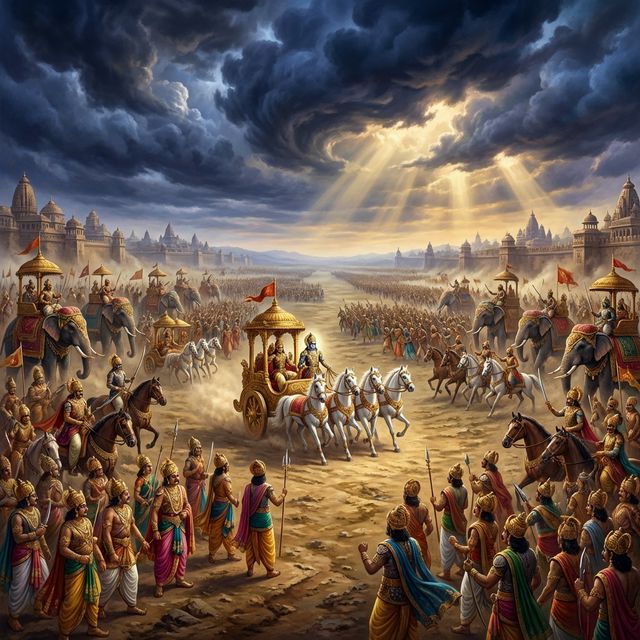
Upamanyu's Penance
The boy who refused every god but Shiva, and the god who came disguised as Indra to hear him do it
The Names Yudhishthira Asked For
Yudhishthira had spent the morning on smaller questions, on the three sins of the body and the four of speech and the three of the mind, and when the grandsire had finished with those the king asked for something larger.
"O son of the River Ganga," he said, "tell us all the names that are applied unto Him who is called Isha and Shambhu, unto Him who has the universe for his form, who is the illustrious preceptor of the deities and the Asuras, who is self-creating, and who is the cause of the origin and the dissolution of the universe. Tell us also of the puissance of Mahadeva."
Bhishma had answered every question put to him since he fell, on kings and gifts and fasting and the feeding of the fathers, and this was the first one he refused.
"I am quite incompetent to recite the virtues of Mahadeva," he said. "He pervades all things and yet is not seen anywhere. All the deities, from Brahma down to the Pisachas, adore him. Man is subject to conception in the womb, to birth, to decrepitude and to death. Being such, what man like me is competent to understand Bhava? Only Narayana, that bearer of the discus and the mace, can comprehend Mahadeva."
Then the old man turned his head on the arrows and looked at the dark man standing among the listeners, and Vaishampayana, telling this afterwards, says that Bhishma addressed Vasudeva directly.
"Thou art Vishnu, in consequence of thy pervading the whole universe. In days of yore the Rishi Tandin, sprung from Brahma, recited in Brahma's own region and before Brahma himself the thousand names of Mahadeva. Do thou recite those names before this conclave, so that these Rishis, observant of high vows, may hear thee."
Krishna began by refusing as well, which is the proper way to begin.
"The very deities with Indra among them, and the Grandsire Brahma, are incompetent to understand the course of Mahadeva's acts. The very Adityas, endued with subtle sight, are unable to behold his abode. How then can one that is merely a man succeed in comprehending Him? I shall therefore recite some of his attributes only."
He touched water to purify himself. Then, instead of starting on the names, he said that he would first tell them how he had come by his own sight of that god, and for whose sake, and how difficult a thing it had been to obtain.
The Retreat on the Breast of Himavat
Twelve years after Pradyumna had slain the Asura Samvara, Krishna said, his wife Jambavati came to him wanting a son.
She was the daughter of the prince of apes, and she had been watching Rukmini's boys grow up around her, Charudeshna and Sucharu and Charusravas, and she asked for one like them. "There is nothing in the three worlds unattainable by thee," she said. He told her the truth, which was that he had obtained Rukmini's sons by observing a vow for twelve years and adoring the Lord of all creatures, and that he would have to leave her to do it again. She gave him her permission and a blessing that took in Brahma and Shiva and Kasyapa, the rivers, the oceans, the seasons and the year down to its Kshanas and Nimeshas.
He took leave of his father and mother, of the king, and of Gada and Rama, who told him cheerfully to let his penances increase without obstruction. Then he thought of Garuda, and Garuda came, and carried him to Himavat and was dismissed there.
What he found on that mountain was a hermitage, and he describes it the way a man describes a place he was not expecting. It was planted with Dhavas and Kadambas and Ketakas, with banians and Bilwas and Salas and palmyras, with Punnagas and Asokas and Champakas, all bearing fruit and flower at once. Heaps of ash from the sacrificial fires lay in their proper places. Deer and peacocks and apes moved through it, and tigers and bears, and the Ganga ran clear through the middle of it. And the mongoose sported there with the snake and the tiger with the deer, like friends, having forgotten their natural enmity in the presence of ascetics whose penances blazed.
The ascetics were the strangest sight in it. Some subsisted upon air and some upon water, some upon smoke and some upon fire and some upon milk. Some had taken the vow of eating like kine, giving up the use of their hands altogether. Some husked their grain with two stones and some with their teeth only. Some drank the rays of the moon and some drank froth.
In the middle of them Krishna saw a Rishi with matted locks, dressed in rags, blazing like fire, and young in the face.
"Welcome art thou, O thou of eyes like lotus petals," the Rishi said. "Today, by this visit of thine, we see that our penances have borne fruit. Thou art worthy of our adoration, and yet thou adorest us. Thou art worthy of being seen, and yet thou desirest to see me."
His name was Upamanyu, and he was a descendant of Vyaghrapada.
What His Mother Told Him About Bhava
"Thou shalt obtain a son like unto thyself," Upamanyu told him. "Betake thyself to severe penances and gratify Ishana, the Lord of all creatures. That divine Master sporteth here with his spouse by his side, and it was here that the deities and the Rishis, in days of yore, gratified him and obtained the fruition of many high desires."
Krishna asked him how he knew, and Upamanyu went back to the beginning.
In the Krita age there was a Rishi named Vyaghrapada, celebrated for his mastery of the Vedas, and Upamanyu was born his son, with Dhaumya for a younger brother. His childhood comes down to one incident. He had tasted milk once, from a celestial cow at a sacrifice; and afterwards, at home, he asked for food prepared with milk, and there was none, and his mother boiled a cake of rice in water until the water went white and called it milk. He knew at the first mouthful that it was not. She wept and told him why: that milk and every other object of enjoyment come from the boon-giving Sthanu and from nowhere else.
So the boy asked the questions that turned the rest of his life.
"Mother, who is this Mahadeva? In what manner can one gratify him? Where does that god reside? What is the form of Sarva? If gratified, will he show himself unto me?"
She smelt his head, with her eyes covered in tears, and answered at length, and it is her answer that he repeated to Krishna word for word after all those years.
Mahadeva, she said, is exceedingly difficult to be known by persons of uncleansed souls. Men of wisdom aver that his forms are many, and many are the places in which he resides. He assumes the forms of Brahma and Vishnu and the chief of the celestials, of the Rudras and the Adityas. He assumes the forms of men and women, of Pretas and Pisachas, of Kiratas and Savaras, of every creature that lives in water or in a hole. He is the tiger and the deer, the owl and the jackal, kine and elephants and horses. He is sometimes six-faced, sometimes three-eyed, sometimes possessed of a million legs.
"He has snakes for his belt," she said, "and snakes form the sacred thread he wears, and an elephant skin is his upper garment. He laughs and sings and dances most beautifully. He wanders over crematoria. He is perfectly naked, for he has the horizon for his garments. He resides in the hearts of all creatures, and knows the desire cherished by every one of his worshippers. Devote thyself to him, O son, and accept him as thy refuge."
One Thousand Years on the Left Toe
From that day, Upamanyu said, his devotion was directed to Mahadeva and had nothing else for its object.
The penance he then undertook is set down as a bare accounting, and it is better read slowly than quickly. For one thousand years he stood on his left toe. After that he passed one thousand years subsisting only upon fruits. The next thousand years he passed subsisting upon the fallen leaves of trees. The next thousand he passed upon water only. After that he passed seven hundred years upon air alone. In this manner he adored Mahadeva for a full thousand years of the celestials.
And at the end of it the god was gratified with him. But before he would show himself, he wanted to know whether the boy who had been refused milk was devoted to him alone, or merely devoted.
So he came in the shape of another god.
What Upamanyu saw coming towards him through the air was Shakra, the chief of the celestials, with a thousand eyes upon his person and the thunderbolt in his hand. He rode an elephant of the purest white, with red eyes and folded ears and the temporal juice trickling down its cheeks, its trunk contracted, terrible to look at, and endued with four tusks. A white umbrella was held above the rider's head. He wore a beautiful crown, garlands round his neck, bracelets round his arms. Apsaras waited upon him and Gandharvas sang his praise, and all the deities came behind him, so that the sky over that one starved ascetic was as full as the sky ever gets.
Then the visitor spoke, and what he said was the thing every man who has ever undertaken a penance is waiting to hear.
"O foremost of regenerate persons, I have been gratified with thee. Beg of me whatever boon thou desirest."
Four thousand seven hundred years of standing and starving had just been declared successful by the king of heaven in front of witnesses, with the whole apparatus of reward assembled and hovering, and the boon left open and unnamed so that the man could have anything at all.
"Hearing these words of Shakra," Upamanyu said, "I did not become glad."
I Would Rather Be a Worm
He answered the chief of the celestials, and he did not soften it.
"I do not desire any boon at thy hands, or from the hands of any other deity. O amiable deity, I tell thee truly, it is Mahadeva only from whom I have boons to ask. True, true it is, O Shakra, true are these words that I say unto thee. No other words are at all agreeable to me save those which relate to Maheshwara."
Then he began to name the things he would rather have, and the list is not a list of renunciations. It is a list of humiliations chosen deliberately over honours.
"At the command of Pashupati I am ready to become a worm, or a tree with many branches. If not obtained through the grace represented by Mahadeva's boons, the very sovereignty of the three worlds would not be acceptable to me. Let me be born among the very Chandalas, but let me still be devoted to the feet of Hara. Without being devoted to that Lord of all creatures, I would not like to have birth in the palace of Indra himself. At the word of Hara I would become even a dog. In fact, that would accord with my highest wish."
He was saying this to Indra, in Indra's palace's own hearing, on the subject of Indra's palace.
"I do not wish to have this dominion of the heavens. I do not wish to have the sovereignty of the celestials. I do not wish to have the region of Brahma. Indeed, I do not wish to have that cessation of individual existence which is called Emancipation and which involves a complete identification with Brahma. But I want to become the slave of Hara."
That is the sentence that goes furthest. Men who refuse heaven are common enough in these histories; a man who refuses Emancipation is refusing the last thing there is to want. He was declining the exit and asking to stay in, on condition of belonging to one master.
"As long as that Lord of all creatures, with the crown on his head and his body of the pure white complexion of the lunar disc, does not become gratified with me, so long shall I cheerfully bear all those afflictions, due to a hundred repetitions of decrepitude and death and birth, that befall the lot of embodied beings. And if, in consequence of my faults, rebirths be mine, in those new births also I shall devote myself solely to Bhava."
The god on the white elephant heard him out and then asked the one question that had not yet been asked.
What Reason Canst Thou Assign
"What reason canst thou assign," Indra said, "for the existence of a Supreme Being, or for His being the cause of all causes?"
It is a fair question, and it is asked in the manner of a man who expects a boy raised in a forest to be unable to answer it. What Upamanyu gave back was an argument, not a hymn.
"I solicit boons from Him whom the utterers of Brahma have described as existent and non-existent, manifest and unmanifest, eternal, one and many. I solicit boons from Him who is without beginning and middle and end. I solicit boons from Him who, though himself unsprung from any seed, is the seed of all things in the universe."
Then he came down out of the abstractions and began asking questions back.
"The wise say that the Grandsire Brahma is the creator of this universe. But Brahma acquired his high puissance by adoring and gratifying Mahadeva. Who else than that Supreme Lord could be the creator of Fire, Water, Wind, Earth, Space, Mind, and that which is called Mahat? Who else could create Understanding, Consciousness, the Tanmatras, and the senses? The points of the horizon, Time, the Sun, the planets and the constellations, know thou that these are from Mahadeva. Who else is there in the matter of the creation of Sacrifice and the destruction of Tripura? Who else is praised as having the horizon only for his garments? Who else has half his body occupied by his dear spouse? Who else has subjugated Kama, the god of desire? Who else has the crematorium for his sporting ground?"
And then he put the proof that a child could check.
"Brahma has for his sign the lotus. Vishnu has for his the discus. Thou, O Indra, hast for thy sign the thunderbolt. But the creatures of the world do not bear any of the signs that distinguish these deities. All creatures bear the signs that mark Mahadeva and his spouse. Every being with the mark of the masculine sex should be known to be of Ishana, and every being with the mark of the feminine sex to be of Uma."
"My mother told me formerly that he is the one cause of everything. There is none higher than Isha, O Shakra. It is from Mahadeva that I wish to obtain boons. Failing in this, I would rather prefer dissolution itself. Go or remain, O slayer of Vala, as thou desirest. I wish to have boons or curses from Mahadeva. No other deity shall I ever acknowledge."
Having said it, he stopped, and grief came over him, because for all his fine speaking the god he wanted had still not come.
The Elephant Becomes a Bull
Within the twinkling of an eye, while he was still standing there overwhelmed at the thought that his austerities had failed, the celestial elephant in front of him changed.
It became a bull, and the description of that bull is the most loving passage in the whole account. It was white as a swan, or as a stalk of the lotus, or as silver, or as the ocean of milk. Its body was huge and the hair of its tail was black. The hue of its eyes was tawny, like honey. Its horns were hard as adamant and had the colour of gold, and with their sharp ends, whose hue was a mild red, the bull seemed to be tearing at the earth. It was adorned all over with ornaments of the purest gold, and its hump shone and seemed to occupy the whole of its shoulder joint, and the animal looked like the summit of a mountain of snow, or a cliff of white cloud standing in the sky.
Upon the back of that animal sat Mahadeva, and beside him his spouse Uma.
Then the light came. The fire born of the god's energy resembled the lightning that flashes amid clouds, and it seemed as if a thousand suns had risen at once, filling every side with a dazzling splendour. It looked, Upamanyu said, like the Samvartaka fire that destroys all creatures at the end of the Yuga. Overspread with it, the horizon became such that he could see nothing on any side, and he stood in the blaze wondering what it could mean, and then, through the illusion of that god of gods, the air cleared.
And he saw him plainly, seated on the back of his bull, of blessed and agreeable appearance, looking like a smokeless fire.
He was blue-throated. He had eighteen arms and was adorned with every kind of ornament. He was clad in white vestments and wore white garlands, and white unguents were smeared upon his limbs, and the colour of his banner, irresistible in the universe, was white, and the sacred thread round his person was white. A crescent moon of pale hue formed his crown, and on his forehead it looked like the moon that rises in the autumnal sky. He dazzled with his three eyes, which looked like three suns. Parvati of faultless features sat beside him, and all round him were his associates, every one possessed of prowess equal to his own, singing or dancing or playing upon instruments.
The boy who had once been given whitened water and told it was milk was looking at a bull the colour of the ocean of milk, with god on its back.
The Weapons in Their Embodied Forms
He looked next at what the god was carrying, and here the account slows down, because Upamanyu was seeing weapons the rest of the epic only hears about.
The bow first. Its hues resembled those of the rainbow, and it is celebrated under the name of the Pinaka, and it is in reality a mighty snake of seven heads and vast body, of sharp fangs and virulent poison, twined about with the cord that served it as a bowstring.
Then the shaft on the string, whose splendour was like the fire that appears at the end of the Yuga. That was the Pashupata, the terrible weapon which is without a second. It had one foot, and large teeth, and a thousand heads and a thousand stomachs, a thousand arms and a thousand tongues and a thousand eyes, and it seemed to vomit fire continually. It is superior to the Brahma weapon, to the Narayana, the Aindra, the Agneya and the Varuna weapons, and can neutralise every other weapon in the universe. It was with that single arrow that Mahadeva had burnt the triple city of the Asuras in a moment.
Then the Shula, which may be greater still. Hurled by the god it is competent to rive the earth, or dry up the ocean, or annihilate the universe. It was this that the Rakshasa Lavana obtained from Shiva, and with which he destroyed Yuvanaswa's son, king Mandhatri, together with all his troops. Upamanyu saw it as if roaring with rage, having contracted its forehead into three wrinkles, its handle made of a mighty snake.
And on the god's shoulder hung the sharp-edged battle-axe given in days of yore to Rama of Bhrigu's race, with which he slew Kartavirya and exterminated the Kshatriyas one and twenty times.
Nor was the god alone. On his left stood the Grandsire Brahma, on a car drawn by swans endued with the speed of the mind. Near him was Narayana, seated on the son of Vinata, bearing the conch and the discus and the mace. Close to the goddess Uma sat Skanda on his peacock, looking like a second Agni. In front of Mahadeva stood Nandi, his attendant, armed with a Shula.
The Munis headed by the Self-born Manu came, and the Rishis with Bhrigu at their head, and the deities with Shakra at theirs. Brahma praised Mahadeva by uttering a Rathantara. Narayana sang the Jyestha Saman. Shakra used those foremost of Vedic Mantras, the Shata-Rudriya. The three shone there like three sacrificial fires, and in their midst the god shone like the sun in the middle of his corona.
And Upamanyu, alone of everyone present, had not yet said anything.
Salutations to Thee That Wearest the Form of Shakra
Then he praised him, and the first thing he said was about the disguise.
"Salutations to thee, O illustrious one, O thou that constitutest the refuge of all things, O thou that art called Mahadeva. Salutations to thee that assumest the form of Shakra, that art Shakra, and that disguisest thyself in the form and the vestments of Shakra."
He had worked it out. The thousand-eyed rider on the four-tusked elephant had never been Indra at all. Every boon Upamanyu had refused had been offered to him by the one he was refusing them for.
After that the hymn opened out. Salutations to thee that art armed with the thunder and always armed with the Pinaka. Salutations to thee that art clad in black, of dark and curly hair, with a dark deer-skin for thy upper garment. Salutations to thee that art of white complexion, clad in white robes, with limbs smeared in white ashes, ever engaged in white deeds. Salutations to thee that art red of colour, with red banner and red flags and red garlands. Salutations to thee whose face is like the sun. Salutations to thee that art Soma, that art as mild as Soma, that bearest the lunar disc. Salutations to thee that hast a form half of which is male and half female. Salutations to thee that ownest a bull for thy vehicle, that hast the universe for thy home, that makest a happy home of every place where thou mayst happen to be for the moment.
Then he came to the end of it and apologised for the only fault he could find in himself.
"Be thou gratified with me, who am thy worshipper, and who am very miserable and helpless. It behoveth thee to pardon all those transgressions of which I have been guilty. I was stupefied by thee, O Lord of all the deities, in consequence of the disguise in which thou showedst thyself to me. O Maheshwara, I did not give thee the Arghya, or water to wash thy feet."
He had spent that interview refusing the sovereignty of the three worlds, and what he asked forgiveness for was a lapse in hospitality.
Then he gave him water for his feet and the ingredients of the Arghya, and with joined hands resigned himself, being prepared to do whatever he was bidden. A shower of flowers of celestial fragrance fell on his head. The celestial musicians began upon their kettle-drums. A delicious breeze went across that mountain.
And Mahadeva turned to the assembled gods and said: "Behold, ye deities, the devotion of the high-souled Upamanyu. Verily, steady and great is that devotion, and entirely immutable, for it exists unalterably."
The Ocean of Milk, Wherever He Wants It
The deities bowed and asked, on his behalf, that this best of regenerate persons might obtain the fruition of all his desires. And Shankara, smiling, spoke to him.
"O dear Upamanyu, I am gratified with thee. Behold me. Thou art firmly devoted to me, and well hast thou been tested by me. I shall give thee today the fruition of whatever desires thou mayst have in thy heart."
Tears came into his eyes and the hair stood up on his body, and he knelt and bowed and bowed again, and said with a voice choked with delight that it seemed to him he had been dead until that day and had only now been born. Then he asked for four things, and the order of them is worth noticing.
"If thou wouldst grant me boons, let this be the boon, O Lord of all the deities, that my devotion to thee may remain unchanged. Let me, through thy grace, have knowledge of the Present, the Past and the Future. I shall also, with all my kinsmen and friends, always eat food mixed with milk. And let thy illustrious self be for ever present at our retreat."
The devotion first, and the milk third, and the milk not for himself alone.
"Be thou free from every misery and pain," the god answered, "and be thou above decrepitude and death. Be thou possessed of fame, and let spiritual knowledge be thine. Let undecaying youth be thine, and let thy energy be like that of fire. Wherever thou mayst desire the presence of the ocean of milk that is so agreeable to thee, there shall that ocean appear before thee. Do thou with thy friends always obtain food prepared with milk, with the celestial nectar besides mixed into it. After the expiration of a Kalpa thou shalt obtain my companionship, and I shall always accord my presence to thy asylum. Thought of by thee, I shall grant thee a sight of myself again."
Having said this and granted these boons, Ishana, endued with the effulgence of millions of suns, disappeared there and then.
"It was even thus, O Krishna," Upamanyu said, "that I beheld, with the aid of austere penances, that God of gods. Behold these Siddhas residing here, and these Rishis and Yakshas and Gandharvas, and these trees bearing the flowers of every season. All are endued with a celestial nature through the grace of that Supreme Lord."
Krishna asked whether Shankara would grant him a sight of himself as well; and Upamanyu, who could now see the three times, told him that he would, in the sixth month, and gave him the Mantras, and began his initiation eight days later.
Dharma Lesson
A test is not made of temptations you despise; it is made of the exact thing you have been starving for, offered by an authority you have no reason to doubt. Upamanyu had asked for milk and been given whitened water, and the king of heaven arrived with every reward in the universe held open and unnamed, and the boy said no to all of it, including release itself, because none of it came from the hand he wanted it from. What the story insists on is that the tester and the sought god were one person the whole time: the devotion was not being measured against Shiva, it was being measured by him.