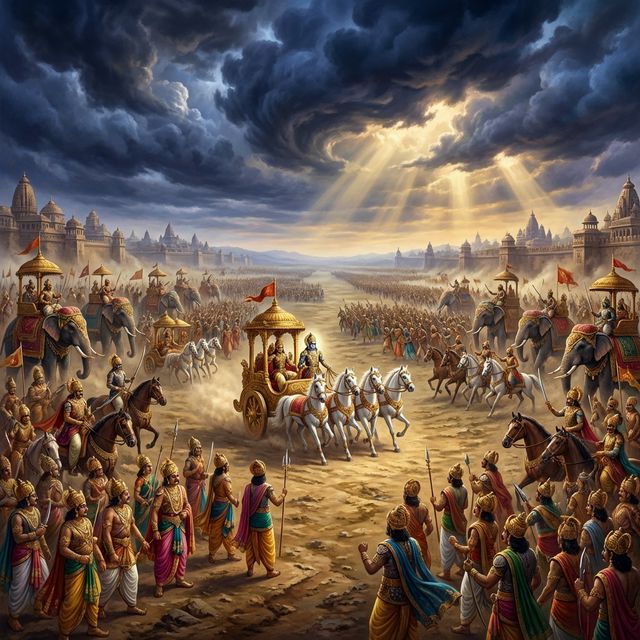
Karna Takes the Field
The vow that kept him out of ten days of war, and the grief that brought him into it
The Question Asked in the Night
Janamejaya was hearing the epic from the rishi Vaisampayana, and when the tenth day of the war had ended in the telling, the king stopped his teacher to ask about a father and a son.
"Hearing that his sire Devavrata of unrivalled vigour and might had been slain by Shikhandi, the prince of the Panchalas, what, O regenerate rishi, did the powerful king Dhritarashtra do, with his eyes bathed in tears? His son wished for sovereignty after vanquishing those mighty bowmen the sons of Pandu, through Bhishma and Drona and the other great car-warriors. Tell me all that he of Kuru's race did after that chief of all bowmen had been slain."
Vaisampayana said that the blind king, hearing his father had been slain, was filled with anxiety and grief and obtained no peace of mind. He sat in Hastinapura brooding over that sorrow, and while he was brooding, Gavalgana's son of pure soul came to him once more.
Sanjaya was the king's charioteer and his eyes. Vyasa had given him a sight that could follow every horse and every arrow on that field eighty miles away, and he was the only man in the palace who came back each night with the truth in his mouth. That night he came from the camp to the city called after the elephant, and Dhritarashtra, cheerless from having heard of Bhishma's fall and still desirous of the victory of his sons, began to lament.
"After having wept for the high-souled Bhishma of terrible prowess, what, O son, did the Kauravas, urged by fate, next do? When that high-souled and invincible hero was slain, what did they do, sunk as they were in an ocean of grief? That swelling and highly efficient host of the Pandavas would excite the keenest fears of even the three worlds. Tell me, therefore, Sanjaya, what the assembled kings did after Devavrata, that bull of Kuru's race, had fallen."
"Listen, O king, with undivided attention," Sanjaya said, "to me as I recite what thy sons did."
A Herd Without a Herdsman
When Bhishma of unbaffled prowess was slain, said Sanjaya, both armies stopped and reflected by themselves. Thinking on the duties of the kshatriya order, they were filled with wonder and joy, and acting according to those duties they all bowed to that high-souled warrior together, Kaurava and Pandava alike.
Then those tigers among men contrived for him a bed with a pillow made of straight shafts, and made arrangements for his protection, and stood about him addressing one another in pleasant converse, as men do at a funeral. They bade Ganga's son farewell. They walked round him. Then they looked at one another with eyes red in anger, and, urged by fate, went out once more against one another for battle.
By the blare of trumpets and the beat of drums the divisions marched. The best part of the day had already passed away; they went out late, yielding to the influence of wrath, with hearts afflicted by fate, disregarding the words of the high-souled Bhishma, which had been worthy of acceptance and which no one on that side had ever accepted. In consequence of thy folly and thy son's, Sanjaya told the king to his face, and of the slaughter of Santanu's son, the Kauravas with all their kings seemed to have been summoned by Death himself.
And then he ran out of plain speech and reached for pictures, one after another, because there was no single thing the leaderless host was like.
The Kurus deprived of Devavrata resembled a herd of goats and sheep without a herdsman in a forest abounding with beasts of prey. That host looked like the firmament divested of stars, or like the sky without the atmosphere, or like the earth with blasted crops, or like an oration disfigured by bad grammar. It was like the Asura host of old after Vali had been smitten down, like a beautiful damsel deprived of her husband, like a river whose waters have dried up, like a roe deprived of her mate and encompassed in the woods by wolves, like a spacious mountain cave with its lion killed. On the fall of Ganga's son the Bharata host became like a frail boat on the bosom of the ocean, tossed by a tempest blowing from every side.
The frightened kings and the common soldiers no longer relied upon one another. They seemed, Sanjaya said, to be sinking into the nethermost region of the world.
The Name the Army Cried
Then the Kauravas remembered Karna.
All hearts turned to that foremost of all wielders of arms as the heart of a man in distress turns to a friend capable of relieving it, and the kings began to call out his name across the camp. Karna! Karna! The son of Radha, our friend, the son of a Suta, that one who is ever prepared to lay down his life in battle. He has not fought for these ten days, he and his followers and his friends. Summon him soon.
He had been on the field the whole time and had not lifted a bow, and the reason was an insult.
Before the war, when the warriors were counted and graded, Bhishma had gone through the Kaurava army naming each man a Ratha or a Maharatha or an Atiratha according to what he was worth in a fight. Karna, the son of the charioteer Adhiratha and king of Anga by Duryodhana's gift, the man who had his knowledge of weapons from Jamadagni's son and would venture to fight with Yama and Varuna and Indra, was classed by the grandsire before all the assembled kshatriyas as an Ardha-ratha. Half a car-warrior. That was said of a man who is the equal of two Maharathas, and it was said in public, where every king in the hall could hear it.
Through anger caused by this, Karna had gone to Ganga's son and made his own arrangement.
"As long as thou livest, O thou of Kuru's race, I will never fight. If thou, however, succeedest in slaying the sons of Pandu in great battle, I shall, with Duryodhana's permission, retire into the woods. If, on the other hand, thou, O Bhishma, slain by the Pandavas, attainest to heaven, I shall then, on a single car, slay all of them whom thou regardest as great car-warriors."
Duryodhana had approved it. So for ten days, while Bhishma killed a very large number of Yudhishthira's warriors and was killed in his turn, the best bowman in the army sat out of the battle keeping the terms of a quarrel.
Now the whole host wanted him at once, the way men wanting to cross a river want a boat. Even this, they said, is the time for the display of his prowess. He is competent to save us from great dangers, as Govinda always saves the celestials.
In the palace, Dhritarashtra sighed like a snake as he listened.
"When Bhishma, that refuge of the Kauravas, was slain, could Karna, that foremost of bowmen, succeed in filling up the gap? Filling it, could he fill the foe with fear? Could he crown with fruit the hopes of my sons?"
I Regard All Other Heroes as Already Slain
Adhiratha's son had heard already. Knowing that Bhishma was slain, he came to the field of his own accord, desirous of rescuing his king's army from the distress into which it had fallen, which then resembled a boat sunk in the fathomless ocean. He came, Sanjaya said, like a brother, and like a sire desirous of rescuing his children.
The soldiers gathered where he stopped his car, and he spoke to them first about the dead man.
"That Bhishma who possessed firmness, intelligence, prowess, vigour, truth, self-restraint, and all the virtues of a hero, as also celestial weapons, and humility, and modesty, agreeable speech, and freedom from malice, that ever-grateful Bhishma, that slayer of the foes of Brahmanas, in whom these attributes were as permanent as Lakshmi in the moon. When that Bhishma, that slayer of hostile heroes, hath received his quietus, I regard all other heroes as already slain."
It was not consolation. He was telling an army of frightened men that they were dead, and he was telling them why.
"In consequence of the eternal connection of all things with work, nothing exists in this world that is imperishable. When Bhishma of high vows hath been slain, who is there that would take upon himself to say with certitude that tomorrow's sun will rise? He was endued with prowess equal to that of the Vasus. He was born of the energy of the Vasus. That ruler of the earth hath now been united with the Vasus once more. Grieve, therefore, for your possessions and your children, for this earth and the Kurus and this host."
He said it with a cheerless heart and with his eyes filled with tears, and the effect on the troops was immediate and total. Dhritarashtra's sons and all their soldiers began to wail aloud, and the tears they shed were as copious as their wailing was loud.
That was the whole of the first speech. The man who had come to save them had stood up in front of the army and mourned, and let them mourn with him, and had not yet said one word about what he intended to do.
Let This Burden Devolve on Me
Then the dreadful battle took shape again around them. The Kaurava divisions, urged on by their kings, set up loud shouts, and Karna turned from the weeping and addressed the great car-warriors in words that caused them delight.
"In this transient world everything is continually flitting towards the jaws of Death. Thinking of this, I regard everything as ephemeral. When, however, all of you were here, how could Bhishma, that bull among the Kurus, immovable as a hill, be thrown down from his car?"
He let that stand. Then he went on.
"He lieth now on the ground like the sun himself dropped from the firmament, and the Kuru kings are scarcely competent to bear Dhananjaya, like trees incapable of bearing the mountain-wind. I shall, however, now protect, as that high-souled one did, this helpless Kuru host of cheerless mien, whose foremost warriors have already been slain by the foe. Let this burden now devolve on me. I see that this universe is transient, since that foremost of heroes hath been slain. Why shall I then cherish any fear of battle?"
He did not pretend the odds were good, and he named them one by one for men who had been staring at them for ten days.
"Yudhishthira is possessed of firmness, intelligence, virtue, and might. Vrikodara is equal to a hundred elephants in prowess. Arjuna is young and is the son of the chief of the celestials. That host is not capable of being easily defeated by the very celestials. That force in which are the twins, each resembling Yama himself, that force in which are Satyaki and the son of Devaki, that force is like the jaws of Death. No coward, approaching it, can come back with life."
And then the principle, which is the only argument he offered.
"The wise oppose swelling ascetic power with ascetic austerities. So should force be opposed by force. My mind is firmly fixed upon opposing the foe and protecting my own party. I will not tolerate this intestine feud. When the troops are broken, he that cometh in the endeavour to rally them is a friend. I shall either achieve this righteous feat worthy of an honest man, or, casting off my life, shall follow Bhishma. Regarding fame as the highest object in the world, I shall slay them in battle, or, slain by the foe, shall sleep on the field."
There was no promise of victory anywhere in it. There was a man offering to stand where the dead man had stood, and to be killed there if that was what standing there cost.
Bring Me My Armour
Then he turned to his charioteer and began giving orders, and the orders run on and on, because a man arming after ten days of enforced idleness wants everything at once.
"Let my armour, beautiful, made of gold, bright, and radiant with jewels and gems, be donned, and my head-gear of effulgence equal to that of the sun, and my bows and arrows that resemble fire, poison, or snakes. Let sixteen quivers be tied to my car at the proper places, and let a number of excellent bows be procured. Let shafts, and darts, and heavy maces, and my conch variegated with gold, be got ready."
The standard he described in more detail than the weapons, cleaned with a delicate cloth, decked with excellent garlands and a network of wires, made of gold, possessed of the effulgence of the lotus, and bearing the device of the elephant's girth.
"Bring me also, with speed, some fleet steeds of the hue of tawny clouds, not lean, bathed in water sanctified with mantras, and furnished with trappings of bright gold. Bring me an excellent car decked with garlands of gold and adorned with gems, bright as the sun or the moon, furnished with every necessary. Bring bows of great toughness and bowstrings capable of smiting, and quivers large and full of shafts, and coats of mail for my body. Bring every auspicious article needed for occasions of setting out, vessels of brass and gold full of curds. Let garlands of flowers be brought and put on the proper limbs of my body. Let drums also be beaten for victory."
Then the destination, which he gave as an address.
"Go, O charioteer, quickly to the spot where the diadem-decked Arjuna, and Vrikodara, and Dharma's son, and the twins are. Encountering them in battle, either I shall slay them or, being slain by them, I shall follow Bhishma. If all-destroying Death himself with unremitting vigilance were to protect Kiritin, still shall I slay him, encountering him in battle, or repair to Yama's abode by Bhishma's track."
So he mounted, and the car was costly and of great strength with an excellent pole decked with gold, and the steeds yoked to it were fleet as the wind, and the rattle of the wheels resembled the roll of clouds. The foremost of the Kuru car-warriors worshipped him as the celestials worship Indra. Endued with immeasurable energy like the sun himself, of beautiful person, shining with the splendour of fire, Karna proceeded with a large force behind him.
He did not drive to the front of the army. He drove first to the place where Bhishma had paid his debt to nature.
On Foot Among the Arrows
The grandsire lay where Savyasachin's celestial weapons had put him, covered with arrows that had coursed in a stream as continuous as the Yamuna, and Sanjaya, describing it, could not stop describing it either.
He looked like the vast ocean dried up by mighty winds. He looked like Mainaka of unbearable energy thrown down on the earth by the great Indra. He looked like the sun dropped down from the firmament, and like Indra himself after his defeat of old by Vritra. That destroyer of the kshatriyas, that hero of righteous soul, that man who had always been an island unto persons sinking in the fathomless ocean, lay on a hero's bed under Arjuna's shafts, and the hope of Dhritarashtra's sons for victory had gone out of them along with their coats of mail and their peace of mind.
Karna alighted from his car.
He came the rest of the way on foot, in great affliction, filled with grief and almost senseless, with his eyes troubled by tears, and when he reached the arrows he saluted the old man with joined palms and named himself, because Bhishma's eyes were closed.
"I am Karna. Blessed be thou. Speak to me, O Bharata, in sacred and auspicious words, and look at me, opening thy eyes. No man certainly enjoyeth in this world the fruits of his pious deeds, since thou, reverend in years and devoted to virtue, liest slain on the ground. I do not see that there is anyone else among the Kurus who is competent, as thou wert, in filling the treasury, in counsels, in the disposing of troops in battle array, and in the use of weapons. He that was endued with a righteous understanding, he that always protected the Kurus from every danger, having slain numberless warriors, proceedeth to the region of the Pitris."
The man on the arrows did not answer him yet, and Karna went on speaking into that silence.
Fire and Wind
He told the dying man what was coming, in the plainest terms anyone had used that day.
"From this day, O chief of the Bharatas, the Pandavas, excited with wrath, will slaughter the Kurus like tigers slaying deer. Today the Kauravas, acquainted with the force of Gandiva's twang, will regard Savyasachin with terror, as the Asuras regard the wielder of the thunderbolt. Today, like a raging conflagration of fierce flames consuming a forest, the shafts of Kiritin will consume the sons of Dhritarashtra. In those parts of a forest through which fire and wind march together, they burn all plants and creepers and trees. Without doubt Partha is even like a surging fire, and, without doubt, Krishna is like the wind. Hearing the blare of Panchajanya and the twang of Gandiva, all the Kaurava troops will be filled with fear. Without thee, the kings will never be able to bear the rattle of the ape-bannered car."
And then the request he had walked across the field to make.
"Who amongst the kings, save thyself, is competent to battle with that Arjuna, whose feats are all superhuman? Superhuman was the battle he fought with the three-eyed Mahadeva, from whom he obtained a boon unattainable by persons of unsanctified souls. Delighted in battle, that son of Pandu is protected by Madhava. Who is competent to vanquish him whom thou couldst not vanquish, although thou hadst vanquished Rama himself in battle, that fierce destroyer of the kshatriya race? Incapable of putting up with that son of Pandu, even I, with thy permission, am competent to slay him with the force of my weapons, that brave and fierce warrior who resembleth a snake of virulent poison and who slayeth his foes with his glances alone."
He stopped, standing among the arrows with his palms still joined, waiting for an old man who had called him half a car-warrior to open his eyes.
Dharma Lesson
Karna kept his word for ten days, and the word he kept was made in anger over a slight to his rank. A vow can be honoured perfectly and still be the wrong vow, and the cost of this one was paid by an army that needed him while he sat with his pride. What redeems him in this episode is not the fighting but the walking: he gets down off the car and covers the last distance to Bhishma on foot, and asks permission from the man who insulted him. Grief made him useful in a way that grievance never had.