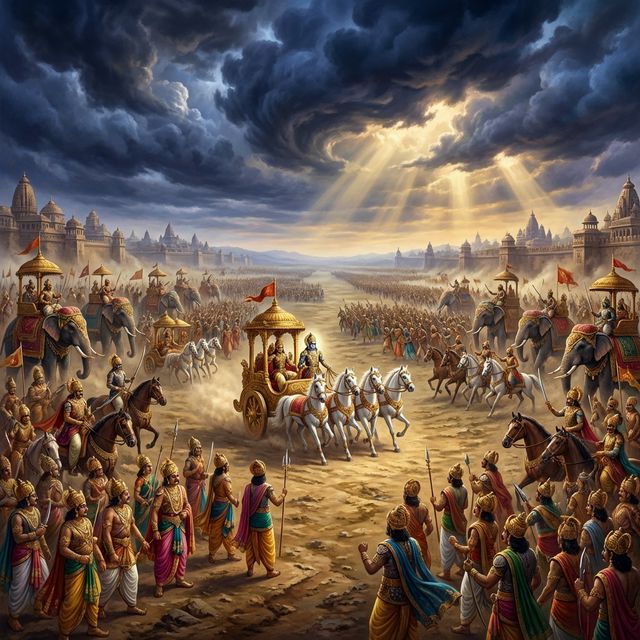
The Telling in the Rout
Ashwatthama rides back through a fleeing army to ask what happened, and Kripa has to tell him how Drona was killed
The Sun Dropped Down Upon the Earth
Sanjaya was still telling the blind king what had happened at noon on the fifteenth day, and the part he had come to was not a battle at all. It was what an army does in the hour after its commander is killed.
"Upon the fall of Drona, O king," he said, "the Kurus, afflicted with weapons, deprived of their leader, broken and routed, were filled with exertion and deprived of energy through grief."
They wailed. Their eyes filled with tears and their hearts were inspired with fear, and they saw their foes prevailing over them and trembled again and again. Then they gathered round Duryodhana, because that was the only thing left to gather round. Covered with dust, shaking, casting vacant looks on every side, their voices choked, they resembled the Daityas of old after Hiranyaksha fell.
And Duryodhana, surrounded by them all as if by small animals struck with fear, could not stay in their midst. He moved away.
It was past midday and no one had eaten or drunk since dawn. The men were scorched by the sun, afflicted with hunger and thirst, and exceedingly cheerless. Sanjaya reached for images large enough to carry what they had watched, and used four of them one after another, because no single one would do. The fall of Bharadwaja's son, he said, was like the sun dropping down upon the earth. It was like the ocean drying up. It was like Meru being carried off its place. It was like the defeat of Vasava, the king of the gods, in his own heaven.
It was an act incapable of being quietly witnessed, and the Kauravas did not witness it quietly. They fled away in fear, and terror lent them greater speed.
The man who had led them for five days, from the morning he took the command until this noon, lay on the terrace of his car with no head on him, and nobody on that field could find the body afterward among the thousands of headless trunks.
The Roll of Those Who Ran
Sanjaya named them, one by one, the way he had named them going into battle. It is the same list read backwards.
Shakuni, the ruler of the Gandharas, saw Drona of the golden car slain and fled with the car-warriors of his division, and Sanjaya notes that his speed was much greater than the rest.
Karna fled in fear, taking his own vast division with him, all its standards retreating at speed.
Shalya, the ruler of the Madras, casting vacant looks around, went with his division of cars and elephants and steeds.
Kripa, the son of Saradwat, brahmana and teacher, who had been in the Kuru court longer than the king had been on the throne, fled saying, "Alas. Alas," and took with him his division of elephants and foot-soldiers, the greater part of which had already been killed.
Kritavarman of the Bhojas went, borne by his swift steeds, with the remnant of his Kalinga and Aratta and Valhika troops. Uluka the gambler's son fled with a large body of foot. Dushasana, handsome and young and reputed for his bravery, fled in great anxiety, surrounded by his elephants. Vrishasena took ten thousand cars and three thousand elephants away with him. Susharma went, who had sworn with his brothers never to return alive from a battle.
And Duryodhana fled, taking the remnant of the Samsaptakas whom Arjuna had not yet slaughtered.
Behind the captains the army came apart into individual men. Some urged on their fathers, some their brothers, some their maternal uncles, some their sons, some their friends. With their hair loose and their armour unfastened they ran in such a way that no two of them could be seen running together. Others threw off their coats of mail entirely. They abandoned their vehicles and their cars decked with ornaments and went on horseback or on their own legs.
They called to each other as they went, "Wait. Wait. Do not fly." Not one man who shouted it stopped running himself.
The Kuru army has been totally destroyed. That, Sanjaya said, was the belief of everybody on the field.
The Alligator Against the Current
One car in that whole army was moving the other way.
Ashwatthama, Drona's son, had been fighting far off on another part of the field and knew nothing. While the troops, deprived of energy, streamed past him toward the camp, he went forward against them like a huge alligator coming up against the current of a stream.
A fierce battle took place between him and the warriors who met him: Shikhandi at their head, and the Prabhadrakas, and the Panchalas, and the Chedis, and the Kaikeyas, which is to say the best of the troops the Pandavas had, the ones nobody defeated easily. He killed a great many of them. He got out of the press with difficulty, still possessed, said Sanjaya, of the tread of an infuriated elephant.
And when he was clear of it he looked around him and saw the Kaurava host running away, resolved on flight.
He could make no sense of it. Nothing had been lost. He himself had just come out of the thick of the Panchalas alive with their dead behind him. So he turned his horses and went looking for the king, and found Duryodhana, and drew up beside him, and asked the question of a man who has been out of earshot for an hour.
"Why, O Bharata, are the troops flying away as if in fear? Although they are flying away, why dost thou not rally them in battle? Thyself, too, O king, dost not seem to be in thy usual frame of mind. Upon the slaughter of that lion among car-warriors, thy force hath fallen into this plight. O Kaurava, all these that are headed even by Karna wait not on the field. In no battle fought before did the army fly away thus. Hath any evil befallen thy troops, O Bharata?"
He had said it himself without knowing it. That lion among car-warriors. He meant the loss of some commander down the line, some breach in the array. He was looking straight at the king and asking to be told, and he had already, in passing, spoken his own father's epitaph.
The King Could Not Say It
Duryodhana opened his mouth and found that he could not do it.
This was the man who had said everything else out loud in his life. He had called for Draupadi to be dragged into a hall of men. He had told Drona to his face that he was sparing the Pandavas out of affection. He had ordered the field lit with lamps at midnight so that the killing could go on. There was no cruelty he had ever been too delicate to name.
And now, said Sanjaya, that bull among kings felt himself unable to impart the bitter intelligence. He seemed to sink into an ocean of grief like a foundered boat. He looked at Drona's son standing on his car in front of him, waiting, and became bathed in tears.
It is worth being exact about why. Drona had died because of a lie, and the lie had been told about this man, this son, who was alive and unhurt and standing here asking what was wrong. The whole deceit had been built out of Ashwatthama's name. Duryodhana had not devised it and had not been able to prevent it, but he had watched it work, and he was the king in whose service the old man had gone into that battle at all.
Suffused with shame, he did what men in his position do. He turned to the eldest person present.
"Blessed be thou," he said to Kripa, the son of Saradwat. "Say thou, before others, why the army is thus flying away."
Before others. He wanted witnesses to the telling, so that it would not be his own voice carrying it.
Kripa was the right man and the worst man for it. He was Ashwatthama's uncle by marriage, Kripi's brother, and he had known Drona since the day Drona walked into Hastinapura with nothing. He was a brahmana and a teacher of princes, and he was old, and he had run from that field an hour ago crying alas.
Repeatedly feeling great anguish, he began to tell Drona's son how his father had been slain.
An Old Man Fighting Like a Youth of Sixteen
"Placing Drona, that foremost of car-warriors, at our head," Kripa said, "we commenced to fight with only the Panchalas."
He began where a soldier begins, with the order of battle. When the fighting commenced the Kurus and the Somakas mingled together and roared at one another and struck one another down. And in the course of it the Dhartarashtras began to be thinned. Duryodhana's ranks were being eaten away, and Drona saw it, and was filled with rage, and called a celestial weapon into existence.
"Indeed, thy sire, that bull among men, having invoked the Brahma weapon, slew his enemies with broad-headed arrows by hundreds and by thousands."
Kripa gave his nephew the count, because the count was the honour of it. Urged by fate, the Pandavas and the Kaikeyas and the Matsyas and the Panchalas came up against that car and began to perish there. With the Brahma weapon Drona sent a thousand brave warriors and two thousand elephants to the abode of Yama.
Then he described the man doing it, and this is the sentence in the whole account that a son would keep.
"Of a dark complexion, with his gray locks hanging down to his ears, and full five and eighty years old, the aged Drona used to career in battle like a youth of sixteen."
The Panchalas, though they were filled with the desire of revenge, turned back from that fight. And when the enemy turned and partly lost their order, Drona invoked more celestial weapons and shone resplendent like the risen sun. He got into the middle of the Pandava host with arrows for the rays that came out of him, and he was, said Kripa, like the midday sun at whom none could gaze.
Scorched by him as if by the blazing sun, they became cheerless and lost their energy and their senses.
That is the position the story has to reach before the rest of it makes sense. Nobody was going to beat Drona that afternoon. Kripa took his nephew all the way to that point and stopped there, and then told him what was done about it.
Lay Aside Righteousness
"Beholding them thus afflicted by Drona with his shafts," Kripa said, "the slayer of Madhu, desirous of victory to the son of Pandu, said these words."
He quoted Krishna to Krishna's enemy's son, on a battlefield, in front of the king. He did not soften a syllable of it.
"Truly, this foremost of all wielders of arms, this leader of the leaders, is incapable of being vanquished in battle by the slayer of Vritra himself. Ye sons of Pandu, laying aside righteousness, take care of victory, so that Drona of the golden car may not slay all of you in battle. I think he will not fight after the fall of Ashwatthama. Let some man falsely tell him that Ashwatthama has been slain in battle."
The name was the weapon. Not a mantra, not an astra out of the Vedas that Drona himself had taught half the men on that field to draw. A word. His son's name, spoken by somebody he would believe.
Kripa reported the vote as well, which is a strange thing to include and the reason his account can be trusted. Hearing those words, Kunti's son Dhananjaya approved them not. Arjuna, who had been Drona's best pupil and had a bow in his hand that his teacher had taught him to string, said no.
The advice, however, met with the approval of all the others.
And even of Yudhishthira, with some difficulty.
That clause carries the whole weight of what came next. The king of dharma agreed to it, but not easily, and not cleanly, and the difficulty he had is exactly the crack the lie went through afterward. He would not say a plain falsehood. So a plan that needed a plain falsehood had to be bent until it could be told by a man who would not tell one.
Then Bhimasena went to look for something that could carry the name, and found it, and killed it.
The Elephant of the Malava Chief
"Then Bhimasena, with a tinge of bashfulness, said unto thy sire, Ashwatthama hath been slain."
Kripa gave his nephew that detail too. The strongest man in the world came up to an old brahmana in the middle of a battle and told him his son was dead, and was embarrassed while he did it.
Drona did not believe him. He suspected the intelligence to be false. And then, said Kripa, thy father, so affectionate towards thee, enquired of Yudhishthira as to whether thou wert really dead or not.
He went to the one man on the field who did not lie. That was not weakness. It was the most reasonable thing anyone did that day. Everyone knew what Yudhishthira was, and Yudhishthira knew it best of all, and it was precisely because his word had never been broken that his word was worth stealing.
There was an elephant on that field, huge as a hill, belonging to Indravarman the chief of the Malavas, and its name was Ashwatthama. Bhima had killed it. Yudhishthira, afflicted with the fear of a lie and solicitous at the same time of victory, looked at the dead animal and went to Drona and said:
"He for whom thou wieldest weapons, he, looking upon whom thou livest, that ever dear son of thine, Ashwatthama, hath been slain. Deprived of life he lieth on the bare ground like a young lion."
Aware fully of the evil consequences of falsehood, said Kripa, the king spoke those words to that best of brahmanas, indistinctly adding the word elephant after Ashwatthama.
The most careful man alive found a way to keep the letter of the truth and hand over everything else. He said the true word so quietly that it did not arrive, and the sentence that reached Drona's ear was the sentence Krishna had asked for.
Hearing of the fall of his son, the old man began to wail aloud, afflicted with grief. He restrained the force of his celestial weapons. He fought, but not as he had been fighting.
And Ashwatthama stood listening to this on his own car, alive, holding his own bow.
Seized With the Left Hand
"Beholding him filled with anxiety, and almost deprived of his senses by grief," Kripa said, "the son of the Panchala king, of cruel deeds, rushed towards him."
Dhrishtadyumna had been born out of a fire for this. Drupada had bought him from the gods for the killing of Drona, and Drona had accepted the boy afterward as a pupil anyway and taught him what he knew, and both of them had lived every day since knowing how it ended.
So when the prince came at him through the smoke, Drona did not reach for a weapon. Versed in all truths about men and things, said Kripa, and seeing the prince who had been ordained as his slayer, he abandoned all his celestial weapons and sat in Praya on the field of battle. Praya is the vow of a man who has decided to die where he sits and will neither eat nor move nor defend himself again. He put down the Brahma weapon and became, in the middle of a war, a brahmana at his prayers.
"Then Prishata's son, seizing Drona's head with his left hand and disregarding the loud admonitions of all the heroes, cut off that head."
Kripa did not spare himself the left hand. It is the unclean hand. The head of the preceptor of the Kurus and the Pandavas was held by it like a thing being butchered.
Drona should not be slain. Those were the words uttered from every side, by the Kauravas, who were his own troops, and by his enemies. And Arjuna jumped down from his car and ran toward Prishata's son with his arms raised over his head, saying it again and again: "O thou that art acquainted with the ways of morality, do not slay the preceptor, but bring him alive."
Forbidden by both armies at once, Dhrishtadyumna killed him.
"For this, afflicted with fear, the troops are all flying away," Kripa finished. "Ourselves also, for the same reason, in great cheerlessness, O sinless one, are doing the same."
Hearing of the slaughter of his sire, said Sanjaya, Drona's son became like a snake struck with the foot. He blazed up in that battle like a fire fed with a great quantity of fuel. He squeezed his hands and ground his teeth and breathed like a serpent, and his eyes turned red as blood.
Dharma Lesson
The deceit that killed Drona was assembled out of small permissions. Krishna named the need, most of the council agreed, Yudhishthira agreed with difficulty, Bhima found an elephant to make the words technically true, and no single man in that chain told an outright lie. Kripa's account is honest enough to record that Arjuna objected and was overruled, which is usually the only trace such a decision leaves. What none of them arranged was the last part, the left hand on the head of a praying man, and that is the part the son heard, and the part he answered.