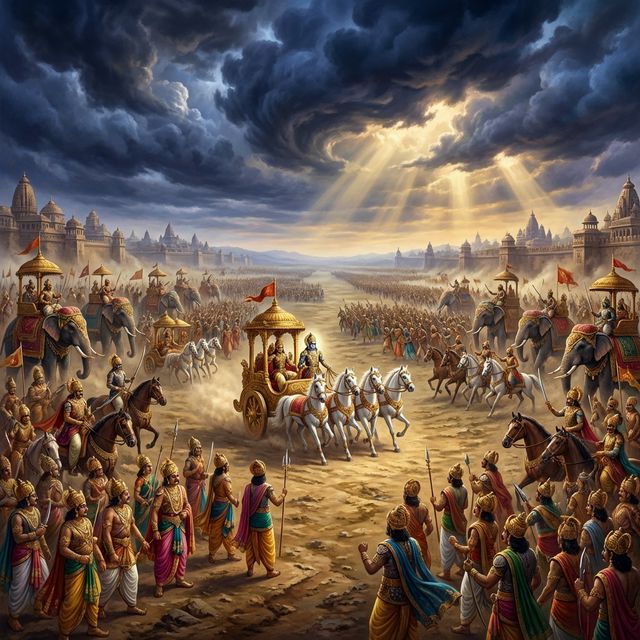
Sword and Shield Against the Preceptor
Dhrishtadyumna, stripped of car and bow, dances the twenty-one motions to reach Drona
The Man Drupada Bought From the Fire
Sanjaya said: "It was the fifteenth day, O king, and the third part of it was gone. Bhima had shouted that Ashwatthama was dead. Yudhishthira, who had never in his life been suspected of a false word, had said the same and added the word elephant so low that nobody heard it. The rishis had come down out of the air and stood in front of the preceptor and told him that his hour had come and that he should lay his weapons down.
"Drona heard all of it. Then he looked up and saw Dhrishtadyumna in front of him, and could not fight as he had fought before."
He had reason to look at that particular face and lose his hold on the day.
Dhrishtadyumna was the son of Drupada, king of the Panchalas, and he had not been born the way other men are born. Drupada, humiliated by Drona long before the war, had gone to the Bearer of sacrificial libations with a great sacrifice and asked for a son who would kill him, and the fire had given him one. The whole world knew what that man had been made for. Drona knew it best of all.
Now, seeing the preceptor filled with anxiety and almost deprived of his senses by grief, Prishata's son rushed at him.
He took up a bow that gave victory, a formidable and celestial thing, irrefragable, its string possessed of great strength, its twang like the roll of clouds. On it he fixed one fierce arrow that resembled a snake of virulent poison and had the splendour of fire in it.
Within the circle of the bent bow that arrow looked like the autumn sun standing inside its own ring of light.
The troops on both sides saw the blazing bow bent with force by the son of Prishata, and there was a moment in which every man on that field believed that this was the last hour of the world.
Bharadwaja's son, looking straight down the length of it, thought that the last hour of his own body had come.
The Weapons That Did Not Come
The preceptor prepared with care to baffle that shaft. He had done it ten thousand times. A man who has taught every great bowman on both sides of a war does not have to think about what his hands are doing.
He reached, as he had always reached, for the celestial weapons.
They did not come.
Sanjaya said that the weapons of that high-souled one no longer appeared at his bidding. For four days and one night he had shot without stopping and his arrows had not been exhausted; his quivers had behaved like the quivers of a god. On the expiry of the third part of the fifth day his arrows simply ran out. And the astras, which are not kept in quivers but in the memory and the mouth, would not answer him either.
Three things had happened to him at once and he could feel each of them separately. His arrows were gone. His son, he had been told by the one man on earth he had never known to lie, was dead. And the celestial weapons, which had been his since Agnivesa taught him and Rama of the axe gave him the rest, had turned their faces away.
He wanted to lay his weapons down. The rishis had asked him for exactly that. Viswamitra had asked, and Jamadagni, and his own father Bharadwaja, and Gautama and Vasishtha and Kasyapa and Atri, standing in the air with the Bearer of sacrificial libations at their head. Lay aside thy weapons, they had said. Drive away the film of error that shrouds thee. The period for which thou art to dwell in the world of men is now full.
Filled with great energy still, an old Brahmana of five and eighty years who could career on a battlefield like a youth of sixteen, he found that he could not fight as before.
So he did the other thing. He took up another celestial bow, one that Angiras had given him long ago, and certain arrows that resembled a Brahmana's curse, and he went on fighting with Dhrishtadyumna.
Standard, Bow and Driver
What followed was not a contest between an old man and a young one. It was a lesson given at speed by a teacher who had run out of everything except skill.
Drona covered the Panchala prince with a thick shower of arrows and, filled with rage, mangled his angry antagonist. With his own keen shafts he cut the prince's arrows into a hundred fragments while they were still in the air. Then the standard came down. Then the bow. Then the driver went out of his niche and off the car.
Dhrishtadyumna smiled.
That is the detail Sanjaya kept, and it is worth stopping on. The man had just been stripped of his flag, his weapon and the hands that steered him, and what he did was smile, take up another bow, and put a keen shaft into Drona's chest, in the centre, where it goes deepest.
Deeply pierced with it, the mighty bowman lost his self-possession for a moment. Then he recovered, and with one sharp broad-headed arrow cut off Dhrishtadyumna's second bow at the grip.
After that he set about the rest of it methodically. The invincible Drona cut off all the weapons, O king, and all the bows that his antagonist had, with the exception only of his mace and his sword. Everything in that car that could be shot from or thrown was reduced to splinters and lay about the prince's feet.
Then, filled with wrath, he pierced the angry Dhrishtadyumna with nine keen arrows capable of taking the life of every foe.
The Panchala prince, standing in the ruin of his own arsenal with nine shafts in him, did not withdraw and did not call for help. He had been made for this. He had been told so from the day he stepped out of the fire, and the day had finally arrived, and he had a mace and a sword and a car and four white horses left.
He decided to spend them one at a time.
Red Horses and White
What Dhrishtadyumna did next was strange and beautiful and, in the end, useless, and every man who saw it remembered it.
He invoked the Brahma weapon. Not to burn anybody with it, which is what that astra is for, but to tangle the two chariots together. By its power he caused the steeds of his own car to be mingled with the steeds of his foe.
Drona's horses were red. Dhrishtadyumna's were white as pigeons. Endued with the speed of the wind, the two teams came together in one heaving mass in the middle of that field, red and grey mixed, harness against harness, and Sanjaya, who had spent fifteen days describing men being killed, stopped to say that they looked exceedingly beautiful. Like roaring clouds in the rainy season, he said, charged with lightning.
The purpose was plain enough. Locked to Drona's car, the prince could not be shot at from a distance any more. Whatever happened now would happen at arm's length, where a bow is a burden and a sword is not.
The preceptor understood it before the horses had stopped moving.
That twice-born one of immeasurable soul, without leaving his standing place, cut the shaft-joints of Dhrishtadyumna's car, and the wheel-joints, and the other joints besides, so that the chariot came apart around its own occupant like a wooden puzzle taken to pieces.
Deprived of his bow, made carless and steedless and driverless, fallen into great distress, the heroic Dhrishtadyumna grasped his mace.
He never got to swing it. Drona, of unbaffled prowess, with a number of keen shafts, cut that mace apart while it was on the point of being hurled at him, and the pieces of it fell among the horses.
The prince looked at his empty hands. Then he reached down and took up a spotless sword, and a bright shield decked with a hundred moons.
The Shield of a Hundred Moons
Without doubt, said Sanjaya, under those circumstances the Panchala prince had determined to make an end of that foremost of preceptors.
It was not a reasonable decision. A swordsman on a broken car, inside the arrow-range of the greatest bowman alive, has no business at all planning to reach that bowman's chest. Sanjaya says as much in so many words: desirous of achieving, from folly, a difficult feat, he hoped to pierce the chest of Bharadwaja's son in that battle.
But he had the two chariots locked together, and he used them.
Sometimes he sheltered himself in his own car-box, dropping out of sight so that no arrow could find him. Sometimes he came up riding on the car-shafts, uplifting his sword and whirling the bright shield. Sometimes he stayed on the yoke itself, standing among the trappings. Sometimes he went low, in under the haunches of Drona's own red steeds, and stood there.
That was the trick of it, and everybody watching saw the trick. While the prince was in among the yoke-trappings, or behind those red horses, Drona could not shoot at him. To kill the man there he would have to shoot through his own team, and a car-warrior who kills his own horses in the middle of a battle has finished fighting for the day.
So the preceptor waited, and turned, and looked for one clear instant, and did not get it.
All this seemed exceedingly wonderful, Sanjaya said. The movements of Drona and of Prishata's son in that battle resembled the fight of two hawks careering through the sky for a single piece of meat.
The troops applauded. Men who had been killing each other since dawn stopped where they stood to watch an unhorsed swordsman crouch under a Brahmana's horses and wait for his moment, and they praised him aloud for it, and Drona above him held a drawn bow he could not use.
The Dart That Chose Its Horses
There was one way out of it, and Drona found it.
He put down the bow and took up a dart, and with it he pierced the white steeds of his antagonist one after another. Not one of them was struck at random. Sanjaya was careful about this and so should we be: he did not strike the red ones among them, that belonged to himself.
Consider what that means. The two teams were mingled and heaving in the same tangle of harness, red horse against white horse, the whole knot of them shifting with every breath, and a man of five and eighty years old picked out four white horses in it by hand with a dart and left the red ones untouched.
Deprived of life, the steeds of Dhrishtadyumna fell down upon the earth.
The red steeds of Drona, freed from the entanglements of the prince's car, came loose and stood clear, and the chariot of the preceptor was a chariot again, and the sheltering place under the haunches and the yoke and the car-shafts and the whole clever geometry that had kept the Panchala prince alive for the last few minutes was so much dead meat lying in the dust.
Beholding his steeds slain by that foremost of Brahmanas, Prishata's son could not brook it.
He did not look for another car. He did not look for his brothers, who were somewhere behind him in the press with Yudhishthira, nor for Satyaki, who was somewhere ahead. He came down onto the ground with the sword in his hand and the shield of a hundred moons on his arm, and he went at Drona on foot.
Sanjaya, telling it afterwards to a blind man in a hall, reached for the largest images he had. Like Vinata's son making a swoop at a snake, he said. And the form of Dhrishtadyumna at that moment, when he sought to slay the son of Bharadwaja, resembled the form of Vishnu himself in the days of yore when he was at the point of slaying Hiranyakasipu.
One and Twenty Motions
What the two armies watched then was the finest display of swordsmanship in the whole war, and it was given by a man who was about to lose.
Drona was on a chariot with a bow. Dhrishtadyumna was on the ground with three cubits of steel and a shield, and the only thing between him and a shaft through the throat was his own footwork. So he used all of it. He performed diverse evolutions, said Sanjaya, and exhibited the well-known one and twenty different kinds of motion.
He wheeled about. He whirled the sword on high. He made side thrusts. He rushed forward and ran sideways and leapt high in the air. He assailed his antagonist on the flanks, and receded backwards, and closed with his foes, and pressed them hard, so that no man watching could say from one instant to the next where he would be standing.
Having practised them well, he showed also the evolutions called Bharata, and Kausika, and Satwata, which are named schools of the sword that a prince learns from masters over years and that most princes never have occasion to use.
He was using them to cross perhaps thirty paces of open ground, and he could not cross them.
Beholding those beautiful evolutions of Dhrishtadyumna as he careered on the field, sword and shield in hand, all the warriors were filled with wonder. And so, Sanjaya said, were the celestials assembled above the field to watch the old Brahmana die.
That is the picture to keep. The man who had been born out of a fire for one purpose only, dancing the twenty-one motions in the dust with a hundred moons on his shield, applauded by both armies and by the gods, and getting no nearer.
The regenerate Drona, shooting a thousand arrows into the thick of the fight, cut off the sword of Dhrishtadyumna, and cut off his shield with it.
Arrows a Span Long
The arrows Drona used to do it were of a kind the field had not seen that day.
Fighting from such a near point, he shot arrows of the length of a span, hand to elbow, no longer. Such arrows are used only in close fight, where a full shaft has no room to leave the bow, and Sanjaya, who took a herald's pleasure in exactness, gave the whole list of men then living who could shoot them: Kripa, and Partha, and Ashwatthama, and Karna, and Pradyumna, and Yuyudhana. Abhimanyu also had such arrows, and Abhimanyu had been dead a day and a night.
That is seven names in the world, and Drona had taught most of them.
So the sword went, chopped out of the prince's fist, and the bright shield decked with a hundred moons went with it, and Dhrishtadyumna stood on the ground in front of his teacher's teacher with nothing in either hand at all.
Then the preceptor fixed on his bowstring a shaft endued with great impetuosity.
Sanjaya does not soften what that meant, and the words he used are the ones worth keeping: the preceptor, desirous of slaying his disciple who was unto him even as his own son.
It is the whole of the war in one line. Dhrishtadyumna of Panchala had learned his weapons in Drona's own school, in the same yard as Arjuna and Duryodhana, from the man his father had produced him to kill. The teacher had taken the son of his enemy and taught him anyway, because that is what a teacher does, and had watched him grow into exactly the instrument the fire had promised, and now stood over him with a shaft on the string in the hour the rishis had told him was his last, about to kill a boy he had raised.
He drew, and the field held its breath, and ten arrows came in from the side.
Excellent, Excellent
They were Satyaki's.
The grandson of Shini had come across the whole Kaurava army that afternoon on Yudhishthira's orders and had been fighting ever since inside the car-tracks of the Kuru warriors, within the range of the shafts of Drona and Karna and Kripa at once. He saw the shaft go onto the string. He cut it in the air with ten arrows, in the very sight of Duryodhana and of the high-souled Karna, and so rescued Dhrishtadyumna, who was on the point of succumbing to Drona.
Kesava and Dhananjaya, coming up out of the press, saw him do it.
"Excellent, Excellent!" both of them said, loudly, so that men heard it, and Arjuna could not stop talking about it.
"Behold, O Kesava, that perpetuator of Madhu's race, Satyaki of true prowess, sporting before the preceptor and those mighty car-warriors, and gladdening me and the twins and Bhima and king Yudhishthira. With skill acquired by practice and without insolence, behold that enhancer of the fame of the Vrishnis careering in battle, sporting the while with those mighty car-warriors. All these troops, as also the Siddhas in the welkin, beholding him invincible in battle, are filled with wonder, and applaud him, saying, Excellent, Excellent!"
Sanjaya, who was reporting all of this to Dhritarashtra and had no reason to flatter a Vrishni, agreed with him. The warriors of both armies, he said, all applauded the Satwata hero for his feats.
So the duel ended, and neither man had what he wanted.
Dhrishtadyumna was alive on the ground with no car, no bow, no mace, no sword and no shield, and his teacher was still standing on a chariot above him.
And Drona, who had run out of arrows and astras and reasons, had once again failed to kill the man the fire had made for him. There was very little of the fifteenth day left. Both of them knew what was still coming, and only one of them had been told the hour.
Dharma Lesson
Dhrishtadyumna was made for one task and spent this hour proving that being made for a thing is not the same as being able to do it. Everything he had was taken from him in order, and each time he reached for the next thing down, and the last thing he reached for was his own feet. Drona, for his part, could still outshoot any man alive and could no longer find a reason to; the arrows ran out on the fifth day and the will had gone before them. Skill decides duels. It does not decide the hour, and both men on that patch of ground had already been told whose hour it was.