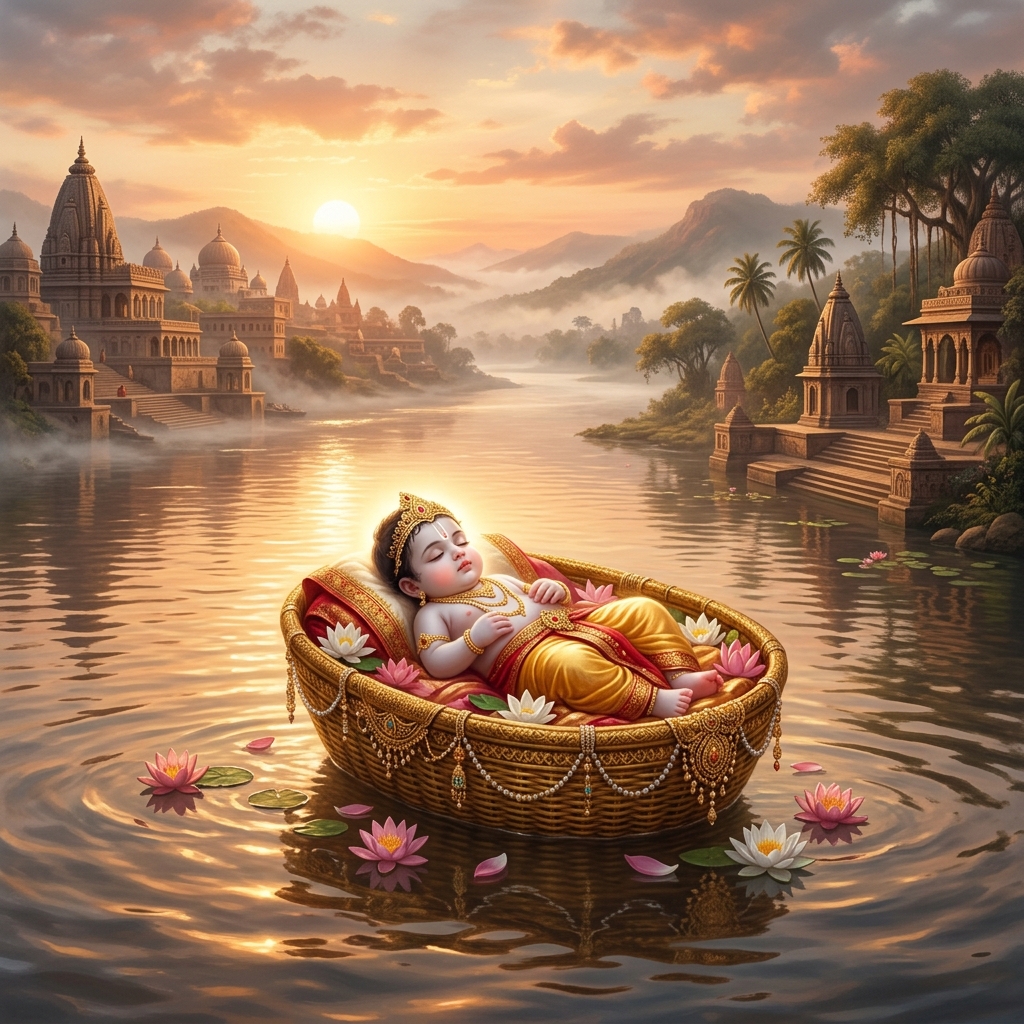
A Casket on the Ganga
Adhiratha was a charioteer in service to the Kuru court, a suta by caste and profession, married to Radha, and after years of a marriage without children, the two had made their peace with a quiet house. That peace ended on an ordinary morning at the banks of the Ganga, when Adhiratha, walking the riverbank, saw a sealed casket drifting against the reeds, gleaming strangely in the early light. He waded in and pulled it free, and when he pried it open, he found not treasure but an infant, radiant, already wearing armor grown into his skin and earrings shaped from the same unearthly gold, as though he had been born already dressed for battle by some hand no mortal parent could claim.
Who had set that casket adrift, and why a child arrived armored and jeweled rather than swaddled in cloth, belongs to another telling entirely, the story of a young princess named Kunti and a son she could not acknowledge (birth_of_karna tells that reckoning in full). What concerned Adhiratha, standing in the river with a living child in his arms, was simpler and larger than any mystery: here, unlooked for, was the son his house had never managed to produce on its own.
He carried the infant home to Radha, and whatever fear either of them felt at raising a child of such strange origin dissolved, by all the epic's telling, almost at once into ordinary parental wonder. They named him Vasusena, for the wealth of gold he had arrived wearing, and set about raising him as their own, with no ceremony beyond a charioteer's household could offer and no hesitation about whether an infant found floating on a river deserved a suta's love rather than a king's. Radha nursed him, Adhiratha carried him on his own chariot before the boy could walk, and between them they gave the abandoned son of an unknown mother the one thing his birth had not provided: a family who wanted him without needing to know where he had come from.
The Boy Who Prayed to the Sun
As Vasusena grew, it became clear to Adhiratha that his son was no ordinary charioteer's boy. Each morning the child stood in the river with his arms raised, praying to Surya, the sun, with a devotion that seemed to come from somewhere older than any lesson Adhiratha had taught him, and each afternoon he wandered toward the archery grounds where kshatriya boys trained, watching the bow work with a hunger Adhiratha recognized but could not fully explain. A suta's son was meant to master horses and chariots, the family trade, not the bow that belonged by custom to warrior castes alone, and yet nothing in the boy's bearing suggested a chariot driver's contentment with the reins.
Adhiratha might have forbidden the fascination, might have insisted his son learn the family trade and set aside a warrior's ambitions that custom said were not his to hold. He did the opposite. He watched Vasusena's hunger for the bow the way a father watches a gift he does not understand but refuses to waste, and rather than cage the boy inside the caste that had raised him, Adhiratha made the harder choice: he arranged for his son to study under the masters training princes at Hastinapura, knowing full well that a suta's son among kshatriya pupils would face doors closed and insults offered, and sending him anyway because the boy's gift demanded it.
It cost Adhiratha something to make that choice. A charioteer sending his only son to compete, even informally, among princes was inviting a lifetime of the boy being reminded of exactly where he came from, in rooms that would never let him forget it. But Adhiratha had lifted this child from a river with no promise attached, and having chosen to be his father in every way that mattered, he was not going to be the one to tell him his birth set the limit of his reach. Vasusena went to Hastinapura still praying to the sun each dawn, and Adhiratha stayed behind, a charioteer's household now waiting to see what its adopted son would become.
Years at Hastinapura
The years at Hastinapura tested every ounce of resolve Adhiratha's decision had asked of his son. Vasusena, whom the world would soon call Karna, trained among princes who never let him forget his birth, jeering at a suta's son daring to draw a warrior's bow, and yet his skill, when it showed itself, silenced even that mockery for as long as an arrow was in flight. He matched, by some accounts surpassed, the finest students in that royal school, drawing looks from teachers who could not deny his gift even as custom told them he had no right to display it.
Adhiratha heard reports of his son's progress the way any father hears news of a child grown mostly out of reach: proudly, and from a distance. Karna rarely returned to the charioteer's quarter during those years of training, absorbed in a world of princes and masters that had little use for a suta charioteer, and Adhiratha, watching the gap widen between the son he had raised and the warrior Hastinapura was shaping, did not resent it. He had sent the boy to that world precisely so it could make him into whatever his gift required, even if that meant losing the easy nearness of his childhood.
When father and son did meet, in the quiet of the charioteer's quarter away from the eyes of princes, Adhiratha found the same boy underneath the growing warrior: dutiful, quick to touch his father's feet for blessing, still more interested in whether the household's horses were well fed than in any honor the court might eventually grant him. It reassured Adhiratha, in a way he could not have put into words, that whatever Hastinapura was making of his son on its training grounds, it had not yet unmade the son he knew at home.
What Adhiratha could not have anticipated was how publicly, and how cruelly, Hastinapura would eventually remind Karna exactly where he had come from, on the one day meant to celebrate every student's skill before the whole court.
A Father's Arrival, A Kingdom's Answer
The exhibition tournament at Hastinapura, staged to display the princes' training to the assembled court, had already turned tense by the time Karna stepped into the ring and matched, feat for feat, everything Arjuna had shown the crowd (the contest itself belongs to its own full telling). What followed was swift and cutting: the assembled kshatriyas demanded to know Karna's lineage before allowing him to challenge a prince to combat, and when no answer satisfied them, the court's laughter turned openly cruel, a boy of undeniable skill dismissed in front of everyone as nothing more than a charioteer's son, unfit to stand where he stood.
It was Duryodhana who answered the jeering, crowning Karna king of Anga on the spot, giving him a throne in the same breath the court had tried to strip his dignity away, an act that bound the two men into a friendship that would outlast every reversal either of them suffered afterward.
And then, into that charged hall, walked Adhiratha, an old charioteer arriving as fathers arrive to see their sons, without ceremony, without any sense of the moment he was interrupting. The kshatriya princes seized on his appearance with fresh scorn, certain they now had final proof of what they had suspected: here was the low-born father of the pretender who had dared challenge a prince. The hall waited to watch Karna recoil from the old man, to deny him, to protect the throne Duryodhana had just given him by disowning the charioteer standing before the entire court.
Karna did the opposite. He set aside his bow, crossed the hall in front of every jeering prince and every watching king, and bent to touch his father's feet, embracing Adhiratha openly as the man who had raised him, armor and gold earrings and royal crown notwithstanding. It was, in a single gesture, both a public humiliation accepted without flinching and a declaration louder than any crown Duryodhana could offer: whatever blood had put him in that river casket, Adhiratha was the father Karna claimed, and no throne was worth denying him.
The Father He Never Renounced
Karna wore the crown of Anga for the rest of his life without ever setting aside the household that had raised him. He remained, by every account the epic offers, a devoted son to Adhiratha and Radha, visiting them as king when duty allowed, never trading the memory of a charioteer's affection for the grander family his armor and earrings hinted at but that no one, for years, dared to name aloud.
That silence broke only on the eve of Kurukshetra, when Kunti came to Karna in private and told him at last what the casket on the Ganga had never explained: that she was his true mother, that the five Pandavas arrayed against Duryodhana's army were his own younger brothers, and that he had every right, by birth, to claim a kshatriya's inheritance and a place among the Pandavas rather than fight them (their full exchange belongs to its own telling).
Karna's answer, offered gently but without hesitation, was to refuse. He would not disown the parents who had raised him to spite a birth he had never chosen, and he would not abandon Duryodhana, who had crowned him a king when the rest of the world offered only mockery, merely because a mother who had once set him adrift now wished to reclaim him at the hour it suited her. He promised Kunti only that he would spare four of her sons regardless of the battle's outcome, keeping intact her claim to at least one living child, but he would go to Kurukshetra as Karna, son of Adhiratha, not as some newly discovered prince trading loyalties on the eve of war.
It is this refusal, more than his birth or his archery, that the epic remembers as Karna's truest inheritance from the charioteer who found him. Adhiratha had never asked to be a hero's father; he had only refused to treat a child pulled from a river as anything less than his own. In the end, that was the lesson his son carried onto the battlefield and would not set down even for the mother who could have made him a prince: that the family who chooses you is the family you owe, whatever blood may later claim otherwise.
Dharma Lesson
Adhiratha's story insists that fatherhood is a choice renewed daily, not a fact of blood: he claims an abandoned, mysteriously armored child without hesitation and gives him the one thing his origins could not, an identity to stand on. Karna's lifelong refusal to renounce his suta parents, even when a royal birth is finally offered to him, honors that choice as the truer inheritance.