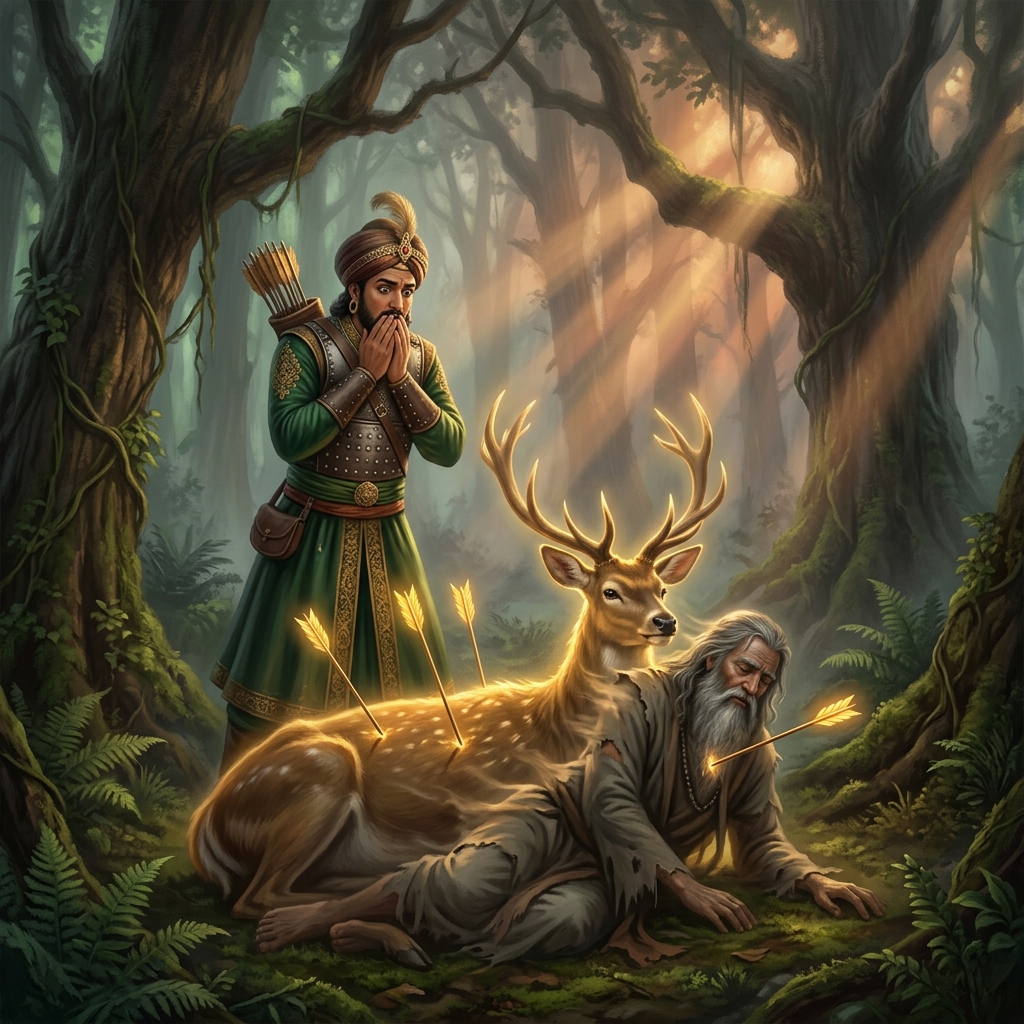
The Sons of the Dead King
Kunti answers Pandu's plea for niyoga with the tale of a widow's unbroken faith
A Question on the Mountain
On the slopes of Shatashringa, where King Pandu had retired with his two wives to escape the curse that barred him from a father's ordinary joys, the old grief returned to him again, as it often did in the quiet of the mountain evenings.
'Kunti,' he said, watching the sages who lived among those peaks pass by with their own sons trailing after them, 'a man without a son walks a road that ends nowhere. I am forbidden by my own curse to embrace you as a husband should, yet the law is not silent on such misfortune. The sages have long permitted a childless man to have his wife bear sons through another, worthy man, so that his line does not end with him and his ancestors go on receiving the offerings owed to them. Vyasa gave sons to my own mother and her sister in just this way, so that Bhishma's vow would not leave Hastinapur without heirs. I ask you now to consider the same for us.'
Kunti heard him out in silence, turning the request over with the seriousness it deserved, for she understood the ache behind it was not desire but duty - the duty of a king to the fathers who had come before him and the sons who had not yet been born.
But she did not answer him at once with a yes or a no. Instead she said, 'Let me tell you first of a queen named Bhadra, my lord, and of a king of your own line named Vyushitashva, who needed no living man to give his wife sons - and see if the old story does not answer your question better than I could.'
Pandu, who loved his wife's way of teaching through story as much as he loved her, settled back against the mountain rock to listen.
The King Who Loved Too Well
'There was once a king of the Puru line,' Kunti began, 'named Vyushitashva, a sacrificer so devoted that he performed a hundred great rites and pleased the gods with the smoke of his offerings until Indra himself grew watchful of his growing merit. He ruled with such strength that no enemy dared cross his borders, and with such righteousness that his people wanted for nothing.
But it was in his palace, not his battlefield, that Vyushitashva's true nature showed itself. He had taken as his queen a woman named Bhadra, daughter of the sage Kakshivat, and he loved her beyond the measure that even devoted husbands usually allow themselves. He could not bear to be parted from her - not for a day, not for an hour if he could help it. Where other kings kept their duties and their pleasures in separate chambers, Vyushitashva let his devotion to Bhadra spill into every hour of his day and every hour of his night, until his ministers began to whisper that the king's love for his queen had begun to outweigh his love for his own strength.
They were right to worry. However mighty a man's body, it is not made to sustain such constant and consuming passion without cost, and Vyushitashva, for all his sacrifices and all his victories, began to fail. His color faded, his limbs grew thin, his breath grew short, and though Bhadra nursed him with everything her love could offer, the excess that had built his happiness now emptied his strength drop by drop, until, still a young man, still a king in the fullness of his reign, Vyushitashva died in his own palace, in his own queen's arms, undone by nothing but the very love that had made his life so full.'
Bhadra's Lament
'Bhadra would not leave him,' Kunti went on. 'While the palace mourned and the priests prepared the rites, she remained beside her husband's body, refusing food, refusing comfort, refusing to believe that a love so complete could simply end. She wept over him and spoke to him as though he could still hear her, recounting every kindness he had shown her, every year of their marriage, every reason her heart had for not wanting to go on without him.
'You have left me nothing,' she cried, 'no son to carry your name to the ancestors, no reason for the fires of this kingdom to keep burning. What was the good of such love, my lord, if it ends in this silence?'
She lay beside him through the night, her grief too large for the customs of mourning to contain, and the priests who watched from a distance did not have the heart to pull her away.
It was then, in the deepest part of that long night, that a voice spoke to her - not from the body beside her, which lay as still as it had lain since morning, but from the air above, gentle and familiar, unmistakably her husband's own voice, though no living throat had shaped it.
'Bhadra,' the voice said, 'do not grieve as though all is lost. On the nights appointed by the sages for a woman's fertility, come and lie beside me as my wife, and you shall not go childless, nor shall my line end with my death.'
Bhadra, who would have obeyed that voice regardless of what it asked, for it was the only piece of her husband still left to her, did exactly as she was told.'
Seven Sons
'On the appointed nights, just as the voice had instructed her, Bhadra came and lay beside the body of her dead husband, faithful to a marriage that death itself had not been allowed to end. And in time, to the astonishment of the physicians and the wonder of the priests, she conceived - not once, but again and again across the years that followed, until she had borne seven sons, all begotten by a king who had already left the world of the living.
Those seven sons grew into mighty princes, wise and strong, and became the ancestors of a line that the sages still name with honor when they trace the descent of kings. Not one person in that kingdom ever doubted that they were Vyushitashva's true sons, born of his queen's unbroken faith to him, though he had given them nothing of the ordinary means a living father gives a child.
Bhadra never took another husband. She never even considered it, though she was still young, still beautiful, and though wise counselors would have found her a match worthy of her rank in a season if she had asked. She had been given a duty by the voice of the only man she had ever loved, and she carried it out with a devotion that made the question of remarriage seem, to her, beneath discussion. Her sons called her mother, and called their dead father's name with pride, and the kingdom prospered under princes who had been born from nothing but a wife's faithfulness and a promise kept from beyond the grave.'
Kunti's Answer
Kunti fell silent a moment, letting the last of the story settle, and then she turned to Pandu with the directness she had learned never to soften when the truth of a matter was at stake.
'You have offered me the sages' law, my lord, and I do not dismiss it - I know how many worthy queens have borne sons to their husbands' names through other men, when their husbands could not, and I do not think less of them for it. But consider Bhadra. Her husband was not merely unable to embrace her - he was dead, his body already given to the fire's waiting, farther from her than any curse has placed you from me. And still she needed no other man. She turned to her own husband and to him alone, and the gods, moved by that faithfulness, gave her seven sons through no ordinary means at all.
'If a widow's devotion could reach across death itself and bring back sons to a king who no longer breathed, what excuse does a living wife have, sitting beside a living husband, for turning to any man but him? You are here beside me, my lord. You are not gone. Do not ask me to look elsewhere for what a devoted wife should never need to seek outside her own marriage.'
Pandu had no ready answer to that, and for a while the two of them sat together in the mountain quiet, the story of Bhadra settled between them like a small, stubborn fire that would not easily be argued down - though Kunti, for her part, already carried a secret of her own that would settle the question before the season turned again.
Dharma Lesson
Kunti answers Pandu's plea for niyoga not with refusal but with a story: a widow so faithful to her dead husband that she bore him seven sons rather than seek a living man. Devotion, the tale insists, does not need permission from custom to hold - it only needs to be kept. A wife who is truly given to her husband needs no one else, in life or in death.