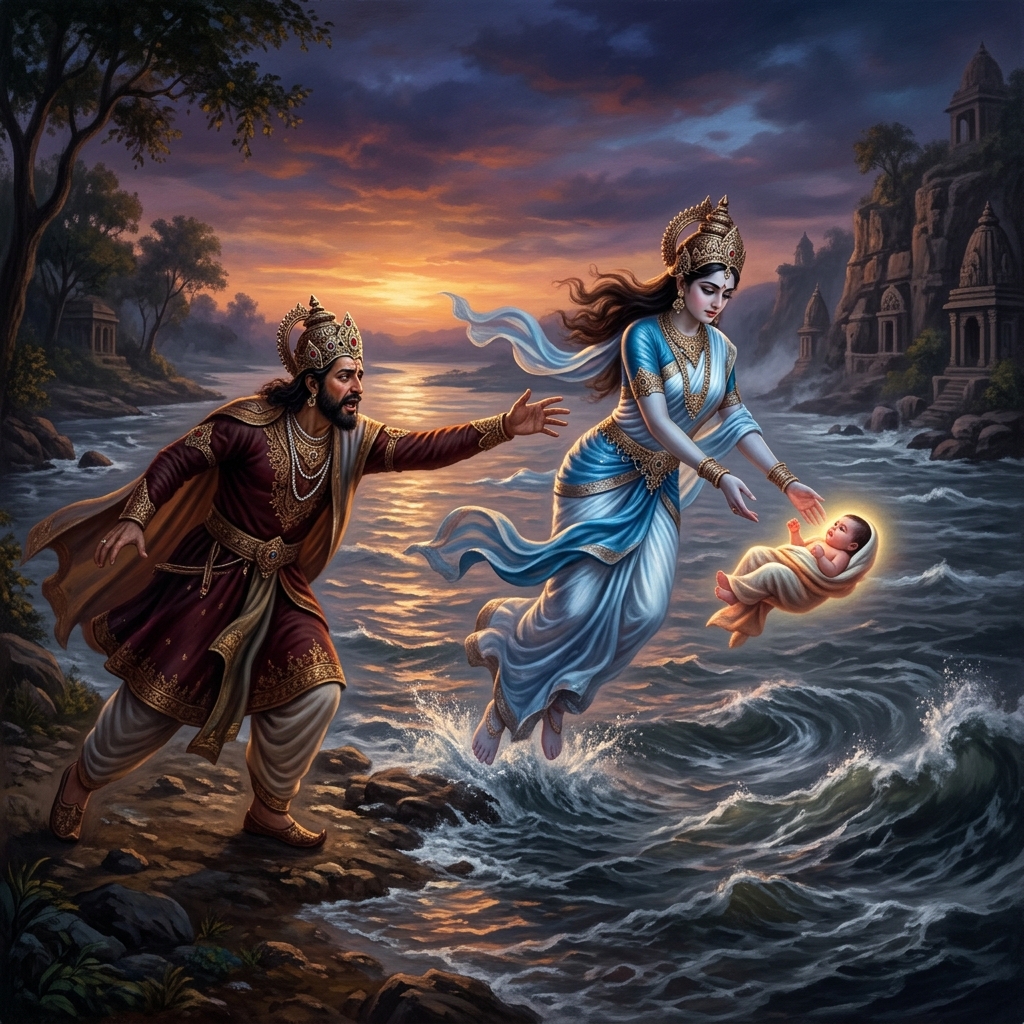
Mahabhisha's Glance
One unguarded look in Brahma's court sets a dynasty moving
The King Who Would Not Look Away
Sage Vaishampayana, continuing the long tale for King Janamejaya, spoke next of how the river Ganga first came to walk among mortals - and of the king whose one unguarded look began it all.
In the earliest days there lived a king named Mahabhisha, lord of a realm on the banks of the sacred river he would one day become bound to. By a hundred great horse sacrifices and austerities beyond counting, he had earned a seat no mortal king before him had held: a place in the assembly hall of Brahma himself, among sages, ancestors, and gods.
One day the river-goddess Ganga came to that hall to pay her reverence to the Grandsire, her garments bright as moonlight on water. As she bowed before Brahma's throne, a sudden wind rose and caught the hem of her robe, lifting it from her ankle. Every god and sage in that assembly turned their eyes away at once, for it was not fitting to look upon the goddess so, even by accident of wind.
Every eye but one. Mahabhisha alone did not look away. He watched Ganga a moment longer than modesty allowed, and she, feeling his gaze upon her, looked back at him - and in that single exchanged glance something passed between them that no sacrifice had earned and no austerity had asked for.
Brahma saw it all. The Grandsire's eyes moved from the river-goddess to the king, and the hall that had been full of chanting fell silent, waiting on his word.
Brahma's Curse
'Mahabhisha,' said Brahma, and his voice filled the hall though he did not raise it, 'you sat among us by the strength of a hundred sacrifices, a seat few mortals have ever earned. Yet a hundred sacrifices did not teach you to master a single glance. You looked on Ganga as men look upon women in the world below, not as the immortals look upon a goddess. For this, you cannot remain here.'
The assembly held its breath, for a curse from the Grandsire was not lightly given, nor lightly lifted.
'Return to the world of men,' Brahma said. 'Be born again as a mortal king, and live out a mortal span, and only then may you come back to this hall.'
Another king, so cast down from heaven's own court before the eyes of gods and sages, might have wept or pleaded. Mahabhisha did neither. He bowed to the Grandsire without a tremor in his voice, for in that one long look at Ganga he had already decided something in his heart that made the curse feel less like a punishment than a doorway.
'Grant me only this, Grandsire,' he said. 'Let me choose the house into which I am born.'
Brahma, who read the courage in the request more than the request itself, granted it.
Mahabhisha considered, one by one, the great royal lines of the earth, and set his mind at last on the line of Puru, on a king named Pratipa, whose devotion to truth was spoken of even in heaven. To be born his son, he decided, was fortune enough to make a fall from heaven feel like a blessing.
Ganga, too, had not been unmoved by that long glance. In those same days, the eight Vasus, gods themselves bound under a separate curse, sought her out and begged that she become their mother when their time of mortal exile came, and she agreed to it - but she also resolved, privately, that whatever mortal life the bold king chose for himself, she would go and find him there.
The Promise on the Riverbank
True to that resolve, Ganga did not wait long. She took the form of a woman of unearthly beauty and came to where King Pratipa sat in meditation on the southern bank of her own waters, his eyes closed, murmuring the sacred syllable that was his daily discipline. She seated herself, without a word, upon his right thigh.
Pratipa opened his eyes to find a woman more radiant than any he had beheld seated in his lap, and though her boldness might have unsettled a lesser man, he only asked, gently, who she was and what she desired.
'I desire you,' she said. 'Take me as your wife, great king. I have chosen you above all men.'
Pratipa smiled, though he was moved by her beauty and touched by the honesty of her asking. 'Fair one,' he said, 'you have honored me beyond my worth, but you have also mistaken your seat. The left thigh is the place of a wife or a beloved; the right, which you have chosen, is the seat kept for a daughter, or for a daughter-in-law. I am old, and bound besides to a vow of continence in these later years of my life. I cannot take you as I once might have. But I will not send you away disappointed either. Wait for me a little longer. A son will be born to me. Be his wife, and the right thigh you chose today will have chosen truly, for you will be, in every way that matters, a daughter of this house before you are a bride.'
Ganga, who had expected many answers but perhaps not this one, found in it something she could accept. A king's promise, once given with such care, was not a small thing, and the son of a man so scrupulous in truth was a son worth waiting for. She agreed to his condition and vanished from the riverbank as suddenly as she had come, leaving Pratipa alone again with his beads and his river and a promise now woven into his household's fate.
The King Tells His Son
In time a son was born to Pratipa and his queen, and they named him Shantanu, for peace seemed to settle over the old king's household with the child's birth. Shantanu grew straight and strong, skilled with the bow, gentle with his people, restless for the forest and the hunt - and in this restlessness, and in a certain fearless directness of the eye, those who remembered the assembly of Brahma might have recognized something of Mahabhisha, though of course none on earth could have known.
When Pratipa grew old and Shantanu had come into the fullness of young manhood, the old king called his son to him. 'There is a promise bound to your birth that you must know,' he said. 'Long before you were born, a woman of surpassing beauty came to me by the river and asked to be my wife. I told her to wait for my son. If she comes to you now, on the riverbank, and asks to be your wife, do not question her - not who she is, nor where she comes from, nor anything she does, however strange it may seem. Only marry her, and be happy, for she is no ordinary woman, and this is no ordinary match.'
Shantanu listened with the particular attention a young man gives to a mystery bequeathed to him by his father, and though he did not fully understand what he had been promised, he did not forget it either. Not long after, Pratipa placed the crown upon his son's head, retired to the forest as was the custom of righteous kings in their last years, and left Shantanu to rule alone in Hastinapur - a young king now, unmarried, and waiting, whether he knew it or not, for a woman he had never met to come and complete a bargain struck before his birth.
The Woman by the River
One day, hunting deer along the banks of the Ganga, Shantanu came upon a woman standing at the water's edge, and every step he took toward her banished, without his knowing why, some old caution he might otherwise have felt at meeting a stranger so radiant and so alone. She was tall and fair beyond any woman of the court, dressed in garments that seemed woven of river-light, and when she looked at him he felt, though he could not have named the feeling, that he was not looking at her for the first time.
'Who are you,' Shantanu asked, 'and what brings a woman such as you to walk this bank alone?'
'I am who I choose to be seen as,' she answered, 'and I have come because I wished to. Do you desire me, king?'
Her directness startled him less than it should have. 'I do,' he said simply, 'and I ask you to be my queen.'
'I will be your wife,' she said, 'on one condition, and you must swear to it before I take your hand. Whatever I do, however strange or terrible it may seem to you, you must never question me, and never speak a word against it. The day you do, I will leave you, and you will never look upon me again.'
Shantanu remembered, in that moment, his father's old counsel by the same river - do not question her, whoever she is - and though a wiser king might have paused at so heavy a condition, love and memory together made him swear it without hesitation.
'I swear it,' he said, 'by my crown and by my line.'
She smiled then, the smile of one who had waited through the fall of a heaven and the patience of two kings to hear those words, and gave him her hand. Of what she was, and what she would ask of him once she was his queen, and what it would cost him to keep an oath sworn so easily beside the water - that is a tale that belongs to its own telling.
Dharma Lesson
One unguarded glance is enough to set a dynasty moving: Mahabhisha's stare costs him his place among the gods, yet he meets the fall without complaint and turns exile into the beginning of a royal line. Desire mastered too late still shapes destiny, but a clear conscience in the reckoning matters as much as the sin itself.