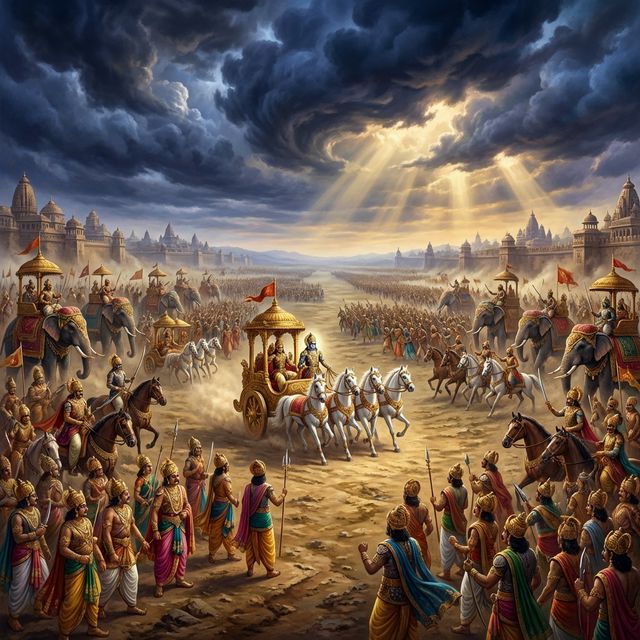
The Consecration of Drona
Karna names the Preceptor commander, and Drona names the man he cannot kill
The Host Without a Head
Sanjaya had been telling it in order, and this was the part he had come to: the morning of the eleventh day, with the grandsire off the field.
Bhishma had commanded the Kaurava host for ten days and had done what nobody else could have done, and now he was lying on a bed of his own arrows between the two armies, waiting for the sun to turn north before he would consent to die. The army he had held together was still standing where he had left it. It had no one at its head.
Then Karna came out to it. He had kept away from the fighting for all ten of those days because of a quarrel with Bhishma, and Bhishma had released him from it that same morning with words that made him a grandson of the house. He had gone straight from those arrows to the encampment, and when the Kauravas saw him come and take his station at the head of the whole army they received him with shouts and the slapping of arm-pits and leonine roars and the twang of bows.
Duryodhana, beholding that tiger among men mounted on his car, was filled with joy.
"This host, protected by thee, hath now, I think, got a proper leader," he said. "Let that, however, be settled now which is proper and within our power."
"Tell us thyself, O tiger among men," Karna said, "for thou art the wisest of kings. Another can never see so well what should be done as one seeth it whose concern it is. These kings are all desirous of listening to what thou mayst have to say. I am sure that no improper words will be uttered by thee."
So the king said the thing aloud that every man in the camp had been thinking since the previous evening.
A Boat Without a Helmsman
"Bhishma was our commander," Duryodhana said, "possessed as he was of years, prowess and learning, and supported by all our warriors. That high-souled one, O Karna, achieving great glory and slaying large numbers of my enemies, protected us by fair fight for ten days. He achieved the most difficult of feats. But now that he is about to ascend to heaven, whom dost thou think fit to be our commander after him?"
Then he gave his reasons, and the reasons are worth hearing, because they are not a king's reasons. They are a merchant's.
"Without a leader, an army cannot stay in battle for even a short while. Indeed, as a boat without a helmsman, or a car without a driver, would go anywhere, so would the plight be of a host that is without a leader. Like a merchant who falleth into every kind of distress when he is unacquainted with the ways of the country he visits, an army that is without a leader is exposed to every kind of distress."
He was not asking who was the best fighter. He knew who the best fighters were; they were standing around him in their armour. He was asking who could be put over eleven armies without the whole apparatus wandering off in eleven directions.
"Look thou, therefore, among all the high-souled warriors of our army, and find out a proper leader who may succeed the son of Santanu. Him whom thou wouldst regard as a fit leader in battle, him, all of us, without doubt, will together make our leader."
It was a large thing to hand a man. The command of the Kaurava host had been offered, in effect, to Karna's own judgement, on the first morning Karna had ever been permitted to fight, by a king who had waited eleven years to have him on the field. Every man there understood what the obvious answer was.
Karna gave the other one.
Karna Names the Preceptor
"All these foremost of men are high-souled persons," Karna said. "Every one of them deserveth to be our leader. There is no need of any minute examination. All of them are conversant with noble genealogies and with the art of smiting. All of them are endued with prowess and intelligence, all of them attentive and acquainted with the scriptures, possessed of wisdom, and unretreating from battle."
Then he named the difficulty, and it was not a difficulty of merit at all.
"All, however, cannot be leaders at the same time. Only one should be selected as leader, in whom are special merits. All of these regard one another as equals. If one amongst them, therefore, be honoured, others will be dissatisfied, and, it is evident, will no longer fight for thee from a desire of benefiting thee."
That was the whole trouble with the Kaurava army in a sentence, and Karna, who had spent his life being told he was nobody's equal in one direction or the other, was the man best placed to see it. Set any king over the rest and the rest would sulk. What was needed was a man whom none of them could resent, because none of them had ever been his equal in the first place.
"This one, however, is the Preceptor in arms of all these warriors. He is venerable in years, and worthy of respect. Therefore Drona, this foremost of all wielders of weapons, should be made the leader. Who is there worthy of becoming a leader, when the invincible Drona, that foremost of persons conversant with Brahma, is here, that one who is equal to Shukra or Brihaspati himself? Amongst all the kings in thy army, O Bharata, there is not a single warrior who will not follow Drona when he goeth to battle."
Shukra is the teacher of the Asuras and Brihaspati the teacher of the gods, and between them they are the two ends of all instruction there is.
"Therefore, O Duryodhana, make this one the leader of thy forces without delay, as the celestials made Kartikeya their leader in battle for vanquishing the Asuras."
The man he had named was standing in the middle of the troops, listening.
The King Asks in Front of Everyone
Duryodhana turned to Drona where he stood among the soldiers, and made the request in the open, in the hearing of eleven akshauhinis.
"For the superiority of the order of thy birth, for the nobility of thy parentage, for thy learning, years and intelligence, for also thy prowess, skill, invincibility, knowledge of worldly matters, policy and self-conquest, by reason also of thy ascetic austerities and thy gratitude, superior as thou art as regards every virtue, among these kings there is none who can make so good a leader as thou. Protect thou, therefore, ourselves, like Vasava protecting the celestials."
Then the comparisons, poured out one after another the way a man pours them out when he wants a thing badly and is not sure of getting it. As Kapali among the Rudras, Pavaka among the Vasus, Kuvera among the Yakshas, Vasava among the Maruts, Vasishtha among Brahmanas, the Sun amongst luminous bodies, Yama among the Pitris, Varuna among aquatic creatures, the Moon among the stars, and Usanas among the sons of Diti, so art thou the foremost of all leaders of forces.
"Be thou therefore our leader. O sinless one, let these ten and one akshauhinis of troops be obedient to thy word of command. Disposing these troops in battle array, slay thou our foes, like Indra slaying the Danavas. Proceed thou at the head of us all, like Pavaka's son at the head of the celestial forces. We will follow thee to battle, like bulls following a bovine leader."
And then, having exhausted the gods, he came down to the one argument he actually believed.
"A fierce and great bowman as thou art, beholding thee stretching the bow at our head, Arjuna will not strike. Without doubt, O tiger among men, if thou becomest our leader, I will vanquish Yudhishthira with all his followers and relatives in battle."
There it was. Not that Drona was the best of them, though Duryodhana had said so at length. That Drona was the one man in the world Arjuna would not shoot at. The kings all cried victory to Drona and made a loud leonine shout, and the troops began to glorify that best of Brahmanas, and in all that noise the Preceptor was the only one who had not yet spoken.
The One Man He Cannot Kill
"I know the Vedas with their six branches," Drona said. "I know also the science of human affairs. I am acquainted also with the Saiva weapon, and diverse other species of weapons. Endeavouring to actually display all those virtues which ye, desirous of victory, have attributed to me, I will fight with the Pandavas."
Then he set down the exception, in front of the whole army, before he had accepted the command.
"I will not, however, O king, be able to slay the son of Prishata. O bull among men, he hath been created for my slaughter."
The son of Prishata is Dhrishtadyumna, and every man on that field knew where he had come from. King Drupada, humiliated by Drona in an old quarrel over half a kingdom, had gone to the Brahmanas and paid for a sacrifice with one purpose, and out of that fire had walked a grown man in armour with a bow in his hand, born for the killing of Drona and for nothing else. His sister came out of the same fire. He had been raised in Drupada's house with that as his occupation, and he was at that hour the commander of the Pandava army standing across the plain.
So the new commander of the Kaurava host announced, at his own investiture, that the enemy's commander was going to kill him.
He did not ask to be excused. He did not ask for a guard. He simply told them what he could and could not deliver, the way a workman tells a customer, and then he went on with the rest of it.
"I will fight with the Pandavas, and slay the Somakas. As regards the Pandavas, they will not fight with me with cheerful hearts."
That is the whole of the terms he offered, and both halves of it are grim. He would kill the Panchalas and the Somakas, meaning Dhrishtadyumna's people, whom he could kill, though not the man himself. And the Pandavas, his own students, the five he had taught to hold a bow, would come at him without any joy in it.
Duryodhana heard all of that and took the bargain, because the second half of it was exactly what he had asked for.
Drums, Conchs and the Dance of Mimes
Thus permitted by Drona, the king made him the commander of his forces according to the rites prescribed in the ordinance.
Sanjaya says that the kings headed by Duryodhana performed the investiture of Drona in the command of the forces like the celestials headed by Indra in days of yore performing the investiture of Skanda, and it is the second time in a quarter of an hour that the same image has been used. Karna had asked for Drona as the gods asked for Kartikeya. Duryodhana had asked him to walk at their head as Pavaka's son walked at the head of the celestial forces. Now the water was poured and the thing was done, and the comparison was made for the third time by the man narrating it.
After the installation, the joy of the army expressed itself by the sound of drums and the loud blare of conchs. There were cries such as greet the ears on a festive day. There were auspicious invocations by Brahmanas, and cries of Jaya uttered by the foremost of them, gratified with what they had been given, and there was the dance of mimes. Drona was duly honoured.
And the Kaurava warriors, said Sanjaya, regarded the Pandavas as already vanquished.
That is the sentence to hold on to, because of what had just been said in their hearing and how completely they had failed to hear it. The old Brahmana they were garlanding had told them, without hedging and without shame, that he would fight and win and kill and be killed, and that the killer was in sight across the plain. They cried Jaya and put mimes on to dance.
Sanjaya was telling all of this, months afterward, to a blind king in a hall in Hastinapura, and he already knew how it ended. He knew what would come of the promise about Yudhishthira, and he knew that the son of Prishata would do exactly what he had been made for. He tells the festival in full anyway, the drums, the conchs, the invocations, the dancing, letting his king hear the whole of that morning's happiness before he gets to the rest.
The Cart and the Crane
Then Bharadwaja's son, having obtained the command, arrayed the troops and went out with the sons of Dhritarashtra to fight.
He drew up the Kaurava host in the form of a Sakata, a cart. Jayadratha the ruler of the Sindhus, and the chief of the Kalingas, and Duryodhana's brother Vikarna, clad in mail, took the right wing, with Shakuni behind them and many foremost horsemen of the Gandhara tribe battling with bright lances. Kripa and Kritavarman and Chitrasena and Vivinsati, headed by Dushasana, strove vigorously to protect the left, supported by the Kambojas under Sudakshina and by the Sakas and the Yavanas on steeds of great fleetness. The Madras, the Trigartas, the Amvashthas, the Westerners and the Northerners, the Malavas, the Surasenas, the Sudras, the Maladas, the Sauviras, the Kaitavas, the Easterners and the Southerners formed the rear guard with Duryodhana and Karna at their head.
Karna went at the head of the bowmen. His blazing and tall standard, bearing the device of the elephant's rope, shone with an effulgence like the sun and gladdened his own divisions, and beholding him there, none regarded the calamity caused by Bhishma's death. The kings became free from grief. Men said to one another that the Pandavas would never be able to stand in battle now, that Karna was competent to vanquish the very gods with Vasava at their head, that the mighty-armed Bhishma had spared the Parthas but Karna would slay them with his keen shafts.
Across the plain Yudhishthira, in great cheerfulness, had drawn up his own host in the form of a Krauncha, a crane. At the head of the array stood one car with white steeds yoked to it, carrying Krishna and Arjuna, with the ape on the banner floating over them, and Sanjaya said that banner seemed to illumine the entire host, and resembled the blazing sun that rises at the end of the Yuga to consume the world.
So the cart faced the crane, and at the very front of each army stood one of the two men who had sworn to kill the other, Karna at the head of the Kauravas and Dhananjaya at the head of the Pandavas, both excited with wrath, looking across the ground at each other.
A Shower of Flesh and Bones
When that mighty car-warrior, Bharadwaja's son, proceeded to battle with great speed, the earth seemed to tremble with loud sounds of wailing.
The thick dust raised by the wind, resembling a canopy of tawny silk, enveloped the sky and the sun. Though the firmament was cloudless, a shower fell of pieces of flesh and bones and blood. Vultures and hawks and cranes and Kankas and crows in thousands began continually to fall upon the Kaurava troops. Jackals yelled aloud. Many fierce and terrible birds wheeled again and again to the left of the army, wanting flesh to eat and blood to drink. Blazing meteors, lighting the sky and covering large areas with their tails, fell on the field with a loud sound and a trembling motion, and the wide disc of the sun seemed to emit flashes of lightning with a thundering noise.
These and many other portents were seen, and Sanjaya names what they indicated: a destruction of heroes. Every one of them came down on the side that had been dancing an hour before.
Then the two armies met, and so loud was the din that it seemed to fill the whole earth.
Drona rushed at the Pandava troops scattering hundreds of sharp arrows, and the Pandavas and the Srinjayas received him with showers upon showers of their own. Agitated and broken by him, the large host of the Pandavas and the Panchalas broke like rows of cranes scattered by the force of the wind. He invoked celestial weapon after celestial weapon into existence, and within a very short time the Panchalas trembled where they stood.
And the man at the head of the Panchalas was Dhrishtadyumna.
He was acquainted with celestial weapons himself. He broke Drona's division with his arrowy showers in many places. He baffled the showers shot by Drona with showers of his own and caused a great slaughter among the Kurus, and Drona, rallying his men and gathering them together, turned his car and rushed straight at the son of Prishata, and shot at him a thick shower of arrows like Maghavat in rage pouring his shafts upon the Danavas.
The first enemy the new commander charged, on the first hour of his command, was the one man he had told them all he could not kill.
Dharma Lesson
Drona takes the command honestly, which is rarer than taking it well. He lists what he can do, names the one thing he cannot, and does not pretend the exception away to keep the garland from slipping. The army around him hears the same sentence he speaks and celebrates through it, because men who have decided to win will treat a warning as a formality. The difference between the teacher and his employers is not courage or skill; it is that he was willing to say the true thing out loud on the morning it would have cost him something, and they were not willing to listen to it even free of charge.