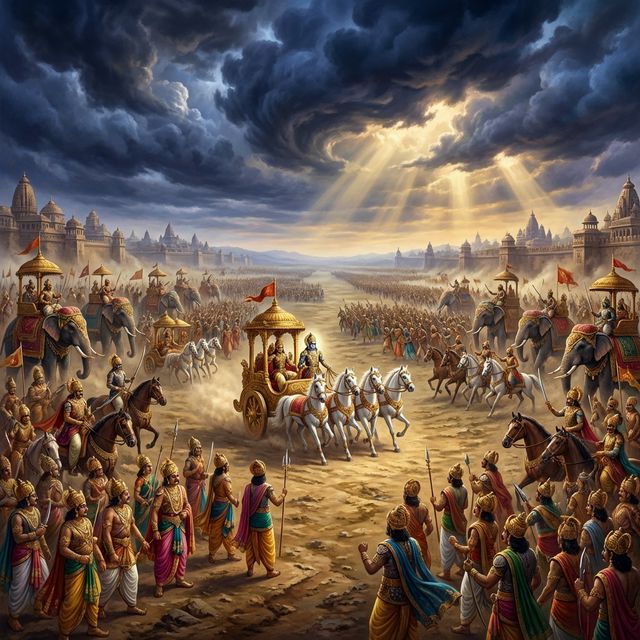
The Silent Camp
Arjuna comes back at dusk from the samsaptakas and learns that Abhimanyu is dead
The End of the Thirteenth Day
Sanjaya said: when that terrible day departed, so fraught with the slaughter of creatures, and when the sun set, the beautiful twilight of the evening spread itself over the field. The troops of both parties, O bull of Bharata's race, had retired to their tents.
Far out at the southern end of the line, the ape-bannered Jishnu had spent the whole of that day where he had been called. The samsaptakas were the sworn men of Trigarta, warriors who had taken an oath in front of both armies that they would either kill Arjuna or die, and who had no other purpose in the war than to shout for him every morning and pull him away from the centre. He could not refuse them. A challenge answered is a day spent, and that was the arrangement, and it had worked exactly as it had been designed to work.
He had slain a large number of them by means of his celestial weapons. Now he turned that victorious car of his back toward the camp with the light going out of the sky behind him, and Govinda held the reins, and neither of them yet knew anything.
What Arjuna knew was that something was wrong with him.
It came on him on the road, the way weather comes on. His limbs went weak. His mouth would not shape words properly. He looked at the ordinary evening country on either side of the track, and it was full of signs, and every one of them was bad.
He turned to the man driving him and spoke with his voice choked with tears.
Why Is My Heart Afraid
"Why is my heart afraid, O Kesava, and why does my speech falter? Evil omens encounter me, and my limbs are weak. Thoughts of disaster possess my mind without my willing it. On earth, on all sides, various omens strike me with fear. Of many kinds are those omens and indications, and they are seen everywhere, foreboding dire calamity."
Then the question underneath the question, and it is worth noticing that he did not ask about his son.
"Is it all right with my venerable superior, the king, with all his friends?"
He asked after Yudhishthira. Drona had been hunting the eldest brother for three days by then with the whole weight of the Kaurava army behind him, and the one disaster Arjuna had been trained by the last three days to expect was the capture of the king. That was the shape his fear took, because that was the shape his fear had been given.
Vasudeva answered him.
"It is evident that everything is right with thy brother and his friends. Do not grieve. Some trifling evil in another direction will happen."
Krishna had been on the field all day. He had a charioteer's view of everything that had passed on the right hand of that army and he had said nothing about it for hours, and here, asked directly, he chose those words. Some trifling evil. In another direction.
Then the two of them stopped, because the hour required it. They stepped down and adored the Twilight, the evening rite that a man performs wherever he happens to be standing when the sun goes, and the archer with the omens crowding him and the god holding his horses said the same words to the fading light that every householder in every village between there and the sea was saying at that moment.
Then they mounted the car again and went on, talking as they went of the day's battle, so destructive of heroes. Having achieved feats exceedingly difficult of accomplishment, Vasudeva and Arjuna at last reached the Pandava encampment.
No Trumpet Blew
A camp at the end of a day of battle is the loudest place in the world. That is the first thing to understand about what happened next. The wounded are carried in, the horses are led off, the cooking fires go up, and over the top of all of it come the instruments, because the return of the army is an occasion and occasions are announced.
Vibhatsu, that slayer of hostile heroes, came up the track and beheld the camp joyless and melancholy and everything in confusion, and he addressed Krishna with an agonised heart.
"O Janardana, no auspicious trumpet blows today, its blasts mingled with the beat of drums and the loud blare of conchs. The sweet vina also is nowhere played upon in accompaniment with the slapping of palms. Auspicious and delightful songs fraught with praise are nowhere recited or sung by our bards amongst the troops."
He was listening for particular sounds and naming them one by one as he failed to hear them, which is what a man does when he is trying to persuade himself that he has merely arrived early.
Then he stopped listening and looked instead.
"The warriors also all recede, hanging down their heads. They do not tell me, beholding me, as before, of the feats achieved by them."
That is the detail that broke him. Soldiers who have had a good day come and tell you about it. These men saw the car of Arjuna come in and turned their faces away and got out of his path.
"O Madhava, is it all right with my brothers today? Beholding our own men plunged in grief, I know no peace. Is it all right, O giver of honours, with the ruler of the Panchalas, or Virata, or all our warriors, O thou of unfading glory?"
Drupada of the Panchalas and old Virata of the Matsyas were the two allied kings whose houses the Pandavas had married into, and their deaths would have accounted for a camp like this one. Arjuna was going down the list of the men whose loss would explain the silence, and he came to the end of the list, and the end of it was not a king.
"Alas, Subhadra's son, ever cheerful, does not today, with his brothers, come out with smiles to receive me returning from battle."
Pale Is the Colour of Your Faces
Thus conversing, those two entered their own camp. And they saw that the Pandavas, all cheerless, were sitting, plunged in great grief.
Beholding his brothers and his sons, the ape-bannered Arjuna became very cheerless. He looked along the seated men once, and did not find the one face, and began to speak, and every sentence he said from that moment was a question he already knew the answer to.
"Pale is the colour I behold of the faces of you all. I do not, again, see Abhimanyu. Nor does he come to congratulate me."
Then, without waiting, he assembled the thing himself out of what he had heard in the field.
"I heard that Drona had today formed the circular array. None amongst you, save the boy Abhimanyu, could break that array."
The circular array is the chakra, the wheel, and the knowledge of it was a family matter. Arjuna could pierce it. So could Krishna, and so could Pradyumna. Abhimanyu had the entering of it and nothing else, and his father knew precisely how much of it the boy had and precisely where the knowledge stopped, and he said so aloud in front of all of them.
"I, however, did not teach him how to come out of that array, after having pierced it."
Then the accusation, put as a question, which is the only way a man can put it to his own brothers.
"Did you cause the boy to enter that array?"
Nobody answered him.
"Has that slayer of heroes, the son of Subhadra, that mighty bowman, having pierced that array, through numberless warriors of the enemy in battle, fallen at last in the fight? Oh, tell me, how has that hero of mighty arms and red eyes, born in our line like a lion on the mountain breast, and equal unto the younger brother of Indra himself, fallen on the field of battle? What warrior, deprived of his senses by Death, ventured to slay that dear son of Subhadra, that favourite of Draupadi and Kesava, that child ever loved by Kunti?"
He had named the whole house in one breath. The boy's mother, the boy's aunt, the boy's uncle, the boy's grandmother. There was nobody in that camp who was not going to be told something tonight.
The Boy He Was Describing
What Arjuna did then was the thing that grief actually does, which is not to howl but to enumerate.
"With locks ending in soft curls, of tender years, with eyes like those of a young gazelle, with a tread like that of an infuriated elephant, tall like a sala offshoot, of sweet speech accompanied with smiles, quiet, ever obedient to the behests of his superiors, acting like one of mature years though tender in age, of agreeable speech, reft of vanity, of great courage and great energy, of large eyes resembling lotus-petals, kind to those devoted to him, self-restrained, following nothing mean, grateful, possessed of knowledge, accomplished in weapons, unretreating from battle, always delighting in fight, and enhancing the fears of foes, engaged in the welfare of kinsmen, never striking first, perfectly fearless in battle. Alas, if I do not behold that son, I will repair to the abode of Yama."
He said that last sentence four times before he was finished, and each time he had added something more to the list in front of it.
"In the counting of car-warriors always reckoned as a maharatha, superior to me one and a half times, of tender years, of mighty arms, dear even to Pradyumna and Kesava and myself. Alas, if I do not behold that son, I will repair to the abode of Yama."
Superior to me one and a half times. That is a technical rating out of the muster rolls, the sort of thing that is read out when the army is counted, and a father was reciting his son's rating to a tent full of men who had watched him die.
"Of beautiful nose, of beautiful forehead, of fair eyes and eyebrows and lips. If I do not behold that face, what peace can my heart have? Melodious as the voice of the male kokila, delightful, and sweet as the warblings of the vina. Without listening to his voice, what peace can my heart have? His beauty was unrivalled, rare even among the celestials. Without casting my eyes on that form, what peace can my heart have? Accomplished in saluting his superiors with reverence, and always obedient to the behests of his sires. Alas, if I do not behold him, what peace can my heart have?"
He Sleeps Tonight on the Bare Earth
Then his mind went out of the tent and across the dark field to where the body was, and it began to furnish that place with everything the boy had been used to, and to note the substitution.
"Brave in battle, accustomed to every luxury, deserving of the softest bed. Alas, he sleeps today on the bare earth, as if there is none to take care of him, although he is the foremost of those that have protectors to look after them."
Although he is the foremost of those that have protectors. Five uncles, a grandfather in Dwaraka, Krishna himself, and the greatest bowman alive for a father.
"He on whom, while on his bed, the foremost of beautiful women used to attend, alas, he, mangled with shafts, will have inauspicious jackals, prowling over the field, to attend upon him today. He who was formerly roused from his slumbers by singers and bards and panegyrists, alas, he will today be surely awakened by discordant beasts of prey. That beautiful face of his eminently deserved to be shaded by the umbrella, and the dust of the battlefield will surely befoul it today."
Then, quietly, the only line in the whole lament that is about himself.
"O child, unfortunate that I am, death forcibly takes thee away from me, who was never satiated with looking at thee."
After that he made himself say the other thing, the consoling thing, and he said it in the form men use when they are trying it out to see whether it will hold weight.
"Without doubt, that abode of Yama, which is always the goal of persons of righteous deeds, that delightful mansion, illuminated today by thy own splendours, is rendered exceedingly beautiful by thee. Without doubt, Yama and Varuna and Satakratu and Kuvera, obtaining thee as a favourite guest, are making much of thy heroic self."
Thus indulging in diverse lamentations, like a merchant whose vessel has been sunk, Arjuna, afflicted with great grief, turned to Yudhishthira.
"O thou of Kuru's race, has he ascended to heaven, having caused a great slaughter among the enemy and contended with the foremost warriors in the face of battle?"
What Yuyutsu Shouted at Them
He could not stop himself imagining it, and what he imagined was worse than anything he had been told.
"Without doubt, while contending single-handed with the foremost of warriors, countless in number, and fighting with vigour and resolution, his heart turned towards me from a desire of help. While afflicted by Karna and Drona and Kripa and others with sharp shafts of bright points, my son of little strength must have repeatedly thought: my father will in this press be my rescuer. I think that while indulging in such lamentations he was felled on the ground by cruel warriors."
Then he took it back.
"Or perhaps, when he was begotten by me, when he was the nephew of Madhava, when he was born of Subhadra, he could not have uttered such lamentations."
"Without doubt, my heart, hard as it is, is made of the essence of the thunder, since it breaks not, even though I do not behold that mighty-armed hero of red eyes. I grieve for Subhadra, who, hearing of the death in battle of her unretreating son, will, afflicted with sorrow, cast away her life. What will Subhadra, missing Abhimanyu, say unto me? What also will Draupadi say unto me? Afflicted with grief as they are, what shall I say unto them? Without doubt my heart is made of the essence of the thunder, since it breaks not into a thousand fragments at the sight of my weeping daughter-in-law, pierced with grief."
And then he remembered a sound he had heard that afternoon and had not understood.
"The leonine shouts of the Dhritarashtras, swelling with pride, did indeed enter my ears."
He had heard that noise while he was killing samsaptakas and had thought nothing of it. Krishna had heard something else in the same hour. Yuyutsu, Dhritarashtra's son by his Vaisya wife, who had walked across to the Pandavas on the first morning of the war, stood in the middle of his own brothers' rejoicing and rebuked them.
"Ye mighty car-warriors, having been unable to vanquish Vibhatsu, and having slain only a child, why do ye rejoice? Why, having done what is disagreeable to Kesava and Arjuna in battle, do you in joy roar like lions, when truly the hour for sorrow is come? The fruits of this sinful deed of yours will soon overtake you. Heinous is the crime perpetrated by you. How long will it not bear its fruits?"
Then he went away, casting off his weapons, afflicted with rage and grief.
Arjuna turned on the man beside him.
"O Krishna, why did you not tell me all this during the battle? I would then have consumed all those car-warriors of cruel hearts."
The Man Nobody Could Speak To
Then Vasudeva consoled Partha, whose eyes were bathed in tears.
"Do not yield so to grief. This is the way of all brave, unretreating heroes, especially of kshatriyas, whose profession is battle. This is the goal ordained by the authors of our scriptures for unretreating heroes, and death is certain for heroes that do not retreat. There is no doubt that Abhimanyu has ascended to those regions that are reserved for persons of righteous acts. Abhimanyu, having slain in battle many heroic and mighty princes, has met with that death in the face of battle which is coveted by heroes."
Then the practical part.
"These brothers of thine are all exceedingly cheerless, as also the king and these thy friends, seeing thee plunged in grief. O giver of honours, comfort them in consoling words. That which should be is known to thee. It behoves thee not to grieve."
Thus comforted, Partha turned to his brothers with his voice choked with sorrow, and did not comfort them.
"O lord of the earth, I desire to hear how the mighty-armed Abhimanyu fought. Ye will see that I will exterminate the foe. Ye all are accomplished in arms. Ye all were armed with weapons. How then could Subhadra's son be slain, even if it were the wielder of the thunderbolt himself with whom he fought? Ye were then on your cars. Ye were shooting your shafts. Alas, ye have no manliness, nor have ye any prowess, since in the very sight of you all was Abhimanyu slain. Or I should chide my own self, since, knowing that ye all are weak, cowardly and irresolute, I went away."
And then the last of it, said to men he would have to fight beside tomorrow.
"Alas, are your coats of mail and weapons of all kinds only ornaments for decking your persons? Were words given to you only for speaking in assemblies, that ye failed to protect my son?"
Having said these words, Partha sat down, holding his bow and his excellent sword.
Nobody could look at him, and Sanjaya says it twice so the blind king would not miss it. Vibhatsu resembled the Destroyer himself in wrath, drawing deep breaths, and none of his friends or kinsmen could venture to look at him or speak to him. There were exactly two men in that camp permitted, under all circumstances, to address Arjuna when he was like this, because both were reverenced by him and both were dearly loved.
One of them had just finished speaking.
Then king Yudhishthira, addressing Partha, who was filled with rage and afflicted with grief on account of his son, began to tell him what had happened.
Dharma Lesson
Arjuna spends this whole episode asking questions whose answers he already has, which is what the mind does when it is refusing an unbearable fact one sentence at a time. The epic does not hurry him through it, and it does not let the consolation arrive early: Krishna's true and correct words about the death coveted by heroes are spoken to a man who cannot hear them yet, and they do not work. What is asked of a kshatriya here is not that he should feel less, but that he should be able to sit down afterwards, still holding the bow, with the grief entire and the duty unchanged.