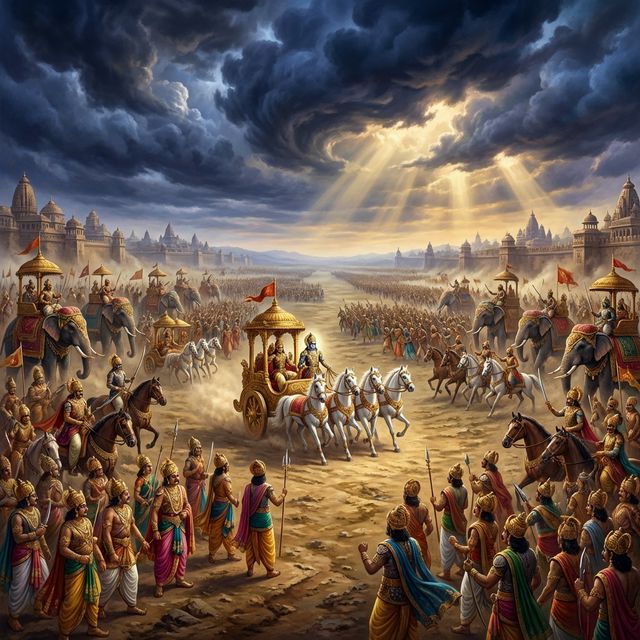
The Boon Somadatta Asked For
A wrestling match at Devaki's self-choice, and the son born a generation later to answer it
The Question About the Foot
It was the fourteenth day of the war, and of everything that had happened in it, the thing the blind king could not get past was a picture: one of his own men standing over Satyaki with a foot on him.
"Unvanquished by Drona," Dhritarashtra said, "and by Radha's son, and by Vikarna and Kritavarma, how could the heroic Satyaki, never before checked in battle, having after his promise to Yudhishthira crossed the ocean of the Kaurava troops, be humiliated by the Kuru warrior Bhurishravas and forcibly thrown on the ground?"
It was a fair question and he asked it as a soldier's question. Satyaki of the Vrishnis had gone through the whole Kaurava army alone that morning, past Drona himself, past Karna, past every commander who tried to stop him. Men like that are not simply knocked down and trodden on in front of an army. And Bhurishravas, son of Somadatta, of the house of Bahlika, was a fine warrior but he was not Drona.
Sanjaya did not answer with tactics. He answered with a genealogy.
"Hear, O king, about the origin, in past times, of Sini's grandson, and of how Bhurishravas also came to be descended. This will clear thy doubts."
That is the whole shape of the thing, and it should be noticed before the story starts. Dhritarashtra had asked why one man beat another on a particular afternoon. Sanjaya told him that the afternoon had been arranged before either man was born, at a wedding, by a god, at the request of a king who had been shamed and could not live with it.
Satyaki was the grandson of Sini. Bhurishravas was the son of Somadatta. Neither of them had chosen the other. What passed between them in the dust that day, in front of both armies, had passed already between their fathers' fathers in front of a hall full of kings, and the only new thing about it was that this time it was finished.
Sanjaya began at the beginning, with a name out of the first age of the world.
The Line from Atri
"Atri had for son Soma," said Sanjaya. "Soma's son was called Vudha. Vudha had one son, of the splendour of the great Indra, called Pururavas. Pururavas had a son called Ayus. Ayus had for his son Nahusha. Nahusha had for his son Yayati, who was a royal sage equal to a celestial."
Nine names, and the ninth is the one that matters to a Kuru listening, because Yayati is where the world divides. Yayati had by Devayani a son named Yadu, and Yadu was the eldest, and Yadu was passed over. Out of the younger brother came the line that ends in the hall where Dhritarashtra was sitting. Out of Yadu came the Yadavas, and it is their branch of the family that Sanjaya was tracing.
"In Yadu's race was born a son of the name of Devamidha. Devamidha of Yadu's race had a son named Sura, applauded in the three worlds. Sura had for his son that foremost of men, the celebrated Vasudeva. Foremost in bowmanship, Sura was equal to Kartavirya in battle. And in Sura's race, and equal unto Sura in energy, was born Sini, O king."
So there are two young men standing at the end of that list, of the same house and the same generation. Vasudeva, son of Sura, who would in time be the father of Krishna, though nobody in this story knows that yet. And Sini, his kinsman, of the same blood and the same strength, who is the sort of man a family sends when something has to be taken and held.
The list is not decoration. Sanjaya is establishing, before he says anything about the wedding, exactly what Sini was: not a retainer, not a hired arm, but a Vrishni of the senior stock, descended through Yadu from Yayati and Nahusha and Pururavas up to the moon and to Atri, with as much right to stand in an assembly of kings as any man who would be standing there.
That is worth having clear, because of what he did in that assembly, and because of how a Kuru would afterwards describe it.
The Self-Choice of Devaka's Daughter
"About this time, O king, occurred the swayamvara of the high-souled Devaka's daughter, in which all the Kshatriyas were present."
Her name was Devaki. She was the daughter of Devaka, of the Yadava house at Mathura, and she is the one woman in this story whose name every listener already knows, because of a prison and a midnight and a basket carried across a river years later. None of that has happened. On the day Sanjaya is describing she is a princess at her own self-choice, and the whole of the Kshatriya order has come to stand in front of her and be looked at.
A swayamvara is exactly what the word says. The kings assemble, they are named and displayed, and the woman walks along the line with a garland in her hands and chooses. The convention is that the losers accept it. The other convention, older and much better attested in the epic, is that the losers do not, and that a self-choice ends about as often in a battle in the courtyard as it does in a wedding.
The man Devaki wanted, or the man her family wanted for her, was Vasudeva, son of Sura. But it was not Vasudeva who came out of the Vrishni ranks to fetch her.
It was Sini.
Ganguli's line is short and gives no reason, and the reason is not hard to supply from the custom of the age: a kinsman goes and takes the bride for the bridegroom, by force if the assembled kings make force necessary, and the taking is itself a claim about the house he takes her for. Sini went into that hall on Vasudeva's behalf, in front of many thousands of kings who had come for the same girl and had brought their weapons with them.
Nobody there thought it improper. Every man in the hall had come prepared for it to happen and had hoped to be the one doing it.
Taken Up on the Car
"In that self-choice, Sini, vanquishing all the kings, quickly took up on his car the princess Devaki for the sake of Vasudeva."
The whole event goes past in one sentence, and the sentence has three parts worth separating.
He vanquished all the kings. Not one champion, not a contest of archery at a fish in a wheel, but the assembly. Whatever resistance the hall offered, and a hall of Kshatriyas denied a bride offers a great deal, Sini went through it.
He took her up on his car. That is the physical act the whole story turns on, and it is done quickly, which is the mark of a man who has thought about it beforehand. The car is at the door; the princess is lifted; the horses are already moving before the men in the hall have finished deciding to be angry.
And he did it for the sake of Vasudeva. Not for himself. He was of Sura's race and equal to Sura in energy and could have kept her, and there is no suggestion anywhere in the text that the thought crossed his mind. He carried off the most sought-after woman in the assembly in order to hand her to his kinsman, and every king in that hall watched him do it and knew exactly why he was doing it.
So the picture, for a moment, is this. A chariot in the courtyard, a princess of Mathura standing on it, a Vrishni holding the reins, and behind them a hall of defeated kings.
That is the image that one man in the hall could not swallow.
The Man Who Could Not Brook the Sight
"Beholding the princess Devaki on Sini's car, that bull among men, the brave Somadatta of mighty energy, could not brook the sight."
Somadatta was a Kuru, of the elder branch, son of Bahlika, and he had come to the self-choice like everyone else. Ganguli does not say that Somadatta wanted Devaki for himself, and does not say that he was defending the honour of the assembly, and does not say that he thought the Vrishni had cheated. He says only that Somadatta looked at another man's car with the woman standing on it and could not bear to look at it.
"A battle ensued between the two which lasted for half a day and was beautiful and wonderful to behold."
Half a day. Not an exchange of blows at a doorway, but a fight that began in the morning and was still going on in the afternoon, with a courtyard full of kings who had just been beaten themselves standing round the edge of it and watching two men do properly what they had all failed to do.
And then the detail that decides everything afterwards.
"The battle that took place between those two mighty men was a wrestling encounter."
Not chariots. Not bows. Whatever the two of them began with, they finished with their hands, which means that for the second half of that day two kings were rolling in the dirt of a wedding courtyard in front of the entire Kshatriya order, gripping each other by the arms and the neck, getting up and being thrown down again, until one of them could not get up.
A man killed by an arrow at a distance is a casualty. A man held down by another man's hands, in front of people he knows, is something else, and both of them understood the difference while it was happening.
Live
"That bull among men, Somadatta, was forcibly thrown down on the earth by Sini."
What follows is four movements, and Ganguli sets them down one after another without a word of comment, which is the correct way to set down something that everybody watching is going to remember for two generations.
Sini uplifted his sword.
He seized his foe by the hair.
He struck him with his foot.
And he did it in the midst of many thousands of kings who stood as spectators all around.
Take those in order. The sword comes up first, which means that for the length of a breath everyone in that courtyard believed they were about to watch a killing. Then the hand goes into the hair, which is not how a man is held for execution but how a man is held to be shown to people. Then the foot. And the last clause is not scene-setting but the point of the whole exercise: the audience is part of the act. It was done where it could be seen, and it was done slowly enough to be seen.
To be struck with a foot is, in the code these men lived by, the lowest thing that can be done to a Kshatriya. It is what is done to an animal or to a corpse.
"At last, from compassion, he let him off, saying, Live!"
One word. Sini opened his hand and gave the man his life back and walked off with the bride, and by every rule he knew he had behaved well: he had beaten his enemy, he had not killed a beaten enemy, and mercy is a virtue.
Somadatta got up out of the dirt of that courtyard with his life, in front of thousands of kings who had watched him get into it.
Nothing else in this story would have happened if Sini had killed him.
The Boon
"Reduced to that plight by Sini, Somadatta, under the influence of wrath, began to pay his adorations to Mahadeva for inducing the latter to bless him."
He did not raise an army. He did not follow the Vrishnis to Mathura, and he did not challenge Sini a second time, which is the thing a man in a story usually does. He went away and undertook penance, and he directed it at Rudra, the god of the destroyer's aspect, who is the one boon-giver in the epic that a furious man goes to when what he wants is not prosperity.
Penance in this literature is not prayer and it is not repentance. It is work. A man sits down with his purpose and holds it steadily for as long as it takes, and heat gathers, and eventually the god has no choice.
"That great lord of all boon-giving deities, Mahadeva, became gratified with him, and asked him to solicit the boon he desired."
Here is a king who has been trodden on, standing in front of Shiva, with the sentence of his life to spend. He could have asked for Sini's death. He could have asked for strength enough to reverse the wrestling match, or for the memory of it to be taken out of the minds of the kings who watched. He asked for none of those things.
"I desire a son, O divine lord, who will strike Sini's son in the midst of thousands of kings, and who will in battle strike him with his foot."
Read it beside what was done to him and the two match clause for clause. In the midst of thousands of kings. With his foot. He did not want revenge on Sini; Sini would be dead long before any son of his could be born. He wanted the picture repeated. He wanted somebody of that man's blood held down in front of an audience and touched with a foot, and he was willing to wait a generation and to spend a son on it.
"Hearing these words of Somadatta, the god, saying, So be it, disappeared then and there."
The Son Who Was the Boon
"It was in consequence of the gift of that boon that Somadatta subsequently obtained the highly charitable Bhurishravas for son."
That is the sentence Sanjaya had been travelling toward since Atri, and it turns the whole story round to look at the field the two men were standing on.
Bhurishravas was not a monster bred for an errand. He is called highly charitable, and everything else the epic says of him agrees: a performer of sacrifices, a giver of thousands of gold coins, a man whose banner carried the sacrificial stake, so devout that when he came to die he spread a bed of arrows with his one remaining hand and sat down on it with his mind on the Upanishads. Nothing in his character was borrowed from his father's grudge. Only his existence was.
"And it was for this that Somadatta's son threw down Sini's descendant in battle, and struck him, before the eyes of the whole army, with his foot."
That is the answer to the question Dhritarashtra asked. Satyaki was not beaten because Bhurishravas was the better man, and the ocean of the Kaurava host had not broken him, and neither Drona nor Karna nor any commander in that army had managed what happened in those few minutes on the fourteenth day. It happened because an old man had knelt somewhere in the previous age and asked for it in those exact words, and had been told, So be it.
What came after, on that same afternoon, is another story: an arm cut off from behind by Arjuna, a warrior sitting in the vow of Praya with his gaze on the sun, a sword, and an old father in the Kuru lines swearing by his two sons. Sanjaya did not go back over it. He had been asked how a Vrishni came to be trodden on, and he had answered.
Two men fought at a wedding. One of them was merciful. The other one went to a god about it.
Nor Is Any Vrishni Vanquished
Then Sanjaya, having explained the defeat, spent his last breath insisting that it had not been one.
"Indeed, the Satwata hero is incapable of being vanquished in battle by even the foremost of men. The Vrishni heroes are all of sure aim in battle, and are conversant with all modes of warfare. They are vanquishers of the very gods, the Danavas and the Gandharvas. They are never confounded. They always fight, relying upon their own energy. They are never dependent on others."
He went through them as a list, and the list is not about weapons.
"They never show disrespect to their kinsmen. They are always obedient to the commands of those that are reverend in years. They never covet the possessions of those that ever render them aid on any occasion of distress. Devoted to the Brahmanas and truthful in speech, they never display any pride although they are wealthy. The Vrishnis regard even the strong as weak and rescue them from distress. Always devoted to the gods, the Vrishnis are self-restrained, charitable, and free from pride. It is for this that the prowess of the Vrishnis is never baffled."
"A person may remove the mountains of Meru, or swim across the ocean, but cannot defeat the Vrishnis."
It is a strange speech to make about a man who had just been thrown on the ground, and it is the point. What put Satyaki in the dust was not the strength of a Kuru. It was a promise made by a god to a man who could not forget an afternoon, and against that kind of arrangement the conduct of a whole clan, however faultless, is no protection at all.
Sanjaya turned it, at the end, on the man who had asked.
"I have told thee everything about which thou hadst thy doubts. All this, however, O king of the Kurus, that is happening is due to thy evil policy, O best of men."
A blind man in a hall, asking why one warrior had shamed another, had been told the truth: that these things are old, that they are kept alive by people who will not let them die, and that he was doing it himself.
Dharma Lesson
Sini did everything right by the code he lived under. He fought fairly, he won, he did not kill a beaten enemy, and the mercy he showed cost his own grandson a humiliation before two armies. The epic does not say he should have killed Somadatta; it says that a shame inflicted in front of witnesses is not discharged by sparing the man's life, and that the injury Somadatta could not forget was never the throw but the audience. What one generation takes lightly enough to walk away from, another generation is handed as a debt.