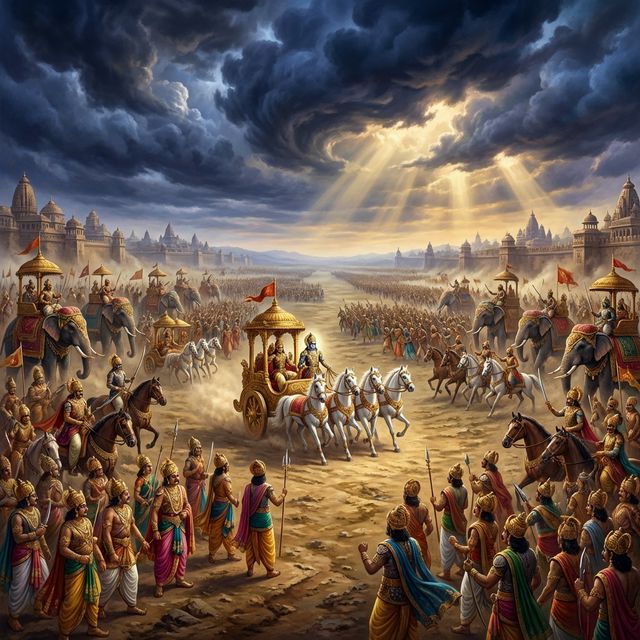
How Drona Won the Narayana Weapon
Ashwatthama tells the Kauravas where his father's last astra came from, and the one rule that came with it
What Did the Son Say
It was the fifteenth day of the war, and the news carried back into the hall at Hastinapur was that Drona was dead.
The old king wanted one thing out of it, and it was not the manner of the killing. He had been told that already: how the preceptor, hearing that Ashwatthama had fallen, had let his bow drop out of his hands and given his mind to yoga on the terrace of his car; and how Dhrishtadyumna, son of Drupada of the Panchalas, who had been born out of a fire for exactly this, had taken the old man by the hair and cut off his head in the sight of both armies.
What Dhritarashtra wanted was the consequence.
"Hearing of the slaughter of his aged sire by unrighteous means," he said, "what did the valiant Ashwatthama say?"
Sanjaya answered him.
"Hearing of the slaughter of his sire by Dhrishtadyumna of sinful deeds, O bull among men, Drona's son was filled with grief and rage."
That is the plainest sentence in the whole account, and everything else in this story comes out of it. Sanjaya then reached for the comparison the epic keeps for one occasion only. Filled with rage, he said, the body of Drona's son seemed to blaze forth like the body of the Destroyer while he is engaged in slaughtering creatures at the end of the Yuga.
Around him the Kuru host was coming apart. Their commander was down, the man they had followed for five days was lying headless in the dust with his white hair in a Panchala's fist, and the line was loosening the way a line does when nobody left in it can think of a reason to stay.
Ashwatthama stood in his car in the middle of that and wiped his eyes, and they filled again, and he wiped them again. He was breathing hot sighs in rage, the way a man breathes when he cannot get enough air.
Then he turned to Duryodhana and began to speak, and the speech he made is the reason this hour is remembered.
Death in Battle Is To Be Applauded
"I have now learnt how my sire has been slain by those low wretches after he laid aside his weapons," he said, "and how also a sinful act has been perpetrated by Yudhishthira disguised in the garb of virtue. I have now heard of that unrighteous and exceedingly cruel act of Dharma's son."
Then he said the thing nobody standing there expected, and he said it before any of the rest.
"Indeed, to those engaged in battle, either of two things must happen, victory or defeat. Death in battle is always to be applauded. That death in battle of a person engaged in fight, which takes place under circumstances of righteousness, is not deserving of grief, as has been observed by the sages. Without doubt my sire has gone to the region of heroes. He having met with such a death, I should not grieve for him."
This is a son who has just been told his father is dead, standing in front of an army, refusing on principle to mourn the death itself. Drona had gone out that morning knowing what the field was, and he had ended where such men hope to end. There is no complaint to be made about the fact of it, and Ashwatthama had been too well taught to make one.
What he could not get past was the half minute that came after it.
"The humiliation, however, of a seizure of his locks, that he sustained in the very sight of all the troops, while he was righteously engaged in battle, is tearing the very core of my heart."
The hair. Not the sword and not the blood. A hand in the white hair of an old man, in front of everybody, with his son somewhere on the same field and not there.
"Myself alive," he said, "my sire's locks were seized. Why should sonless people then entertain a desire of offspring?"
There is no answer to that question, and it was not asked for one. If a man can have a son like me, a son with every celestial weapon in his keeping, and still be handled like that in public, then what is it exactly that childless men spend their lives praying for?
The Debt
"People perpetrate unrighteous acts or humiliate others," he went on, "moved by lust or wrath or folly or hatred or levity."
He was going down the five looking for the one that fitted, and he did not find any of them, which left contempt.
"The cruel and wicked-souled son of Prishata hath perpetrated this exceedingly sinful act in total disregard of me."
Prishata was Drupada's father, and the epic reaches back for that older name when it wants the whole quarrel of the two houses standing behind a man at once. The grandfather, the father whom Drona had humbled and whose kingdom he had halved, and now the fire-born son with the blood on his hands.
"Dhrishtadyumna, therefore, shall surely suffer the dreadful consequence of that act, as also the false-speeched son of Pandu, that has acted so wrongly. Today the earth shall certainly drink the blood of that king Yudhishthira the just, who caused the preceptor, by an act of deceit, to lay aside his weapons. I swear by truth, O Kauraveya, as also by my religious acts, that I shall never bear the burden of life if I fail to exterminate the Panchalas. By every means I contend with the Panchalas in dreadful strife. I shall certainly slay in battle Dhrishtadyumna, that perpetrator of unrighteous deeds. Mild or violent, let the means be what they will, I shall effect the destruction of all the Panchalas before peace becomes mine."
Mild or violent, let the means be what they will. It is worth marking that clause, because he kept it.
"O tiger among men, persons desire children so that, obtaining them, they may be rescued from great fears both here and hereafter. My sire, however, fell into that plight like a friendless creature, although I am alive, his disciple and his son, resembling a mountain in might."
Then he turned on the only thing left to turn on, which was his own equipment.
"Fie on my celestial weapons. Fie on my arms. Fie on my prowess. Since Drona, although he had a son in me, had his locks seized!
"I shall therefore, O chief of the Bharatas, now achieve that by which I may be freed from the debt I owe to my sire, now gone to the other world."
The One Thing None of Them Knows
"He that is good never indulges in self-praise," he said. "Unable, however, to brook the slaughter of my sire, I speak of my prowess."
Having apologised for the boast, he made it, and it ran on for some time.
"Let the Pandavas, with Janardana among them, behold my energy today, while I grind all their troops, achieving what is done by the destroyer himself at the end of the Yuga. Neither the gods, nor the Gandharvas, nor the Asuras, the Uragas, and the Rakshasas, nor all the foremost of men, shall today be able to vanquish me on my car in battle. There is none in the world equal to me or Arjuna in knowledge of weapons.
"Entering into the midst of the troops, like the sun himself in the midst of his blazing rays, I shall today use my celestial weapons. Today, applied by me, innumerable shafts sped from my bow in dreadful battle, displaying their terrible energy, shall grind the Pandavas. Today all the points of the compass will be seen by the warriors of our army shrouded with my winged arrows of keen points, as if with torrents of rain. Scattering showers of shafts on all sides with a loud noise, I shall overthrow my foes, like a tempest felling trees."
Then he stopped, and did something colder than boasting. He went down the list of the best men on the other side, one after another, by name, and said what none of them had.
"Neither Vibhatsu, nor Janardana, nor Bhimasena, nor Nakula, nor Sahadeva, nor king Yudhishthira, nor Prishata's wicked-souled son, nor Shikhandi, nor Satyaki, O Kauravya, knoweth that weapon which I have, along with the mantras, for hurling it and for withdrawing it."
Vibhatsu is Arjuna, who had been Drona's other son in everything but blood and had been given everything Drona knew. Janardana is Krishna, who had been present at the founding of the world. Between them those two had seen every weapon there was to see.
They had not seen this one. Ashwatthama had it, and he had both halves of it, the mantra that sends it out and the mantra that calls it back, and the nine men he had just named had neither.
Then, because an army about to witness a thing like that is owed some account of where it came from, he told them.
The Brahmana at the Door
"Formerly, on one occasion," he said, "Narayana, assuming the form of a Brahmana, came to my father."
That is the whole of the setting, and the epic offers no more of it. No mountain, no thousand years standing on one leg, no voice out of the fire. A Brahmana walked up to the house of a poor Brahmana and was received.
What happened next was the oldest rite there is, and it is the hinge of the story. Drona did what any householder in the land was bound to do for a guest at his door, and he did it correctly.
"Bowing unto him, my father presented his offerings unto him in due form."
Water for the feet, water for the hands, the seat, the honey and the curds, the words that go with each of them. Drona in those years had nothing. His was the household where the wife stirred flour in water and gave it to the child to drink for milk, and the guest at that door was given whatever there was, in due form, because form was the one thing in that house which had never run short.
"Taking them himself, the divine Lord offered to give him a boon."
Taking them himself. The text puts that in deliberately. The god did not decline the poor man's offering, or transmute it, or leave it standing on the ground. He accepted it with his own hands, and then, being under the obligation a guest incurs, he offered payment.
A man to whom Narayana offers a boon may ask for anything in the three worlds. Drona had a wife in rags, a son, no cattle at all, and an old friend in Panchala who had laughed at him for coming to the gate. He could have asked for the herd, or the kingdom, or bread for the remainder of his life.
"My father then solicited that supreme weapon called Narayana."
He asked for the god's own weapon. He asked for the thing that would settle every quarrel he was ever going to have, and he asked for it standing in a house with nothing in it.
And the divine Lord, the foremost of all gods, addressing his father, said: "No man shall ever become thy equal in battle."
That was the boon. Then, before Drona could take his hands out of the gesture of receiving, the god attached the conditions.
The Rule That Came With It
"This weapon, however, O Brahmana, should never be used in haste."
That was the first of them, and every clause after it explains why.
"It never comes back without effecting the destruction of the foe. I know none whom it may not slay, O lord. Indeed, it would slay even the unslayable. Therefore it should not be used without the greatest deliberation."
Read that as the maker's own account of the thing he had made. Not that the weapon is very strong. That there is no exception to it anywhere, that its owner cannot name a creature it would fail against, and that once it is out it does not return unfed. A weapon of that kind has no aim in it worth speaking of. It has only a direction.
So the god who had just granted it spent the rest of his breath on the fence around it.
"This mighty weapon, O scorcher of foes, should never be hurled upon persons that abandon their cars or their weapons in battle, or upon those that seek for quarter, or those that yield themselves up. He who seeketh to afflict in battle the unslayable with it is himself exceedingly afflicted by it."
Three men are named there: the one who has thrown down his weapons, the one who asks for quarter, and the one who gives himself up. Against those the weapon is not merely forbidden. It turns. The man who sends it at someone who has laid down his arms is the man it comes back on.
It is a strange thing to hand across a threshold. The gift and its leash were spoken in one breath, in a poor man's house, in front of a boy old enough to keep every word of it for thirty years and repeat it on a battlefield.
"My sire thus received that weapon."
Then Lord Narayana turned to the boy.
"With the aid of this weapon, thou too shalt pour diverse showers of celestial weapons in battle, and blaze with energy in consequence of it."
Having said these words, the divine Lord ascended to heaven.
"Even this," said Ashwatthama, to Duryodhana and to every man within hearing, "is the history of the Narayana weapon, which has been obtained by my sire's son."
He had just recited aloud, in front of witnesses, the one rule by which the thing in his keeping could be turned aside. He did not appear to notice that he had done it.
He Touched Water
"With that I will rout and slay the Pandavas, the Panchalas, the Matsyas and the Kaikeyas in battle, like Sachi's lord routing and slaying the Asuras."
Sachi's lord is Indra, and that comparison is kept for a slaughter which is also a victory of the order of the world over its enemies. Ashwatthama had put himself on the side of the gods and the four peoples in front of him on the side of the Asuras, and having arranged them that way he described what he intended to do to them.
"My shafts, O Bharata, will fall upon the contending foes in those particular forms which I shall wish them to assume. Staying in battle, I will pour showers of weapons as I desire. I will rout and slay all the foremost of car-warriors with sky-ranging arrows of iron points. Without doubt I will shower innumerable battle-axes upon the foe. With the mighty Narayana weapon, a scorcher of foes that I am, I will destroy the Pandavas, causing an immense carnage amongst them."
And then, last, the man it was really for.
"That wretch amongst the Panchalas, who is an injurer of friends and Brahmanas and of his own preceptor, who is a deceitful wretch of the most reprehensible conduct, shall never escape from me today with life."
Sanjaya said that hearing these words of Drona's son, the Kuru army rallied.
That is the whole effect of the speech, stated in six words. The host that had been dissolving an hour earlier stopped dissolving. Many foremost of men blew their gigantic conchs. Filled with delight, they beat their drums and their dindimas by thousands. The earth resounded with the noise, afflicted by the hoofs of steeds and the wheels of cars, and the firmament echoed it back at them.
Across the field the Pandavas heard it. Sanjaya says it reached them deep as the roll of the clouds, and that those foremost of car-warriors drew together and began to take counsel of one another, because a beaten army does not make a sound like that.
Meanwhile, Drona's son, having said those words, touched water, and invoked the celestial weapon called the Narayana.
Dharma Lesson
The most dangerous gifts arrive with their limits attached, and the limit is usually spoken in the same breath as the gift. Narayana told Drona plainly that the weapon would slay even the unslayable, and in the next sentence named the three men it must never be sent against: the one who has dropped his weapons, the one who asks for quarter, the one who yields. Ashwatthama recited that condition aloud to an army before he ever used the astra, and it did not slow his hand by a moment. A man who can repeat a rule and a man who keeps it are not the same man, and the distance between them is where this epic does most of its work.