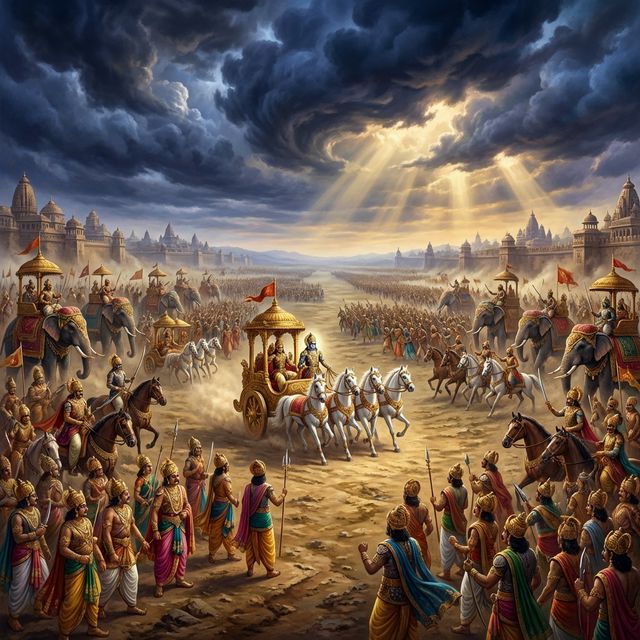
The One Who Walked Before the Car
Vyasa tells Arjuna whose lance was breaking the ranks in front of him
The Man Who Threw His Bow Down
Sanjaya was telling it in a hall to a blind king, and he had come to the end of the fifth day of Drona's command.
Drona was dead by then. His son had answered that death with two weapons in one afternoon, and the second of them, the Agneya, had burnt an entire akshauhini of the Pandava host down to shapes nobody could put a name to. Then Arjuna had called up the Brahma weapon, and the darkness went off the field like a cloth pulled away, and cool winds blew, and the two men everybody had given up for dead were standing there together, unwounded, like the sun and the moon in one firmament.
Ashwatthama looked at that for a while and could not carry it.
He reflected, O sire, on what had happened, and having reflected he became filled with anxiety and grief, and began to breathe long and hot sighs. Then he laid his bow aside on the terrace of his car, and came down off the car, and said out loud, "O fie, fie. Everything is untrue," and walked away from the fighting.
On the road he met Vyasa.
This was the son of Parasara, the compiler of the Vedas and the abode of Saraswati, the man who had fathered Dhritarashtra and Pandu and who walked in and out of that war as freely as a man walks through his own house. He was of the hue of a rain-charged cloud, and he was unstained by sin, and he was standing in the road.
Ashwatthama saluted him with his voice choked in grief, like one exceedingly cheerless.
"O sire, O sire, is this an illusion, or is it some caprice on the part of the weapon? I do not know what it is. Why has my weapon become fruitless? What breach was there in the method of invocation? Or is it something abnormal, or is it a victory over Nature, since they are yet alive? It seems that Time is irresistible. Neither Asuras nor Gandharvas nor Pisachas nor Rakshasas nor Yakshas nor birds nor human beings can venture to baffle this weapon when I shoot it. It has slain one akshauhini and been pacified. It is capable of slaying all creatures. For what reason then could it not slay Kesava and Arjuna, both of whom are endued with the attributes of humanity? Answer me truly, O holy one. I desire to hear all of it, in detail."
Sixty-Six Thousand Years on Air
"Highly significant is this matter that thou enquirest of me from surprise," Vyasa said. "I will tell thee everything. Listen attentively."
He did not begin with the weapon. He began with the man in the chariot the weapon had failed to burn, and he began a long way back.
"He that is called Narayana is older than the oldest ones. For accomplishing some purpose, that creator of the universe took his birth as the son of Dharma. On the mountain of Himavat he underwent the severest ascetic austerities."
Endued with mighty energy, resembling fire or the sun in splendour, he stood on that mountain with his arms upraised. He had eyes like the petals of lotuses. He emaciated himself there for sixty-six thousand years, subsisting the whole time upon air alone. Then, not having finished, he undertook austerities of another kind for twice that period, and with them he filled the whole space between earth and heaven with his energy.
And when by those austerities he had become like Brahma, he was given the thing he had been standing there for.
He beheld the Master, the Origin and the Guardian of the Universe, the Lord of all the gods, who is exceedingly difficult of being gazed at, who is minuter than the minutest and larger than the largest. He is called Rudra. He is called Hara and Sambhu. He has matted locks on his head. He is the infuser of life into every form and the first cause of all things mobile and immobile, irresistible, of frightful aspect, of fierce wrath and great soul, the All-destroyer, and of large heart.
He bore the celestial bow and a couple of quivers, and was cased in golden armour. He held Pinaka. He was armed with the thunderbolt, a blazing trident, a battle-axe, a mace and a large sword. His eyebrows were fair and his locks were matted, and he had the moon on his forehead, and he was clad in a tiger-skin. He was decked with beautiful angadas, and he had snakes for his sacred thread, and he was surrounded by numerous ghosts and spirits. He is the One. He is Water, Heaven, Sky, Earth, Sun, Moon, Wind and Fire, and he is the measure of the duration of the universe.
Persons of wicked behaviour never obtain a sight of that unborn one. Only Brahmanas of righteous conduct, when cleansed of their sins and freed from the control of grief, behold him, and they behold him with the mind's eye.
Narayana, standing on the mountain, saw him with both.
The Praise of the Three-Eyed One
Beholding that supreme abode of all splendour, that God with a garland of Akshas round his neck, Vasudeva was filled with a delight he sought to express by words, heart, understanding and body all at once.
He worshipped him first: the divine Lord, the giver of boons, that puissant one sporting with the fair-limbed Parvati and surrounded by his bands of ghosts and spirits. Then, having saluted Rudra, that destroyer of the Asura Andhaka, the lotus-eyed Narayana praised the Three-eyed one.
"O adorable one, O first of all the gods. The Prajapatis who are the regents of the world, who entered the earth, thy first work, and protected it, have all sprung from thee. Gods, Asuras, Nagas, Rakshasas, Pisachas, human beings, birds, Gandharvas, Yakshas and every other creature, with the entire universe, we know have all sprung from thee. Everything that is done to propitiate Indra, and Yama, and Varuna, and Kuvera, and the Pitris, and Tvashtri, and Soma, is really offered to thee.
"Form and light, sound and sky, wind and touch, taste and water, scent and earth, time, Brahma himself, the Vedas, the Brahmanas, and all these moving objects, have sprung from thee.
"Vapours rise from diverse receptacles of water and become rain-drops, and the drops fall upon the earth and are separated from one another. When the time of the universal dissolution comes, those individual drops, separated from one another, once more unite together and make the earth one vast expanse of water. He that is learned, observing in this way the origin and the destruction of all things, understands thy oneness.
"Two birds, which are Iswara and Jiva. Four Aswatthas with their wordy branches, which are the Vedas. The seven guardians, which are the five elements and the heart and the understanding. And the ten others that hold this city, which are the ten senses that constitute the body. All of them have been created by thee, and thou art separate from them and independent of them.
"The Past, the Future and the Present, over each of which none can have any sway, are from thee, and so are the seven worlds and this universe.
"I am thy devoted adorer. Be gracious unto me. Do not injure me by causing evil thoughts to penetrate my heart. Thou art the Soul of souls, incapable of being known. He that knows thee as the Universal Seed attains to Brahma. Desiring to pay thee respects, I am praising thee, endeavouring to ascertain thy real nature, O thou that art incapable of being understood by the very gods. Adored by me, grant me the boons I desire. Do not hide thyself in thy illusion."
Thou Shalt Be Superior to Myself
The blue-throated God, that wielder of Pinaka, then gave boons unto Vasudeva, who deserved them all.
"O Narayana, through my grace, amongst men, gods and Gandharvas, thou shalt be of immeasurable might and soul. Neither gods, nor Asuras, nor Uragas, nor Pisachas, nor Gandharvas, nor men, nor Rakshasas, nor birds, nor Nagas shall ever be able to bear thy prowess. Through my grace, none shall ever be able to cause thee pain by the weapon of thunderbolt, or with any object that is wet or dry, or with any mobile or immobile thing. Thou shalt be superior to myself, if thou ever goest to battle against me."
"Thus were these boons acquired by Sauri in days of yore," Vyasa said. "Even that God now walks the earth as Vasudeva, beguiling the universe by his illusion."
That was one of the two men in the chariot accounted for.
"From Narayana's asceticism was born a great Muni of the name of Nara, equal to Narayana himself. Know that Arjuna is none else than that Nara. Those two rishis, said to be older than the oldest gods, take their births in every Yuga for serving the purposes of the world."
Ashwatthama had shot the Agneya at two ascetics who are born in every age to do the world's work, and it had killed an akshauhini of other men instead. The rishi was not finished, and the last part of it was about him.
"Thyself also hast been born as a portion of Rudra, by virtue of all thy religious acts and as a consequence of high ascetic austerities, endued with great energy and wrath. Regarding the universe to consist only of Mahadeva, thou hadst emaciated thyself by diverse vows to gratify that God. Thou hast worshipped him with mantras, with homa and with offerings, and the great God became gratified with thee and granted thee numerous boons that thou hadst cherished in thy heart. Like them, in every Yuga, thou hast adored the great God in his Phallic form. Kesava is that devoted worshipper of Rudra who has sprung from Rudra himself, and the God having the bull for his mark cherishes greater regard for Kesava than for any other."
Hearing this, Drona's son bowed unto Rudra, and regarded Kesava as worthy of the highest regard. His soul came under his own control, and he became filled with a delight whose marks appeared on his body.
Then he bowed to the great rishi, and cast his eyes over the Kuru army, and gave the order to withdraw it for the night. Having fought for five days and caused an immense carnage, Drona had gone to the region of Brahma.
The Lance That Never Left His Hand
"Upon the slaughter of Drona by Prishata's son," Dhritarashtra said, "what did my sons and the Pandavas do next?"
Sanjaya said that after the rout of the Kuru army, Vyasa came that way again in the course of his wanderings, and this time it was Arjuna who stopped him.
Dhrishtadyumna had killed the preceptor. The field was quiet. And Arjuna, who had spent those days breaking a line that the greatest bowman alive had built to hold him, had a question he had been carrying for some time and had told nobody, because it is not the kind of thing a man says out loud while there is still fighting to do.
"O great rishi, while I was engaged in slaying the foe in battle with showers of bright shafts, I continually beheld before me, proceeding in advance of my car, a person of blazing hue, as if endued with the effulgence of fire. Wherever he went with his uplifted lance, all the hostile warriors were seen to break before him. Broken in reality by him, people regarded the foe to have been broken by me. Following in his wake, I only destroyed those already destroyed by him."
That is the whole of Arjuna's difficulty, and it is worth stopping on. He had won. Men had watched him win. Both armies had spent days describing what the wielder of Gandiva had done to the Kaurava divisions, and the wielder of Gandiva had been riding along behind somebody else the entire time, finishing off what was already finished.
Then he gave the details, the way a bowman would.
"O holy one, tell me who was that foremost of persons, armed with a lance, resembling the sun himself in energy, that was thus seen by me? He did not touch the earth with his feet. Nor did he hurl his lance even once. In consequence of his energy, thousands of lances issued out of that one lance held by him."
He had never hurled it. That was the part Arjuna could not get past. Whatever went ahead of his horses through the Kaurava host for those days had held one weapon in its hand and had never once let go of it, and everything in front of it had fallen anyway.
Thou Hast Seen Sankara
"Thou hast, O Arjuna, seen Sankara," Vyasa said.
"That first cause from which have sprung the Prajapatis, that puissant Being endued with great energy, he that is the embodiment of heaven and earth and sky, the Divine Lord, the protector of the universe, the great Master, the giver of boons, called also Isana. Seek the protection of that boon-giving Deity."
Then he named him properly, because with this God the naming is the teaching.
He is called Mahadeva, the Supreme Deity, of Supreme Soul, the one only Lord, with matted locks, the abode of auspiciousness. Of three eyes and mighty arms, he is called Rudra, with his locks tied in the shape of a crown and his body attired in skins. He is called Hara and Sthanu. He is the foremost of every being in the universe, the delighter of the universe and its supreme ruler. He is Yoga and the lord of Yoga. He is the Soul of knowledge, incapable of being compassed by knowledge, the highest of all knowledge, and he is unknowable. Through grace he gives to his worshippers the boons they desire.
And his companions, Vyasa said, are celestial beings of diverse forms. Some are dwarfs. Some have matted locks and some are bald. Some have short necks, some large stomachs, some huge bodies, some enormous strength, some long ears. All of them, O Partha, have deformed faces and mouths and legs, and strange attires. That Supreme Deity called Mahadeva is worshipped by followers that are even such.
"Even that Siva, O son, endued with such energy, proceeds through kindness in advance of thee."
Then the rishi asked Arjuna the practical question, which was the one the bowman had not thought to ask himself.
"In that fierce battle, O Partha, making the very hair stand on end, who else than the divine Maheswara, that foremost of all bowmen, could even in imagination venture to vanquish that force which was protected by such smiters as Ashwatthama and Karna and Kripa? None can venture to stay before the warrior that has Maheswara walking before him. There is no being in the three worlds that is equal to him. At the very scent of the enraged Mahadeva, foes in battle tremble and become senseless and fall in large numbers. Those men of pious conduct that devoutly worship the boon-giving, divine and auspicious Rudra obtain happiness here and attain to the highest state hereafter."
And then, because Arjuna had asked who it was, Vyasa began to answer that question in the only way it can be answered, which is at length.
Bow Down Unto Him That Is Peace
"O son of Kunti, bow down unto him that is peace."
Unto him called Rudra of the blue throat, exceedingly subtle and of great effulgence. Unto him called Kapardin, him that is terrible, him that is of tawny eyes, him that is boon-giving. Unto that great ordainer of red locks and righteous conduct. Unto him that always does auspicious acts. Unto him that is the embodiment of all sacred waters, and him that is the God of gods.
Him that has the mountains for his habitation. Him that is peace and him that is the protector. Him that has barks of trees for his attire, and whose arms are decked with ornaments of gold. Him that is the lord of the clouds and of all created beings, the lord of all trees and of all kine. Him who is the celestial generalissimo. Him who has the sacrificial ladle in his hand. Him who had the munja grass for his attire. Him who has a thousand heads, a thousand eyes, a thousand arms and a thousand legs.
"Seek the protection of that boon-giving Lord of the universe, the lord of Uma, that God of three eyes, that destroyer of Daksha's sacrifice."
He is the one whose navel is like that of a bull and who has the bull for his symbol, who is the lord of bulls and the bull of bulls, and who has the image of the bull on his banner. He can be approached by Yoga only. He owns very superior weapons, and he has Vishnu himself for his arrow. He wields the sword and the shield and the trident and the bow called Pinaka.
"Salutations," said Vyasa, "to that Lord of the celestials who has Vaisravana for his friend. Salutations ever to him of excellent vows. To him who has excellent bowmen for his companions. To that God with whom the bow is a favourite weapon, who is himself the shaft impelled by the bow, who is the bowstring and the bow, and the preceptor teaching the use of the bow. Salutations to him who destroyed the triple city. Salutations to him who slew the Asura Bhaga. Salutations to him who is the lord of the celestial Mothers and of those tribes of spirits known as the Ganas. Salutations ever to him who is the lord of kine and of sacrifices, and to him who is the destroyer of Surya's teeth."
Arjuna, who was a bowman by trade, had just been told that the God is the archer and the bow and the string and the arrow and the man who teaches the craft. He said nothing, and Vyasa went on to the deeds.
The Sacrifice and the Three Cities
"If Mahadeva becomes angry, neither gods nor Asuras nor Gandharvas nor Rakshasas, even if they hide themselves in deep oceans, can have peace."
In the days of yore, Daksha had collected the articles for a sacrifice, and Mahadeva destroyed that sacrifice in wrath. He shot an arrow from his bow and uttered terrible roars. The waters swelled up in agitation, the earth trembled, the mountains split, and the universe was enveloped in a thick darkness in which the splendour of all the luminaries, with the sun, was destroyed.
Surya was eating the principal oblation at the time. Sankara approached him, smiling, and tore out his teeth.
Then he aimed at the gods a shower of blazing arrows resembling flames of fire mixed with smoke, and the gods, bowing down unto Maheswara, assigned to Rudra a substantial share in every sacrifice and sought his protection in fright. His wrath being dispelled, the great God restored the sacrifice. To this day, Vyasa said, they are afraid of him.
The second deed was one Arjuna would have known by name.
The Asuras had three cities in heaven, each excellent and large. The golden city belonged to Kamalaksha, the silver to Tarakaksha, and the third, made of iron, had Vidyunmalin for its lord. With all his weapons Indra could make no impression on them. The afflicted gods went to Rudra and said that these dwellers of the triple city had received boons from Brahma and were afflicting the universe, and that none save he was competent to slay them; if he did it, the creatures slain in every sacrifice would be his.
So he built a chariot out of the world.
Gandhamadana and Vindhya were the two poles of it. The earth with her oceans and forests was the car. Sesha, that prince of snakes, was the axle. The moon and the sun were the two wheels, the Malaya mountains the yoke, and the great Takshaka the string that tied the yoke to the poles. The four Vedas were his four steeds and the supplementary Vedas their bridle-bits, and Gayatri and Savitri were the reins, and the syllable Om was the whip, and Brahma was the driver.
He made the Mandara mountains his bow, Vasuki the bowstring, Vishnu his shaft, Agni the arrow-head, Vayu the two wings of that shaft, Yama the feathers in its tail, and Meru the standard.
Then he stood still, in an array called after his own name, and did not move for a thousand years. When at last the three cities came together in the firmament, he pierced them with that one shaft of three knots, and the Danavas could not so much as look at it.
The Child on Parvati's Lap
While the triple city was burning, the goddess Parvati came to watch it, and she had a child on her lap.
It was a small boy with a bald head that had five clumps of hair on it. The goddess asked the deities who the child was, and none of them knew, and Sakra, through ill feeling, tried to strike that child with his thunderbolt. The divine lord Mahadeva, for the child was nobody else, smiled, and paralysed the arm of the enraged Sakra where it was.
So the king of the gods went to Brahma with his arm hanging useless and all the celestials behind him.
"Some wonderful creature, O Brahma, lying on the lap of Parvati in the form of a child, was beheld by us but not saluted. We have all been vanquished by him. We desire to ask thee who he may be. Indeed, that boy, without fighting, has with the greatest ease vanquished us all with Purandara at our head."
Brahma reflected for a moment and understood.
"That child is the divine Hara, the Lord of the entire mobile and immobile universe. There is nothing superior to Maheswara. That Being of immeasurable splendour who was beheld by you all with Uma had assumed the form of a child for Uma's sake. Let us all go unto him. Ye gods, ye could not recognise that master of the universe."
Then all the gods went with the Grandsire to the child endued with the effulgence of the morning sun, and Brahma adored him.
"Thou art Sacrifice, O lord. Thou art the stay and refuge of the universe. Thou art Bhava, thou art Mahadeva, thou art the abode of all things and the highest refuge. O lord of the past and the future, O protector of the universe, let Sakra, afflicted with thy wrath, have thy grace."
Maheswara was gratified. Desirous of extending his grace, he laughed aloud, and the celestials praised Uma and Rudra together, and the arm of the thunder-wielding Sakra returned to its natural state.
He is Rudra, he is Siva, he is Agni, he is everything, and he has knowledge of everything. He is Indra, he is the Wind, he is the twin Aswins, he is the lightning. He is the Moon, he is Isana, he is Surya, he is Varuna. He is Kala, he is Antaka, he is Mrityu, he is Yama.
Brahmanas versed in the Vedas say that he has two forms, the terrible and the auspicious. Half his soul is fire and half of it is the moon. With the auspicious half he practises Brahmacharya, and with the terrible half, as supreme Lord, he devours everything.
Go and Fight, Son of Kunti
The names came last, and Vyasa gave the reasons with them, because a name that is only a sound teaches nothing.
Since he always protects the creatures of the universe and sports with them, and since he is the lord of all creatures, he is called Pasupati. Since with respect to the past, the future and the present that God has many forms, he is called Vahurupa, the many-formed. Since three goddesses have recourse to him, Firmament and Water and Earth, he is called Tryamvaka. Since he always increases all kinds of wealth and wishes the good of mankind in all their acts, he is called Siva. Since he protects this vast universe, he is called Mahadeva. Since he is great and ancient and is the source of life and of its continuance, he is called Sthanu. Since the solar and lunar rays that appear in the world are spoken of as the hair of the Three-eyed one, he is called Vyomakesa. Since, afflicting Brahma and Indra and Varuna and Yama and Kuvera, he destroys them ultimately, he is called Hara. Since Maheswara, with his two eyes closed in meditation, created through sheer force of will a third eye on his forehead, he is called the Three-eyed. And since he burns, since he is fierce, and since he devours flesh and blood and marrow, he is for that reason called Rudra.
"All the attributes of that God are not capable of being enumerated by me," Vyasa said, "even if, O son of Pandu, I were to recite them continually for a thousand years."
Then he closed the circle and brought it back to the dust of that afternoon.
"Even such is the deity called Mahadeva, armed with Pinaka, who was seen by thee engaged in slaying thy foes in advance of thy car. After thou hadst vowed to slay the ruler of the Sindhus, Krishna showed thee this God in thy dream, sitting on the top of that foremost of mountains. It is he who gave thee those weapons with which thou didst slay the Danavas. The hymn approved of the Vedas and called Sata-Rudriya, in honour of that God of gods, has now, O Partha, been explained to thee. It is destructive of all sins, and competent to drive away all stains and to kill all sorrows and all fears."
And then the last of it, which is the only instruction the rishi actually gave.
"Go and fight, O son of Kunti. Defeat is not for thee, that hast Janardana on thy side for thy adviser and protector."
Having addressed Arjuna in these words, the son of Parasara went away to the place he had come from.
Dharma Lesson
Arjuna is told, at the height of his fame as a bowman, that the ranks he thought he was breaking had already been broken before he reached them. He is not humiliated by that, and he is not asked to stop fighting either; he is told to go back and fight, knowing it. The story sets a devotion that costs sixty-six thousand years on a mountain beside a devotion that consists of drawing a bow all day, and refuses to rank them, because the God who was praised on Himavat is the same one walking in the dust ahead of the horses. What is asked of a man is that he do his own work without mistaking it for the whole of the work being done.