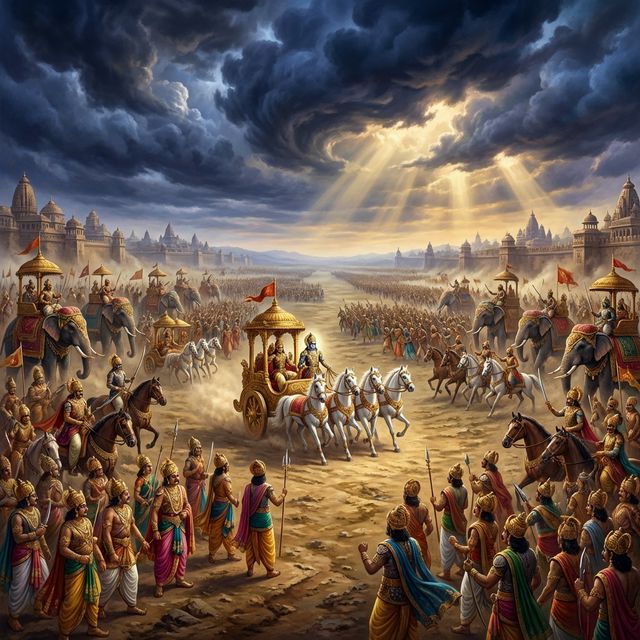
The King Falls Out of His Seat
Dhritarashtra hears that Drona is dead, faints in his hall, and wakes to ask who was supposed to be guarding him
The Question After the News
Sanjaya had finished. He had told the whole of it in one breath, the way a man tells the worst thing he has to say before his courage fails him: that Drona had slain more than two akshauhinis of brave and unreturning warriors, that he had scorched the world like the sun rising at the end of the yuga, and that at the last he had been slain by Dhrishtadyumna, and that when the preceptor fell there went up in the sky a cry of all creatures, a loud "O Fie!" resounding through heaven and earth and the space between them.
He was speaking in a hall in Hastinapura to a king who could not see him. Sanjaya was the son of Gavalgana, of the suta caste, charioteer and counsellor, and Vyasa had given him the sight by which he watched the field from a hundred and fifty miles away and reported it. For fifteen days he had been bringing this old man the deaths of his hopes one at a time.
Dhritarashtra did not ask what happened next. He asked how it could have happened at all.
"How did the Pandavas and the Srinjayas slay Drona in battle," he said, "Drona, who was so accomplished in weapons amongst all wielders of arms?"
Then the questions came out of him in the order a man asks them when he is looking for an accident to blame.
"Did his car break in course of the fight? Did his bow break while he was striking the foe? Or was Drona careless at the time when he met with his death-blow?"
Because there had to be a mechanical reason. A wheel, a string, a moment of inattention. Something that could be pointed at and understood. The alternative, which the old king would arrive at before he finished speaking, was that nothing had gone wrong at all, and that Drona had been killed simply because it was time for him to be killed.
"How, indeed, O child, could Prishata's son, the prince of the Panchalas, slay that hero incapable of being humiliated by enemies?"
Destiny Is Superior to Exertion
He went on describing the dead man, and the description was itself the argument.
Here was one who scattered thick showers of shafts furnished with wings of gold, endued with great lightness of hand, that foremost of Brahmanas who was accomplished in everything, acquainted with all modes of warfare, capable of shooting his shafts to a great distance, and self-restrained. Possessed of great skill in the use of weapons and armed with celestial weapons. A mighty warrior of unfading glory, who was always careful.
Always careful. Dhritarashtra put that word in deliberately, because it closed off the third of his own three explanations. Drona had not been careless. There was no lapse to find.
So he found the only thing that was left.
"It is plain, it seems to me, that destiny is superior to exertion, since even brave Drona hath been slain by the high-souled son of Prishata, that hero in whom were the four kinds of weapons. Alas, thou sayest that that Drona, that preceptor in bowmanship, is slain."
He tried to hold the picture of the man in front of him and could not put it down.
"Hearing of the slaughter of that hero who used to ride his bright car covered with tiger skins and adorned with pure gold, I cannot drive away my grief."
Then he said a thing about himself that nobody else in that hall would have dared to say about him.
"Without doubt, O Sanjaya, no one dies of grief caused by another's calamity, since, wretch that I am, I am yet alive although I have heard of Drona's death. Destiny I regard to be all powerful, exertion is fruitless. Surely, my heart, hard as it is, is made of adamant, since it breaketh not into a hundred pieces, although I have heard of Drona's death."
It is the complaint of a man who has discovered that grief does not kill, and who resents the discovery. He had said something very like it about Bhishma. He would say it again about Karna. Each time he was a little more certain that the fault of surviving was his own.
The Drying Up of the Ocean
The king reached for images large enough to hold the loss, and each one he chose was a thing that cannot happen.
"He who was waited upon by Brahmanas and princes desirous of instruction in the Vedas and divination and bowmanship, alas, how could he be taken away by Death? I cannot brook the overthrow of Drona, which is even like the drying up of the ocean, or the removal of Meru from its site, or the fall of the sun from the firmament."
Not a defeat. A violation of the order of the world. The ocean does not dry. The mountain at the centre of the earth does not move. The sun does not come down out of the sky. Dhritarashtra was saying that he had lived to see one of those.
Then he began the list of what the man had been, and it is worth noticing what he praises.
"He was a restrainer of the wicked and a protector of the righteous."
That is a strange sentence in the mouth of the father of Duryodhana, and the king knew it, because he went straight from it to the thing that made it unbearable.
"That scorcher of foes who hath given up his life for the wretched Duryodhana, upon whose prowess rested that hope of victory which my wicked sons entertained, who was equal to Brihaspati or Usanas himself in intelligence, alas, how was he slain?"
Brihaspati is the preceptor of the gods. Usanas, whom the epic also calls Shukra, is the preceptor of the asuras. Between them they are the whole of teaching, on both sides of every war ever fought, and Dhritarashtra reached for both names at once because one would not do.
And in the same breath he called his own son wretched, and his other sons wicked, and admitted that Drona had spent his life on them anyway.
A blind man in a hall, with the news three hours old, telling the truth about his children for as long as the shock lasted.
The Red Steeds of the Sindhu Breed
Then, because he could not get at the man, he began to interrogate the horses.
It is the oddest passage in the whole lament and the most human. Dhritarashtra had never seen Drona's chariot. He had heard it described, year after year, by people who had, and he had built it in his head out of their words, and now he took the thing apart piece by piece and asked whether each piece had failed.
"His large steeds of red hue, covered with net of gold, fleet as the wind and incapable of being struck with any weapon in battle, endued with great strength, neighing cheerfully, well-trained and of the Sindhu breed, yoked unto his car and drawing the vehicle excellently, always persevering in the midst of battle, did they become weak and faint?"
He was not finished with them.
"Coolly bearing in battle the roar of elephants, while those huge creatures trumpeted at the blare of conchs and the beat of drums, unmoved by the twang of bows and showers of arrows and other weapons, foreboding the defeat of foes by their very appearance, never drawing long breaths in consequence of toil, above all fatigue and pain, how were those fleet steeds that drew the car of Bharadwaja's son soon overpowered?"
And then, having asked it, he answered himself twice over, insisting on the horses as though Sanjaya had contradicted him.
"Even such were the steeds yoked unto his golden car. Even such were the steeds yoked thereto by that foremost of human heroes."
"Mounted on his own excellent car decked with pure gold, why, O son, could he not cross the sea of the Pandava army?"
The sea of the Pandava army. That is the first time in the speech that the king allows the enemy to be a size rather than a name. He had been asking what broke. He was beginning to suspect that nothing broke, and that the ocean was simply wider than the horses were fast.
Ants Pressing Upon a Snake
Having failed to find an accident, he went looking for a crime.
"What feat were achieved in battle by Bharadwaja's son, that warrior who always drew tears from other heroes, and upon whose knowledge of weapons all the bowmen of the world rely? Firmly adhering to truth, and endued with great might, what, indeed, did Drona do in battle? Who were those car-warriors that encountered that achiever of fierce deeds, who resembled Sakra himself in heaven? Did the Pandavas fly away beholding him of the golden car?"
Then he reconstructed it, and his reconstruction is close enough to what happened that it is uncomfortable to read.
"Or did king Yudhishthira the just, with his younger brothers, and having the prince of Panchala for his binding chord, attack Drona, surrounding him with his troops on all sides? Verily, Partha must have, with his straight shafts, checked all the other car-warriors, and then Prishata's son of sinful deeds must have surrounded Drona. I do not see any other warrior, save the fierce Dhrishtadyumna protected by Arjuna, who could have compassed the death of that mighty hero."
His binding chord. The king's word for Dhrishtadyumna is the word for the rope that holds a sacrificial animal, and he means that Yudhishthira brought the rope and Arjuna kept the field clear while it was used.
"It seems that when those heroes, the Kekayas, the Chedis, the Karushas, the Matsyas, and the other kings, surrounding the preceptor, pressed him exceedingly like ants pressing upon a snake while he was engaged in some difficult feat, the wretched Dhrishtadyumna must have slain him then. This is what I think."
Ants on a snake. It is the picture of a thing killed by number rather than by strength, and it is the nearest the old king came to naming what actually happened at that hour of the fifteenth day, which was not a duel and not an accident, but a lie told to an honest man and a sword brought up while his hands were empty.
The Brahmana at the Edge of a Weapon
Then Dhritarashtra said the thing that had been under the whole speech, which is that Drona should never have been on that field at all.
"He who, having studied the four Vedas with their branches and the histories forming the fifth, became the refuge of the Brahmanas as the ocean is of rivers, that scorcher of foes who lived both as a Brahmana and as a Kshatriya, alas, how could that Brahmana, reverend in years, meet with his end at the edge of a weapon?"
A Brahmana who lived as a Kshatriya. The double life is stated without excuse and without apology, because the whole court knew the history: the poor teacher, the old friendship with Drupada that went wrong, the half of a kingdom taken by force through his students, and the pupils of both houses who had learned everything they knew from him and were now using it.
And then a sentence that costs the speaker something.
"Of a proud spirit, he was yet often humiliated and had to suffer pain on my account. However undeserving of it, he yet attained at the hands of Kunti's son the fruit of his own conduct."
Read the two halves against each other. The humiliations were mine, says the king. The end was his own doing. Dhritarashtra takes the shame of the years in Hastinapura onto himself and hands the death back to Drona, and both halves are true, and the second half is the reason the first half never mattered.
"He upon whose feats depend all wielders of bows in the world, alas, how could that hero, firmly adhering to truth and possessed of great skill, be slain by persons desirous of affluence? Foremost in the world like Sakra himself in heaven, alas, how could he be slain by the Parthas, like the whale by the smaller fish?"
"He whom, while alive, these two sounds never left: the sound of the Vedas by those desirous of Vedic lore, and the twang of bows caused by those desirous of skill in bowmanship."
Two sounds, in one house, for a lifetime. That is Drona's whole biography in a line, and the old king found it while he was grieving.
Who Stood at the Wheels
Then he turned from the dead man to the living, and asked the question that would decide who was to be blamed in his own camp.
"How could Prishata's son, in the sight of the foremost of men, slay in battle that invincible warrior whose might was never humiliated and whose fame was never tarnished? Who were they that fought in Drona's van, protecting him, standing by his side? Who proceeded in his rear and obtained that end which is so difficult of attainment? Who were those high-souled warriors that protected the right and the left wheels of Drona?"
The van, the rear, the right wheel, the left wheel. That is not a poetic sequence. It is the standing order for the protection of a commander, four assignments given to four named men every morning of a war, and Dhritarashtra was going down the roster in his mind and asking who had been where.
"Who were in the van of that hero while he struggled in battle? Who were they that, reckless of their lives on that occasion, met with death which stood face to face with them? Who were those heroes that went in the last journey in Drona's battle?"
And then the accusation, put as a question, which is how a king puts an accusation when he is afraid of the answer.
"Did any of those Kshatriyas that were assigned for Drona's protection, proving false, abandon that hero in battle? Was he slain by the foe after such desertion and while alone? Drona would never, from fear, show his back in battle, however great the danger. How then was he slain by the foe? Even in great distress, O Sanjaya, an illustrious person should do this: put forth his prowess according to the measure of his might. All this was in Drona."
Then the voice stopped.
"O child, I am losing my senses. Let this discourse be suspended for a while. After regaining my senses I will once more ask thee, O Sanjaya."
He had asked to be given a moment. He did not get one.
The Women Who Lifted Him
Here Sanjaya is not the narrator. The frame opens outward for a moment and it is Vaishampayana, reciting the whole epic years later to king Janamejaya, who tells what the blind man's hall looked like from outside.
"Having addressed the suta's son in this way, Dhritarashtra, afflicted with excessive grief of heart and hopeless of his son's victory, fell down on the ground."
Not a faint that was noticed after the fact. He was in the middle of speaking, and then he was on the floor.
"Beholding him deprived of his senses and fallen down, his attendants sprinkled him with perfumed and cold water, fanning him the while. Seeing him fallen, the Bharata ladies, O king, surrounded him on all sides and gently rubbed him with their hands. And slowly raising the king from the ground, those royal ladies, their voices choked with tears, seated him on his seat."
The women of the house came in and took hold of him. They chafed his hands and his arms, and they lifted him between them off the ground, and they were crying while they did it, and they put him back on the seat he had fallen out of. Nobody in that room needed to be told what the news was. The women who lifted him had sons on that field, and they knew what it meant that Drona was gone before Karna had even been given the command.
"Seated, the king continued to be under the influence of that swoon. And he remained perfectly motionless, while they fanned him standing around."
That is the picture the epic stops on. A circle of weeping women fanning a motionless blind man on a throne, in a palace, while a hundred and fifty miles away the field is being cleared for the sixteenth morning.
"And a tremour then passed over the monarch's body and he slowly regained his senses. And once more he began to interrogate Gavalgana's son of the suta caste about the incidents as they occurred in the battle."
He had come back only to ask again.
Who Surrounded the Sons of Pandu
What came out of him the second time was not a lament. It was a roll call, and every entry in it has the same shape: here is a Pandava warrior, here is everything that is terrible about him, and now tell me the name of the man of mine who stood in front of him.
He began with Yudhishthira, whom he calls Ajatasatru, the one with no enemy born.
"He who, like the risen sun, dispelleth darkness by his own light, who rusheth against a foe as a swift and angry elephant with rent temples, O, what warriors of my army resisted that Ajatasatru as he came, for keeping him away from Drona? That hero who, unassisted by any one, can consume the entire host of Duryodhana by means of his terrible glances alone, that slayer by his sight, O, who were those heroes of my army that surrounded that warrior?"
Then Bhima, who in strength is equal to ten thousand elephants, and who came upon Drona with great celerity: what brave combatants of my army surrounded him as he rushed upon my host?
Then Arjuna, and here the sentence runs away from the speaker and does not come back for half a page. Vibhatsu, looking like a mass of clouds, emitting thunderbolts like the clouds themselves, shooting showers of arrows like Indra pouring rain, making all the points of the compass resound with the slaps of his palms and the rattle of his car-wheels, whose bow was like the lightning's flash, who like Death himself bathes all the points of the compass with human blood in profusion, who pours on my warriors headed by Duryodhana shafts whetted on stone and furnished with vultures' feathers.
"When that hero of great intelligence came upon you, what became the state of your mind? When that warrior having the huge ape on his banner came, obstructing the welkin with dense showers of arrows, what became the state of your mind at sight of that Partha?"
Then he stopped asking about his own men and stated a fact.
"My troops are incapable of bearing the impetus of that warrior having white steeds yoked unto his car and the twang of Gandiva, that resembles the roll of the very clouds. That car which has Vishnu himself for its driver and Dhananjaya for its warrior, that car I regard to be incapable of being vanquished by the very gods and the Asuras united together."
"In that battle in which the troops trembled and even heroes were struck with fear, who were they that did not desert Drona, and who were those cowards that abandoned him from fear?"
The Whole List, and the Name at the End of It
Then he went through the rest of the Pandava host, name by name, a blind man reciting from memory an army he had never seen.
Nakula, delicate and young and brave and of a very handsome countenance, rushing at Drona with a loud noise: what heroes of my army surrounded him? Sahadeva, who resembles an angry snake of virulent poison, observant of laudable vows and never vanquished: what heroes surrounded him?
Satyaki of the Satwata race, in whom are always truth and firmness and bravery and brahmacharya, who through Arjuna's instruction has become foremost in the use of arrows and is regarded as Krishna's second self: what warrior of my army resisted him?
Uttamaujas of the Panchalas, ever engaged in the welfare of Arjuna, born only for my evil. Dhrishtaketu, the one man among the Chedis who deserted them for the Pandavas. Ketumat, who slew prince Durjaya in Girivraja. Shikhandi, son of Yajnasena, who knows in his own person the merits and demerits of manhood and of womanhood, and who became the cause of Bhishma's death. Abhimanyu, whom the old king still names among the living. The sons of Draupadi, rushing at Drona like rivers rushing towards the sea. The four sons of Dhrishtadyumna, children who gave up all sport for twelve years and waited upon Bhishma for the sake of weapons. Chekitana, whom the Vrishnis reckoned superior to a hundred car-warriors. The five Kekaya brothers, red of mail and weapon and banner. Yuyutsu, his own son. Dhrishtadyumna, the chief counsellor of the Pandavas, who was created for Drona's destruction. Saivya, grandson of Usinara's son. Virata of the Matsyas. And Ghatotkacha, born of Bhima in the course of a single day, that thorn in the side of my sons, of whom I entertain very great fears.
Then he put the list down.
"What, O Srinjaya, can remain unconquered by them for whose sake these and many others are prepared to lay down their lives in battle? How can the sons of Pritha meet with defeat, they that have the greatest of all beings, the wielder of the bow called Sarnga, for their refuge and benefactor?"
"Vasudeva is, indeed, the great Master of all the worlds, the Lord of all, and Eternal. Of celestial soul and infinite power, Narayana is the refuge of men in battle. The wise recite his celestial feats. I also will recite them with devotion, for recovering my firmness."
He had begun by asking how a wheel could have broken. He ended by naming the reason the war was lost, and then asked only to be allowed to go on speaking of Krishna until he could sit upright again.
Dharma Lesson
Dhritarashtra asks after the wheel, the bowstring, the horses, the moment of carelessness, because a mechanical failure could have been prevented and a destiny cannot. When every part of the chariot proves sound he is left with the answer he already knew, which is that the war he permitted has been eating the men he loved in the order of their greatness. Grief that spends itself hunting for a smaller cause is grief refusing to look at itself. He recovers only when he stops asking who failed Drona and begins naming, out loud, what the other side actually had.