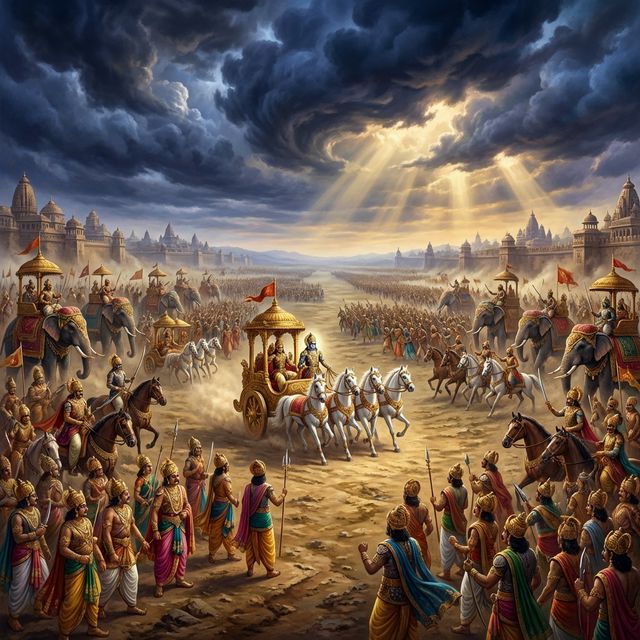
The Mouth of the Garuda
Drona draws his host as a bird and comes for Yudhishthira on the twelfth morning
I Am Thine
The eleventh day had ended with a promise still standing. Bhishma was down on his bed of arrows, Drona had the command of the Kaurava host, and Duryodhana had asked his old preceptor for one thing only: bring me Yudhishthira alive. Drona had answered that it could be done, and had added the condition that made the whole rest of the war: it could be done on any day when Arjuna was not on the field.
So Drona spent a night arranging for Arjuna not to be on the field.
"Having passed the night," Sanjaya said, telling it afterwards to a blind king in a hall at Hastinapura, "that mighty car-warrior, Bharadwaja's son, addressed Suyodhana, saying, I am thine. I have made arrangements for Partha's encounter with the Samsaptakas."
Two sentences at dawn, and the twelfth day was decided.
The Samsaptakas were the sworn ones, the warriors of Trigarta under Susharma who had stood at the fire and taken an oath that they would kill Arjuna or not come back, and who had discovered the one weakness in the greatest bowman alive. They did not have to defeat him. They only had to call him. Arjuna had never in his life refused a man who challenged him by name, and they were willing to spend themselves by thousands on that fact.
They called him again that morning, from the far southern end of the field, and Arjuna turned to Vasudeva and asked to be driven towards them, and the white horses took him away out of sight.
That left the thing Drona had been waiting for. At the head of his troops arrayed for battle, the preceptor proceeded, O chief of the Bharatas, for the seizing of king Yudhishthira the just.
The eldest son of Pandu was going to spend that day being hunted by his own teacher, and the only man on earth who could reliably stop that teacher was a long way off, killing volunteers.
The Bird Drawn Up on the Field
Drona arrayed his forces that morning in the form of a Garuda, the great bird that carries Vishnu, and it was drawn out on the plain limb by limb so that every man in it knew what part of the creature he was.
In the mouth was Drona himself.
The head was king Duryodhana, surrounded by his uterine brothers. Kritavarman and the illustrious Kripa formed the two eyes. At the neck stood Bhutasarman and Kshemasarman and the valiant Karakaksha, and with them the Kalingas, the Singhalas, the Easterners, the Sudras, the Abhiras, the Daserakas, the Sakas, the Yavanas, the Kamvojas, the Hangsapadas, the Surasenas, the Daradas, the Madras and the Kalikeyas, with hundreds and thousands of elephants and steeds and cars and foot-soldiers behind them.
Bhurisravas and Shalya and Somadatta and Valhika took the right wing with a full akshauhini at their backs. Vinda and Anuvinda of Avanti and Sudakshina the ruler of the Kamvojas took the left, stationed at the head of Drona's son Ashwatthama. In the back were the Amvashthas and the Magadhas and the Paundras, the Madrakas, the Gandharas, the Sakunas, the mountaineers and the Vasatis. In the tail stood Vikartana's son Karna with his sons and kinsmen and friends and a host raised out of many realms.
And in the heart of the bird, keeping the region of Brahma before their eyes, which is to say having already settled with themselves that they would not be coming out, stood Jayadratha and Bhimaratha and Sampati, the Jayas and the Bhojas, Bhuminjaya and Vrisha and Kratha, and the mighty ruler of the Nishadhas.
That array, in consequence of its foot-soldiers and steeds and cars and elephants, seemed to surge like the tempest-tossed ocean as it advanced, and warriors kept starting out from its wings and sides like roaring clouds charged with lightning rushing from every quarter of the sky in summer.
In the midst of it Bhagadatta, the old king of Pragjyotisha in the far east, sat on his war elephant like the rising sun. He wore garlands of flowers and a white umbrella was held over his head, so that he looked like the full moon in conjunction with the constellation Krittika, and his elephant, blind with the wine-like exudation running down its temples, looked like a mass of black antimony, like a huge mountain washed by mighty clouds.
Yudhishthira looked at all of this and drew his own troops up in a semi-circle facing it, which is the shape a man makes when he expects to be closed on from both ends.
Let Me Not Be Taken
Then Yudhishthira, beholding that superhuman array incapable of being vanquished by foes in battle, turned to the son of Prishata's line and said the thing a king does not usually say out loud.
"O lord, O thou that ownest steeds white as pigeons, let such measures be adopted that I may not be taken a prisoner by the Brahmana."
Not killed. Taken. That was the shape of the danger, and everyone in the Pandava host understood it. Drona had no wish to burn Yudhishthira out of existence; he wanted him whole and in a tent, because a captured king ends a war without another arrow being shot, and because Duryodhana had asked for him that way.
The man Yudhishthira asked was Dhrishtadyumna, son of Drupada, the prince who had come out of a sacrificial fire in Panchala for one purpose, born with armour on and a bow in his hand, and whose purpose was the death of Drona. He was the commander of the Pandava army. He had also, at the beginning of all this, formally taken Drona as the victim allotted to his own share.
"O thou of excellent vows," Dhrishtadyumna said, "never shalt thou be placed under the power of Drona, however much may he strive. Even I shall check Drona today with all his followers. As long as I am alive, O thou of Kuru's race, it behoveth thee not to feel any anxiety. Under no circumstances will Drona be able to vanquish me in battle."
Having said it, the mighty son of Drupada, whose horses were the colour of pigeons, scattered his shafts and rushed at Drona himself.
And Drona, who had faced every great bowman on that field without changing colour, looked up and saw that particular man coming at him out of the dust.
Beholding that evil omen in the form of Dhrishtadyumna stationed before him, Sanjaya said, Drona soon became exceedingly cheerless.
He had known since the fire in Drupada's courtyard what that child had been made for. Here it was, on its own feet, with a bow.
Durmukha Steps In
It was one of Dhritarashtra's sons who saw the preceptor's face and understood what he was looking at.
Durmukha was not among the famous Kaurava brothers. He appears in the war the way most of the hundred appear, as a name that comes forward at a bad moment and does something creditable and is not heard of again for a while. Desirous of doing what was agreeable to Drona, he put his car between the preceptor and the man born to kill him.
Then a terrible and fierce battle took place, O Bharata, between the brave son of Prishata and thy son Durmukha.
Dhrishtadyumna tried to fight both of them at once. He covered Durmukha quickly with a shower of arrows and at the same time checked Bharadwaja's son with a thick arrowy downpour, holding the son off with one hand and the father-figure of the whole Kuru host off with the other. For a few moments it worked. Beholding Drona checked, Durmukha rushed in closer and confounded the Panchala prince with clouds of arrows of every kind, and the two of them locked together, and neither could leave.
That was the whole of Durmukha's service, and it was enough. While the prince of the Panchalas and that foremost one of Kuru's race were thus engaged with each other, Drona was free, and Drona used it.
He consumed many sections of Yudhishthira's host. As a mass of clouds is dispersed in different directions by the wind, so was Yudhishthira's host, in many parts of the field, scattered by Drona.
The vow that had been made to the king a quarter of an hour earlier was already, through no fault of the man who made it, impossible to keep. Dhrishtadyumna had promised to check Drona, and he had been checked instead, by a brother nobody counted, and the preceptor was loose in the middle of the Pandava line with nothing in front of him.
For only a short while after that did the battle look like an ordinary combat.
Fought by Watchwords
Then, O king, it became an encounter of infuriated persons in which no consideration was shown for anybody.
The combatants could no longer distinguish their own men from the foe. The battle raged on with the warriors guided by inferences and watch-words, which is to say that by mid-morning men were killing on the strength of a password and a guess. Upon the gems on their headgears, upon their necklaces and their other ornaments, upon their coats of mail, rays of light like those of the sun seemed to fall and play, and the cars and elephants and steeds with their streaming banners looked like masses of cloud with flocks of cranes flying beneath them.
Men slew men. Steeds of fiery mettle slew steeds. Car-warriors slew car-warriors and elephants slew elephants.
The worst of it was among the great beasts. Elephants rushed together and rubbed their bodies against hostile compeers and tore at one another with their tusks, and from the friction of countless tusks against tusks fires mixed with smoke were generated on that field. Shorn of the standards on their backs, those elephants with fire at their tusks looked like clouds in the welkin charged with lightning. Some, wounded with lances and shafts, became panic-stricken and left the field crying out. Some, struck by others of their own kind, uttered yells of distress that sounded like the roll of the all-destroying clouds at the end of the Yuga. Some, turned back by huge antagonists, were driven at the charge again by sharp hooks, and crushed whatever came in their way without caring whose it was. Drivers, shot through the breast with broad-headed shafts, fell from their beasts with the lances and hooks loosening out of their hands, and the riderless animals wandered singly in all directions like clouds torn away from mightier masses, and then fell down where they collided.
The earth, suddenly struck by those falling bodies, huge as hills, trembled and made a sound.
Covered with the bodies of elephants and steeds and car-warriors, the ground became miry with flesh and blood, and men sank ankle-deep in the gory mire and looked like tall trees whose lower parts have been swallowed up in a blazing forest fire. Robes and mail and umbrellas and standards were all dyed one colour. And there father slew his son, and son slew his sire, for the battle was exceedingly fierce and nothing could be distinguished.
In that fierce and awful battle, confounding the senses of his foes, Drona at last rushed at Yudhishthira.
The River Drona Made
He did not reach him. Two men stood in front of the preceptor that morning and both of them paid the price of it.
Satyajit of Panchala, whose prowess was incapable of being baffled, came in first and fought Drona as Indra fought Vali, cutting his standard, striking his charioteer senseless with five arrows fatal as snake-poison, piercing his horses and both his Parshni drivers, wheeling at the head of his troops in a circle while the Pandavas shouted and waved their garments in the air. Vrika, coming to help him, pierced Drona in the centre of the chest with sixty arrows, and that feat, said Sanjaya, seemed highly wonderful. Then Drona opened his eyes wide and mustered all his energy, and after that it took him six shafts to kill Vrika with his charioteer and his steeds, and one crescent-shaped arrow to take off Satyajit's head.
Yudhishthira, from fear of Drona, fled away, borne by fleet horses.
Satanika, the younger brother of the ruler of the Matsyas, came in next, put six shafts bright as sunbeams into Drona and his driver and his horses, and shouted. Drona cut his head, decked with earrings, from his trunk with an arrow sharp as a razor, and the Matsyas ran.
After that there was nothing organised in front of him at all, and the preceptor of both armies, seventy years old and in a golden car, began to do to the Pandava host what fire does to heaped cotton.
The twang of his bowstring was heard in every direction at once. His gold-decked bow was seen in all quarters like lightning inside cloud, and the beautiful altar on his banner went by like a crest of Himavat.
And Sanjaya, who was watching all this with the eyes Vyasa had given him, said that Drona caused a river to flow there.
Coats of mail formed its waves and standards its eddies. Elephants and horses were its alligators and swords were its fishes. The bones of brave warriors made its pebbles, drums and cymbals its tortoises, shields and armour its boats, and the hair of warriors its floating moss and weeds. Arrows were its wavelets and bows its current, and the arms of men were the snakes in it. Heads made its stones and thighs its fishes, maces were the rafts by which some tried to cross, head-gear was the foam on its surface, and blood and flesh were the mire at its bottom. Standards stood along it like trees on a bank.
Thousands of kshatriyas sank in that river, and it ran towards the abode of Yama.
Nine Arrows for King Kshema
Then the Pandava warriors stopped trying to hold a line and simply went at him. Headed by Kunti's son, rushing at that mighty car-warrior who was consuming their divisions like Death himself, they surrounded him on all sides, and the kings and princes of the Kaurava army came up with weapons raised to keep them off him, and the fight closed into a ring.
Sanjaya counted the arrows, because that is how the honour of it was reckoned.
Shikhandin pierced Drona with five straight arrows. Kshatradharman with twenty. Vasudeva with five, Uttamaujas with three, Kshatradeva with five. Satyaki pierced him with a hundred, and Yudhamanyu with eight. Yudhishthira put in a dozen shafts. Dhrishtadyumna, who had got free of Durmukha by then, put in ten. Chekitana put in three.
Ten of the best bowmen in the world, and the old man in the middle of them was not slowed.
Drona, of unbaffled aim, resembling an elephant with rent temples, got clear over the whole car-division of the Pandavas and overthrew Dridhasena as he went.
And then, approaching king Kshema, who was battling fearlessly, he struck him with nine arrows, and Kshema, deprived of life, fell down from his car.
That is the entire record of that king. He is named once, he is described in three words as fighting without fear, he is given nine arrows, and he is gone. He had brought his men to that field from some kingdom the epic does not stop to identify, and he did not run when the river came at him, and Sanjaya, listing the dead of a single morning for a blind man who wanted to hear about his own sons, gave him one line.
Getting then into the very midst of the hostile troops, Drona careered in all directions, protecting others but himself in no need of protection.
The Prince Who Fell Like a Luminary
Then he paid the ring back, name by name, in the same currency they had used on him.
He pierced Shikhandin with twelve arrows and Uttamaujas with twenty. He despatched Vasudeva, a Panchala of that name and no kin to Krishna, to the abode of Yama with a single broad-headed shaft. He pierced Kshemavarman with eighty arrows and Sudakshina with six and twenty. He felled Kshatradeva out of his niche in the car with a broad-headed arrow. He put sixty-four arrows into Yudhamanyu and thirty into Satyaki.
Then, having cleared his own circumference, Drona of the golden car turned and went for Yudhishthira again, and Yudhishthira, that best of kings, again fled away from his preceptor, borne by his fleet steeds. Twice in one morning the eldest Pandava had been made to run in front of his own army, and both times it was the right thing to do, and both times everyone watched him do it.
Then a prince of the Panchalas rushed at Drona.
Sanjaya does not give him a name. He gives him a lineage and a death. Drona slew the prince, cutting off his bow, and felling his steeds and his charioteer along with him, and deprived of life the prince fell down on the earth from his car like a luminary loosened from the firmament.
Upon the fall of that illustrious prince of the Panchalas, loud cries were heard on that part of the field, and they were not cries of grief.
"Slay Drona! Slay Drona!"
It was the first time that day the whole shout had gone up together, and it was the shout that would eventually be answered, three days later, by a lie about an elephant. On the twelfth morning it answered nothing. The mighty Drona began to crush and mangle the Panchalas, the Matsyas, the Kaikeyas, the Srinjayas and the Pandavas, all of them excited with rage and none of them able to stand, and supported by the Kurus he vanquished Satyaki, and Chekitana's son, and Senavindu, and Suvarchas, and numerous other kings besides.
The Kaurava warriors, having obtained the victory, killed the Pandava soldiers as they fled in every direction. And the Panchalas and the Kaikeyas and the Matsyas, slaughtered on all sides like the Danavas by Indra, began to tremble.
The King Laughing in the Middle of His Army
In the hall at Hastinapura the blind king interrupted his charioteer here, because something in the account had reached him.
"When the Pandavas were broken by Bharadwaja's son in that dreadful battle," Dhritarashtra said, "and the Panchalas also, was there anybody that approached Drona for battle? Beholding him stationed in battle like a yawning tiger, or an elephant with rent temples, ready to lay down his life, well-armed, conversant with all modes of fight, that great bowman, that tiger among men, grateful, devoted to truth, ever desirous of benefiting Duryodhana, beholding him at the head of his troops, was there no man that could approach him with a laudable determination for battle, a determination that enhances the renown of kshatriyas, that mean-spirited persons can never form? Tell me, Sanjaya, who were those heroes."
Sanjaya said that the Pandavas and the Panchalas and the Matsyas and the Srinjayas and the Chedis and the Kalikeyas were at that hour going off the field like vessels sent adrift by the waves of a tempest-tossed ocean, with the Kauravas after them on every side, roaring, sounding every instrument they had.
And that in the middle of his own forces, encompassed by his relatives and his kinsmen, Duryodhana was filled with joy, and laughed while he spoke to Karna.
"Behold, O son of Radha, the Panchalas broken by that firm bowman with his shafts, like a herd of wild deer frightened by a lion. These, I think, will not come to battle again. They have been broken by Drona like mighty trees by the tempest. Afflicted by that high-souled warrior with shafts winged with gold, they are fleeing away, and no two persons of them are together. Indeed, they seem to be dragged in eddies all over the field. Checked by the Kauravas and by the high-souled Drona, they are huddling close to one another like a herd of elephants in the midst of a conflagration. Like blossoming trees penetrated by flights of bees, these warriors, pierced with the sharp shafts of Drona, are huddling together as they fly.
"And there, Karna, is the thing that delights me most. The wrathful Bhima, abandoned by the Pandavas and the Srinjayas, surrounded by my warriors. It is evident that wicked wight beholdeth the world today to be full of Drona. Without doubt that son of Pandu hath today become hopeless of life and kingdom."
Karna had been standing in the tail of the Garuda all morning, watching the same field.
What Karna Saw Instead
"That mighty-armed warrior will not certainly abandon the battle as long as he is alive," Karna said. "Nor will he, O tiger among men, brook these leonine shouts of ours. Nor will the Pandavas, I think, be defeated in battle."
Then he told the king why, and the reasons he gave were not military.
"They are brave, endued with great might, accomplished in weapons, and difficult of being resisted. Recollecting the woes caused them by our attempts at poisoning and burning them, and the woes that arose from the match at dice, bearing in mind also their exile in the woods, the Pandavas, I think, will not abandon the fight."
That is the whole argument, and it is strange coming from the man who did as much as anybody to put those memories there. Karna was not counting cars. He was counting the number of things the sons of Pandu had to remember, and he had concluded that an army with that much stored up in it does not stop because it has had a bad morning.
"The mighty-armed Vrikodara of immeasurable energy hath already turned back for the fight. The son of Kunti will certainly slay many of our foremost car-warriors. With sword and bow and dart, with steeds and elephants and men and cars, with his mace made of iron, he will slay crowds of our soldiers. Other car-warriors, headed by Satyajit, together with the Panchalas, the Kekayas, the Matsyas, and especially the Pandavas, are following him. They are all brave, and possessed of great might and prowess. Mighty car-warriors, they are again led by Bhima in wrath.
"Those bulls of the Bharata race, surrounding Vrikodara on all sides like the clouds surrounding the sun, begin to approach Drona from all sides. Closely intent upon one object, these will certainly afflict unprotected Drona, like flights of insects, on the point of death, striking a blazing lamp. Accomplished in weapons, they are certainly competent to resist him. Heavy is the burthen, I think, that now rests on Bharadwaja's son.
"Let us then quickly go to the spot where Drona is. Let not those of regulated vows slay him like wolves slaying a mighty elephant."
Duryodhana stopped laughing and went. Accompanied by his brothers, he proceeded towards Drona's car, and behind them, said Sanjaya, the noise was deafening: the Pandava warriors coming back onto the field they had just been driven off, on cars drawn by excellent steeds of every hue, all of them actuated by the desire of slaying one man.
The morning had belonged to Drona. Karna was the only man on that side who had noticed that a morning is not a day.
Dharma Lesson
Duryodhana reads a rout as a verdict, because he has always mistaken the state of a field for the state of the men on it. Karna, who has spent his life being hated and knows exactly what a man carries out of a humiliation, reads the same field and sees an interval. The Pandavas are not fleeing from Drona, they are turning round, and what turns them round is not strategy but thirteen years of memory. A commander can win every exchange in a morning and still lose the day, if the men he scatters have something to remember.