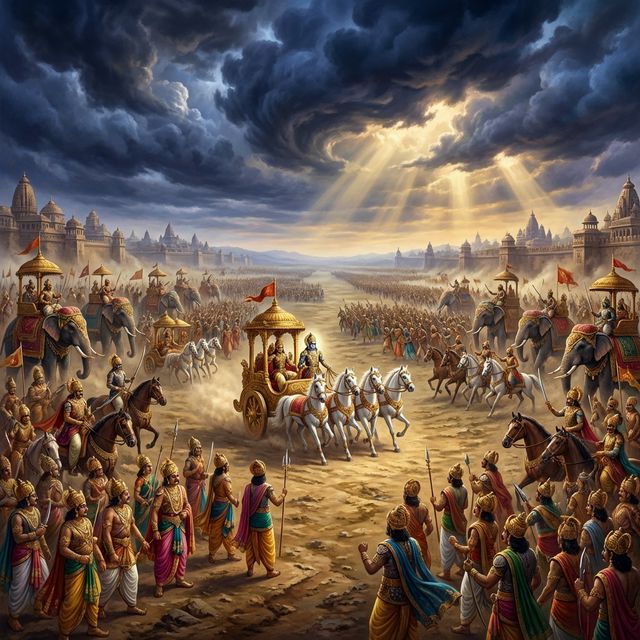
The King of the Fire City
Ashwatthama kills Nila of Mahishmati, and Arjuna kills three of Karna's brothers in his sight
The Question About Broken Ranks
"When those divisions of mine were broken and routed, Sanjaya, and all of you retreated quickly from the field, what became the state of your minds? The rallying of ranks when they are broken and flying away, without beholding a spot whereon to stand, is always exceedingly difficult. Tell me all about it."
It was the twelfth day of the war, and the blind king in the hall at Hastinapur was asking about an hour of it that nobody on his side wanted to describe to him.
Drona had held the command for two days. He had sworn to take Yudhishthira alive, and to keep him from the attempt the Pandavas had put their whole strength across his path. That morning Susharma and the Samsaptakas had drawn Arjuna away to the southern part of the field with an oath to kill him or die, and while Arjuna was gone the Kauravas had made their charge and lost it. Bhagadatta of Pragjyotisha had fallen with his elephant. Vrishaka and Achala, the two Gandhara princes who were Duryodhana's own uncles by marriage, had been killed side by side on one car by a single arrow. Shakuni had thrown every illusion he possessed at Arjuna, rocks and darts and beasts and darkness and a rising flood, and Arjuna had burnt each of them away laughing, and Shakuni had gone off the field behind his fast horses like a common wretch.
The host had split in two like the Ganga meeting a mountain, half of it running toward Drona and half toward Duryodhana, and then the dust came up and swallowed the field, and from inside it the men of Hastinapur could hear only one sound, which was the twang of Gandiva rising over the conchs and the drums.
That was what Dhritarashtra wanted explained: what a man thinks about when his army is running and there is nowhere to put his feet.
Sanjaya, who had been given the divine sight in order to answer questions like this one, gave the answer.
"Although thy troops were broken, O monarch, yet many of the foremost heroes in the world, inspired by the desire of doing good to thy son and of maintaining their own reputation, followed Drona."
Making Drona the Stake
They followed him into a dreadful pass and they followed him without fear, achieving meritorious feats against the Pandava troops with their weapons upraised and Yudhishthira within reach of them. Bhimasena made an error, and so did Satyaki, and so did Dhrishtadyumna, and the Kuru leaders saw the gap open and fell upon the Pandava army through it.
After that there was one word being shouted on both sides of the field.
The Panchalas urged their troops forward crying "Drona, Drona!" Duryodhana's men urged all the Kurus crying "Let not Drona be slain! Let not Drona be slain!" One side calling slay him and the other calling do not let him be slain, so that, Sanjaya said, the Kurus and the Pandavas seemed to be gambling with each other, and had made Drona their stake.
It is worth stopping on that image, because Sanjaya was speaking it aloud to Dhritarashtra, in whose hall the first game had been played. They had gambled once before over a kingdom and a woman. Now two armies were throwing dice for the life of the old teacher who had taught both of them to hold a bow, and the counters were men.
Dhrishtadyumna, prince of the Panchalas, went wherever Drona went. Whichever body of Panchala car-warriors Drona sought to crush, their commander turned up on that side of the field and stood in front of them.
So no rule was observed any longer as to which antagonist a man might select for battle. Heroes simply ran at heroes, shouting. The Kauravas could not make the Pandavas tremble; the Pandavas, recollecting all their woes, made the ranks of their enemies tremble instead. Modest men, excited with rage and vindictiveness, walked into that fight reckless of their lives for the single purpose of killing one Brahmana, and the collision was like iron against adamant.
The oldest men on that field could not recollect, and could not remember ever hearing of, a battle as fierce as that one. The earth itself, marked with great carnage and afflicted by the weight of the host standing on it, began to tremble.
And through it Drona came, breaking the Pandava divisions by thousands with his whetted shafts, until Dhrishtadyumna, filled with rage, checked him, and the two of them fought an encounter which Sanjaya said had no parallel that he knew of.
The Fire Out of Mahishmati
While the commander and the man born to kill him were locked together, another fire started in the Kuru ranks.
Nila was the king of Mahishmati, the old city on the Narmada in the south whose walls the Pandavas knew well, because Sahadeva had gone there during the conquest before the Rajasuya and had found it defended by fire itself. Its people were reckoned to stand under the protection of Agni. Nila had brought them north to Kurukshetra for Yudhishthira, and he had the look of the thing his city was famous for: a tall man of the colour of the lotus, the brightness of his face like the splendour of a full-blown lotus, his eyes like lotus petals.
Sanjaya described him as a fire and did not qualify it. His arrows were its sparks. His bow was its flame. And he went into the Kuru divisions the way a conflagration goes into heaps of dry grass in the hot season, taking the common soldiers by the hundred, burning a lane through them, working steadily forward with nobody able to stand in the lane.
There was one man on the Kaurava side who had been wanting a meeting with him for some time.
Ashwatthama, the son of Drona and of Kripi, was the only warrior in either army who had been born with a jewel set in his forehead; he was also his father's best pupil, which in that family meant something exact. He had been desirous of an encounter with Nila from before, Sanjaya said, and now he had his chance, and he brought his car across the field toward the burning place smiling.
What he said when he arrived was polite. Sanjaya was careful to put it that way when he repeated it to the king. Polite words.
"O Nila, what dost thou gain by consuming so many common soldiers with thy arrowy flames? Fight with my unaided self, and filled with rage, strike me."
It was an invitation and it was also an accusation. Leave off burning the men who cannot answer you. There is no reply a proud man can make to that except the one Nila made.
Bow, Standard and Umbrella
Nila turned his fire off the infantry and put it on the man who had asked for it.
He pierced Ashwatthama with his shafts, deeply and suddenly, and Sanjaya lingered over the two of them standing opposite each other, because they were made out of the same imagery and he seems to have found that strange. The king of Mahishmati, the brightness of whose face resembled the splendour of a full-blown lotus. Drona's son, whose body resembled an assemblage of lotuses and whose eyes were like lotus petals. Two flowering trees shooting at each other across forty yards of trampled ground.
The wounds went in, and Ashwatthama lost not a moment over them. He took three broad-headed arrows and cut off, in one movement, his antagonist's bow, his standard and his umbrella.
Every one of the three was chosen. The bow was the fight. The standard was how his own men found him in the dust and knew where their king was still standing. The umbrella was the mark carried above a crowned head on the field, the thing that announced that Mahishmati was present. Ashwatthama cut all three away and left the man himself untouched in the middle of the wreck of them: disarmed, unwounded, and no longer a king to look at.
It was the moment for Nila to fall back to another car, take up another bow and begin again, which is what the great car-warriors of that war did four and five times in an afternoon without any loss of honour.
He did not do it.
He came down off his chariot onto the ground, quickly, took a shield on his arm and an excellent sword in his hand, and started forward on foot toward Ashwatthama's car.
Sanjaya, describing the intention, reached for the image of a bird: Nila desired to sever from his enemy's trunk his head, as a hawk bears away its prey in its talons. A king of the fire city, on foot, with a sword, walking at the son of Drona.
Ashwatthama watched him come, and reached for a bearded arrow.
The Head With the Ear-rings
The arrow went out once, and it was finished.
By means of that single bearded shaft Drona's son cut off from his antagonist's trunk the head that rested on those elevated shoulders, graced with a beautiful nose and decked with excellent ear-rings.
Sanjaya was not describing a stranger, and he did not let the description go. He went back over the man once more, in the sentence in which he fell. He whose face had the brightness of the full moon. He whose eyes were like lotus petals. He whose stature was tall and whose complexion was that of the lotus. Thus slain, he fell down upon the earth.
The fight had lasted the length of two exchanges. Nila had wounded him, lost his bow and his standard and his umbrella, come down onto his feet with a sword because he would not be seen to withdraw, and been killed for it while still walking forward. It is the whole career of a brave man who was not quite good enough, told in five sentences by a herald who liked him.
On the far side of the field the Pandava host felt it go. Filled with great grief, Sanjaya said, they began to tremble when the Preceptor's son slew Nila of blazing energy, and the trembling was not for the king of Mahishmati alone. It was arithmetic. The fire that had been eating the Kuru ranks had gone out. Dhrishtadyumna was fully occupied holding Drona. Bhima was somewhere in the press. And the one man who could have crossed the field and put the balance back was nowhere in sight.
The great car-warriors of the Pandavas all thought the same thought at the same moment, and Sanjaya, who could see into it, gave it to the blind king in their own words.
"Alas, how would Indra's son be able to rescue us from the foe, when that mighty warrior is engaged on the southern part of the field, in slaughtering the remnant of the Samsaptakas and the Narayana force?"
It was a fair question. They had sent their best bowman away that morning to answer a challenge, and the challenge had been built by Susharma for exactly this purpose: to have Arjuna somewhere else while the real work was done.
The Ape Banner Comes Back
He came back.
Having vanquished a large number of the Samsaptakas, Jishnu turned his horses out of the south and made for the place where Drona was grinding the Pandava troops. He crossed lakes on the way whose waters were blood and whose fierce billows and eddies were shafts, and then, at the edge of the fighting, the men of Hastinapur saw a standard they knew, and Sanjaya named it, because it was the thing that ended the fear in the Pandava army: Arjuna's emblem, the banner bearing the ape, beheld by us to blaze with splendour.
Having dried up the Samsaptaka ocean by means of weapons that were his rays, the son of Pandu then blasted the Kurus also, as if he were the very sun that arises at the end of the yuga, burning down all creatures. Elephant riders and horsemen and car-warriors came off their mounts by thousands with their hair dishevelled, some uttering cries of distress, some setting up loud shouts, some already dead before they landed.
And in the middle of it Sanjaya set down one sentence about what Arjuna did not do, and it is the sentence that separates that afternoon from a massacre.
Recollecting the practices of good warriors, he struck not those combatants among the foe that had fallen down, nor those that were retreating, nor those that were unwilling to fight.
The rules of the war had been agreed by both armies before the first day, and by the twelfth most of them had been bent by somebody. Arjuna kept that one while burning through an army. A man on the ground was not shot. A man running was not shot in the back. A man who had put down his weapon was passed by.
Which meant that the field filled up with Kauravas who had been deprived of their cars and were still alive, and they turned away from the fighting, and being alive they made a noise. Cries of Oh and Alas went up all along the line, and out of the middle of them came one name, called over and over by men who wanted somebody put between themselves and the ape banner.
They were calling for Karna.
Do Not Fear
Adhiratha's son heard the din the Kurus were making, and the first thing he said to them was not a boast.
"Do not fear."
He said it loudly, assuring the troops as he went past them, and he took his car forward to face Arjuna, which nobody else on that part of the field was willing to do. Then that foremost of Bharata car-warriors, that delighter of all the Bharatas, that first of all persons acquainted with weapons, invoked the Agneya weapon into existence.
Fire against fire. Arjuna baffled the flights of arrows shot by that warrior of the blazing bow with downpours of his own, and Karna baffled the shafts of Arjuna in the same manner, and for a time nothing else happened at all: two men cancelling each other out, each shooting the other's weapons out of the air, Karna uttering loud shouts as he worked and speeding many shafts at his antagonist between them.
Then three more cars came into it, because the Pandava commanders could see a chance to finish the Suta's son while his hands were full. Dhrishtadyumna came up, and Bhima, and the mighty car-warrior Satyaki, and each of them pierced Karna with three straight shafts.
Karna, still checking Arjuna's weapons with his own arrowy showers, cut off the bows of all three with three sharp shafts.
Their bows cut off, Sanjaya said, they looked like snakes without poison. So they took darts instead and hurled them from their respective cars, uttering loud leonine shouts, and the darts went at Karna's chariot through the smoke looking like snakes themselves, of great splendour and great impetuosity, coursing impetuously out of those mighty arms.
He cut every one of them out of the air, three straight arrows to each dart, speeding many arrows at Partha at the same time, and shouted again.
It was the finest single stretch of shooting Karna had yet been seen to do on that field. It is worth marking, because within the next few moments of the same engagement he would be made to pay a price for standing exactly where he was standing, and there would be nothing whatever that he could do about it.
Three Uterine Brothers
Arjuna pierced Karna with seven shafts, and then he stopped shooting at Karna.
With the arrows that followed he despatched Karna's younger brother, who had come out of the charioteer's house at Hastinapur with him and taken his place beside him, because that is what a younger brother does. Then Satrunjaya, another of them, with six arrows. Then Vipatha, standing up on his car, with one broad-headed shaft that struck his head off where he stood.
Three uterine brothers of the Suta's son, despatched by Arjuna unaided by any one, in the very sight of the sons of Dhritarashtra, and in the very sight of Karna.
He could not go to them. He was under the bows of four men. Sanjaya reports no speech from him at that moment and no gesture, and the silence in the account is the loudest thing in it, because the epic has already shown what Karna does when a man he loves falls a few yards away: on another day he walked round Duryodhana's dead brothers weeping, not knowing what to do with his hands. These were his own blood. Nobody in that army was going to compose a lament for them, because they were the sons of a Suta.
The fight closed over the place where they lay. Bhima jumped down from his car like a second Garuda and killed fifteen of Karna's supporters with his sword, then mounted again, took up another bow, and put ten shafts into Karna and five into his charioteer and steeds. Dhrishtadyumna, with a sword and a bright shield, despatched Charmavarman and Vrihatkshatra the ruler of the Naishadhas, then remounted his own car and pierced Karna with seventy-three shafts and roared. Satyaki, the grandson of Shini, cut Karna's bow with two well-shot arrows and put three more into his arms and chest.
Karna was going down into that ocean, and Duryodhana and Drona and Jayadratha drove in and pulled him out of it.
Cars and horses and elephants by the hundred came up to the spot where he had been frightening his assailants, and the business began again, and went on until the sun went to his chambers in the western hills and both armies walked slowly back to their tents.
In the days ahead there would be Jayadratha, and Abhimanyu, and the wheel formation. On the twelfth evening there were four men lying out there whom nobody has much to say about: a king of the fire city who would not step back out of a sword fight he was losing, and three brothers of the greatest bowman on the Kaurava side, killed within sight of him while he was busy saving everybody else.
Dharma Lesson
Ashwatthama's challenge to Nila is offered as courtesy and it works as a trap: stop burning the men who cannot answer you, and come and be killed by someone who can. Nila accepts it, and when his bow and standard and umbrella are gone he refuses the honourable second chance of another chariot, because stepping back would look like retreat, and so he walks at an archer with a sword in his hand. The same afternoon shows the other shape of the same thing. Karna does everything a warrior should, answers the cry of frightened men, holds four great bowmen at once, and is paid for it by watching three of his own brothers killed a few yards away with no hand free to reach them. A battlefield does not distribute its costs according to merit.