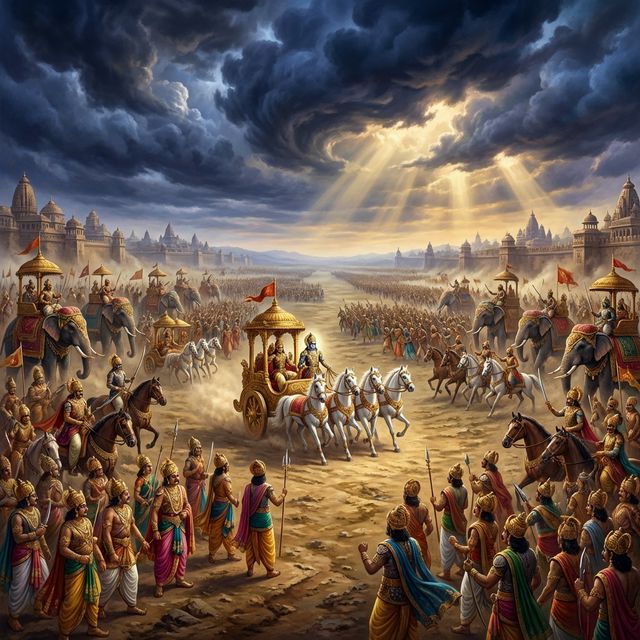
The Field at Dusk
Sanjaya describes the evening of the thirteenth day, and the army that won walks home through it
What the Victors Carried Home
"Having thus slain one of their foremost warriors," Sanjaya said, "and having been afflicted with their arrows, we came back to our encampment in the evening, covered with blood."
That is how the charioteer of the Kaurava king reported the end of the thirteenth day to the blind Dhritarashtra, sitting in a hall in Hastinapura a long way from the smell of it. One of their foremost warriors. He does not give the name in that sentence. The warrior was Abhimanyu, sixteen years old, the son of Arjuna and Subhadra, who had opened the wheel array by himself because nobody could follow him in, and who had been brought down inside it by six great car-warriors at once, with Drona and Karna among them.
Sanjaya had already told the whole of that. What he tells now is what the winners did afterwards, which is a thing the epic almost never stops to describe, and it takes him one section to do it, and there is not a single blow struck in the whole of it.
They went back to camp in the evening covered with blood. Not the enemy's blood only. Sanjaya says in the same breath that they had been afflicted with the arrows of the Pandavas all day, and he puts the wound and the victory into one sentence without appearing to notice that he has done it.
"Steadfastly gazed at by the enemy, we slowly left, O monarch, the field of battle, having sustained a severe loss and nearly deprived of our senses."
Read what is not there. No pursuit. No leonine roars, though the same troops had been roaring an hour before over the body. The Pandavas did not come after them. The Pandavas stood and watched them go, steadfastly, without moving, and the Kaurava army walked off the field slowly under that gaze with a severe loss of its own to count and its senses nearly gone.
An army that has won does not usually withdraw at that pace, or need to be described in the words used for a man who has been struck on the head.
The Hour Between Day and Night
"Then came that wonderful hour intervening between day and night."
Sanjaya calls it wonderful, and then he tells his king what was in it. Inauspicious howls of jackals were heard. That is the first sound of the evening in his account, and it comes before he has said anything else about the light: the animals that eat the dead announcing to each other that the work of the day is finished and theirs is about to begin.
The sun, he says, with the pale-red hue of the filaments of the lotus, sank low in the horizon, having approached the western hills.
"And he took away with him the splendour of our swords and darts, rapiers and car-fences, and shields and ornaments."
This is the exact observation of a man who has spent thirteen days looking at armies in the open. All that brilliance an army carries about with it, the flash off a blade, the gilding on a car-fence, the polish of a shield, the ornaments a kshatriya wears into battle so that he may be recognised and so that he may be seen, is not in the metal at all. It is lent by the sun every morning and taken back every evening, and the sun does not consult the owners about the hour of collection. The Kaurava host came off the field at the moment when everything that made it look like an army was being withdrawn from it.
Then the last image of the light: causing the firmament and the earth to assume the same hue, the sun assumed his favourite form of fire.
Sky and ground went the same colour, so that there was no longer a horizon to tell a man which way was up, and the disc that had been pale as lotus filaments a moment before turned into what Sanjaya says is its own preferred shape. Fire. The thing that would be wanted, in a few days, for all of them.
Hills Riven by Thunder
The field they were leaving is described next, and Sanjaya begins with the elephants, because on that field the elephants were what a man saw first.
"The field of battle was strewn with the motionless bodies of innumerable elephants deprived of life, looking like crests of cloud-capped hills riven by the thunder, and lying about with their standards and hooks and riders fallen from their backs."
Take the comparison seriously and it is not decoration. A living war elephant on the move looks like weather. It is grey, it is enormous, it changes the shape of the sky along the line of the horizon, and men on foot see it coming the way they see a storm coming. What is lying on the field now is that same mass with the motion taken out of it: hill crests split open by lightning, still smoking, not going anywhere. The standard that was planted on the back is in the dirt. The iron hook the driver used to steer with is in the dirt. The driver is in the dirt.
Then the chariots.
"The earth looked beautiful with large cars crushed to pieces, and with their warriors and charioteers and ornaments and steeds and standards and banners crushed, broken and torn."
Beautiful. Sanjaya uses that word and does not take it back, and he is not being ironic; he is reporting what a battlefield does to the eye at that hour, when the wreckage catches the last of the red light and lies about in patterns no craftsman could arrange. The site of a great slaughter is a beautiful thing to look at from a little distance. That is one of the more uncomfortable facts the Mahabharata insists on, and it insists on it here, in the middle of an inventory of the dead.
"Those huge cars, O king, looked like living creatures deprived of their lives by the foe with his shafts."
The cars themselves have become bodies. They were killed with arrows the way their owners were, and they lie there in the same attitude, and Sanjaya can no longer tell the two kinds of corpse apart.
Deserving of Costly Beds
From the cars he goes to the horses, and the tone changes, because with the horses the description stops being grand.
"The field of battle assumed a fierce and awful aspect in consequence of large numbers of steeds and riders all lying dead, with costly trappings and blankets of diverse kinds scattered about, and tongues and teeth and entrails and eyes of those creatures bulging out of their places."
He had the option of stopping at the trappings. Costly trappings and blankets scattered about is a complete picture and a decent one, and a court reciter could have left it there and gone on to something else. Sanjaya does not leave it there. He names the tongues, the teeth, the entrails and the eyes, and he says they are out of their places, which is the phrase of a man who knows what a horse is supposed to look like and is telling his king that these no longer do.
Then the men, and here the sentence is built to hurt.
"Men decked with costly coats of mail and ornaments and robes and weapons, deprived of life, lay with slain steeds and elephants and broken cars, on the bare ground, perfectly helpless, although deserving of costly beds and blankets."
Every one of these was somebody's son and most of them were somebody's lord. They had armour worth a village and robes worth an estate, and every night of their lives before this one they had slept on something soft, because that is what their rank provided and what their household existed to arrange. Tonight they are on the bare ground. The word Sanjaya chooses for them is helpless, which is a strange word to use of the dead, until you notice that he is not describing their condition but their claim: these were men whom others attended, and there is nobody attending them now.
Deserving of costly beds. He says it of both armies at once, and he does not distinguish, because at that hour and in that light there was no way to distinguish.
The Singing of the Rakshasas
What came onto the field as the army walked off it was not human, and Sanjaya lists it by name.
"Dogs and jackals, and crows and cranes and other carnivorous birds, and wolves and hyenas, and ravens and other blood-drinking creatures, all the diverse tribes of Rakshasas, and large numbers of Pisachas, on the field of battle, tearing the skins of the corpses and drinking their fat, blood and marrow, began to eat their flesh."
He gives the full roll because the roll is the point. This is the audience the day had really been fought for. Every creature named there had been waiting somewhere out beyond the flanks since morning, and the moment the men with weapons turned their backs the field changed hands.
"And they began to suck also the secretions of rotten corpses, while the Rakshasas laughed horribly and sang aloud, dragging dead bodies numbering thousands."
The Rakshasas are singing. That is the detail to carry away from this section. Not screaming, not fighting over the bodies, but singing aloud and laughing while they haul the dead off in their thousands, in exactly the mood of men coming home from a good harvest with the carts full. The Kauravas had gone back to their encampment in silence, nearly senseless, and behind them the only celebration anywhere on that plain was being held by the night-wanderers over the corpses of both sides.
There is no verdict pronounced on this and no god objects to it. The eaters are simply there, as they are always there, and the epic gives them their meal in plain language while the great names walk away in the dark.
The men who had killed Abhimanyu could hear all of it behind them as they went. Sanjaya, who was on the field with them and who saw everything by the sight Vyasa had given him, does not say that any of them turned around.
The River They Made Themselves
Then Sanjaya makes the one comparison in the whole passage that a Kuru king could not have misunderstood.
"An awful river, difficult to cross, like the Vaitarani itself, was caused there by the foremost of warriors."
The Vaitarani is the river at the boundary of Yama's kingdom, the one the dead have to get across, and the point about it is that it cannot be crossed by an unrighteous man. To say that the foremost of warriors made one on the plain of Kurukshetra with their own hands is to say that the border of the country of the dead had been moved, that afternoon, by men who thought they were fighting a battle.
He itemises it like a surveyor.
"Its waters were constituted by the blood of fallen creatures. Cars constituted the rafts for crossing it, elephants formed its rocks, and the heads of human beings its smaller stones. And it was miry with the flesh of slain steeds and elephants and men. And diverse kinds of costly weapons constituted the garlands floating on it or lying on its banks. And that terrible river flowed fiercely through the middle of the field of battle, wafting living creatures to the regions of the dead."
Every ornament of a real river has been supplied by the battle and each one is a thing that was recently in use. The rafts were chariots that morning. The stones in the shallows are heads. The garlands are weapons, and they cost more than garlands.
"And large numbers of Pisachas, of horrible and repulsive forms, rejoiced, drinking and eating in that stream. And dogs and jackals and carnivorous birds, all eating of the same food, and inspiring living creatures with terror, held their high carnival there."
All eating of the same food. That phrase does the work of a hundred laments. On the banks of that river there was no Kuru and no Pandava, no kshatriya and no Suta, no side that had been in the right at noon; there was one food, and everything that had teeth was sharing it.
The Fire No Longer Fed
The last thing Sanjaya reports is the manner in which the army finally got itself off the field, and it is the strangest sentence of the section.
"And the warriors, gazing on that field of battle which, enhancing the population of Yama's domain, presented such an awful sight, and where human corpses rising up began to dance, slowly left it."
Corpses rising up and dancing. Ganguli sets it down without a word of apology, and it belongs to the same hour as the singing Rakshasas: the bodies on that plain were being pulled about by the creatures feeding on them until the limbs moved, and what the departing soldiers saw in the red half-light was their own dead standing up. Enhancing the population of Yama's domain is Sanjaya's dry accounting of the day's achievement, delivered to the king whose sons had ordered it.
And they went slowly, still looking, and the section ends with the thing they were looking at.
They beheld the mighty car-warrior Abhimanyu, who resembled Sakra himself, lying on the field, his costly ornaments displaced and fallen off, and looking like a sacrificial fire on the altar no longer drenched with clarified butter.
That is the image the whole day is finally reduced to, and it is a priest's image, not a soldier's. A sacrificial fire is not a thing that dies; it is a thing that stops being fed. So long as the ghee goes on being poured, it stands up on the altar and does everything a fire can do, and the moment the pouring stops it goes down into ash in front of the people who lit it, and what is left is a cold hearth and a smell in the air and the ornaments of the rite lying about with nothing to do.
The boy had been the fire on that altar since noon. Six men had put out the arm that was holding the ladle.
The Kauravas walked back to their tents in the dark, covered with blood, having won, and the sun that had taken away the splendour of their swords went down behind the western hills, and the fourteenth day was waiting for Arjuna to be told.
Dharma Lesson
The epic gives a whole section to the hour after the killing, and nothing happens in it. That is the point. Victory is described here entirely by what it leaves behind: men who deserved beds lying on bare ground, a river of blood that no righteous man could cross, and eaters who make no distinction between the two armies because at that hour there is none to make. Sanjaya reports it to the king whose sons ordered the day, without a word of blame, because the field says it better than an accusation could.