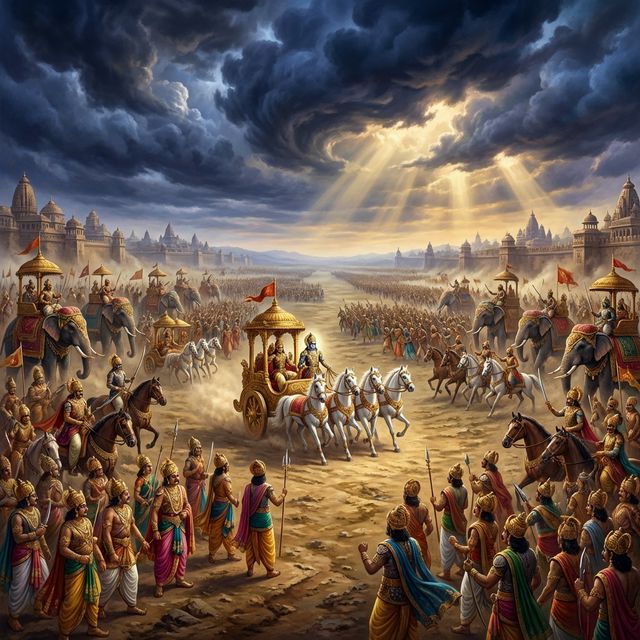
The March to Kurukshetra
Duryodhana walks out on the last counsel and orders the host to move that same day
The Last Word in the Hall
Krishna had come back from Hastinapura with nothing, and the Pandavas sat down around him at Upaplavya to hear how it had been lost.
"Though thus addressed by Bhishma, and Drona, and Vidura, and Gandhari, and Dhritarashtra," Vasudeva said, "that wicked wight could not yet be brought to his senses."
It is worth stopping on the list, because the list is the whole of the matter. Bhishma was the grandsire of both houses, the man from whom every prince in that hall had learned what a Kuru was. Drona was the preceptor who had taught Duryodhana and Yudhishthira alike to hold a bow, and who would fight for Duryodhana when it came to it. Vidura was the king's own brother, born of a waiting woman and therefore never a king himself, and the wisest voice in Hastinapura. Gandhari was his mother, who had come into the assembly with the cloth still bound over her eyes to say what a mother says. And Dhritarashtra was his father, the blind king, who had just finished telling him in front of the assembled monarchs that he was not the son of a king, that the kingdom was lawfully Yudhishthira's, and that he should give up half of it and hope to live a while longer with his brothers.
Five voices. Every authority a man is given in this world, seated in one room on one afternoon, agreed with one another for once, and every one of them speaking against him.
And he could not be brought to his senses.
The text records no answer from him. There is no reply, no argument, no last defence of his claim. He had made all of those before, on other days, in other halls, and he was finished with making them.
"On the other hand, the wicked Duryodhana, disregarding them all, rose," Krishna said, "with eyes red in anger."
He stood up in the middle of his father's sentence, with the blood in his face, and walked out of the assembly of the Kurus.
The Kings Who Went Out Behind Him
"And all the kings, prepared to lay down their lives, followed him behind."
That is the sentence Krishna set down next, and he did not enlarge on it, and it did not need enlarging. The hall had been full of monarchs. They had come from every quarter at Duryodhana's invitation, brought in over the previous months by messengers and by promises and by the plain arithmetic of who looked likely to win, and they had been sitting through the counsel of Bhishma and Drona and Vidura and the queen and the king exactly as Duryodhana had, hearing every word of it.
Then a young man stood up with red eyes and went to the door, and the kings of the earth got up and went out after him.
Krishna had spent his days in that city working on precisely those men. When conciliation had failed he had turned to dissension, which is the second of the arts a statesman is taught to use, and he had rebuked the assembled kings to their faces, and told them what the sons of Pandu could do in battle, and reminded them what they were being asked to die for. He had done it well enough that the court had tried to lay hands on him for it.
Not one of them stayed in his seat.
The phrase for them is exact and terrible in its economy: prepared to lay down their lives. They knew. That is the point of the words. These were not men being deceived about the size of the thing they were joining. They had heard the grandsire say it would end the race, and they had heard the father disown the son's claim in open court, and they rose anyway and walked out into the courtyard after him, and most of them would never come home.
Behind them the hall was left to the five who had spoken.
Pushya Is Ascendant
Out in the open, with the kings around him, Duryodhana began to give orders, and Krishna reported that he gave them over and over, repeatedly, to those wicked-hearted rulers, like a man who cannot stop talking after a thing has been decided.
"Today constellation Pushya is ascendant. March ye this very day to Kurukshetra."
Pushya is an asterism, the eighth of the twenty-seven, and among all of them it is held to be the most auspicious under which to begin anything that matters. Its name means the nourisher. Armies march under it, kings are crowned under it, journeys are begun under it, because the sky is understood to be favourable on that day and a man who sets out then has the arrangement of things on his side.
So the order was not merely to march. It was to march before the day was out, while the star still stood, and not to lose the hour.
Consider what has just happened. A man has heard his grandsire, his teacher, his uncle, his mother and his father tell him in sequence that what he is doing is against dharma and will destroy his house, and has walked out of the room rather than answer them. And the first thing he does in the air outside is to consult the heavens for a lucky moment. He would not take counsel from the five people on earth best qualified to give it, and he would not take a single step without the good opinion of a constellation.
"Impelled by Fate, those monarchs then, with their soldiers, gladly set out."
Two words in that carry the weight. Fate, because Krishna will not allow that any of it was accident, and gladly, because they were not driven. Nobody had to be compelled. They went out of Hastinapura in high spirits, in good order, with their banners up and their soldiers behind them, on the best day of the month for beginning something, toward the plain of Kurukshetra.
Eleven Akshauhinis and the Palmyra Banner
"Making Bhishma their generalissimo," Krishna said.
The first of the five men who had argued against the war that morning rode out at the head of it that evening. Krishna does not pause over this and neither does the text. It is set down as a fact of the order of march, in the same breath as the count of the troops, and it is left there for the listener to do with what he can.
"Eleven Akshauhinis of troops have been, O King, assembled for the Kauravas."
An akshauhini is a fixed thing, not a loose word for a crowd. It is twenty-one thousand eight hundred and seventy chariots, the same number of elephants, sixty-five thousand six hundred and ten horse, and one hundred and nine thousand three hundred and fifty foot, in the proportions of one, one, three and five. Eleven of them had come in to Duryodhana. Seven had come in to Yudhishthira. Krishna gave the number to the Pandavas plainly, because a man about to fight has a right to know what is coming toward him, and because eleven against seven is the shape of the war that follows and explains a good deal of it.
"At the head of that host shineth Bhishma, with the device of the palmyra on the banner of his car."
The palmyra was his standard, a tall straight tree worked in gold on the flag above his chariot, and it was the sign every soldier on the field would look for first, on both sides, for ten days. The old man was going to be visible from a great distance. That was the arrangement.
Then Krishna turned from the report to the man he was reporting to.
"In view, therefore, of what hath happened, do now, O monarch, that which seemeth to be proper. I have told thee everything that was said by Bhishma, Drona, Vidura, Gandhari and Dhritarashtra, in my presence.
The Accounting of an Envoy
Then he gave the accounting, because an envoy who has failed owes his king an accounting.
There are four arts a statesman is taught: conciliation, the making of dissension, gift, and chastisement. They are used in that order, and the order matters, because a man who reaches for the fourth without having honestly exhausted the first three has not been dealing but posturing. Krishna went down the list in front of the brothers and showed them what he had done with each.
"The arts beginning with conciliation were all employed by me from desire of establishing brotherly feelings, for the preservation of this race, and for the growth and prosperity of the earth's population."
Note what he says he was preserving. Not the Pandava claim. The race, and the population of the earth, which is a larger client than the one who sent him.
"When conciliation failed, I employed the art of producing dissensions, and mentioned, ye Pandavas, all your ordinary and extraordinary feats. Indeed, when Suyodhana showed no respect for the conciliatory words I spoke, I caused all the kings to be assembled together and endeavoured to produce dissension amongst them. Extraordinary and awful and terrible and superhuman indications were then manifested by me."
That last sentence covers the moment the court will never forget, and he passes over it in a line, as a means employed and found insufficient. He goes on with the inventory: rebuking all the kings, making a straw of Suyodhana, terrifying Radha's son, censuring Suvala's son again and again for the gambling match, working on the alliance with words and with intrigues.
And then, having done all that, he went back to the beginning and tried conciliation a second time. Not because it had become more likely to work. Because the alternative was a war.
"For the unity of Kuru's race, and in view of the special requirements of the business at hand, I spoke also of gift.
Five Villages, and the Rod
The gift was the third art, and what Krishna offered under it was so far past the Pandava claim that the brothers listening to him must have heard it with their teeth set.
"Those heroes, the sons of Pandu, sacrificing their pride, will live in dependence on Dhritarashtra, Bhishma and Vidura. Let the kingdom be given to thee. Let them have no power. Let it all be as the king, and as Ganga's son, and as Vidura say for thy good. Let the kingdom be thine. Relinquish but five villages to the Pandavas. O best of kings, without doubt they deserve to be supported by thy father."
Everything. The throne, the treasury, the command, the empire that had been built at Indraprastha and staked and lost at dice. Five brothers who had held the imperial sacrifice would live as dependants in another man's house, on another man's word, and Duryodhana would be king of all of it. Against that whole world, five villages.
"Though addressed thus, that wicked soul did not still give you your share."
So there was one art left.
"I therefore see that chastisement, and nothing else, is now the means that should be employed against those sinful persons."
Chastisement is danda, the rod, the last of the four, the one a king holds when persuasion has been spent. It is not revenge and it is not glory. In the science of statecraft it is what remains when the other three have been tried honestly and have failed, and its use is a confession that they have.
"Indeed, all those kings have already marched to Kurukshetra. I have now told thee everything that had happened in the assembly of the Kurus. They will not, O son of Pandu, give thee thy kingdom without battle. With death waiting before them, they have all become the cause of a universal destruction."
While he was saying it, the eleven armies were already on the road.
Dharma Lesson
Duryodhana would not hear his grandsire, his teacher, his uncle, his mother or his father, and then would not set out without the approval of a star. It is a familiar exchange. Counsel that can argue back gets refused, and authority that cannot is obeyed to the hour. The episode also shows what an honest failure looks like: Krishna went down the whole ladder of statecraft, conciliation, dissension, gift, and offered the Pandavas' empire away for five villages before he would say the word chastisement, so that when war came nobody could say it had been chosen in haste.