Madhavi Chooses the Forest
At her own swayamvara she passes over every king and takes the woods for a husband
The Chariot to the Confluence
Narada was still speaking in the Kuru assembly, and the man he was speaking to had not moved.
He had brought the tale of Galava down to its last accounting. The fee was paid. Six hundred horses of lunar brightness, each with one black ear, were grazing in Vishvamitra's asylum, and a fourth son had been born to make up the two hundred that could not be found anywhere on earth. The disciple was free of his debt. The preceptor was satisfied. Every man in that story had got what he had set out to get, and Narada, who told it to Duryodhana as a warning about what stubbornness costs, had one thing left to tell.
The girl was given back.
"And returning the maiden unto her father," Narada said, "Galava himself went into the woods."
So Madhavi came home to Yayati, king of the Kurus, son of Nahusha, in the house she had left as a gift. She had been lent to three kings and to a rishi. She had borne four sons and left every one of them behind her in a different city. The boon her body carried had done what boons do, and had restored her each time to what she had been before, so that a father could look at her and see, in the plain arithmetic of a court, a daughter still unmarried and still to be disposed of.
And Yayati, being a king and a father and a man who had done this once already, decided to do the thing that was proper. He would hold a swayamvara for her, a second one, and this time it would be done in the sight of the whole world, and she would choose.
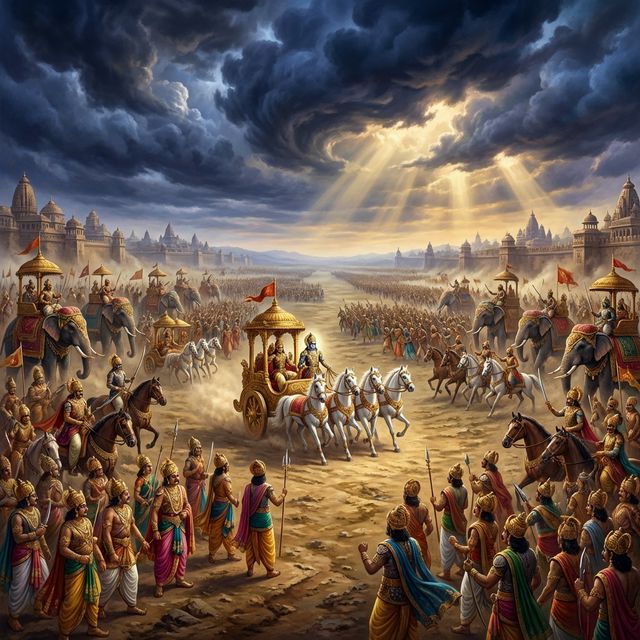
He had her decked in garlands of flowers. He set her on a chariot. And he took her out of the city to a hermitage that stood at the confluence of the Ganga and the Yamuna, where the two rivers come together and the ground is sacred for as far as a man can walk in a morning.
Both her brothers went with her. Puru and Yadu, those foremost of men, followed their sister to that asylum, and neither of them, so far as the account records, said anything at all on the road.
The Concourse at the Meeting of the Rivers
What gathered at that hermitage was not a gathering of kings.
Narada names the guests, and the list keeps widening as it goes. There was assembled in that spot a vast concourse of Nagas and of Yakshas and of human beings. There were Gandharvas. There were animals, and there were birds. There were the dwellers of mountains, and the dwellers of trees, and the dwellers of forests. There were many inhabitants of that particular province, ordinary people who had heard that a daughter of the Kuru line was to choose a husband at the meeting of the rivers and had come to stand in the crowd and see it. And the woods all around the asylum were filled with numerous Rishis, resembling Brahman himself.
A swayamvara is a small ceremony by design. The suitors are named and seated, the girl walks the line with a garland in her hands, and she puts it round the neck of one of them. What Narada describes is that ceremony with the whole of creation invited to watch it, snakes and deer and birds in the branches and ascetics standing among the trees with the light of Brahman on them, and it is worth asking why the account is built that way.
Because of who was standing in the middle of it.
This was the maiden Galava had carried from Ayodhya to Kasi to Bhoja and thence to the asylum of Vishvamitra, and had exchanged four times for two hundred horses at a time, and had been thanked for it. By these sons, he had told her at the parting, thou hast saved not only thy father, but four kings and myself also. She had been the price of a fee, and every man in the transaction had come out of it satisfied, and not one of them had asked her anything.
Now she stood on a chariot in flowers, and the selection of a husband commenced, and for the first time in the whole history of her life the question was put to her and the answer was hers.
The bridegrooms waited in their rows. Every one of them was a king.
She Passed Over Them All
That maiden of the fairest complexion passed over all the bridegrooms there assembled, and selected the forest as her lord.
Narada does not slow down for it. There is no speech. She is not made to explain herself to her father, and she does not denounce anybody, and no king is named and refused to his face. The whole of it happens in a single line of the account, in the same even voice that has been listing Nagas and Yakshas, and the line is this: passing over all the bridegrooms, she selected the forest.
Understand what that does to the ceremony. A swayamvara is a form of choice with the answers printed on it. The girl may choose, and the men she may choose from are standing in front of her, and the ritual has never once anticipated a woman who looks along the row, finds the whole row wanting, and picks something that is not in it. She did not decline to marry. She married. She took a husband in the proper form at the proper moment before the proper witnesses, and the husband she took was the forest, which is always sacred, and which had not asked her for anything and would not trade her to anybody.
Then she got down off the chariot.
She descended, and she saluted all her friends, every one of them, in the courteous manner of a woman leaving a house where she has been well treated. There was nothing to reproach them with. They had done what people do. Then the daughter of Yayati walked away from the concourse of Nagas and Yakshas and Gandharvas and kings and men, into the forest, and devoted herself to ascetic austerities.
Her father stood at the confluence of two rivers with his sons on either side of him and watched his daughter go, having twice arranged her marriage and twice been obeyed exactly.
The Life of a Wild Doe
What she did in the woods is set down with more care than anything else in her story, and every detail of it is a detail of taste, thirst and open country.
She reduced her body by means of fasts of various kinds, and by religious rites, and by rigid vows. Then she adopted the deer's mode of life, which is not a figure of speech in Narada's account but the literal shape of her days. She ate what deer eat. She subsisted upon soft and green grass-blades, resembling the sprouts of lapis lazuli, which were both bitter and sweet to the taste, and she drank the water of sacred mountain-streams, which the account pauses to call sweet, pure, cool, crystal and very superior, as though somebody had knelt at that water and come up and wanted it described properly.
A woman who had been carried from city to city on other people's business was now choosing her own ground, and the ground is described by what is absent from it. She wandered with the deer in forests destitute of lions and tigers. She lived in deserts free from forest-conflagration. She went into thick woods. No predator, no fire, nothing that hunts and nothing that sweeps through and takes everything. She had spent her life inside arrangements made by men who wanted something from her, and she had gone and found the one country in the world where nothing was going to come for her at all.
That maiden, leading the life of a wild doe, earned great religious merit by the practice of Brahmacharya austerities.
That is the whole verdict, and it is worth reading twice, because Brahmacharya is exactly the merit that the four kings and the rishi had made impossible for her four times over, and she had gone into the woods and earned it anyway, out of grass and cold water and her own body, with no boon involved and nobody to trade it to.
And here the account leaves her, alive and grazing, and turns to her father.
Yayati Among the Royal Sages
King Yayati, following the practice of kings before him, submitted to the influence of Time, after having lived for many thousands of years.
That is how Narada disposes of a reign. No battle, no illness, no deathbed. The man simply came to the end of the term that even great kings are lent, and did what all his predecessors had done, and Narada says it in the tone of a clerk closing a ledger, because in this story Yayati's death is not the interesting thing that happens to Yayati.
He left two lines behind him, and both prospered. The progeny of Puru and of Yadu, those foremost of men who had walked beside their sister's chariot to the confluence, multiplied greatly, and it was on account of that multiplying that Nahusha's son won great respect in this world and in the other. His grandsons and their grandsons filled the earth. The merits of his descendants came up to him where he was, as merits do, and they were counted to him.
So, dwelling in heaven, king Yayati, resembling a great Rishi, became an object of much regard. He enjoyed the highest fruits of those regions. He sat among the illustrious royal sages and the great Rishis in the assembly of the gods, a mortal in the seat of the honoured, and the account says plainly that many thousands of years passed away for him there in great happiness.
Hold the two pictures side by side, because Narada has deliberately set them there. One of them is a woman with nothing, in a forest without lions, chewing bitter grass and drinking from a stream, earning merit a day at a time out of her own body. The other is a king with everything, seated in heaven among the sages, spending merit that was largely earned for him by other people, in a place where nobody was ever going to tell him that the account had a bottom to it.
He was there a very long time, and he was happy, and then one day he had a thought.
We Do Not Know Him
On one occasion, while he was seated among the illustrious royal sages and the great Rishis, king Yayati, from folly, from ignorance and from pride, mentally disregarded all the gods, and all the Rishis, and all human beings.
He did not say it. Nothing was spoken in that assembly and no god was insulted aloud. It went through him where he sat, the way such thoughts go through a man who has been honoured for a great while and has stopped asking why: that he was the finest thing in the hall, and that the gods on one side of him and the rishis on the other and the whole race of men down below were, when you came to look at them squarely, rather less.
Thereat the divine Sakra, the slayer of Vala, at once read his heart.
That is the first consequence, and it is silent. Indra did not accuse him. He simply saw, in the moment the thought was formed, the whole of it. And the royal sages seated around Yayati, who had shared their bench with him for thousands of years, turned and addressed him, saying, "Fie, fie."
Then the questions began, and they were not put to him. They were put about him, over his head, by everyone in the hall at once.
"Who is this person? What king's son is he? Why is he in heaven? By what acts hath he won success? Where did he earn ascetic merit? For what hath he been known here? Who knoweth him?"
The dwellers of heaven asked one another these things about Yayati, that ruler of men, while he sat there in his garlands and his ornaments hearing every word. And the question travelled outward through the whole establishment of that place. Hundreds of heaven's charioteers were asked. Hundreds of those that kept heaven's gates. Those that were in charge of heaven's seats, the ones who had shown him to his own seat and had known his name and his lineage and his rank for thousands of years.
Every one of them answered, "We do not know him."
The minds of all had been clouded, so that not one being in heaven recognised the king. And thereupon the monarch was soon divested of his splendour.
In a forest without lions, at that same hour, his daughter was eating grass and had lost nothing.
Dharma Lesson
Madhavi is the only person in her whole story who is ever asked what she wants, and she answers by declining the entire list. The forest was not an escape from marriage but a marriage to something that would take nothing from her, and the merit she earned there was earned out of grass and cold water by her own body, with no boon involved and nobody to trade it to. Set against that, her father sits in heaven on merit other people earned for him, and loses it all in one unspoken thought. What is given to us can be taken back and can be forgotten by everyone who gave it; what we earn ourselves, in a forest with nothing in it, is the only property that stays.