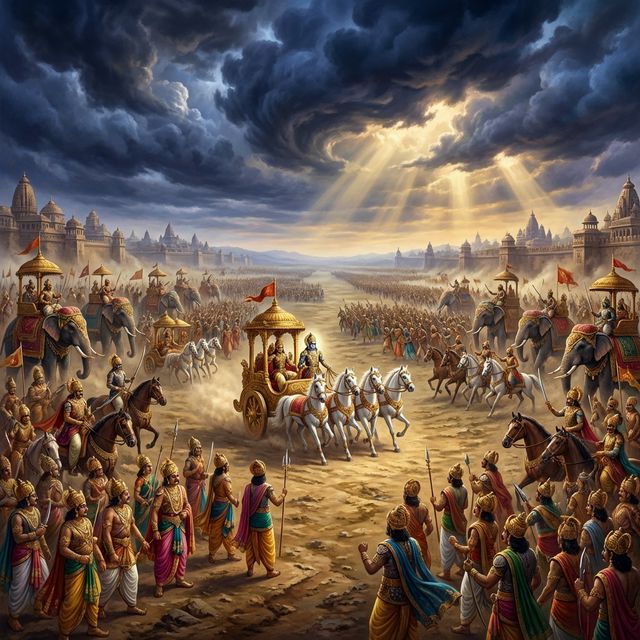
Arjuna's Message to the Kurus
Sanjaya recites the message in open court, and names every man who will die
The Question in the White Hall
Sanjaya had come back from the Pandavas at Upaplavya, and the kings of the Kuru court had taken their seats in the great hall to hear what he had carried home. He had already given them the courtesies, the salutations offered by the sons of Pandu to each man according to his years. The old king did not want courtesies. He wanted the one thing everybody in that hall was waiting for, and he asked for it out loud, so that nobody could say afterwards that it had been delivered in a corner.
"I ask thee, O Sanjaya," Dhritarashtra said, "in the presence of my boy and of these kings, what words were said by the illustrious Dhananjaya of might that knoweth no diminution, that leader of warriors, that destroyer of the lives of the wicked?"
Sanjaya, who was a suta, a charioteer's son bred to memory and to speech, and who had spent the whole of the previous night being counselled by Vidura, stood up in front of them.
"Let Duryodhana listen," he said, "to the words which the high-souled Arjuna, eager for fight, uttered, with Yudhishthira's sanction and in the hearing of Kesava."
Then he told them how the message had been given to him, because Arjuna had been particular about that. Fearless and conscious of the might of his arms, the wielder of Gandiva had spoken with Vasudeva standing beside him, and his instructions had been these: say it to Dhritarashtra's son in the presence of all the Kurus, and say it in the hearing of that Suta's son of foul tongue and wicked soul, of little sense and stupid reason and numbered days, who always desires to fight against me, and say it in the hearing of all those kings assembled for battle against the Pandavas, and see that every word of it is heard well by that king and by his counsellors.
Karna was sitting in the hall. Sanjaya did not look away from him.
The Pandavas and the Srinjayas had listened to those words, Sanjaya said, the way the celestials listen to their chief when he stands among them with the thunderbolt in his hand. And now he would give them back, in order, to the men they had been aimed at.
Do Not Propose Peace
Arjuna had begun, Sanjaya said, with his eyes red as the lotus, and he had begun not with a threat but with a diagnosis.
"If Dhritarashtra's son doth not surrender to king Yudhishthira of the Ajamida race his kingdom, then it is evident there must be some sinful act committed by the sons of Dhritarashtra whose consequences are yet unreaped by them. For it can be nothing else, when they desire battle with Bhimasena and Arjuna, and the Ashwins, and Vasudeva, and Sini's son, and Dhrishtadyumna infallible in arms, and Shikhandi, and Yudhishthira, who is like Indra himself and who can consume heaven and earth by merely wishing them ill."
The Ashwins were Nakula and Sahadeva, named for the twin physicians of heaven. Sini's son was Satyaki of the Vrishni line, Krishna's own kinsman and pupil, a man the court knew by reputation and would come to know better. It was a short list, and Arjuna had assembled it the way a man lays out tools before beginning work.
"If Dhritarashtra's son desireth war with these, then will all the objects of the Pandavas be accomplished. Do not, therefore, propose peace for the sons of Pandu. Have war, if thou likest."
That sentence went across the hall and settled. Thirteen years of embassies and offers and counter-offers, and here was the wronged party saying plainly that peace was no longer being requested, only permitted.
Then he named the price.
"That bed of woe in the woods which was Yudhishthira's, when that virtuous son of Pandu lived in exile. Oh, let a more painful bed than that, on the bare earth, be now Duryodhana's, and let him lie down on it, as his last, deprived of life."
It was an exact answer. The Pandavas had slept on the ground for twelve years because of a game of dice. Arjuna was asking for one night of the same for the man who had thrown it, and was specifying that the man would not get up in the morning.
He made the moral claim once, and made it as a conditional, which is how a man states a thing he considers already settled.
"If they vanquish us in fight, aided by the very gods headed by Indra, then the practice of vice would be better than virtue, and surely there would be nothing like righteousness on earth."
The Wrath Kept for Years
"Win thou over those men that were ruled by the wicked Duryodhana of unjust conduct," Arjuna had said, "to the side of Pandu's son endued with modesty and wisdom and asceticism and self-restraint and valour and might regulated by virtue."
This was addressed to Sanjaya personally, and Sanjaya delivered it in front of the king whose envoy he was. He had been sent to buy time and to talk of peace without offering any. He was being asked, by the enemy, to change sides.
Then Arjuna spoke about his brother, and the hall heard a description of Yudhishthira that nobody in it could honestly dispute. Endued with humility and righteousness, with asceticism and self-restraint, with valour regulated by virtue, always speaking the truth. Afflicted by numerous deceptions and having forgiven all of them. Having patiently borne great wrongs.
"When the eldest son of Pandu, of soul under proper control, will indignantly dart at the Kurus his terrible wrath accumulated for years, then will the son of Dhritarashtra repent for this war."
That last clause was the hinge of the whole message, and Sanjaya let them hear it as it had been spoken, because Arjuna had used it perhaps thirty times, coming back to it after every image like a drumbeat under a chant. Then will the son of Dhritarashtra repent for this war. He never once said, I will win. He said, you will be sorry, and then he described exactly what the sorrow would look like.
"As a blazing fire burning all around consumeth dry grass in the hot season, so will Yudhishthira, inflamed with wrath, consume the Dhritarashtra host by the glance alone of his eye."
The point was in the arithmetic of it. A man who has been patient for thirteen years is not a man with no anger. He is a man with thirteen years of anger and nowhere yet to put it. Every wrong that Duryodhana had committed and got away with was still in existence, stored, and it had been drawing interest the whole time.
What He Will See When He Sees Bhima
Then Arjuna turned to his elder brother, and the pictures came faster.
"When Dhritarashtra's son will behold Bhimasena, that wrathful Pandava of terrific impetus, stationed on his car, mace in hand, vomiting the venom of his wrath, then will Duryodhana repent for this war."
Bhima who always fights in the van. Bhima accoutred in mail, scarcely capable of being looked at even by his own followers, felling hostile heroes and devastating the enemy's ranks like Yama himself. Then will the exceedingly vain Duryodhana recollect these words.
"When he will behold elephants, looking like mountain-peaks, felled by Bhimasena, blood flowing from their broken heads like water from broken casks, then will Dhritarashtra's son repent for this war."
Nobody interrupted. There were men in that hall who had seen Bhima work, and the images were not exaggerations to them but predictions with a known basis.
"When, falling upon the sons of Dhritarashtra, the fierce Bhima of terrible mien, mace in hand, will slaughter them like a huge lion falling upon a herd of kine, then will Duryodhana repent for this war."
Then the long one, the one Arjuna built out of a workman's labour rather than a beast's hunger. Bhima undaunted in situations of great danger and skilled in weapons, that grinder of hostile hosts, mounted on his car and alone, crushing with his mace crowds of superior cars and entire ranks of infantry, seizing with his nooses strong as iron the elephants of the hostile army, and mowing down the Dhritarashtra host like a sturdy woodsman cutting a forest down with an axe.
"When he will behold the Dhartarashtra host consumed like a hamlet full of straw-built huts by fire, or a field of ripe corn by lightning. When he will behold his vast army scattered, its leaders slain, and men running away with their backs to the field, afflicted with fear, and all the warriors humbled to the dust and scorched by Bhimasena with the fire of his weapons. Then will the son of Dhritarashtra repent for this war."
Duryodhana sat through it without moving. That was the brother who had promised, in this same hall, to break his thigh.
The Young Ones
He went down through the family in order, and every one of them had a picture.
Nakula first, that warrior of wonderful feats, foremost of all car-warriors, dexterously shooting arrows by hundreds and mangling the car-warriors of Duryodhana. And then a second image of the same man that was not about skill at all.
"Accustomed to enjoy all the comforts and luxuries of life, when Nakula, recollecting that bed of woe on which he had slept for a long time in the woods, will vomit the poison of his wrath like an angry snake, then will the son of Dhritarashtra repent for this war."
Then the allied monarchs, ready to lay down their very lives, urged to battle by Yudhishthira the just, furiously advancing on their resplendent cars.
Then Sahadeva, the youngest and the mildest, mounted on a car of noiseless wheels set with golden stars and drawn by well-trained steeds, making the heads of monarchs roll on the field with volleys of arrows. Seated in the midst of that frightful havoc, turning now to the left and now to the right, falling upon the foe in all directions. Modest but mighty, truthful, conversant with all the ways of morality and endued with great activity, he would fall upon the son of Gandhari in fierce encounter and rout all his followers.
Then the five sons of Draupadi, tender in years but not in acts, all well-versed in arms, rushing at the Kauravas reckless of their lives, darting at the foe like snakes of virulent poison.
Then Abhimanyu. Skilled in arms like Krishna himself, that son of Subhadra, a child in years but not in energy, overpowering the foe by showering upon them like the very clouds a thick downpour of arrows, falling like Death's own self upon the ranks of the enemy.
And the youthful Prabhadrakas, the young picked fighters of the Panchala host, endued with great activity and possessed of the energy of lions, overthrowing the sons of Dhritarashtra with all their troops.
Then will Duryodhana repent for this war. Then will Duryodhana repent for this war. Sanjaya said it as often as Arjuna had said it, and did not soften it once.
The Two Old Kings, and the Man Born for Bhishma
"When those veteran car-warriors Virata and Drupada will assail, at the head of their respective divisions, the sons of Dhritarashtra and their ranks, then will Duryodhana repent for this war."
Two fathers-in-law, both old, both with a grievance. Drupada skilled in weapons and seated on his car, desirous of plucking the heads of youthful warriors and wrathfully striking them off with arrows shot from his bow. Virata penetrating into the ranks of the foe, grinding all before him with the aid of his Matsya warriors of cool courage. And the eldest son of the Matsya king in the very van, collected of mien, accoutred in mail, fighting on behalf of the Pandavas.
Then Arjuna said the thing that the men on the front seats of that hall had to hear sitting still.
"I tell thee truly that when that foremost of Kaurava heroes, the virtuous son of Santanu, will be slain in battle by Shikhandi, then all our foes, without doubt, will perish."
Bhishma was in the hall. So was Shikhandi's history, which everybody present knew: born a woman, born out of Amba's fire and Amba's vow, born for exactly this. Arjuna was not announcing a hope. He was reading out a thing that had been settled before that child was born, and he read it out in the grandsire's hearing.
"Indeed, when, overthrowing numerous car-warriors, Shikhandi, seated on his own well-protected car, will proceed towards Bhishma, crushing multitudes of hostile cars by means of his own powerful steeds, then will the son of Dhritarashtra repent for this war."
And then the same courtesy paid to Drona, in Drona's presence, by way of Drona's own pupil.
"When he will behold Dhrishtadyumna, unto whom Drona hath imparted all the mysteries of the science of weapons, stationed in splendour in the very van of the Srinjaya ranks, then will the son of Dhritarashtra repent. When the leader of the Pandava host, of immeasurable prowess and capable of withstanding the rush of any force, will proceed to attack Drona in battle, crushing with his arrows the Dhritarashtra ranks, then will Duryodhana repent for this war."
Two old men had just been named to their killers by a man who loved them both.
Do Not Covet the Kingdom
"Say also this unto Duryodhana. Do not covet the kingdom."
It was the plainest line in the message, and Arjuna set it down between two long passages of praise for the man the Pandavas had chosen to lead their van.
"We have chosen for our leader the dauntless and mighty car-warrior Satyaki, the grandson of Sini, skilled in weapons and having none on earth as his equal."
Then the description, which Arjuna gave at length because he wanted the Kuru marshals to price it. Of broad chest and long arms, that grinder of foes, unrivalled in battle, acquainted with the best of weapons, perfectly dauntless, wielding a bow of full four cubits' length. When that chief of the Sinis, urged by me, will shower his arrows on the foe like the very clouds and completely overwhelm their leaders with that downpour, then will the son of Dhritarashtra repent for this war.
"When that illustrious warrior of long arms and firm grasp of the bow musters his resolution for fight, the foe then, like kine getting the scent of the lion, fly away from him before even commencing the encounter."
He is capable of splitting the very hills and destroying the entire universe. Practised in weapons, skilled in battle, endued with exceeding lightness of hand, he shineth on the field like the sun himself in the sky. That lion of the Vrishni race, that scion of Yadu's line, of superior training, has diverse wonderful and excellent weapons, and knows all those uses of weapons that are said to be of the highest excellence.
"When he will behold in battle the golden car of Satyaki of Madhu's race, drawn by four white steeds, then will that wretch of uncontrolled passions, the son of Dhritarashtra, repent."
What enemy, Arjuna asked, can withstand the man who has that one fighting in his van? The question was not rhetorical in the way questions in a court usually are. The Kurus had spent a year buying allies. Arjuna was telling them, item by item, what they had bought against.
The Twang of Gandiva
Then he came to himself, and the room changed.
"When he will also behold my terrible car, endued with the effulgence of gold and bright gems, drawn by white steeds and furnished with the banner bearing the device of the Ape, and guided by Kesava himself, then will that wretch of uncontrolled passions repent."
"When he will hear the fierce twang produced by the constant stretch of the bow-string with fingers cased in leather gloves, that terrible twang, loud as the rolling of the thunder, of my bow Gandiva wielded by me in the midst of the great battle, then will that wicked wretch, the son of Dhritarashtra, repent, beholding himself abandoned by his troops, flying away like kine from the field in all directions, overwhelmed with the darkness created by my arrowy downpour."
Innumerable keen-edged arrows furnished with beautiful wings, capable of penetrating into the very vitals, shot from the string of Gandiva like fierce flashes of lightning emitted by the clouds, destroying enemies by thousands and devouring numberless steeds and elephants clad in mail. The enemy's own arrows turned off, or turned back struck by his shafts, or cut to pieces pierced transversely. Broad-headed arrows striking off the heads of youthful warriors like birds picking fruits from the tree-tops.
"When he will behold his brothers, even before fairly coming within the range of the enemy's weapons, die all around without having achieved anything in battle, then will the son of Dhritarashtra repent for this war."
And then the last of the pictures, which was not a battle at all but what a field looks like afterwards. His whole army running away in fear in all directions, mangled in limbs and bereft of senses. His steeds, his elephants, the foremost of his heroes slain. His troops thirsty, struck with panic, wailing aloud, dead and dying, with their animals exhausted. And hair, bones and skulls lying in heaps around, said Arjuna, like half-wrought works of the Creator.
"When he will behold on my car Gandiva, Vasudeva, and the celestial conch Panchajanya, myself, my couple of inexhaustible quivers, and my conch called Devadatta, as also my white steeds, then will the son of Dhritarashtra repent for this war. When I consume the Kauravas like Agni consuming innumerable wicked souls assembled together at the ushering in of another Yuga at the end of the last, then will Dhritarashtra with all his sons repent."
The Brahmana Who Made Him Choose
Then Arjuna told them why Krishna was on his car, and it turned out to have been a choice, made once, on an ordinary morning.
"One morning, when I had finished my water-rites and prayers, a Brahmana spoke unto me these pleasant words. O Partha, thou shalt have to execute a very difficult task. O Savyasachin, thou shalt have to fight with thy foes. Either Indra, riding on his excellent steed and thunderbolt in hand, will walk before thee slaying thy foes in battle, or Krishna, the son of Vasudeva, will protect thee from behind, riding on his car drawn by the steeds headed by Sugriva."
"Relying on those words, I have in this battle passed over Indra, the wielder of the thunderbolt, and preferred Vasudeva as my ally. That Krishna hath been obtained by me for the destruction of those wicked ones. I see the hand of the gods in all this."
The man whose success is only wished for by Krishna, without Krishna's actually taking up arms on his behalf, is certain to prevail over all enemies, even if those be the celestials with Indra at their head, and there is no anxiety at all if they are human.
Then he gave the court the reckoning, feat by feat, because Duryodhana had once thought of putting ropes on this man. He that would conquer Vasudeva in battle would with his two arms extinguish a blazing fire, stop the Sun and the Moon, and plunder by force the Amrita of the gods. He mowed down the royal warriors of the Bhoja race and carried off Rukmini on a single car. He smashed the Gandharas, conquered the sons of Nagnajit, and freed king Sudarsana from confinement. He slew Kansa in the midst of the Vrishnis and the Andhakas and gave the kingdom back to Ugrasena. He fought Salya, the lord of Saubha, stationed in the skies and fearless in his powers of illusion, and caught the fierce Sataghni with his bare hands at the gate. In Pragjyotisha, which the gods themselves could not take, he slew six thousand Asuras and Mura and hosts of Rakshasas, killed the Earth's son Naraka, who lay dead like a Karnikara tree uprooted by the wind, and brought back the jewelled ear-rings of Aditi.
"And yet the son of Dhritarashtra seeketh to vanquish that unbearable Vishnu of infinite energy, for that wretch often thinks of imprisoning him. Krishna, however, beareth all this for our sake only. That wretch seeketh to create a sudden disunion between Krishna and myself. How far he is capable of taking away the affection of Krishna from the Pandavas, he will see on the field of battle."
The Bow That Yawns Without Being Handled
"Having bowed down unto Santanu's son, and also Drona with his son, and the unrivalled son of Saradwat, I shall fight for regaining our kingdom."
Bhishma, Drona and Ashwatthama, Kripa. He would salute them and then shoot at them, and he said so in their hearing.
"Deceitfully defeated at dice by those wretches, ourselves of royal birth had to pass twelve years in great distress in the forest and one long year in concealment. If we be superior to Duryodhana, then I hope that, with Vasudeva as my second, I shall slay Duryodhana with all his kinsmen."
Then the summing up. Ye Kauravas, ye will see it with your eyes: if they fight, the sons of Dhritarashtra shall certainly perish. If they act otherwise instead of fighting, then they may live. But in the event of a battle ensuing, none of them will be left alive. Do ye meanwhile whatever ye think best, and enjoy also your wives and other sweet things of life.
There were signs, and Arjuna listed them without excitement. Aged Brahmanas versed in the motions of planets, prophesying the great destruction of the Kurus and the Srinjayas and the victory of the Pandavas. Janardana, who knows the invisible future. And his own foresight, acquired of old and not obstructed.
"My bow, Gandiva, yawneth without being handled. My bow-string trembleth without being stretched. Arrows, issuing from my quiver's mouth, are again and again seeking to fly. My bright scimitar issueth of itself from its sheath, like a snake quitting its own worn off slough. And on the top of my flag-staff are heard terrific voices: When shall thy car be yoked, O Kiritin?"
Jackals howling in the night. Rakshasas alighting from the sky. Deer and peacocks, crows and vultures and cranes, wolves and birds of golden plumage, following his car whenever the white steeds were yoked.
"I will hurl those great weapons called Sthur-karna, Pasupata and Brahma, and all those that Sakra gave me, and I will leave no remnant of those that come to the field of battle. I will rest, having done all this. Even this is my chief and decided resolve. Tell them this, O son of Gavalgana."
Sanjaya, son of Gavalgana, told them.
"Look at the folly of Duryodhana," he finished, in Arjuna's words. "O Suta, they that are invincible in battle even if encountered with the aid of the very gods headed by Indra, even against them that son of Dhritarashtra thinketh of warring. But so let it be, even as the aged Bhishma, the son of Santanu, and Kripa, and Drona with his son, and Vidura endued with great wisdom, are saying. May the Kauravas all live long."
Dharma Lesson
Arjuna never argues that he is in the right. He assumes it and moves straight to arithmetic, listing what each man on his side will do to each man on theirs and letting the Kurus check the figures for themselves. What makes the message terrible is not its anger but its accuracy, since every claim in it was settled within eighteen days. It also shows the price of provoking a patient man: the wrath Arjuna describes is not fresh, it is thirteen years of it kept whole, and a court that heard the whole warning read aloud still preferred not to hear it.