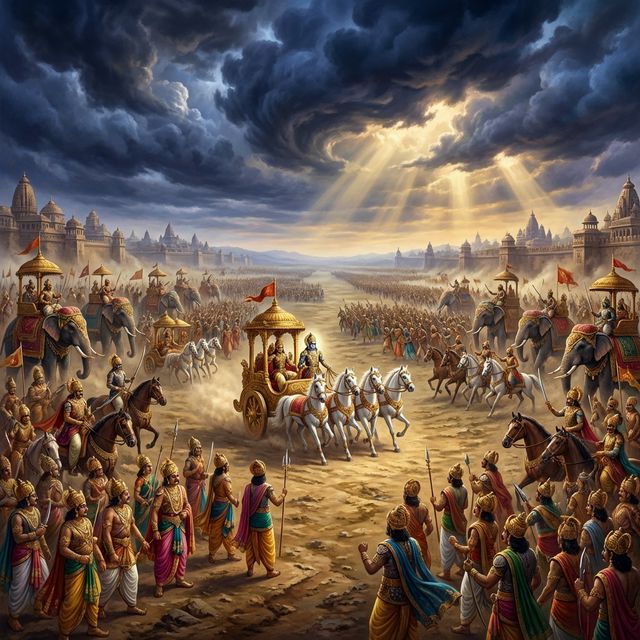
The Cat Who Played the Hermit
Duryodhana's last message to Yudhishthira is a fable about a holy man who ate his worshippers
The Two Camps on the Hiranwati
"Come, O Sanjaya, tell me with the fullest details all that hath happened in the encampment of the Kuru and the Pandava troops."
The old king asked it from his seat in the hall, and he asked it the way a man asks about a fire he has already been told he cannot put out.
"I regard destiny to be superior, and exertion useless," Dhritarashtra said, "for although I understand the evil consequences of war that will lead only to ruin, still I am unable to restrain my son, who rejoices in gambling and considers deceit to be wisdom. Understanding everything, I am not yet able to secure my own welfare. My understanding is capable of seeing the defects of measures, but when I approach Duryodhana, that understanding of mine turneth away."
Sanjaya did not leave him that comfort.
"This question is worthy of thee," he said. "It behoveth thee not, however, to impute entire fault to Duryodhana only. That man who cometh by evil in consequence of his own misconduct should never impute the fault to either time or the gods. Afflicted with injuries in consequence of the match at dice, the sons of Pandu with all their counsellors quietly bore all those injuries, looking up to thy face alone."
Then he told the blind man what had been done on the last evening the world had before the war.
The Pandavas had encamped by the side of the Hiranwati, and the Kauravas had fixed their camps opposite. Duryodhana posted his troops strongly, paid homage to all the kings on his side, and planted outposts and bodies of soldiers for the protection of his warriors. Then he called for the men he trusted. He consulted with Karna first, and alone. Then with Karna and his own brother Dushasana. Then with those two and Shakuni, the son of Suvala, all together.
When they had finished he sent for one more man and had him brought into his presence in private.
Uluka was Shakuni's son, and his grandfather was the king of Gandhara, and he was known in that camp by his father's trade. He belonged to the house whose hands had taken Indraprastha across a gaming cloth without a single arrow being loosed.
"O Uluka," Duryodhana said, "O son of an adept at dice, repair thou unto the Pandavas and the Somakas."
The last embassy of that war was to be carried by a gambler's son, and it carried no offer at all.
The Sloka Prahlada Sang
"Repairing thither, repeat these my words unto Yudhishthira in the hearing of Vasudeva," Duryodhana said. "That terrible battle between the Kurus and the Pandavas which had been expected from a long time back has at last come. Those boastful words which Sanjaya brought to me in the midst of the Kurus, and which thou hadst with Vasudeva and thy younger brothers uttered in deep roar, the time hath at last come for making them good. Do ye achieve, therefore, all which ye have pledged yourselves to achieve."
Then he came to the eldest son of Kunti, and his tone changed, because with Yudhishthira the attack had to be made on the one ground Yudhishthira held.
"Unto the eldest son of Kunti thou must say, as my words, the following. Virtuous as thou art, how canst thou, with all thy brothers, with the Somakas and the Kekayas, set thy heart upon unrighteousness? How canst thou wish the destruction of the universe, when, as I think, thou shouldst be the dispeller of the fears of all creatures?"
That was the whole of the charge, and Duryodhana had a verse ready to hang it on.
"O bull of Bharata's race, this sloka sung of old by Prahlada, when his kingdom had been wrested from him by the gods, hath been heard by us. Ye gods, that person whose standard of righteousness is always up, but whose sins are always concealed, is said to adopt the behaviour of the cat."
Prahlada was the asura king whom the epic keeps as its standing example of rectitude in the wrong family, the one who was known for judging cases against his own interest and against his own son. He had lost a kingdom to the gods. He had not accused the gods of cheating him. What he had said instead was that there is a recognised posture in the world, common enough to have a name, in which the banner of righteousness flies high over a house where everything shameful is kept indoors, and that the name of that posture is the behaviour of the cat.
Duryodhana had chosen to be the man quoting him.
"I will here repeat to thee, O king, this excellent story recited by Narada to my father."
His father was sitting somewhere in Hastinapura while he said it, listening to a charioteer describe the camps. The last message Duryodhana would ever send to Yudhishthira was a tale the rishi Narada had told the blind king years before, in a hall, when it had still cost nothing to hear.
The Ascetic on the Bank of the Ganga
A wicked cat, once on a time, took up his abode on the banks of the Ganga.
He abandoned all work. He stood with his hands upraised, after the manner of a devotee, and pretending to have purified his heart he said unto all creatures these words, for inspiring confidence in them: "I am now practising virtue."
The posture is a real one and it is not a light one. A man who holds his arms above his head and never lowers them keeps that vow until the arms wither in the air, and everyone who passes can see at a glance both what he has undertaken and how long he has kept it. It is the most legible penance there is. It is also, for a cat, the exact opposite of everything a cat is built to do. He was not crouching. He was not lying in wait in the reeds. He was not hiding at all, which is the point, because a creature that is standing in the open with its paws in the air has visibly given up the only advantage it was born with.
After a long time, all oviparous creatures reposed trust in him.
They came unto him all together and they all applauded that cat, and Narada names what the birds were doing in the plainest possible way. Worshipped by all feathery creatures, that devourer of feathery creatures regarded his purpose as already accomplished, as also the purpose of his austerities.
Read that twice. His austerities had a purpose. They were not a mistake he had drifted into and they were not a penance that failed to take. They had been undertaken for a reason, and the reason had now been served, and he knew it on the day the birds began to praise him.
He had been standing there a long time by then, and he had not yet eaten anything.
That is the part of the story that is hardest to hold in mind, and it is what makes the rest of it work. Whatever else the cat was, he was patient enough to starve for a season in order to be trusted. He bought the reputation first, in advance, at full price, and he waited for the market to open.
Let Him Be Our Maternal Uncle
And after some more time, the mice went to that place.
They did not arrive at their opinion of him on their own. They came late, into a settled situation, and they beheld what everybody already there had been saying for a long time: that here was a virtuous person engaged in the observance of vows, and proudly exerting himself in a grand act. The birds had done the investigating. The mice inherited the verdict.
And having arrived at that settled conviction, they entertained a wish.
"Many foes we have," they said among themselves. "Let this one, therefore, become our maternal uncle, and let him always protect all the old and young ones of our race."
Of all the words in the language of kinship they could have reached for, they chose that one. The maternal uncle is the safe relation. He is the mother's brother, the kinsman with no claim on the inheritance and no reason on earth to want the children of the house out of the way, the man to whom a boy is sent when his own home becomes dangerous. In the epic he is the one who comes to fetch you. The mice, who had many foes and were looking for the one kind of relative who could not profit by their deaths, gave that name to a cat.
Then they went to him, all of them, and said it aloud.
"Through thy grace we desire to roam in happiness. Thou art our gracious shelter, thou art our great friend. For this, all of us place ourselves under thy protection. Thou art always devoted to virtue, thou art always engaged in the acquisition of virtue. O thou of great wisdom, protect us, therefore, like the wielder of the thunderbolt protecting the celestials."
They had come to ask a stranger for a guardian, and every proof they offered him of his own fitness was a thing they had been told by somebody else, and the only property they possessed that anyone in the world had ever wanted, they had brought with them.
The Terms He Named
The cat did not accept.
"I do not see the consistency of these two," he said, "viz., my ascetic pursuits and this protection that I am called upon to grant."
It is the finest stroke in the whole fable. The objection that ought to have come from the mice came from him. He raised it himself, in their hearing, and by raising it he made it impossible for any of them to raise it afterwards. A holy man cannot also be a bodyguard; the two lives do not fit together; he saw the difficulty before they did, and he said so, and they loved him for saying it.
Then he gave way, as he had always meant to.
"I cannot avoid, however, doing good to you agreeably to your request. You all, at the same time, should always obey my words. Staying as I am in the observance of a severe vow, I am weakened by my ascetic practices. I do not, therefore, see the means of my moving from place to place. Ye all should, therefore, bear me hence every day to the river-side."
Two conditions, and both of them are the same condition wearing different clothes. Obey me. Carry me.
His weakness was the proof of his holiness. It was also the reason they would have to come close enough to lift him, in numbers, every single morning, with their hands full and their attention on their footing. He had asked them to arrange, as a devotional service, the one situation a cat could never have arranged for himself: a daily procession of mice pressed against his body, on their way to a place he had chosen, out of sight of the rest.
"So be it," the mice said.
They made over all their old and young ones to that cat.
Then that sinful creature of wicked soul, feeding on mice, gradually became fat and of good complexion and strong in his limbs. And thus, while the mice began to be reduced in number, the cat began to grow in vigour and strength.
Nobody in that colony had been deceived about anything except the direction the food was travelling. They had been told, truthfully, that he was too weak to walk. They had simply not been told what would make him strong.
Dindika, and Then Kilika
Then all the mice, coming together, said unto one another: "Our uncle is daily growing stout, while we are being daily reduced in number."
They had the two facts. They had had them for some time. What they did not have was any way of joining the two facts together that did not require them to think a forbidden thought about a person they had publicly called their protector.
A certain mouse endued with wisdom, named Dindika, found the way.
"Go all of ye to the river-side together," he said. "I will follow ye, accompanying our uncle."
"Excellent, excellent," they said, and applauded that one of their number, and they all did just as those words of grave import spoken by Dindika seemed to indicate.
It is a clean experiment. Separate the crowd from the suspect, put one known mouse alone with him on the road, and see whether the count comes right at the other end. Dindika designed it, and Dindika made himself the only subject in it, and nothing in the story suggests he understood he was doing the second of those things.
The cat, however, not knowing all this, ate up Dindika that day.
He was not answering a question. He did not know a question had been asked. He ate the mouse who was walking beside him because a mouse was walking beside him.
Then a very old mouse, named Kilika, said these just words in the presence of all his kinsfolk.
"Our uncle is not really desirous of earning virtue. He hath, like a hypocrite, become our friend when in reality he is our enemy. Indeed, the excreta of a creature that liveth only upon fruits and roots never containeth hair or fur. Then again, while his limbs are growing, our number is decaying. Besides, Dindika cannot be seen for these eight days."
Three proofs, and not one of them is about anything the cat ever said. There is what is on the ground and what is in it. There is the arithmetic of two bodies moving in opposite directions. There is one name, with a number of days attached to it, counted by somebody old enough to keep counting after everyone else had stopped.
The old mouse never once disputes the vow. He simply declines to accept any of it as evidence, and looks instead at the fur.
Hearing these words, the mice ran away in all directions.
And that cat also of wicked soul returned to whence he came. He did not defend himself, because there was nothing left on that bank worth defending himself for. The penance had lasted exactly as long as the food.
Thy Speech Is of One Kind
"O thou of wicked soul, thou too art a practiser of such feline behaviour."
Duryodhana came out of the story the way a man comes out of a doorway, and put it straight into Yudhishthira's face.
"Thou behavest towards thy kinsmen after the manner of the cat towards the mice. Thy speech is of one kind, and thy conduct is of another. Thy devotion to scripture and thy peacefulness of behaviour are only for display before men."
The charge is exact, and it is worth stating precisely, because it is not the ordinary accusation of hypocrisy. It is this: that the man who had spent thirteen years saying he wanted no war, who had asked for five villages instead of a kingdom, who had wept over the coming ruin of the Bharata line, was at that hour standing at the head of seven armies on the field of Kurukshetra with his arms in the air, and that his kinsmen were what he proposed to live on.
And then, having made it, Duryodhana did something stranger than insult him. He gave him advice.
"Giving up this hypocrisy, O king, adopt the practices of a Kshatriya and do all that one should do as such. Art thou not virtuous, O bull among men? Acquiring the earth by means of the prowess of thy arms, make gifts, O best of the Bharatas, unto the Brahmanas and unto thy deceased ancestors as one should. Seeking the good of that mother of thine who hath been afflicted with distress for a series of years, dry up her tears, and confer honours on her by vanquishing thy foes in battle."
There is nothing wrong with a word of it. Take the earth with your arms, give it away properly, and dry your mother's eyes. It is what a kshatriya is for. It is nearly word for word what Kunti herself had sent across to her sons by Krishna's own mouth from the house she was living in. Duryodhana, who wanted Yudhishthira dead, and Kunti, who had carried him, were telling him the same thing on the same night: stop calling it something else and fight.
The insult and the instruction were one sentence, and Duryodhana meant both halves of it.
Five Villages
Then, still speaking, Duryodhana said the thing that no fable could have got out of him.
"Thou hadst with great abjectness solicited only five villages. Even that was rejected by us, for how could we bring about a battle, how could we succeed in angering the Pandavas, was all that we sought."
He was not confessing. He thought he was boasting. But there it is, said aloud in a tent to a messenger on the last night: the five villages had not been refused out of pride or greed or any mistake about what could be spared, but because a settlement was the one outcome the Kuru court could not permit.
"Remembering that it was for thee that the wicked Vidura was driven out by us, and that we had tried to burn you all in the house of lac, be a man now."
The house of lac. He listed it. In a message meant to prove that his cousin was a hypocrite whose sins were always concealed, he read out the arson of Varnavata like a creditor reading a debt.
"At the time of Krishna's setting out from Upaplavya for the Kuru court, thou hadst through him communicated this message: hear, O king, I am prepared for either war or peace. Know, O monarch, that the hour hath come for battle. What doth a Kshatriya regard as a more estimable accession of good fortune than battle? Born thou hast been in the Kshatriya order. Having obtained weapons again from Drona and Kripa, why dost thou rely on Vasudeva, who belongeth to the same order of life as thyself and who is not superior to thee in might?"
Having said this, king Duryodhana laughed aloud.
He was not finished. There were more messages to load onto Uluka before morning, for Bhima and Nakula and Sahadeva, for Virata and Drupada, for Dhrishtadyumna and Shikhandi, and two very long ones for Arjuna and for Krishna, all to be delivered the next day in front of every king in the Pandava camp, and answered there.
But the fable went first, because Duryodhana had picked it to open with. He had asked for it to be repeated in Krishna's hearing, and had chosen the cat on the bank of the Ganga as the last thing he would ever say to his eldest cousin before the conches. Then, in the same breath, he had explained that he refused five villages in order to have this war.
He does not appear to have heard himself. Uluka took the whole of it down and went out to his horse, with the fires of the other camp burning across the flat ground in front of him.
Dharma Lesson
The old mouse Kilika never disputes a word of the cat's theology. He does not argue about the upraised arms or the purified heart; he looks at what is on the ground, notices that the excreta of a creature living on fruits and roots contains no fur, and counts the eight days since Dindika was last seen. A reputation for holiness is evidence about the people who granted it, not about the man who holds it, and the only honest check on it is arithmetic done by somebody willing to be rude. What gives the taunt its edge is the mouth it comes from: Duryodhana could aim the story at Yudhishthira and, a few sentences later, confess that he refused five villages because he wanted this war, without ever hearing the fable turn in his hand.