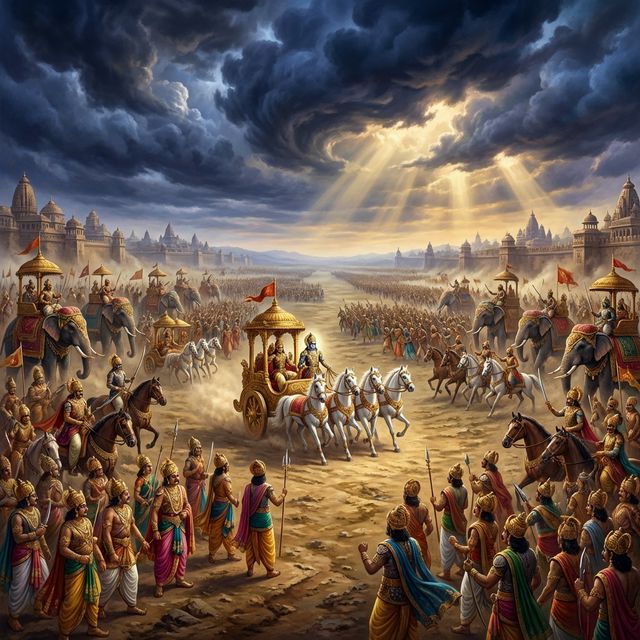
The Sacrifice of Battle
Duryodhana makes the coming war his own rite, and his father disowns him for it
The Roll of Those Who Came
Vaisampayana said that by then the court at Hastinapura had stopped pretending. The armies were counted, the messages had all been carried and answered, and what remained was an old blind king in a hall full of men who had already chosen sides, asking his charioteer questions he did not want answered. Sanjaya had come back from Upaplavya, where the sons of Pandu had gathered seven akshauhinis of troops and were cheerful about it.
"Whom hast thou, O Sanjaya, seen to have, from affection, arrived there," Dhritarashtra said, "and who will, on behalf of the Pandavas, fight my son's forces?"
"I have seen Krishna, the foremost of the Andhakas and the Vrishnis, arrived there, and Chekitana, as also Satyaki, otherwise called Yuyudhana."
Chekitana was a Vrishni prince and Satyaki was Krishna's own pupil in arms, and Sanjaya said what each had brought. Those two mighty car-warriors, proud of their strength and famed over all the world, had joined the Pandavas, each with a separate akshauhini of troops. Not their persons only. Their armies.
"And Drupada, the king of the Panchalas, surrounded by his ten heroic sons, Satyajit and the others, headed by Dhrishtadyumna and well-protected by Shikhandi, hath come there with a full akshauhini, desirous of honouring Yudhishthira."
Drupada was Draupadi's father. His son Dhrishtadyumna had come out of a fire kindled for the destruction of Drona, and his other child, Shikhandi, had been born to end Bhishma. He had furnished his soldiers with every necessary thing before he marched, which is a detail a charioteer notices and a king ought to.
"And that lord of earth, Virata, with his two sons Sankha and Uttara, as also with those heroes Suryadatta and others, headed by Madiraksha and surrounded by one akshauhini of troops, hath thus, accompanied by brothers and sons, joined the son of Pritha."
Virata was the king in whose kitchens and stables and dancing hall the Pandavas had spent their thirteenth year unrecognised. He had brought his family with him.
"And the son of Jarasandha, the king of Magadha, and Dhrishtaketu, the king of the Chedis, have separately come there, each accompanied by an akshauhini of troops. And the five brothers of Kekaya, all having purple flags, have joined the Pandavas, surrounded by an akshauhini of troops. Numbering to this extent have I seen them assembled there, and these, on behalf of the Pandavas, will encounter the Dhartarashtra host. That great car-warrior Dhrishtadyumna, who is acquainted with human, celestial, Gandharva and Asura arrays of battle, leadeth that host."
The son of the fire led it. Sanjaya let that stand a moment before he went on to the harder part.
How They Divided You Among Themselves
"O king," Sanjaya said, "Bhishma, the son of Santanu, has been assigned to Shikhandi as his share."
That was the word. Share. In the Pandava camp the enemy had been cut up and handed out like portions at a feast, every man in that hall allotted to somebody who wanted him, and Sanjaya read the list off in front of the men who were on it.
Bhishma to Shikhandi, with Virata and all his Matsya warriors to support him. The mighty king of the Madras, Shalya, to the eldest son of Pandu, though Sanjaya added, because it was said, that some were of opinion those two were not well matched.
"Duryodhana with his sons and his ninety-nine brothers, as also the rulers of the east and the south, have been assigned to Bhimasena as his share."
A hundred princes counted out to one man.
"Karna, the son of Vikartana, and Jayadratha the king of the Sindhus, have been assigned to Arjuna as his share. And those heroes also on the earth who are incapable of being withstood and who are proud of their might have been accepted by Arjuna as his share."
Whatever was too dangerous to give to anybody else, Arjuna had simply taken.
The five royal brothers of Kekaya had claimed the Kekaya warriors on Dhritarashtra's side, kinsmen against kinsmen, and in their share were included the Malavas also, and the Salwakas, and the two famous warriors of the Trigarta host who had sworn to conquer or die. All the sons of Duryodhana and of Dushasana, with king Vrihadvala, had been assigned to Subhadra's son, the boy Abhimanyu. The sons of Draupadi, on cars with gold-embroidered banners, headed by Dhrishtadyumna, would advance against Drona. Chekitana desired Somadatta in single combat. Satyaki was anxious to battle the Bhoja chief, Kritavarma. Sahadeva, who sets up terrible roars in battle, had taken as his share the king's own brother-in-law, the son of Suvala. Nakula had taken the deceitful Uluka and the tribes of the Saraswatas.
"As for all the other kings of the earth who will go to battle, the sons of Pandu have, by naming them, distributed them in their own respective shares. Thus hath the Pandava host been distributed into divisions. Do thou now, without delay, with thy sons, act as thou thinkest best."
Consecrated by Death
Dhritarashtra heard the list to its end and answered it as a funeral.
"Alas, all my foolish sons, addicted to deceitful dice, are already dead," he said, "when it is the mighty Bhima with whom they desire to encounter in the field of battle. All the kings of the earth too, consecrated by Death himself for sacrifice, will rush to the Gandiva, like so many moths into fire."
He named the other side over again himself, as though the naming were a wound he wanted to press: Yudhishthira for their leader, the slayer of Madhu for their protector, Savyasachin and Vrikodara for their warriors, and Nakula and Sahadeva, Dhrishtadyumna, Satyaki, Drupada, Uttamaujas and the unconquerable Yudhamanyu of the Panchalas, Shikhandi, Uttara the son of Virata, the Kasayas, the Chedis, the Matsyas and the Srinjayas.
"Those, indeed, from whom Indra himself cannot, if they are unwilling, snatch this earth. Those heroes, cool and steady in fight, who can split the very mountains. Alas, it is with them that this wicked son of mine desireth to fight, disregarding me even though I am crying myself hoarse."
Duryodhana had been listening to his father talk this way for months and did not take a word of it seriously.
"Both the Pandavas and ourselves are of the same race," he said. "Both they and we tread upon the same earth. Why dost thou think that victory will declare itself for only the Pandavas? Bhishma, Drona, Kripa, the unconquerable Karna, Jayadratha, Somadatta and Ashwatthama, all mighty bowmen endued with great energy, are incapable of being vanquished by Indra himself united with the celestials. I am powerful enough to encounter in battle the Pandavas with their sons. All those rulers of the earth who are anxious for my welfare will certainly seize all the Pandavas like a herd of young deer by means of a net. In consequence of our crowds of cars and snares of arrows, the Panchalas and the Pandavas will all be routed."
"O Sanjaya," said Dhritarashtra, turning away from his son as from a thing he could not repair, "this my son speaketh like a mad man, for he is incapable of vanquishing in battle Yudhishthira the just. This Bhishma truly knoweth the might of the high-souled Pandavas, for he doth not wish a battle with those illustrious ones. But tell me again of their movements. Who are inciting those mighty bowmen, like priests enkindling homa fires with libations of clarified butter?"
The Whale and the Little Fishes
"O Bharata," Sanjaya said, "Dhrishtadyumna is always urging the Pandavas to war."
He gave the prince's words as he had heard them spoken. "Fight ye, best among the Bharatas. Do not entertain the least fear. All those rulers of the earth who, courted by Dhritarashtra's son, will become in that fierce encounter targets of showers of weapons, I alone will encounter all those angry kings assembled together with their relatives, like a whale seizing little fishes from the water. Bhishma and Drona and Kripa and Karna and Drona's son and Shalya and Suyodhana, them all I withstand, like the bank resisting the swelling sea."
To this the virtuous king Yudhishthira had answered without heat, the way a man speaks to a commander he has chosen and does not intend to second-guess.
"The Panchalas and the Pandavas wholly depend upon thy prowess and steadiness. Rescue us safely from the war. I know, O mighty-armed one, that thou art firm in the duties of the kshatriya order. Even this is the opinion of those acquainted with the scriptures, that the hero who, displaying his prowess, relieves those that after the rout run away from the battle-field seeking for protection, is to be bought with a thousand. Without doubt, thou art that deliverer of those that are overpowered with fear on the field of battle."
Then Dhrishtadyumna had turned to Sanjaya and used him for what he was, a messenger.
"Go thou, O suta, without delay, and say unto all those that have come to fight for Duryodhana, say unto the Kurus of the Pratipa dynasty with the Vahlikas, the son of Saradwata and Karna and Drona and Drona's son, and Jayadratha and Dushasana and Vikarna and king Duryodhana and Bhishma: do not suffer yourselves to be slain by Arjuna, who is protected by the celestials. Before that happens, let some good man approach Yudhishthira and entreat that best of men to accept the kingdom without delay. There is no warrior on the earth like unto Savyasachin, of prowess incapable of being baffled. The celestial car of the holder of Gandiva is protected by the very gods. He is incapable of being vanquished by human beings. Do not, therefore, bend your mind to war."
Sanjaya delivered it in that hall, word for word, to men who had already made up their minds.
Half the Earth Is Enough
The king tried once more, and this time he did not argue about armies. He argued about land.
"Yudhishthira the son of Pandu is endued with kshatriya energy and leadeth the brahmacharya mode of life from his very youth," he said. "Alas, with him these foolish sons of mine desire to fight, disregarding me that am thus bewailing. I ask thee, O Duryodhana, O foremost of the Bharata race, desist from hostility. Under any circumstances, war is never applauded. Half the earth is quite enough for the maintenance of thyself and all thy followers. Give back unto the sons of Pandu their proper share. All the Kauravas deem just this to be consistent with justice, that thou shouldst make peace with the high-souled sons of Pandu. Reflect thus, O son, and thou wilt find that this thy army is for thy own death. Thou understandest not this from thy own folly."
Then he counted, and the count was the most damaging thing he said all day, because it was not a prophecy about the enemy. It was an inventory of his son's own side.
"I myself do not desire war, nor Vahlika, nor Bhishma, nor Drona, nor Ashwatthama, nor Sanjaya, nor Somadatta, nor Shalya, nor Kripa, nor Satyavrata, nor Purumitra, nor Bhurisravas. In fact, none of these desireth war. Indeed, those warriors upon whom the Kauravas, when afflicted by the foe, will have to rely, do not approve of the war."
Every name on that list was a man who would die at Kurukshetra for a cause he had said aloud that he did not want.
"O child, let that be acceptable to thee. Alas, thou dost not seek it of thy own will, but it is Karna and the evil-minded Dushasana and Shakuni, the son of Suvala, that are leading thee to it."
That last sentence was meant kindly. It was a father leaving a door open, an account of the war in which Duryodhana was a young man led astray by bad company and could still turn round without disgrace. All he had to do was accept the version of himself in which he was weak.
Duryodhana would not go through the door. He stood up in the middle of the assembled Kurus and took the whole thing on himself.
The Sacrifice of Battle
"I challenge the Pandavas to battle," Duryodhana said, "without depending upon thyself, Drona, or Ashwatthama, or Sanjaya, or Vikarna, or Kamvoja, or Kripa, or Vahlika, or Satyavrata, or Purumitra, or Bhurisravas, or others of thy party."
He had just been told that his own warriors did not want the war. Very well. He would not ask them to want it. He would keep the war for himself and two other men.
"But, O bull among men, only myself and Karna, O sire, are prepared to celebrate the sacrifice of battle with all the necessary rites, making Yudhishthira the victim."
Then he built the rite in the air, article by article, the way a priest lays out the vessels before he kindles the fire, and every item of it was a thing he was already carrying into the field.
"In that sacrifice, my car will be the altar. My sword will be the smaller ladle. My mace, the large one, for pouring libations. My coat of mail will be the assembly of spectators. My four steeds will be the officiating priests. My arrows will be the blades of kusa grass. And fame will be the clarified butter."
Nothing in it was borrowed. The whole apparatus of the sacred rite had been made out of his own equipment, down to the priests, who were horses, and the offering, which was his own reputation poured into a fire. And the god it was made to was not Agni, and not Indra.
"O king, performing, in honour of Yama, such a sacrifice in battle, the ingredients of which will all be furnished by ourselves, we will return victoriously covered with glory, after having slain our foes. Three of us, O sire, myself and Karna and my brother Dushasana, will slay the Pandavas in battle. Either I, slaying the Pandavas, will sway this Earth, or the sons of Pandu, having slain me, will enjoy this Earth."
He had reduced the war to a wager with two outcomes and said both of them out loud, in order, without flinching at the second.
"O king, O thou of unfading glory, I would sacrifice my life, kingdom, wealth, everything, but would not be able to live side by side with the Pandavas. O venerable one, I will not surrender to the Pandavas even that much of land which may be covered by the sharp point of a needle."
Half the earth had been offered to him. He answered with the point of a needle.
I Now Abandon Duryodhana For Ever
"I now abandon Duryodhana for ever," Dhritarashtra said.
It is the one sentence in that hall nobody expected, and it came from the man who had spent a lifetime refusing to say it. He did not say it in a rage. He said it, and then went straight on to grieve for other people.
"I nevertheless grieve for you all, ye kings, that will follow this fool who is about to proceed to Yama's abode. Like tigers among a herd of deer, those foremost of smiters, the sons of Pandu, will smite down your principal leaders assembled for battle."
Then he began to see it, and he described what he saw to a room full of living men as though he were reading out a record already written.
"Methinks the Bharata host, like a helpless woman, will be afflicted and crushed and hurled to a distance by Yuyudhana of long arms. Adding to the strength of Yudhishthira's army, which without him was already sufficient, Sini's son will take up his stand on the field of battle and scatter his arrows like seeds on a cultivated field. And Bhimasena will take up his position in the very van of the combatants, and all his soldiers will fearlessly stand in his rear, as behind a rampart."
He turned to his son for the rest of it, and he did not threaten him. He told him what he would remember, and when he would remember it.
"Indeed, when thou, O Duryodhana, wilt behold elephants, huge as hills, prostrated on the ground with their tusks disabled, their temples crushed and their bodies dyed with gore, when thou wilt see them lying on the field of battle like riven hills, then, afraid of a clash with him, thou wilt remember these my words. Beholding thy host of cars and steeds and elephants consumed by Bhimasena, and presenting the spectacle of a wide-spread conflagration's track, thou wilt remember these my words. If ye do not make peace with the Pandavas, overwhelming calamity will be yours. Slain by Bhimasena with his mace, ye will rest in peace. Indeed, when thou wilt see the Kuru host levelled to the ground by Bhima, like a large forest torn up by the roots, then wilt thou remember these my words."
Having said this unto all those rulers of the earth, Vaisampayana says, the king turned back to Sanjaya and asked him about something else, as though the disowning of his eldest son had been a piece of business he needed out of the way before he could go on listening.
Two Men on One Seat
"Tell me what Vasudeva and Dhananjaya said."
"With looks bent down and hands joined, I entered the inner apartments for conferring with those gods among men," Sanjaya said. Neither Abhimanyu nor the twins could go where the two Krishnas sat with Draupadi and Satyabhama.
"There I beheld those chastisers of foes, exhilarated with wine and adorned with garlands, seated on a golden dais. And I beheld Kesava's feet resting upon Arjuna's lap, while those of the high-souled Arjuna rested upon the laps of Krishna and Satyabhama."
Partha pointed him to a golden foot-stool. He touched it and sat on the ground instead, and saw the auspicious marks on Arjuna's soles.
"Beholding those youthful heroes, erect like sala trunks, seated on the same seat, a great fear seized me. They seemed to me to be Indra and Vishnu seated together, though Duryodhana of dull sense knoweth it not, in consequence of his reliance on Drona and Bhishma and on the loud vaunts of Karna. That moment I was convinced that the wishes of Yudhishthira the just were certain to succeed."
He was entertained with food and drink, then gave his king's message. Arjuna lifted Kesava's foot off his lap with a hand scarred by the bowstring and urged him to answer.
"Say thou these words unto the wise Dhritarashtra, and in the hearing of Bhishma and of Drona. Do ye celebrate diverse sacrifices, making presents unto the brahmanas, and rejoice with your sons and wives, for a great danger threatens ye. Give away wealth unto deserving persons, for king Yudhishthira is eager for victory."
It is the courtesy of an executioner. Duryodhana had made a sacrifice out of his chariot; Krishna told the Kurus to perform ordinary ones, of the sort men perform when putting a house in order.
Then, as Sanjaya was going, Krishna called after him with tears.
"That debt, accumulating with time, hath not yet been paid off by me. Ye have provoked hostilities with that Savyasachin, who hath for his bow the invincible Gandiva and me for his helpmate. He that is capable of vanquishing Arjuna is able to uphold the Earth with his two arms and to hurl the celestials from Heaven. Among celestials, asuras and men, among yakshas, gandharvas and nagas, I find no person that can encounter him. That ye all fled in all directions, routed in the city of Virata by that son of Pandu singly, is sufficient proof of this."
Bhishma had been at Virata, and Drona, and Karna. He was reminding them of a thing they had agreed to forget. Thus spoke Hrishikesa, roaring like rain-charged clouds, and the diadem-decked Arjuna, of white steeds, spoke to the same effect.
The King Weighs Both Sides
Vaisampayana said that the monarch endued with the eye of wisdom weighed that speech for its merits and demerits, comparing both sides. He was an intelligent king who had always desired victory for his sons, and he sat there doing arithmetic whose answer he did not want. The answer was that the Pandavas were endued with strength and energy both human and divine, and that the Kurus were much weaker.
"This anxiety, O Duryodhana, always filleth me," he said. "Indeed, it doth not leave me. Truly, it seemeth that I behold it with my eye. This conviction is not a matter of inference."
Then he gave his reason, and it was not about soldiers. It was about gratitude.
"All created beings show great affection for their offspring, and do, to the best of their power, what is agreeable and beneficial to them. This is generally to be seen also in the case of benefactors. They that are good always desire to return the good done to them and to do what is highly agreeable to their benefactors. Remembering what was done to him at Khandava, Agni will, no doubt, render aid to Arjuna in this terrible encounter between the Kurus and the Pandavas. And from parental affection, Dharma and the other celestials, duly invoked, will come together to the aid of the Pandavas. I think that to save them from Bhishma and Drona and Kripa, the celestials will be filled with wrath, resembling the thunderbolt in its effects."
The Pandavas had fed Agni an entire forest, and their fathers were gods. Debts of that size do not go unpaid.
Then he described the man he could never stop describing: he who had the celestial Gandiva for his bow, a couple of inexhaustible quivers obtained from Varuna, and on his banner the monkey-image of celestial origin; whose car was unequalled on the earth girt by the four seas, the rattle of which was like the roar of the clouds; who took up five hundred arrows at a time and shot them, unseen, to a great distance; whom Bhishma and Drona and Kripa and Drona's son and Shalya, and in fact all impartial persons, regarded as incapable of being vanquished; who was equal unto Kartavirya in strength of arms and unto Indra in prowess.
"I behold that great warrior committing a great havoc in this terrible battle. Reflecting day and night on this, I am unhappy and sleepless. A terrible destruction is about to overtake the Kurus, if there is nothing but peace for ending this quarrel. I am for peace with the Parthas and not for war. O child, I always deem the Pandavas mightier than the Kurus."
Greater Than the Gods
The passionate son of Dhritarashtra, inflamed with wrath, answered heaven itself.
"Thou thinkest the Parthas, having the celestials for their allies, are incapable of being vanquished. Let this thy fear be dispelled. The gods attained to their divinity for absence of desire, of covetousness and of enmity, and for their indifference to all worldly affairs. Formerly, Dwaipayana Vyasa, and Narada, and Rama the son of Jamadagni told us this. The gods never engage in work from desire, or wrath, or covetousness, or envy. If Agni, or Vayu, or Dharma, or Indra, or the Aswins had ever worked from worldly desire, the sons of Pritha could never have fallen into distress."
Gods who take sides do not leave sons in forests.
Then he stopped arguing and boasted.
"Charmed by me, Agni will be instantly extinguished, even if he blazes up all around to consume all creatures. The energy of the gods is great, but know, O Bharata, that mine is greater than theirs. If the Earth cleaves in twain, or mountain crests split, I can re-unite them by my incantations before the eyes of all. If a tempest or stony shower happeneth for the destruction of this universe, I can stop it. When the waters are solidified by me, even cars and infantry can move over them."
His kingdom, he said, stood under his own protection, not heaven's: no fearful snakes in his dominions, and clouds that rained on his people as much as they wished and when they wished.
"The Aswins, Vayu, Agni, Indra with the Maruts, and Dharma will not venture to protect my foes. Had these been able to protect my adversaries, never would the sons of Pritha have fallen into distress for three and ten years. Neither gods, nor gandharvas, nor asuras, nor rakshasas can save him who hath incurred my displeasure."
Then came the line that gives the speech away. "I mention this for thy information and not from pride. Never had I praised myself before, for to praise one's own self is mean."
"Thou wilt hear of the defeat of the Pandavas and the Matsyas, the Panchalas and the Kekayas, of Satyaki and Vasudeva, at my hands. As rivers entering the ocean are lost in it, so the Pandavas and all their followers, on approaching me, will be annihilated. My intelligence, my energy, my prowess, my knowledge and my resources are superior by far to those of the Pandavas. Whatever knowledge of weapons is in the Grandsire, in Drona and Kripa and Shalya, exists in me as well."
He had answered his father's arithmetic by declaring himself the larger number, and then he turned to Sanjaya to ask what Yudhishthira was doing about the war.
Dharma Lesson
Duryodhana never denies that the war will destroy him; he says plainly that either he will hold the earth or the Pandavas will hold it over his body. What he does is give the destruction a form. A sacrifice has vessels and an order of service, and a man performing one does not have to ask what he wants, only what comes next. That is the danger in this speech: the language of offering can dress an appetite until the man who feels it no longer recognises it, and when his father offers him half the earth to stop, he can refuse a needle-point of ground and hear his own refusal as piety.