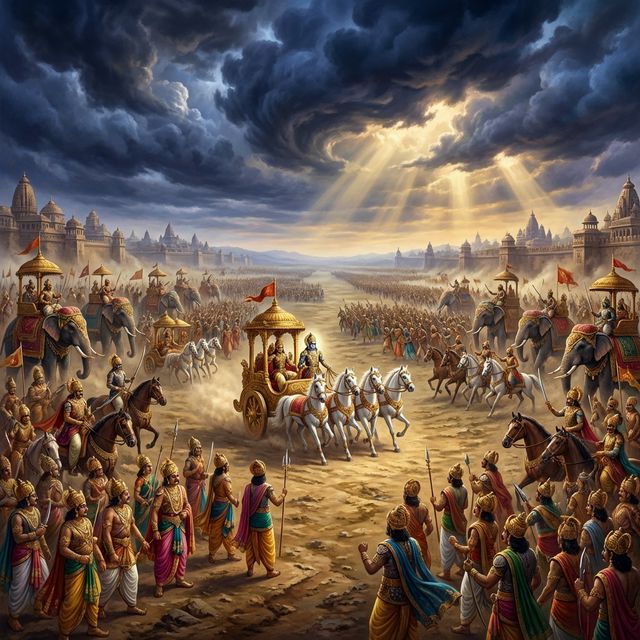
The Weighing of the Bharata
The gods put the epic in a balance against the four Vedas, and Sauti recites the eighteen books
The Scales at Naimisha
The twelve years' sacrifice of Saunaka, whom men called Kulapati, was still burning in the forest of Naimisha when the stranger came out of the trees.
He was Ugrasrava, the son of Lomaharshana, a suta by birth and well versed in the Puranas, and the ascetics who had gathered for that long rite knew him by his other name, Sauti. He bowed to them with joined palms, asked after the progress of their asceticism, and took the seat they assigned him. When he had rested, one of the rishis opened the conversation.
"Whence comest thou, O lotus-eyed Sauti, and where hast thou spent the time? Tell me, who ask thee, in detail."
"I have heard the diverse sacred and wonderful stories which were composed in his Mahabharata by Krishna-Dwaipayana," Sauti said, "and which were recited in full by Vaishampayana at the snake sacrifice of the royal sage Janamejaya, the son of Parikshit. Then I wandered, visiting many sacred waters and holy shrines, and I journeyed to the country the twice-born venerate, called Samantapanchaka, where the battle was fought between the children of Kuru and Pandu and all the chiefs of the land ranged on either side. Thence, anxious to see you, I have come. Shall I recount the sacred stories collected in the Puranas, or the acts of illustrious saints and sovereigns of mankind?"
They did not want the Puranas. They wanted the one that was gleaned from the Vedas and comprehended the sense of the four of them, the holy composition of the wonderful Vyasa which dispels the fear of evil, exactly as Vaishampayana had cheerfully recited it at the snake sacrifice of Raja Janamejaya.
Sauti agreed, and before he told them a single incident of it he told them how its name had been decided.
In former days the celestials had assembled for that purpose. They placed the four Vedas on one side of a balance, with all their mysteries, and on the other side they placed the Bharata.
The Bharata weighed heavier.
From that period it has been called in the world Mahabharata, the great Bharata, being esteemed superior both in substance and in gravity of import. He that knows its meaning is saved from all his sins.
The scale had not been asked which of the two was holier. It had been asked only which was heavier, and it answered.
The Tree of the Parvas
Sauti did not begin with the story. He began by telling them what kind of thing the story was, and he did it in images.
The wisdom of this work, he said, is like the instrument with which collyrium is applied to the eye: it has opened the eyes of an inquisitive world blinded by the darkness of ignorance. As the sun dispels darkness, so does the Bharata, by its discourses on religion, on profit, on pleasure and on final release, dispel the ignorance of men. As the full moon by its mild light expands the buds of the water lily, so this Purana, by exposing the light of the Sruti, has expanded the human intellect. By the lamp of history the whole mansion of nature is properly and completely illuminated.
Then he gave them the tree, and named every part of it.
The chapter of contents is the seed. The divisions called Pauloma and Astika are the root. The part called Sambhava is the trunk. The books called Sabha and Aranya are the roosting perches. The book called Arani is the knitting of the knots. Virata and Udyoga are the pith. The book named Bhishma is the main branch. The book called Drona is the leaves. The book called Karna is the fair flowers. The book named Shalya is their sweet smell. The books entitled Stri and Aishika are the refreshing shade. The book called Shanti is the mighty fruit. The book called Ashwamedha is the immortal sap. The book denominated Ashramavasika is the spot of ground on which the tree grows. And the book called Mausala is an epitome of the Vedas, held in great respect by the virtuous Brahmanas.
"The tree of the Bharata," Sauti said, "inexhaustible to mankind as the clouds, shall be a source of livelihood to all distinguished poets."
He had one more tree, and this one had a man at the root of it.
Yudhishthira is a vast tree, formed of religion and of virtue. Arjuna is its trunk. Bhimasena is its branches. The two sons of Madri are its full grown fruit and its flowers. And its roots are Krishna, and Brahma, and the Brahmanas.
Nowhere in either of those trees is there a place for the war. The war is what happens to the wood.
What a Man Gets for Listening
The ascetics were being offered something, and Sauti was careful to say exactly what it was.
The study of the Bharata is an act of piety. He that reads even one foot of it, with belief, has his sins entirely purged away. In it the Devas have been spoken of, and the Devarshis, and the immaculate Brahmarshis of good deeds, and likewise the Yakshas and the great Uragas. In it has been described the eternal Vasudeva, possessing the six attributes, from whom has proceeded this universe with its principles of generation and progression, its birth, its death and its rebirth. In it is treated that which is called Adhyatma, and that which the foremost yatis behold dwelling in their hearts like an image reflected in a mirror.
Then the plain terms of the bargain.
The man of faith, devoted to piety and constant in the exercise of virtue, is freed from sin on reading this section. The believer who constantly hears the introduction recited from the beginning does not fall into difficulties. A Brahmana who has sinned through his senses in the daylight is freed by reading the Bharata in the evening, and freed of the night's sins in deed, word and mind by reading it at the first twilight of morning. He that causes even a single foot of it to be recited to Brahmanas during a Sradha makes his offerings of food and drink to the manes of his ancestors inexhaustible. He that hears it recited has no need of a bath in the sacred waters of Pushkara. He who gives a hundred kine with horns mounted in gold to a Brahmana learned in the Vedas, and he who daily listens to the sacred narrations of the Bharata, acquire equal merit. The man who listens to it with reverence every day acquires long life, and renown, and ascends to heaven.
"As butter is in curd," Sauti said, "and the Brahmana among bipeds, and the Aranyaka among the Vedas, and nectar among medicines; as the sea is eminent among receptacles of water and the cow among quadrupeds, so is the Bharata said to be among histories."
And then, having promised them so much, he set a limit on all of it in a single line.
"Tapa is innocent, study is harmless, the ordinances of the Vedas prescribed for all the tribes are harmless, the acquisition of wealth by exertion is harmless; but when they are abused in their practices, it is then that they become sources of evil."
Three Editions and a Hundred Parvas
Before the catalogue, Sauti gave them the arithmetic of the thing, because the Bharata exists in more than one size.
Vyasa compiled it first, exclusive of the episodes, in twenty-four thousand verses, and that much alone is what the learned call the Bharata. Afterwards he composed an epitome in one hundred and fifty verses, being the introduction together with the chapter of contents, and this he taught first to his son Shuka. After that he executed another compilation, of six hundred thousand verses. Of those, three million are known in the world of the Devas, fifteen hundred thousand in the world of the Pitris, fourteen hundred thousand among the Gandharvas, and one hundred thousand in the regions of mankind. Narada recited them to the Devas, Devala to the Pitris, Shuka published them to the Gandharvas and Yakshas and Rakshasas, and in this world they were recited by Vaishampayana, a disciple of Vyasa.
"Know that I, Sauti, have also repeated one hundred thousand verses."
Then he began the outline, and the outline itself is a hundred books long.
First Anukramanika, the list; then Sangraha, the summary; then Paushya, then Pauloma, then Astika, then Adivansavatarana. Then Sambhava, of wonderful and thrilling incidents. Then the burning of the house of lac, the killing of Hidimba, the slaughter of Vaka, and Chitraratha. Then the Swayamvara, in which Arjuna by the exercise of kshatriya virtues won Draupadi for wife; then the marriage; then the advent of Vidura, the acquirement of the kingdom, the exile of Arjuna, the carrying away of Subhadra, the receipt of the dower, the burning of the Khandava forest and the meeting with Maya the asura architect.
Then Sabha, Mantra, Jarasandha, the general campaign, the Rajasuya, the robbing of the arghya and the killing of Shishupala. Then the gambling, and what came after the gambling; then the forest; then Kairati, in which is described Arjuna's battle with Mahadeva in the guise of a hunter; then the journey to the regions of Indra; then that mine of religion and virtue, the highly pathetic story of Nala. And so on through the pilgrimage, the abduction of Draupadi, the story of Savitri, the theft of the earrings, Virata, Udyoga, the numbering of the Rathis and the Atirathas, the installation of Bhishma, the Bhagavad Gita, and every death in the war, down to the ascension of Bhishma to heaven and the prophecies of the Bhavishya.
"The high-souled Vyasa composed these hundred parvas," Sauti said, "of which the above is only an abridgement. Having distributed them into eighteen, the son of Suta recited them consecutively in the forest of Naimisha, as follows."
Nobody stopped him.
The First Book and the Second
In the Adi parva, he said, are contained Paushya, Pauloma, Astika, Adivansavatara, Sambhava, the burning of the house of lac, the slaying of Hidimba, the destruction of the asura Vaka, Chitraratha, the swayamvara of Draupadi and her marriage after the overthrow of rivals in war, the arrival of Vidura, the restoration, Arjuna's exile, the abduction of Subhadra, the burning of the Khandava forest, and the meeting with Maya.
Paushya treats of the greatness of Utanka. Pauloma, of the sons of Bhrigu. Astika describes the birth of Garuda and of the Nagas, the churning of the ocean, the birth of the celestial steed Uchchaihsrava, and the dynasty of Bharata at the snake sacrifice of Janamejaya. Sambhava narrates the birth of kings and heroes and of the sage Krishna-Dwaipayana, the partial incarnations of deities, the generation of Danavas and Yakshas and serpents, and the life of king Bharata, born of Shakuntala in the hermitage of Kanwa, who gave the line its name. Here also is the greatness of Bhagirathi, and the birth of the Vasus in the house of Shantanu, and the birth of Bhishma uniting in himself portions of the energies of the other Vasus, his renunciation of royalty, and his protection of Chitrangada and afterwards of Vichitravirya, whom he placed upon the throne. Here is the birth of Dharma among men through the curse of Ani-Mandavya; the plots to send the sons of Pandu to Varanavata; the advice given to Yudhishthira on the road by Vidura in the mlechchha tongue; the burning of Purochana and of the sleeping woman of the fowler caste. Here is the birth of Ghatotkacha, the stay at Ekachakra, the extraordinary births of Draupadi and Dhrishtadyumna, the dejection of Drupada on learning that his daughter was to be wedded to five husbands, and the story of the five Indras recited in consequence. This parva Vyasa divided into two hundred and twenty-seven chapters, containing eight thousand eight hundred and eighty-four slokas.
The second is the extensive parva called Sabha, full of matter: the establishment of the grand hall, the description of the lokapalas by Narada, the preparations for the Rajasuya, the destruction of Jarasandha, the deliverance of the princes confined in the mountain pass, the campaign of universal conquest, the destruction of Shishupala over the offering of the arghya, Bhimasena's ridicule of Duryodhana in the assembly, the preparations for the game of dice, the defeat of Yudhishthira at play by the wily Shakuni, the deliverance of Draupadi by Dhritarashtra from the sea of distress the gambling had caused, as of a boat tossed about by tempestuous waves, and the exile of the defeated king with his brothers. Seventy-eight sections; two thousand five hundred and seven slokas.
Forest, Disguise, and the Failure of Peace
Then comes the third parva, called Aranyaka. It treats of the wending of the Pandavas to the forest with the citizens following them; Yudhishthira's adoration of the god of day, by the injunction of Dhaumya, and the creation of food through the grace of the Sun; the expulsion of Vidura and his return; Duryodhana's plottings, incited by Karna; Bhima's slaying of Kirmira. Here Arjuna wanders in search of weapons and fights Mahadeva in the guise of a hunter, meets the lokapalas, receives their arms and goes to the regions of Indra. Here is the story of Nala, illustrating the patience of Damayanti; here Indra's taking of Karna's earrings and his gift in exchange of a Sakti that could kill only one man; here Bhima's meeting with Hanuman in a grove of bananas; here the seizure of Bhima by a mighty serpent and his release when Yudhishthira answered its questions; here Markandeya's recitals, the abduction of Draupadi by Jayadratha and the shaving of the ravisher's crown, the histories of Rama and of Savitri, and the story in which Dharma came to his son and gave him counsel. Two hundred and sixty-nine sections; eleven thousand six hundred and sixty-four slokas.
The fourth is Virata. The Pandavas, arriving in that kingdom, saw a large shami tree in a cemetery on the outskirts of the city and kept their weapons in it. Then the entry into the city and the year in disguise; the slaying by Bhima of the wicked Kichaka, senseless with lust, who had sought Draupadi; the despatch of Duryodhana's clever spies in all directions and their failure to discover the sons of Pandu; the first seizure of Virata's kine by the Trigartas, the capture of the king and his rescue by Bhimasena; the second seizure of the kine by the Kurus and the defeat of all of them by Arjuna single-handed; and the bestowal of the princess Uttaraa upon Abhimanyu. Sixty-seven sections; two thousand and fifty slokas.
The fifth is Udyoga. Duryodhana and Arjuna came to Vasudeva at the same hour, and Krishna offered them a choice: himself as a counsellor who would not fight, or one akshauhini of troops. Blind to his own interests, Duryodhana asked for the troops. Here Shalya is deceived on the road by hospitality and gives his word to the wrong side; here Sanjaya goes as envoy, and Dhritarashtra cannot sleep, and Vidura counsels him, and Sanatsujata recites the truths of spiritual philosophy; here Krishna goes to Hastinapura for peace and is refused, shows the assembled Rajas his Yoga powers, takes Karna into his chariot and is refused again. Then both sides marched. One hundred and eighty-six sections; six thousand six hundred and ninety-eight slokas.
The Four Books of the Killing
Then, said Sauti, is recited the Bhishma parva, replete with wonderful incidents. In it Sanjaya narrates the formation of the region known as Jambu. In it is the great depression of Yudhishthira's army, and a fierce fight for ten successive days. In it Vasudeva, by reasons based on the philosophy of final release, drove away Arjuna's compunction, which had sprung from his regard for the kindred he was on the eve of slaying. In it Krishna, seeing the loss inflicted on the Pandava army, descended swiftly from his chariot and ran with dauntless breast and his driving whip in hand to effect the death of Bhishma. In it Arjuna, placing Shikhandi before him, felled Bhishma from his car with his sharpest arrows, and Bhishma lay stretched upon his bed of arrows. One hundred and seventeen sections; five thousand eight hundred and eighty-four slokas.
Then the wonderful parva called Drona. The installation of the great instructor in arms; his vow to seize Yudhishthira alive to please Duryodhana; the overthrow of Bhagadatta with the elephant Supratika; the death of the hero Abhimanyu in his teens, alone and unsupported, at the hands of many Maharathas; the destruction by Arjuna of seven akshauhinis and then of Jayadratha; the deaths of Alambusha, Jalasandha, Virata, Drupada and Ghatotkacha; and the terrible weapon Narayana, discharged by Ashwatthama when he was excited beyond measure at the fall of his father. One hundred and seventy sections; eight thousand nine hundred and nine slokas.
Then the most wonderful parva called Karna. The appointment of the king of Madra as his charioteer; the harsh words the two of them used to each other on setting out; the story of the swan and the crow, recited in insulting allusion; Yudhishthira's imminent risk in single combat with Karna; the mutual wrath of Yudhishthira and Arjuna and Krishna's pacification of it. In this parva Bhima, in fulfilment of his vow, ripped open Dushasana's breast in battle and drank the blood of his heart. Then Arjuna slew the great Karna in single combat. Sixty-nine sections; four thousand nine hundred and sixty-four slokas.
Then the parva called Shalya. After all the great warriors had been slain, the king of Madra became the leader of the army, and fell at the hands of Yudhishthira the Just, and Shakuni fell at the hands of Sahadeva. Then Duryodhana went to the lake and made room for himself within its waters and lay there; then Bhima had the news from the fowlers; then the insulting speeches brought him out, since he could never bear affronts; then the encounter with clubs, and the fracture of Duryodhana's thighs by Bhima's mace. Fifty-nine sections; three thousand two hundred and twenty slokas.
The Night Camp and the Two Books of Instruction
Then, said Sauti, comes the parva called Sauptika, of frightful incidents.
The Pandavas having gone away, Kritavarma, Kripa and the son of Drona came to the field in the evening and saw Duryodhana lying on the ground with his thighs broken and covered with blood. Then Ashwatthama vowed that without killing all the Panchalas including Dhrishtadyumna, and the Pandavas with all their allies, he would not take off his armour. The three went into the forest as the sun was setting, and sitting under a banian tree in the night they saw an owl killing crows one after another. At that sight Ashwatthama, his heart full of rage at the thought of his father's fate, resolved to slay the sleeping Panchalas. At the gate of the camp a Rakshasa whose head reached the heavens obstructed all his weapons, and he pacified the three-eyed Rudra by worship, and went in, and with the other two killed the sons of Draupadi and all the Panchalas, slumbering unsuspectingly. All perished that night except the five Pandavas and Satyaki. Then Draupadi resolved to kill herself by fasting; then Bhima followed his preceptor's son in wrath with his mace; then the celestial weapon was discharged and neutralised, and the jewel was taken from Ashwatthama's head. Eighteen sections; eight hundred and seventy slokas.
After this the highly pathetic parva called Stri. Dhritarashtra broke into pieces the iron statue Krishna had deftly placed before him in Bhima's stead. Then Vidura consoled him with reasons pointing to final release; then the king went to the field with the ladies of his house; then the wailings of the wives of the slain, the wrath of Gandhari and Krishna's pacification of it, and at the offering of water to the manes, Kunti's acknowledgment of Karna as her secret son. Its perusal draws tears from the eyes. Twenty-seven sections; seven hundred and seventy-five slokas.
Twelfth comes Shanti, which increases the understanding, in which is related the despondency of Yudhishthira at having slain his fathers, brothers and sons, and in which Bhishma, from his bed of arrows, expounded the systems of duty worth the study of kings, the duties relative to emergencies, and the mysteries of final emancipation. Three hundred and thirty-nine sections; fourteen thousand seven hundred and thirty-two slokas, the largest book of the eighteen.
Next the excellent Anushasana, in which the king of the Kurus was reconciled to himself on hearing the son of Bhagirathi expound the duties: the rules of Dharma and Artha, of charity, of individual duty, the matchless merit of truth, and the great merit of Brahmanas and of kine. In it is the ascension of Bhishma to heaven. One hundred and forty-six sections; eight thousand slokas.
The Horse, the Woods, the Clubs of Grass
Then comes the fourteenth parva, Ashwamedhika: the story of Samvarta and Marutta, the discovery of the golden treasuries, the birth of Parikshit, revived by Krishna after being burnt by Ashwatthama's weapon, the battles of Arjuna with the princes who seized the sacrificial horse, and the mongoose at the horse sacrifice. One hundred and three sections; three thousand three hundred and twenty slokas.
Then the fifteenth, Ashramavasika. Dhritarashtra abdicated the kingdom and went to the woods with Gandhari and Vidura, and the virtuous Pritha left the court of her sons and followed the old couple. In it is the wonderful meeting, through the kindness of Vyasa, of the king with the spirits of his slain children returned from the other world, after which he abandoned his sorrows. In it Vidura attains the most meritorious state, and Sanjaya the blessed, and Yudhishthira hears from Narada of the extinction of the Vrishnis. Forty-two sections; one thousand five hundred and six slokas.
After this comes the Mausala, of painful incidents. Those lion-hearted heroes, oppressed by the curse of a Brahmana and deprived of reason by drink, slew each other on the shores of the Salt Sea with the Eraka grass, which in their hands took on the fatal attributes of the thunderbolt. Neither Balarama nor Krishna, their hour having come, rose superior to the sway of all-destroying Time. Arjuna, finding Dwaraka destitute of the Vrishnis, cremated the dead, and journeying away with the women and children was met by a heavy calamity, and saw the disgrace of his bow Gandiva. Eight sections; three hundred and twenty slokas.
The seventeenth is Mahaprasthanika. The Pandavas abdicated their kingdom and went with Draupadi on the great journey. On the shore of the sea of red waters they came upon Agni, and Arjuna returned to him the bow Gandiva. Then, leaving his brothers who dropped one after another, and Draupadi also, Yudhishthira went on without looking back. Three sections; three hundred and twenty slokas.
And the eighteenth, of celestial incidents, is Svarga. Seeing the celestial car come to take him, Yudhishthira, moved by kindness towards the dog that had accompanied him, refused to ascend without his companion; and Dharma, observing that adherence to virtue, abandoned his canine form and showed himself to the king. Then Yudhishthira in heaven felt much pain, and a celestial messenger showed him hell by an act of deception, and he heard his brothers lamenting under the discipline of Yama. Then he left the human body by a plunge in the celestial Ganges and attained the region his acts had merited. Two hundred and nine slokas. In the appendix are the Harivansa and the Bhavishya, and the slokas of the Harivansa are twelve thousand.
The Ocean and the Ship
"These are the contents of the eighteen parvas," Sauti said, and stopped, and the section he had just finished has its own name. It is called Parva-sangraha, the gathering of the books.
Then he set two numbers side by side. Eighteen akshauhinis of troops came together for battle. The encounter that ensued was terrible, and it lasted eighteen days.
"He who knows the four Vedas with all the Angas and the Upanishads, but does not know this history, cannot be regarded as wise."
That was said to a forest full of men who knew the four Vedas with all the Angas and the Upanishads, and it was not softened. Vyasa of immeasurable intelligence had spoken of the Mahabharata as a treatise on Artha, on Dharma and on Kama, and Sauti was telling them that the three of those could not be had from the Vedas alone.
Those who have listened to this history, he said, can never afterwards bear to listen to others, as they who have heard the sweet voice of the male kokila can never hear the cawing of the crow. As the formation of the three worlds proceeds from the five elements, so do the inspirations of all poets proceed from this composition. As the four kinds of creatures depend upon space for their existence, so do the Puranas depend upon this history. There is not a story current in the world but depends upon it, as the body depends upon the food it takes. As the blessed domestic asrama can never be surpassed by the three other modes of life, so no poets can surpass this poem.
Then he stopped explaining and told them what to do about it.
"Ye ascetics, shake off all inaction. Let your hearts be fixed on virtue, for virtue is the one only friend of him that has gone to the other world. Even the most intelligent, by cherishing wealth and wives, can never make these their own, nor are these possessions lasting."
And last, an image for the thing he had just spent the morning giving them, a table of contents for a poem of a hundred thousand verses recited from memory to men who had twelve years of sacrifice still to burn through.
"As the wide ocean is easily passable by men having ships, so is this extensive history of great excellence and deep import, with the help of this chapter called Parva-sangraha."
Thus ends the section called Parva-sangraha of the Adi Parva of the blessed Mahabharata.
Dharma Lesson
The gods did not ask which book was holier, only which weighed more, and the answer says something about how this tradition measures worth. The Vedas hold the rules; the Bharata holds what happens to people who keep them and to people who do not. Sauti gives his listeners a catalogue rather than a summary, naming every book and counting every verse, because a story that claims to contain the world has to be willing to show its inventory.