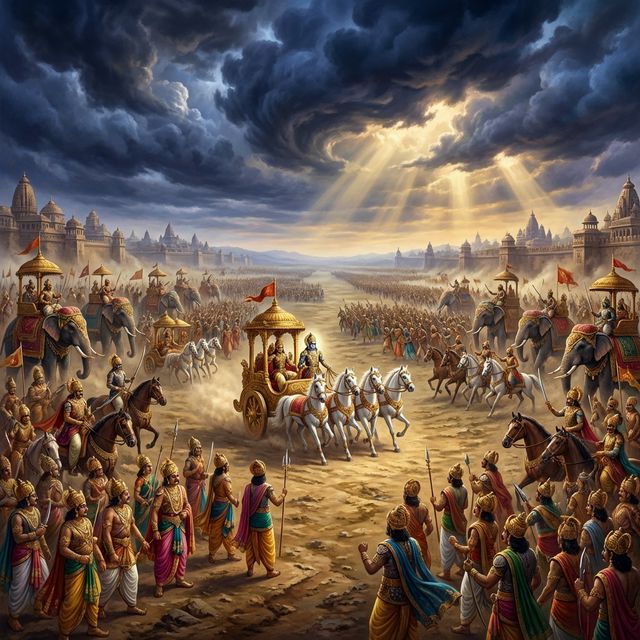
The Boons After the Burning
Indra comes down onto the ashes of Khandava and offers Arjuna and Krishna each a boon no man can obtain
The Last Family Out of Khandava
Vaisampayana was telling it to Janamejaya, and the forest had been burning for fifteen days.
By the time this part of it happened, the fire had already crossed the patch of ground where the Sarngaka birds had their nest, and the four young ones there had come through alive. Their father was the rishi Mandapala, who had taken the shape of a bird in order to get children quickly, and who had then gone away and left them with their mother Jarita, and who had spoken to Agni beforehand and asked that his sons be spared when the burning came. He came back to that place only after the danger had passed. His sons would not speak to him. Jarita would not speak to him either.
So he gave them his account of himself.
"I had spoken unto Agni for the safety of you all," Mandapala said. "The illustrious deity had assured me that he would grant my wish. At those words of Agni, and knowing the virtuous disposition of your mother, as also the great energy that is in yourselves, I came not here earlier. Therefore, ye sons, do not harbour in your hearts any resentment towards me. Ye are all Rishis acquainted with the Vedas. Even Agni knoweth you well."
That was the whole of the defence, and it is worth noticing what it rests on. He had not stayed away because he did not care. He had stayed away because he had a promise from a god, and a wife of good character, and sons who were rishis in their own right, and a man who has all three of those things, he seemed to be saying, is not required to be present.
Having given such assurances unto his sons, the Brahmana Mandapala took with him his wife and his children, and left that region, and went away to some other country.
And with that the last family in Khandava walked out of it. There was nothing left inside the ring of fire now except the fire, and the two men who had spent a fortnight feeding it.
The God of Fierce Rays, Fed
It was thus, said Vaisampayana, that the illustrious god of fierce rays, having grown in strength, consumed the forest of Khandava with the help of Krishna and Arjuna, for the good of the world.
Every word of that sentence is a claim, and the epic makes it without embarrassment. Agni had come to those two starving, a god with an illness in him that only one forest could cure. They had ringed the woods with two chariots and had not let anything out, and the fire had gone up behind them for fifteen days, and the phrase the text uses for what he took out of it is not a delicate one. Agni drank several rivers of fat and marrow.
That is what the burning looked like from the god's side. Not a catastrophe and not a punishment. A meal, of a size no altar in the world could have set before him, poured for him by two men with bows.
And having drunk it, he became highly gratified, and he showed himself to Arjuna.
This is the first time in the whole episode that Agni appears to them in his own form since the day he came asking. He had been the client at the beginning, the mendicant who could not eat, and he had come to Arjuna and Krishna because nobody else would help him against the rain of Indra. Now he stood in front of the man who had made it possible, no longer hungry, and simply let himself be seen.
Nothing had been agreed about what would come afterwards. The bargain had been food in exchange for weapons and a chariot at the start of it, and both sides had delivered on that already. What follows in the story is not payment. It is what gods do when they have been satisfied beyond the terms, and the sky over the burnt ground was about to open a second time.
Because somebody else had been watching the fire, and he had been on the other side of it.
Purandara Comes Down with the Maruts
Then Purandara descended from the firmament.
Purandara is Indra, and the name means the sacker of cities, and he came down surrounded by the Maruts, who are the storm gods, the wind and the thunder that ride with him. They were the same force that had been used against the fire. When the burning began, Indra had covered the sky and rained on Khandava to save it, because the forest was under his protection and Takshaka the snake king was his friend, and he had thrown down water in torrents until Arjuna built a roof of arrows over the whole wood and held the rain off it.
So the god who came down onto the ashes was the god who had lost. He had fought all fifteen days on the losing side of that fire, and he had been beaten by his own son and by Krishna, and this is what he said when he landed.
"Ye have achieved a feat that a celestial even could not," he said, addressing Partha and Kesava. "Ask ye each a boon that is not obtainable by any man. I have been gratified with you."
There is no bitterness anywhere in it. He does not say that they were lucky, or that he had been holding back, or that the forest had been his. He says that what they did was beyond the reach of a god, which from a god is the largest thing that can be said, and then he opens his hands.
This is the shape the epic gives to Indra more than once. He resists, he is defeated, and then he is generous, and the generosity is not a defeat swallowed but a judgment made. He had spent a fortnight trying to find out what those two were, and now he knew, and knowing it he offered each of them a thing no man is ever offered.
Arjuna and Krishna stood on the burnt ground with the offer in front of them, and each of them named exactly one thing.
All Thy Weapons, and Not Yet
Partha asked from Indra all his weapons.
He did not ask for a kingdom, or for long life, or for victory in a war that had not been declared yet. He asked his father for the arsenal of heaven, every astra Indra had, the whole of it, which is the boldest request any mortal in the epic makes of a god and which Arjuna made standing in the wreckage of the god's own forest.
And Sakra of great splendour, which is another of Indra's names, did not refuse. He fixed the time.
"When the illustrious Madhava becomes pleased with thee," he said, "then, O son of Pandu, I will give thee all my weapons. O prince of Kuru's race, I shall know when the time cometh. Even for thy austere asceticism I will give thee all my weapons of fire and all my Vayavya weapons, and thou also wilt accept them all of me."
Read the condition carefully, because it is the strangest clause in the episode. The weapons are not withheld for want of merit and they are not withheld for a price. They are withheld until Krishna is pleased with him. Indra, the king of the gods, granting a boon out of his own store, makes the delivery date depend on the disposition of the man standing next to the petitioner, and says only that he will know when that day arrives.
The rest of the promise is itemised the way a father itemises what a son will inherit. The Agneya weapons, which are the weapons of fire. The Vayavya weapons, which are the weapons of wind. And the last phrase turns the whole thing around at the end: thou also wilt accept them all of me. Not merely I shall give, but you will take, which is a promise made about Arjuna and not about Indra.
Years later Arjuna would climb to his father's city and be taught to use every one of them, and the debt named on this burnt ground would be paid in full. On the day itself, nothing was handed over at all. He had asked for the sky, and had been told to wait.
The Boon Krishna Asked For
Then Vasudeva asked that his friendship with Arjuna might be eternal.
That is the entire request, in the plainest words the translation has, and it is put down without any commentary at all, which is the epic's way of daring the reader to walk past it.
Consider who was asking. This is Krishna, who had held the discus Sudarsana in that fire and used it, who is Vishnu walking about in the world with a chariot and a charioteer, being offered by the king of the gods a boon that no man can obtain. There is nothing in creation he could not have named. He named a thing he already had.
And yet it was not nothing that he asked for, because friendship between a god and a man is the one arrangement that time is guaranteed to end. Men die. Arjuna would be old one day and then he would not be there. What Krishna asked Indra for was that the tie between the two of them should not be subject to that at all, that it should hold before this life and after it, that the pair of them should be a permanent fact rather than an episode.
The chief of the celestials granted unto the intelligent Krishna the boon he desired.
So the two requests made on that ground, side by side, were these. The man asked for the weapons of a god, and got a promise with a condition attached to it. The god asked for the company of the man, and got it outright.
And having granted these boons unto Krishna and Arjuna, the lord of the Maruts, accompanied by the celestials, ascended to heaven. Before he went he spoke also to Hutasana, which is a name for Agni and means the one whose food is the sacrificial butter, though the text does not tell us what was said between them.
The storm gods went up with him. The sky over Khandava closed. And the fire, which had been burning without a pause for fifteen days and nights, began at last to go down.
Three Men on a Riverbank
Agni, having burnt that forest with its animals and its birds for five and ten days, became gratified and ceased to burn.
The count is given twice in this part of the story, five and ten days, as though the number were the thing that mattered most about it. Having eaten flesh in abundance and drunk fat and blood, he became highly gratified, and he turned to the two who had stood guard for him and spoke.
"I have been gratified by you two tigers among men," he said, addressing Achyuta and Arjuna. "At my command, ye heroes, ye shall be competent to go wheresoever ye choose."
That is the discharge. Their work was finished, the god released them from it, and the leave he gave them was the freedom of the whole world.
And then the last sentence of the Adi Parva, which after all that fire is very quiet.
Thus addressed by the illustrious Agni, Arjuna and Vasudeva and the Danava Maya also, these three, having wandered a little, at last sat themselves down on the delightful banks of a river.
Three. Maya was the asura architect, of the race of the Danavas, and he had been inside Khandava when it went up. He had run out of the burning with the fire behind him and the discus of Krishna in front, and he had gone to Arjuna and cried out for shelter, and Arjuna had said that he need not fear and had asked Krishna to let him live. Everything else in that forest died. Maya was the exception, one creature carried out of a fortnight of burning by a single sentence.
So he did not leave. The gods went up, the fire lay down, the two heroes were told they could go anywhere they wished, and the Danava was still with them, and when they stopped walking he stopped too and sat down at the water beside the man who had spared him.
He had not yet said what he wanted to say. He would say it there, on the riverbank, and what he offered in return for his life would take the shape of a hall that a king could lose a kingdom in.
Dharma Lesson
Indra fought for fifteen days to save Khandava, lost, and came down to praise the men who had beaten him. That is a harder thing than defeat, and the epic treats it as the ordinary conduct of a god: to fight with everything you have, and then to judge honestly what you were fighting. Notice also what the two victors asked for when anything in creation was on offer. Arjuna asked for power, and was told to wait for a day another man would decide; Krishna asked only that a friendship should not end, and was given it at once. The gift that had no condition on it was the one that wanted nothing.