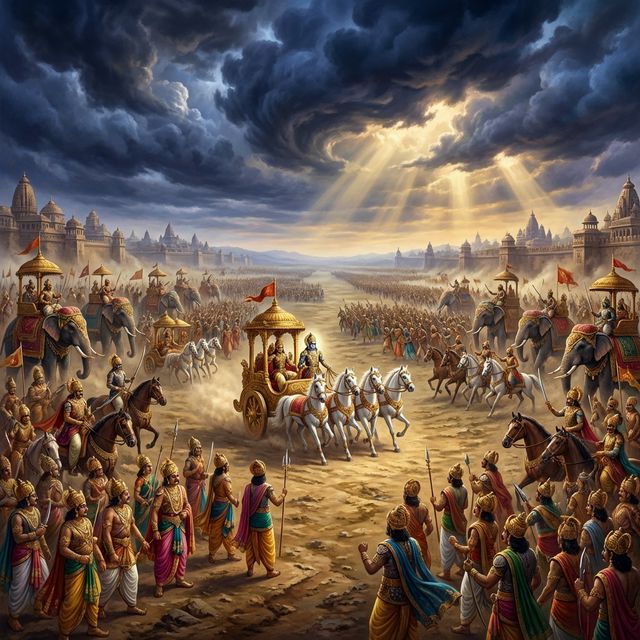
Vidura's Embassy to Panchala
The envoy sent to bring the Pandavas home from Drupada's court
The Order Given in the Blind King's Hall
Vaisampayana told this part in its proper order, and the order matters, because the whole of it turns on one command given by a man who had just been argued out of his own wishes.
The Kuru court had sat a single long session over the news out of Panchala, and when the speeches were finished Dhritarashtra gave his answer. The learned Bhishma, son of Santanu, had spoken the truth, he said, and so had the illustrious Drona, and so had Vidura, and what they had said was also what was most beneficial to him. Those mighty car-warriors, the heroic sons of Kunti, were the children of Pandu, and therefore, according to the ordinance, they were without doubt his children too. And as his own sons were entitled to this kingdom, so were the sons of Pandu certainly entitled to it.
Then came the command that set a man on the road.
"Hasten to bring hither the Pandavas along with their mother, treating them with affectionate consideration. O thou of Bharata's race, bring also Krishna of celestial beauty along with them."
And then, four times in four breaths, the phrase of a king arranging his face in front of his court. From sheer good fortune the sons of Pritha are alive. From good fortune alone those mighty car-warriors have obtained the daughter of Drupada. It is from good fortune alone that our strength hath increased, and from good fortune alone that Purochana hath perished. "O thou of great splendour, it is from good fortune that my great grief hath been killed."
Purochana was the agent who had built the lacquered house at Varnavata and lit it, and who had burned in it himself. The king called that good fortune, in the hearing of the one man in the hall who had warned the Pandavas about the house before they ever walked into it. Nobody corrected him.
That man was Vidura, the king's half-brother, born of a serving woman, barred by his birth from the throne and consulted on everything else. He was what Dhritarashtra reached for when something had to be done correctly.
He went.
What the Envoy Carried
At the command of Dhritarashtra, Vidura repaired unto Yajnasena and the Pandavas, and he did not travel light. He carried with him numerous jewels and various kinds of wealth for Draupadi, for the Pandavas, and for Yajnasena also.
Yajnasena is Drupada, king of the Panchalas, named for the sacrifice out of whose fire his son and daughter had come. It is worth holding both names in mind at once, because Vidura had been sent to a court that had every reason to be watchful. The treasure on the carts had been assembled by the same city that had built the house at Varnavata, and it was being handed to the men who had crawled out of it and to the woman they had just married.
Arrived at Drupada's abode, Vidura, who was conversant with every rule of morality and deep in every science, accosted the monarch properly and waited upon him. Drupada received him in proper form. They enquired after each other's welfare. All of that is protocol, performed exactly, by two men who each knew what the other was.
Then Vidura saw the Pandavas, and Vasudeva standing among them, and the protocol went out of him.
As soon as he saw them he embraced them from affection and asked how they were. It is the only unguarded gesture recorded of him in the whole embassy. The Pandavas along with Vasudeva worshipped him in due order, this Vidura of immeasurable intelligence, and then, having got his own greeting out of the way, he began again in the name of the king and enquired after their welfare repeatedly, and with great affection, on behalf of Dhritarashtra.
After that the gifts were brought out. He gave to the Pandavas, and to Kunti, and to Draupadi, and to Drupada and Drupada's sons, the gems and the various kinds of wealth that the Kauravas had sent through him. Dhrishtadyumna, who had stood at the swayamvara and watched an unknown Brahmana string the bow, took a Kaurava jewel out of a Kaurava hand.
Then the modest Vidura turned, in the presence of the Pandavas and of Keshava, and addressed the well-behaved Drupada.
The Speech About the Alliance
"With thy ministers and sons, O monarch, listen to what I say."
It is a short speech and it is built like a piece of masonry. Vidura laid down the courtesies first, one course at a time, and every one of them was a name that carried weight in Kampilya.
King Dhritarashtra, with ministers, sons and friends, had with a joyous heart repeatedly enquired after Drupada's welfare, and had been highly pleased with this alliance. Bhishma of great wisdom, the son of Santanu, with all the Kurus, had enquired after his welfare in every respect. And Drona also of great wisdom, the son of Bharadwaja, thy dear friend, embracing thee mentally, had enquired after his happiness.
Thy dear friend. Vidura said it without a flicker, to a king whose northern half of Panchala was in Drona's hands, taken in a war fought over exactly that phrase and what had happened to it. The embassy required the sentence and the sentence was delivered.
Then the case itself. Dhritarashtra and all the Kurus, in consequence of this alliance, regarded themselves as supremely blest. "O Yajnasena, the establishment of this alliance with thee hath made them happier than if they had acquired a new kingdom."
And from that, the request. Knowing all this, let the monarch permit the Pandavas to re-visit their ancestral kingdom. The Kurus were exceedingly eager to behold the sons of Pandu. These bulls among men had been long absent from their own country, and they, and Pritha with them, must be very eager to behold their city. And all the Kuru ladies, and the citizens, and the subjects, were eagerly waiting to behold Krishna the Panchala princess.
This, therefore, was his opinion: that Drupada should without delay permit the Pandavas to go, and their wife with them.
He finished with the arrangements, which is how a professional finishes. "And after the illustrious Pandavas, O king, will have received thy permission to go thither, I shall send information unto Dhritarashtra by quick messengers. Then, O king, will the Pandavas set out with Kunti and Krishna."
The couriers were already reckoned into it. He had come expecting a yes.
Not Proper for Me to Say It Myself
Drupada did not refuse and did not simply agree. He did something more careful than either.
"It is even so as thou, O Vidura of great wisdom, hast said. Venerable one, I too have been exceedingly happy in consequence of this alliance. It is highly proper that these illustrious princes should return to their ancestral kingdom."
And then the turn. "But it is not proper for me to say this myself."
A father who tells his new sons-in-law to go home has told them to go, and a father who tells them to stay has made himself their keeper. Drupada would do neither. If the brave son of Kunti, Yudhishthira, and if Bhima and Arjuna, and if those bulls among men the twins themselves desired to go, and if Rama and Krishna, both acquainted with every rule of morality, were of the same mind, then let the Pandavas go. For those tigers among men, he said, meaning Balarama and his brother, are ever engaged in doing what is agreeable and beneficial to the sons of Pandu.
He had handed the decision across the room, and the first man it reached handed it straight back.
"We are now, O monarch, with all our younger brothers, dependent on thee," Yudhishthira said. "We shall cheerfully do what thou art pleased to command."
That left Vasudeva, and Vasudeva gave the shortest speech in the room and the one that settled it.
"I am of opinion that the Pandavas should go. But we should all abide by the opinion of king Drupada, who is conversant with every rule of morality."
So Drupada spoke again, and this time he committed himself. He certainly agreed with what this foremost of men thought, having regard to the circumstances. For the illustrious sons of Pandu were now to him as they were, without doubt, to Vasudeva.
And then he said the thing that decided the room, and it was a compliment to Krishna paid at the expense of Yudhishthira's own vigilance.
"Kunti's son Yudhishthira himself doth not seek the welfare of the Pandavas so earnestly as, Kesava, that tiger among men."
Nobody argued with him. Nobody, in the years afterwards, was ever able to.
The Road to the City Called After the Elephant
Commanded by the illustrious Drupada, the Pandavas went, and Krishna went with them, and Vidura, and they took with them Krishna the daughter of Drupada and the renowned Kunti, and they journeyed towards the city called after the elephant.
They were in no hurry about it. They stopped at various places along the way for purposes of pleasure and enjoyment, which is a line easy to read past and worth stopping on. These were men who had spent the recent seasons in a burnt-out house, in forests, on a river bank at night, and in a potter's lodging in Ekachakra with their mother begging alms. Now they travelled slowly through open country with a wife, an escort and a treasury, and took their time.
King Dhritarashtra, hearing that those heroes had neared the capital, sent out the Kauravas to receive them: Vikarna of the great bow, and Chitrasena, and Drona that foremost of warriors, and Kripa of Gautama's line. Two sons of the house and the two teachers who had trained every man on both sides of the meeting. Surrounded by these, the Pandavas entered Hastinapura slowly, their splendour enhanced by the throng.
The whole city became radiant with the gay throng of sight-seers animated by curiosity, and those tigers among men gladdened the hearts of all who beheld them. What the people said as they passed was written down, and it is not the sort of thing a court arranges.
Some exclaimed, "Here returns that tiger among men, conversant with all the rules of morality, who always protects us as if we were his nearest relatives."
Elsewhere they said, "It seems that king Pandu, the beloved of his people, returneth today from the forest, doubtless to do what is agreeable to us."
And there were some who said, "What good is not done to us today when the heroic sons of Kunti come back to our town? If we have ever given away in charity, if we have ever poured libations of clarified butter on the fire, if we have any ascetic merit, let the Pandavas, by virtue of all those acts, stay in our town for a hundred years."
The citizens were spending their accumulated merit on a lease. They were asking for a hundred years. They would get rather less.
The Feet of the Elders
At the end of the road there was no speech and no ceremony of state. There was only the thing sons do when they come home.
On arriving at the place, the Pandavas worshipped the feet of Dhritarashtra, and then the feet of the illustrious Bhishma. Then they worshipped the feet of everybody else who deserved that honour, and there were a good many. And they enquired after the welfare of every citizen there present, one after another, standing in the dust of their own arrival, until it had been done properly.
Consider what was in that room while it was going on. The king whose sons had arranged the fire, the grandsire who had let the boys be sent to Varnavata, the envoy who had warned them in words nobody else in the hall could understand, and the five men who had been declared dead and burnt in effigy. Not one word of any of it was said. The feet were touched. The greetings were exchanged. Kunti, who had been mourned as ash along with them, stood among the women who had mourned her.
Then, at the command of Dhritarashtra, they entered the chambers that had been assigned to them.
Assigned. That is the word the account uses, and it is the first quiet notice of what the arrangement was going to be. They had not come back to their father's rooms. They had come back to accommodation, allotted by the man who had sent for them, in a house where their cousin had grown up expecting to inherit everything.
They rested there for some time. Draupadi, who had been in Hastinapura for less than a day, learned the corridors of a palace she would one day be dragged through by the hair.
And then they were summoned. Not by the king alone: by king Dhritarashtra and Bhishma the son of Santanu together, which meant that whatever was to be said had already been agreed between the throne and the grandsire before the sons of Pandu were sent for.
Vidura had done exactly what he was sent to do. He had brought them home, with gifts, with the consent of Panchala, with Krishna's blessing and a slow triumphal road, into a hall that had already decided what home was going to be.
They came when they were called.
Dharma Lesson
An embassy is dharma performed in public, and Vidura performs it perfectly: the exact courtesies, the gifts handed over in order, the friendly words about Drona said to a king Drona had robbed. Underneath it, everyone in the room knows what the errand is really settling. Drupada's refusal to speak for his sons-in-law, and his insistence that Krishna and Yudhishthira answer first, is the quiet honesty in the episode. A father who has just gained five kings understands that the moment he begins telling them where to live, he has stopped being their kinsman and started being their master.