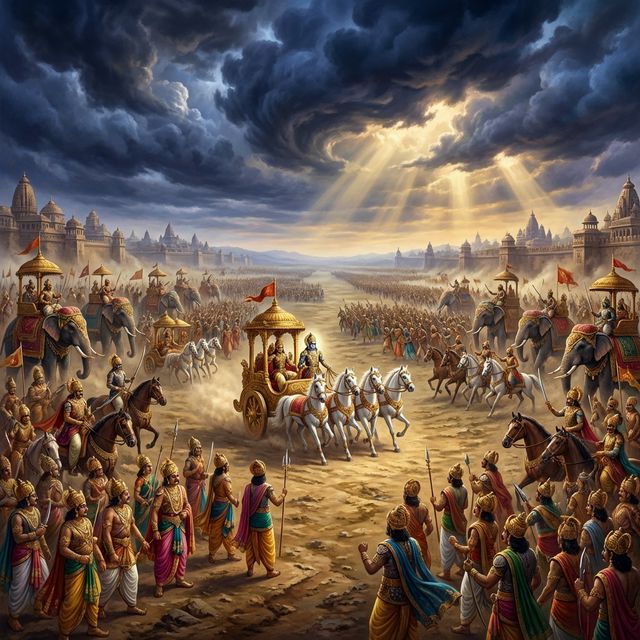
The Lineages of Gods and Demons
Vaishampayana recites the descent of every creature from Brahma and the daughters of Daksha
The Question Asked Before the Descent
Before any of it began on earth, Indra went and sat down with Narayana and held a consultation about the descent.
It was to be done by portions. Not one god sent down whole, but each of the dwellers in heaven putting a part of himself into a human birth, and the parts arranged beforehand between the two of them so that the whole would come out right. Having settled it, and having commanded all the dwellers in heaven, Indra returned from the abode of Narayana, and after that the gods came down gradually, as men are born, for the destruction of the Asuras and for the welfare of the three worlds.
They took their births as they pleased, in the races of Brahmarshis and of royal sages. And they slew the Danavas, the Rakshasas, the Gandharvas and the Snakes, and other man-eaters, and many other creatures besides. Vaishampayana added one detail about them that is easy to pass over. The Danavas and the Rakshasas and the Gandharvas and the Snakes could not slay those incarnate celestials even in their infancy. So strong they were, in the cradle.
At that point Janamejaya, sitting at his own sacrifice and listening to the history of his house, stopped the recitation and asked for something older.
"I desire to hear from the beginning of the births of the gods, the Danavas, the Gandharvas, the Apsaras, men, Yakshas and Rakshasas," the king said. "Therefore it behoveth thee to tell me about the births of all creatures."
He was asking for the root of the thing. If the war his ancestors fought was gods and Asuras wearing the bodies of kings, then the king wanted to know who those gods and Asuras were before they were kings, and where they had come from, and in what order.
Vaishampayana, the pupil of Vyasa, agreed without hedging.
"Indeed, I shall, having bowed down to the Self-create, tell thee in detail the origin of the celestials and other creatures."
He bowed, and then he began at the top, with the mind of Brahma.
Six Sons of the Mind, Thirteen Daughters of Daksha
It is known, said Vaishampayana, that Brahman hath six spiritual sons. They were not begotten. They were thought.
Their names are Marichi, Atri, Angiras, Pulastya, Pulaha and Kratu. Everything that follows in the account comes down through them, and the line that matters most for gods and Asuras alike runs through the eldest of the six. Marichi's son is Kashyapa, and from Kashyapa have sprung these creatures. That single sentence is the hinge of the whole genealogy, and Vaishampayana will set it down a second time before he is finished, because a listener who forgets it will not understand why the enemies in this war are cousins.
The other side of the descent comes through Daksha, one of the Prajapatis, the lords of created beings. Unto Daksha were born thirteen daughters of great good fortune, and they were given to Kashyapa, and the sons and grandsons of these, gifted with great energy, are countless.
Hear their names, said the narrator, in order. Aditi. Diti. Danu. Kala. Danayu. Sinhika. Krodha. Pradha. Viswa. Vinata. Kapila. Muni. And Kadru.
Thirteen women, one husband, and out of that household came the gods, the Asuras, the serpents, the birds of prey, the Gandharvas and the Apsaras, all of them half brothers and half sisters to one another. The wars of heaven are a family quarrel, and this is the roster of the family.
From Aditi have sprung the twelve Adityas, who are the lords of the universe. As they are according to their names, said Vaishampayana, so shall I recount them to thee: Dhatri, Mitra, Aryaman, Sakra, Varuna, Ansa, Vaga, Vivaswat, Usha, Savitri, Tvashtri, and Vishnu.
Twelve, and the last named is the youngest of the twelve, and about him the narrator makes the only judgment of rank in the entire list.
The youngest, however, is superior to them all in merit.
Diti's Son and the Line of Prahlada
Aditi had twelve. Her sister Diti had one, and that one was Hiranyakasipu.
He is the Asura of the old stories, the enemy of Vishnu, and Vaishampayana does not stop to retell any of that here. He is counting. The illustrious Hiranyakasipu had five sons, all famous throughout the world, and the eldest of them all was Prahlada. The next was Sahradha. The third was Anuhrada. And after him were Sivi and Vashkala.
There is a quiet strangeness in that list which the epic never troubles to explain and never lets you forget. The eldest son of the great enemy of Vishnu was the most famous devotee of Vishnu that the Asura race produced. The father is in the catalogue of demons and so is the son, and the son is the one who was right.
It is known everywhere, said Vaishampayana, that Prahlada had three sons. They were Virochana, Kumbha, and Nikumbha.
And unto Virochana was born a son, Vali, of great prowess. That is the Vali whom the worlds remember for a gift rather than for a war, the Asura king so open handed that heaven had to be taken back from him by a measuring of three steps.
And the son of Vali is known to be the great Asura, Vana. Blessed with good fortune, Vana was a follower of Rudra, and was known also by the name of Mahakala.
Follow the line down and see what it does. Hiranyakasipu, who would not have the name of Vishnu spoken in his house. Prahlada, who would speak nothing else. Virochana. Vali, who gave away the earth. Vana, who took the ash and the skull and stood in the train of the god who dances in the burning ground.
Five generations of Asuras, and by the end of them the family has gone over almost entirely to the gods it was born to fight. Vaishampayana lets the names do that work and moves on to Danu.
The Forty Sons of Danu
And Danu had forty sons, O Bharata, said Vaishampayana, and then he named them, because a catalogue is a kind of monument and the point of it is that every one of them had a name.
The eldest of them all was Viprachitti of great fame. Then Samvara, and Namuchi, and Pauloman. Asiloman, and Kesi, and Durjaya. Ayahsiras, Aswasiras, and the powerful Aswasanku. Also Gaganamardhan, and Vegavat, and he called Ketumat. Swarbhanu, Aswa, Aswapati, Vrishaparvan, and then Ajaka. And Aswagriva, and Sukshama, and Tuhunda of great strength. Ekapada, and Ekachakra, Virupaksha, Mahodara, and Nichandra, and Nikumbha, Kupata, and then Kapata. Sarabha, and Sulabha, Surya, and then Chandramas.
These in the race of Danu are stated to be well known. And here the narrator stops to prevent a confusion. The Surya and Chandramas of the celestials, the Sun and the Moon that men see, are other persons, and not the sons of Danu mentioned above. They are not the luminaries.
Ten more, gifted with great strength and vigour, were also born in the race of Danu: Ekaksha, Amritapa of heroic courage, Pralamva and Naraka, Vatrapi, Satrutapana, and Satha the great Asura, Gavishtha, and Vanayu, and the Danava called Dirghajiva.
And Sinhika gave birth to Rahu, the persecutor of the Sun and the Moon, and to three others, Suchandra, Chandrahantri, and Chandrapramardana. Four children of one mother, and three of the four are named for the destruction of the moon.
The countless progeny of Krodha were as crooked and wicked as herself, a tribe wrathful, of crooked deeds, and persecutors of their foes.
Danayu had four sons who were bulls among the Asuras: Vikshara, Vala, Vira, and Vritra the great Asura, the one Indra would have to kill.
And the sons of Kala were all like Yama himself, smiters of all foes, of great energy, oppressors of all foes. They were Vinasana and Krodha, and then Krodhahantri, and Krodhasatru, and there were many others among the sons of Kala.
Last in the roll of that side of the house stands its chaplain. Shukra, whom men call Shukracharya, the son of a Rishi, was the chief priest of the Asuras, and the celebrated Shukra had four sons who were priests of the Asuras also. They were Tashtadhara and Atri, and two others of fierce deeds. They were like the Sun himself in energy, and they set their hearts on acquiring the regions of Brahman.
The demons had Brahmanas. They had a fire, and mantras, and a family of hereditary priests who wanted heaven exactly as the priests of the gods wanted it. The difference between the two halves of this family is whose altar the same learning is standing at.
Serpents, Singers and the Women of Heaven
"Thus hath been recited by me, as heard in the Purana," said Vaishampayana, "of the progeny of the gods and the Asuras, both of great strength and energy. I am incapable, O king, of counting the descendants of these, countless as they are, and they are not much known to fame."
It is an unusual admission from a man reciting a sacred list. He has been naming beings by the score, and he stops to say that below a certain line they cannot be counted at all. What remained were the stranger children of that same house.
The sons of Vinata were Tarkhya and Arishtanemi, and Garuda and Aruna, and Aruni and Varuni. One mother, and out of her came the bird that carries Vishnu and the charioteer of the sun.
And Sesha or Ananta, Vasuki, Takshaka, Kumara, and Kulika are known to be the sons of Kadru. Sesha is the coil the world rests on. Vasuki was the rope at the churning of the ocean. Takshaka is the snake whose bite killed Parikshit, and it was for Takshaka's sake that the fire was burning in front of Janamejaya while he listened to this. The king was hearing the pedigree of his father's killer recited as scripture.
Then the Gandharvas, the singers of heaven, who were the sons of Muni, another of Daksha's daughters. Bhimasena, Ugrasena, Suparna, Varuna, Gopati, and Dhritarashtra, and Suryavarchas the seventh, Satyavachas, Arkaparna, Prayuta, Bhima, and Chitraratha known to fame, of great learning and a controller of his passions, and then Kalisiras, and Parjanya the fourteenth in the list, Kali the fifteenth, and Narada the sixteenth.
Sixteen names, and two of them are met later in this epic as persons with faces. Chitraratha is the Gandharva king who fought Arjuna at a night ford on the Ganga and became his friend. Narada walks in and out of the story to its end.
Pradha brought forth daughters: Anavadya, Manu, Vansa, Asura, Marganapria, Anupa, Subhaga, Vasi. And her sons were Siddha, and Purna, and Varhin, and Purnayus of great fame, Brahmacharin, Ratiguna, and Suparna who was the seventh, Viswavasu, Bhanu, and Suchandra who was the tenth. All these were celestial Gandharvas.
And Pradha, through the celestial Rishi her husband, brought forth the sacred Apsaras: Alamvusha, Misrakesi, Vidyutparna, Tilottama, Aruna, Rakshita, Rambha, Manorama, Kesini, Suvahu, Surata, Suraja, and Supria. Her sons by Amrita were Ativahu, and the celebrated Haha and Huhu, and Tumvuru, the best of Gandharvas.
The Brahmanas, the kine, the Gandharvas and the Apsaras were born of Kapila, as stated in the Purana.
"This account," said Vaishampayana, "extendeth the span of life. It should always be heard, and recited to others, in a proper frame of mind."
The Eleven Rudras and the Fifty Daughters
Then he went back to the beginning and started down a second time, because the first descent had missed a son.
Besides the six great Rishis born of Brahman's mind there was another of the name of Sthanu, and the sons of Sthanu, gifted with great energy, were eleven. Mrigavayadha, Sarpa, Niriti of great fame. Ajaikapat, Ahivradhna, and Pinaki the oppressor of foes. Dahana, and Iswara, and Kapali of great splendour, and Sthanu, and the illustrious Bharga. These are called the eleven Rudras.
The six Rishis themselves had progeny, and this is where the account stops being a list of persons and becomes a list of the kinds of things that exist.
Angiras's sons are three, Brihaspati, Utathya, and Samvarta, all of rigid vows. The sons of Atri are numerous, and being great Rishis they are all conversant with the Vedas, crowned with ascetic success, and of souls in perfect peace.
The sons of Pulastya of great wisdom are Rakshasas, Monkeys, Kinnaras, and Yakshas. The sons of Pulaha were the Salabhas, which are the winged insects, and the lions, the Kimpurushas, the tigers, bears, and wolves. And the sons of Kratu, sacred as sacrifices, are the companions of the sun, the Valikhilyas, known in three worlds, devoted to truth and vows.
Whole orders of being, handed out one sage at a time.
And the illustrious Rishi Daksha, of soul in complete peace and of great asceticism, sprang from the right toe of Brahman, and from the left toe of Brahman sprang the wife of Daksha. He begot upon her fifty daughters, and all those daughters were of faultless features and limbs and of eyes like lotus petals.
Daksha had no sons. So he made those daughters his Putrikas, appointed daughters, so that their sons might belong both to himself and to their husbands, and then he bestowed them according to the sacred ordinance. Ten upon Dharma. Twenty seven upon Chandra, the Moon. Thirteen upon Kashyapa.
The ten wives of Dharma are Kirti, Lakshmi, Dhriti, Medha, Pushti, Sraddha, Kria, Buddhi, Lajja, and Mali. Fame, Fortune, Firmness, Intelligence, Growth, Faith, Action, Understanding, Modesty, and Wealth, married to Righteousness by the appointment of the Self-create.
And the twenty seven wives of Soma, all of sacred vows, are employed in indicating time. They are the Nakshatras and the Yoginis, and they became so for assisting the courses of the worlds. The lunar mansions are a marriage, and the calendar is what the marriage produces.
The Eight Vasus and the Engineer of the Immortals
Brahman had another son named Manu, and Manu had a son of the name of Prajapati, and the sons of Prajapati were eight and were called the Vasus.
They are Dhara, Dhruva, Soma, Aha, Anila, Anala, Pratyusha, and Prabhasa, and every reader of this epic already knows what becomes of them. These are the eight who were cursed to be born of a woman, and who were carried to the river by Ganga one after another and drowned as infants, and the eighth of whom was left alive and grew up to be Bhishma.
Here they are before any of that, with their mothers named. Dhara and the truth knowing Dhruva were born of Dhumra. Chandramas and Swasana were born of the intelligent Swasa. Aha was the son of Rata, and Hutasana of Sandilya, and Pratyusha and Prabhasa were the sons of Prabhata.
Their children are given too. Dhara had two sons, Dravina and Huta-havya-vaha. And the son of Dhruva is the illustrious Kala, Time, the destroyer of the worlds, which is a thing worth noticing about the household of the gods: Time is somebody's boy. Soma's son is the resplendent Varchas, and Varchas begot upon his wife Manohara three sons, Sisira and Ramana among them. The sons of Aha were Jyotih, Sama, Santa, and Muni.
And the son of Agni is the handsome Kumara, born in a forest of reeds, who is also called Kartikeya because he was reared by Krittika and the other stars. After Kartikeya were born his three brothers, Sakha, Visakha, and Naigameya. The wife of Anila is Siva, and Siva's sons were Manojava and Avijnataagati, Swift as Thought and He Whose Going Is Unseen. The son of Pratyusha is the Rishi named Devala, and Devala had two sons who were both exceedingly forgiving and of great mental power.
And the sister of Brihaspati, the first of women, uttering the sacred truth, engaged in ascetic penances, roamed over the whole earth, and she became the wife of Prabhasa, the eighth Vasu.
She brought forth Viswakarman, the founder of all arts.
He was the originator of a thousand arts, the engineer of the immortals, the maker of all kinds of ornaments, and the first of artists. He it was who constructed the celestial cars of the gods. And mankind are enabled to live in consequence of the inventions of that illustrious one, and he is worshipped for that reason by men, and he is eternal and immutable.
The Thirty-Three, and Their Companies
The illustrious Dharma, the dispenser of all happiness, assuming a human countenance, came out through the right breast of Brahman.
He has three excellent sons capable of charming every creature, and they are Sama, Kama, and Harsha, which is to say Peace, Desire, and Joy, and by their energy they are supporting the worlds. The wife of Kama is Rati, Pleasure. The wife of Sama is Prapti, Attainment. The wife of Harsha is Nanda, Delight. And upon them, indeed, are the worlds made to depend, which is the account's way of saying that righteousness holds the universe up by way of contentment and wanting and gladness, and not by way of fear.
The son of Marichi is Kashyapa, said Vaishampayana, setting it down a second time. And Kashyapa's offspring are the gods and the Asuras. Therefore is Kashyapa the Father of the worlds.
And Tvashtri, of the form of a mare, became the wife of Savitri, and she gave birth in the skies to two greatly fortunate twins, the Aswins, the physicians of heaven, born of a horse in the open air. The sons of Aditi are twelve with Indra heading them all, and the youngest of them all was Vishnu, upon whom the worlds depend.
Now the sum. These are the thirty three gods: the eight Vasus, the eleven Rudras, the twelve Adityas, and Prajapati and Vashatkara. Eight and eleven and twelve and two. When the hymns say the thirty three, that is the arithmetic behind it, and the listener has now been given every name in it.
Their progeny are reckoned according to their Pakshas, their Kulas and their Ganas, their wings and families and companies, and the reckoning goes like this. The Rudras, the Saddhyas, the Maruts, the Vasus, the Bhargavas, and the Viswedevas are each reckoned as a Paksha. Garuda the son of Vinata, and the mighty Aruna, and the illustrious Brihaspati, are reckoned among the Adityas. The twin Aswins, all annual plants, and all inferior animals, are reckoned among the Guhyakas.
Grass and cattle filed in the same company as the physicians of the gods. Nothing in the world is left standing outside the muster.
"These are the Ganas of the gods recited to thee, O king," said Vaishampayana. "This recitation washes men of all sins."
Bhrigu's Line, and the Sons of Anger
The illustrious Bhrigu came out, ripping open the breast of Brahman.
His son is the learned Shukra, and here the account explains something it had left standing earlier. Shukra became a planet, and traverses the skies by the command of the Self-existent, pouring and withholding rain, dispensing and remitting calamities, for the sustaining of the lives of all creatures in the three worlds. And Shukra, of rigid vows and leading the life of a Brahmacharin, divided himself in twain by the power of asceticism, and became the spiritual guide of both the Daityas and the gods.
That is how one man is chaplain to both armies. He did not change sides. He split.
After Shukra was thus employed, Bhrigu begot another son, Chyavana, who was like the blazing sun. He came out of his mother's womb in anger, and by coming out in anger he became the cause of his mother's release from the hands of the Rakshasas. Arushi, the daughter of Manu, became the wife of Chyavana, and on her was begotten Aurva of great reputation, who came out ripping open the thigh of his mother.
Aurva begot Richika, who even in his boyhood became possessed of great power and energy and of every virtue. And Richika begot Jamadagni. And the high souled Jamadagni had four sons, and the youngest of them all was Rama, whom the world calls Parashurama. He was superior to all his brothers in the possession of good qualities, skilful in all weapons, the slayer of the Kshatriyas, and he had his passions under complete control. Aurva had a hundred sons with Jamadagni the eldest, and these hundred had offspring by thousands spread over this earth.
Brahman had two other sons, Dhatri and Vidhatri, who stayed with Manu, and their sister is the auspicious Lakshmi, having her abode amid lotuses, whose spiritual sons are the sky ranging horses. And the daughter born of Shukra, named Divi, became the eldest wife of Varuna, and of her were born a son named Vala and a daughter named Sura, which is wine, to the joy of the gods.
And Adharma, which is Sin, was born when creatures from want of food began to devour one another.
Adharma always destroys every creature. His wife is Niriti, whence the Rakshasas who are called Nairitas. And she has three other cruel sons always engaged in sinful deeds, and they are Bhaya and Mahabhaya, Fear and Terror, and Mrityu, Death, who is always engaged in slaying every created thing.
And as he is all destroying, he hath no wife, and no son.
The Mothers of Every Living Thing
What was left was the animals, and they too have mothers with names.
Tamra brought forth five daughters known throughout the worlds. Kaki, Syeni, Phasi, Dhritarashtri, and Suki. Kaki brought forth the crows. Syeni brought forth the hawks, the cocks and the vultures. Dhritarashtri brought forth all ducks and swans, and she brought forth all the Chakravakas as well. And the fair Suki, of amiable qualities and possessing all auspicious signs, brought forth all the parrots.
And Krodha, whose name is Anger, gave birth to nine daughters, all of wrathful disposition. Their names were Mrigi, Mrigamanda, Hari, Bhadramana, Matangi, Sarduli, Sweta, Surabhi, and the agreeable Surasa, blessed with every virtue.
The offspring of Mrigi are all animals of the deer species. The offspring of Mrigamanda are all animals of the bear species, and those called Srimara, the sweet footed. Bhadramana begot the celestial elephants, Airavata among them. The offspring of Hari are all animals of the simian species endued with great activity, and also all the horses, and those animals called Go-langula, the cow tailed. Sarduli begot lions and tigers in numbers, and leopards, and all other strong animals. The offspring of Matangi are all the elephants, and Sweta begat the large elephant known by the name of Sweta, endued with great speed.
Surabhi gave birth to two daughters, the amiable Rohini and the far famed Gandharvi, and to two others named Vimala and Anala. From Rohini have sprung all kine, and from Gandharvi all animals of the horse species. Anala begat the seven kinds of trees yielding pulpy fruits, which are the date, the palm, the hintala, the tali, the little date, the nut, and the cocoanut, and she had another daughter called Suki. Surasa bore a son called Kanka, a species of long feathered birds, and she bore the Nagas, and Kadru bore the Punnagas.
And Syeni, the wife of Aruna, gave birth to two sons of great energy and strength, named Sampati and the mighty Jatayu, the two brother vultures, set down here in a single line as birds among birds.
And Vinata had two sons, Garuda and Aruna, known far and wide.
"Thus hath the genealogy of all the principal creatures been fully described by me," said Vaishampayana. "By listening to this, a man is fully cleansed of all his sins, and acquireth great knowledge, and finally attaineth to the first of states in after-life."
The king had asked where everything came from. He had been answered with one household.
Dharma Lesson
The epic answers a question about origins with a family tree, and the point of the tree is that there is only one of them. Gods and Asuras share a father in Kashyapa and have sisters for mothers, the demons keep priests who want heaven exactly as the priests of the gods want it, and the sons of one sage turn out to be the insects and the tigers. Nothing in the account is left standing outside the household. When the war comes, it is not light against darkness but one family divided against itself, which is the shape every quarrel in this epic finally takes.